
U.S. Airlines Unaccompanied Minor Travel Rules 2026
Most major U.S. airlines allow children to fly alone from around age 5 through a formal unaccompanied minor program, but the eligible ages, fees, permitted connections, and international-travel rules vary significantly by carrier. Other airlines, including Allegiant, Avelo, Breeze, and Frontier, do not provide a supervised unaccompanied-minor service and instead set a minimum age at which a young traveler may fly independently.
For parents, the child’s age is only the starting point. A 7-year-old may be restricted to a nonstop flight on one airline, while an older child may be allowed to connect under airline supervision. Some carriers charge one service fee for several siblings traveling together, while others charge per child.
The rules can also change, so parents should confirm the policy directly with the operating airline before purchasing a ticket.
What Is an Unaccompanied Minor?
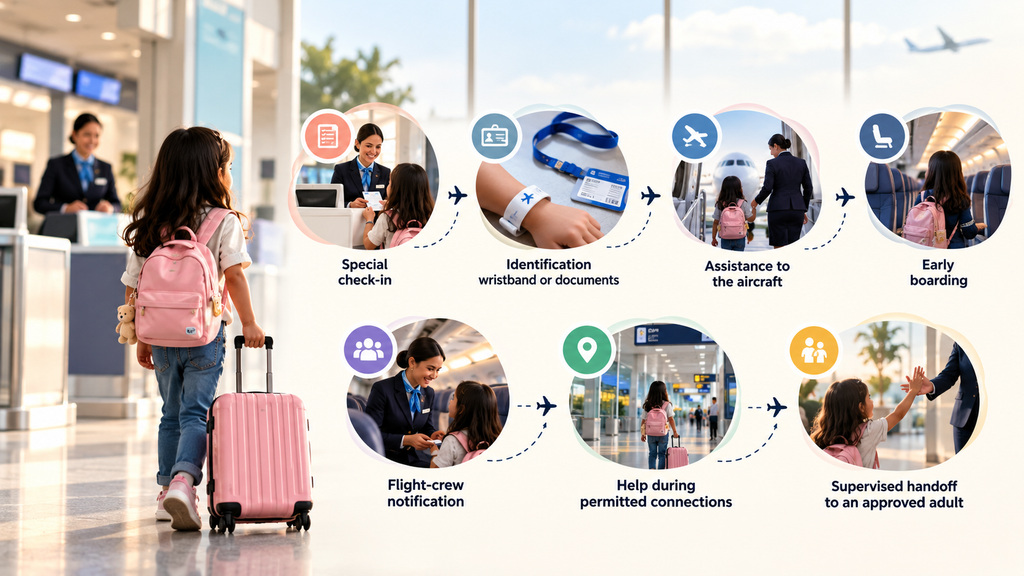
An unaccompanied minor (UM or UMNR) is a child traveling by air without a parent, guardian, or other qualifying older passenger and who is enrolled in an airline’s supervised travel program.
The service commonly includes:
- Special airport check-in
- An identification wristband, lanyard, or travel documents
- Assistance getting to the aircraft
- Early boarding
- Flight-crew notification
- Help during permitted connections
- Supervised handoff to an approved adult at the destination
An unaccompanied-minor service is not the same as continuous one-on-one childcare.
U.S. Airline Unaccompanied Minor Policies at a Glance
Fees and routing restrictions can change independently of age requirements. Always check the airline’s current policy before booking.
| Airline | Formal UM Service? | Mandatory Age Range | Older Children | Typical UM Fee |
| Alaska Airlines | Yes | Generally 5-12 depending on itinerary | Rules vary by age | Check current booking terms |
| Delta Airlines | Yes | 5-14 | Optional at 15-17 | $150 each way for up to 4 children |
| JetBlue Airways | Yes | 5 to under 14 | Age 14+ treated differently | Check current booking price |
| Southwest Airlines | Yes | 5-11 | 12-17 are Young Travelers | Current service charge applies |
| Allegiant Air | No | — | 15+ may travel alone | — |
| Avelo Airlines | No | — | 15+ may travel alone | — |
| Breeze Airways | No | — | Eligible Young Adults may travel alone only on qualifying flights | — |
| Frontier Airlines | No | — | Travelers must meet Frontier’s minimum solo-travel age | — |
Delta Air Lines Unaccompanied Minor Policy
Delta requires its Unaccompanied Minor Program for children ages 5 through 14 traveling alone, while travelers ages 15 through 17 can either travel independently or be enrolled in the program.
Delta charges $150 each way for up to 4 children traveling together.
Delta Age and Flight Restrictions
| Age | Rule |
| 4 and younger | Cannot travel alone |
| 5-7 | Some nonstop flights only |
| 8-14 | Eligible for nonstop and connecting flights |
| 15-17 | UM service optional; eligible nonstop and connecting flights |
Delta’s program provides a trackable wristband and a dedicated employee escort. Children may also use Delta Sky Zone facilities at participating airports.
Delta permits domestic and international UM travel, although itinerary and country-specific restrictions apply. Connections are limited to eligible Delta, Delta Connection, Air France, and KLM services under the program’s current rules.
An adult must accompany the child through check-in, provide identification and pickup information, take the child to the departure gate where permitted, and remain until the flight has left the ground.
JetBlue Unaccompanied Minor Policy
JetBlue accepts unaccompanied children from age 5 until their 14th birthday, subject to its UM service and routing restrictions. Children younger than 5 cannot fly alone.
One of JetBlue most important restrictions is routing: an unaccompanied child must have a confirmed reservation on a nonstop flight.
JetBlue does not accept unaccompanied children on:
- Connecting itineraries
- Flights with intermediate stops
- Flights to or from London
The parent or responsible adult must also complete JetBlue’s Unaccompanied Minor Form and identify the authorized adult meeting the child after arrival.
Because JetBlue’s fee and route eligibility can change, confirm the amount displayed during the current booking process rather than relying on an older published fee.
Southwest Airlines Unaccompanied Minor Policy
Southwest considers children ages 5 through 11 traveling alone to be Unaccompanied Minors, while passengers ages 12 through 17 traveling independently are classified as Young Travelers.
This distinction matters because the airline’s UM supervision procedures do not apply to Young Travelers.
Southwest Rules for Ages 5-11
A child traveling as an UM can be booked on:
- A nonstop Southwest flight
- A flight that stops but does not require changing aircraft
The child cannot travel as an UM on:
- Connecting itineraries
- International flights
- Getaways by Southwest vacation packages
Southwest charges an unaccompanied-minor service fee each way for each child. Parents should check the airline’s current Optional Travel Charges page for the price applying to the itinerary.
Southwest Young Travelers Ages 12-17
Travelers ages 12 through 17 may travel independently as Young Travelers, but Southwest expects them to be capable of handling airport procedures themselves.
That includes:
- Checking in
- Passing through security
- Finding the gate
- Boarding
- Deplaning
- Making permitted connections
- Collecting luggage
Young Travelers cannot travel to or from international destinations or on itineraries with overnight connections.
Alaska Airlines Junior Jetsetters
Alaska Airlines provides a supervised program commonly known as Junior Jetsetters for eligible children traveling without an adult.
Age and routing matter. Younger children face tighter restrictions, while older children may have more itinerary options.
Alaska can also restrict unaccompanied-minor travel when severe weather or operational conditions make disruption more likely. The airline has specifically advised families to check route eligibility when booking children traveling alone.
Because Alaska and Hawaiian have been integrating their operations and customer systems, parents booking travel in 2026 should verify the operating carrier and current child-travel rules displayed for their specific itinerary rather than relying on historical Alaska or Hawaiian fee tables.
Does Allegiant Allow Unaccompanied Minors?
No. Allegiant does not provide an unaccompanied-minor service and does not accept children age 14 or younger traveling by themselves.
A passenger who is 14 or younger must travel with someone who is at least 15 years old on the same reservation.
Travelers ages 15 through 17 can fly independently, but Allegiant does not provide them with special UM supervision.
This distinction is important: a 15-year-old flying alone on Allegiant is an independent passenger, not a child being escorted under an airline UM program.
Does Avelo Airlines Allow Children to Fly Alone?
Avelo does not offer supervised unaccompanied-minor service, and children age 14 or younger cannot travel alone.
Passengers who are 15 or older may fly independently. Avelo advises families to make sure a young traveler can confidently navigate airports, follow crew instructions, and manage possible flight disruptions.
Avelo may allow a responsible adult to request a gate pass, but access beyond airport security is not guaranteed for a person who is not ticketed to travel.
Does Breeze Airways Have an Unaccompanied Minor Program?
No. Breeze Airways does not provide a supervised unaccompanied-minor service.
Instead, it permits qualifying Young Adult Guests to travel independently on eligible nonstop domestic flights, subject to age, documentation, and other requirements.
Breeze does not supervise or continuously monitor a young traveler before, during, or after the flight. Young Adults traveling alone also cannot use connecting itineraries, standard BreezeThru itineraries, or international flights except where the airline’s specific domestic-segment exception applies.
Parents should therefore distinguish between “allowed to fly alone” and “enrolled in an unaccompanied-minor program.”
Does Frontier Airlines Offer Unaccompanied Minor Service?
Frontier does not provide a traditional unaccompanied-minor service.
Families should check Frontier’s current age requirement before purchasing a ticket for a child traveling without an adult. If the traveler is below Frontier’s minimum independent-travel age, the child must travel with an eligible accompanying passenger.
This makes Frontier different from Delta, JetBlue, and Southwest, which provide formal supervision for at least some younger children.
Spirit Airlines and Unaccompanied Minors in 2026
Older policy comparisons may list Spirit Airlines as offering unaccompanied-minor service for children ages 10 through 14.
That information should not be used to plan a current trip. The 2026 reference article itself was updated to state that Spirit Airlines ceased operations on May 2, 2026.
Travelers researching an old Spirit itinerary should therefore look for a currently operating alternative rather than relying on Spirit’s former UM rules.
Which Airlines Do Not Offer Unaccompanied Minor Service?
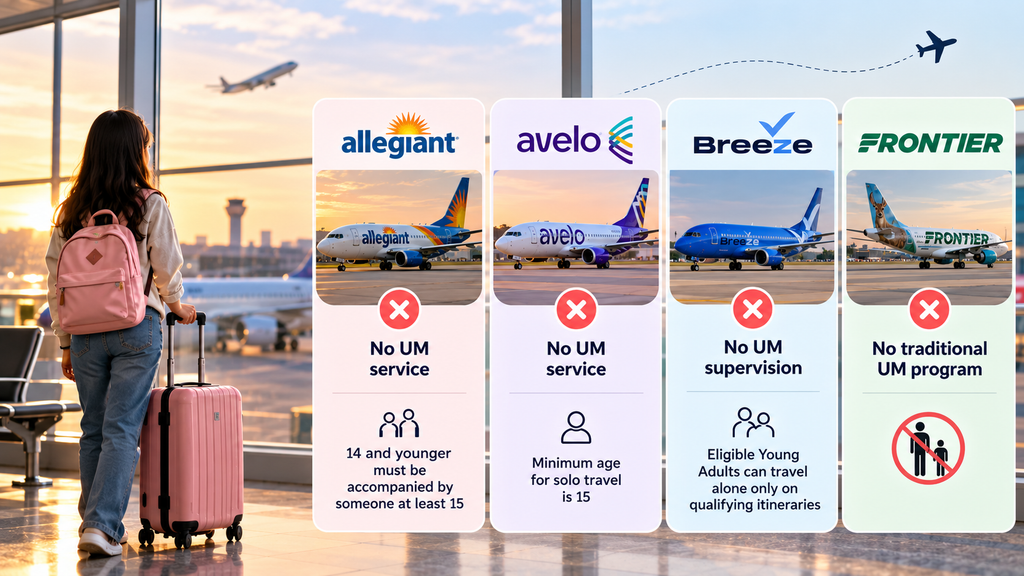
Several U.S. carriers allow older teenagers to travel independently but do not provide the supervised service associated with a formal UM program.
Examples include:
- Allegiant Air: no UM service; travelers 14 and younger must be accompanied by someone at least 15.
- Avelo Airlines: no UM service; minimum age for solo travel is 15.
- Breeze Airways: no UM supervision; eligible Young Adults can travel alone only on qualifying itineraries.
- Frontier Airlines: does not provide a traditional supervised UM program.
This is why simply searching “Can a 15-year-old fly alone?” is not enough. A carrier may permit the trip without accepting responsibility for escorting or supervising the teenager.
Can a 5-Year-Old Fly Alone?
A 5-year-old can fly alone on some U.S. airlines, but only through a mandatory unaccompanied-minor service and usually with strict routing restrictions.
For example:
- Delta permits ages 5-7 on certain nonstop flights.
- Southwest accepts ages 5-11 as UMs on nonstop or same-plane direct domestic itineraries.
- JetBlue accepts qualifying children from age 5 but restricts them to nonstop flights.
Allegiant and Avelo would not allow a 5-year-old to travel independently.
Can a 12-Year-Old Fly Alone?
It depends heavily on the airline.
On Delta, a 12-year-old traveling alone must use the airline’s UM service.
Southwest treats a 12-year-old differently: passengers ages 12 through 17 traveling alone are Young Travelers, not UMs, and are expected to manage their airport journey independently.
The same child can therefore receive very different levels of supervision depending on the carrier.
Can a 15-Year-Old Fly Alone Without Paying a UM Fee?
Often, yes, but airline rules vary.
Delta allows travelers ages 15 through 17 to travel without enrolling in their UM programs, although parents may choose to purchase the service.
Allegiant and Avelo also allow travelers age 15 and older to fly independently, but neither provides a formal UM service.
The practical question is therefore not only “Can the teenager fly?” but also “Will the airline supervise them if something goes wrong?”
Are Connecting Flights Allowed for Unaccompanied Minors?
Some airlines allow connections for older unaccompanied minors, while others restrict children to nonstop flights.
Delta permits eligible connecting itineraries for ages 8 through 14 and for older teens enrolled in its program, subject to operating-carrier and scheduling restrictions.
JetBlue does not permit connecting flights for unaccompanied children.
Southwest also prohibits connecting itineraries for its 5-to-11-year-old UM passengers, although a flight may make a stop without requiring a change of aircraft.
For a child’s first solo trip, a nonstop itinerary can also reduce the number of things that can go wrong even when an airline technically permits a connection.
Can Unaccompanied Minors Fly Internationally?
International travel is possible with some airlines but prohibited or restricted by others.
Delta permits eligible domestic and international UM itineraries, subject to destination and operating-carrier rules.
Southwest does not allow its 5-to-11-year-old Unaccompanied Minors on international itineraries.
JetBlue allows some international travel but does not accept UMs on flights to or from London under its current Contract of Carriage.
For international travel, parents should check both the airline’s rules and the entry/exit requirements of every country involved.
What Documents Does an Unaccompanied Minor Need?
The exact paperwork varies by airline and destination, but parents should be prepared with:
- Child’s proof of age when requested
- Passport for applicable international travel
- Completed airline UM form
- Parent or guardian’s government-issued photo ID
- Name and contact information for the drop-off adult
- Name, address, and phone number of the pickup adult
- Required visa or immigration documents
- Parental consent documentation when required internationally
- Emergency contact information
Delta requires the accompanying adult to provide photo identification and the name, address, and telephone number of the adult meeting the child at the destination.
What Happens at the Airport?
Although procedures differ, supervised UM travel usually follows a similar pattern.
1. Check In With an Airline Agent
Do not assume the child can complete standard mobile or kiosk check-in. The responsible adult may need to visit the airline’s ticket counter to verify documents and complete UM paperwork.
2. Obtain a Gate Pass Where Available
Airlines may issue a gate pass allowing a parent or guardian to accompany the child through security.
Airport and TSA procedures can affect whether a non-ticketed adult receives access.
3. Remain Until the Flight Departs
Many airlines require or instruct the responsible adult to stay at the airport until the aircraft has departed.
Delta specifically requires the designated adult to remain at the gate until the flight has left the ground.
4. The Child Is Preboarded or Assisted
Eligible UMs may board early so employees can introduce them to the cabin crew and help them settle into their seats.
5. An Approved Adult Collects the Child
The airline does not simply allow a supervised UM to walk out of the airport alone.
The pickup adult normally needs to match the information supplied during check-in and present acceptable identification before the child is released.
What Should Parents Pack for a Child Flying Alone?
Keep the child’s carry-on simple and manageable. Useful items include:
- Fully charged phone or tablet
- Charging cable or approved portable charger
- Headphones
- Snacks permitted through security
- Refillable empty water bottle
- Essential medication, with clear instructions where appropriate
- Emergency contact information on paper
- Identification information
- A sweater or light jacket
- One or 2 compact entertainment options
A backpack is often easier for a younger traveler to manage than multiple carry-on items.
How to Prepare a Child for Flying Alone
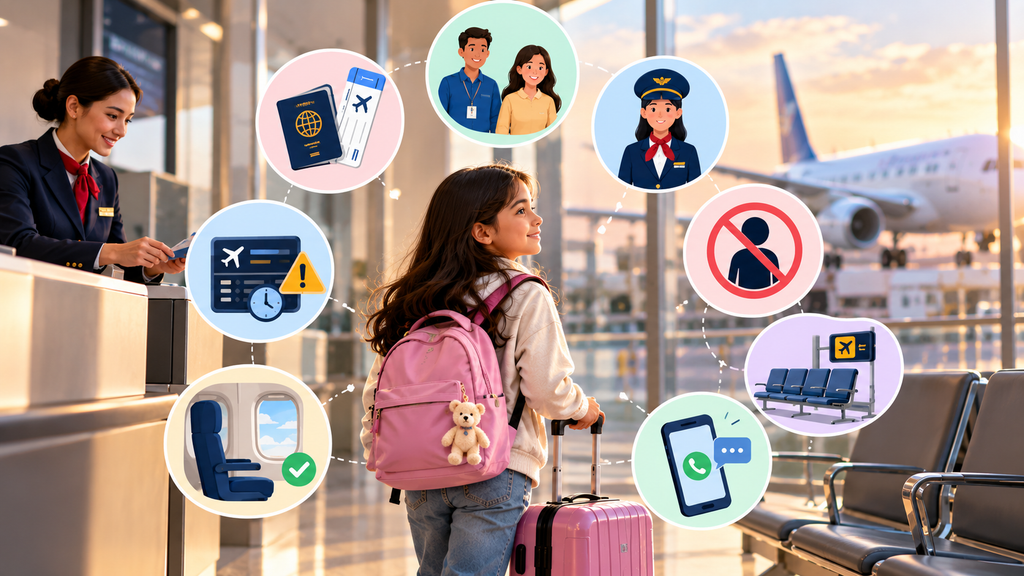
Preparation should cover more than packing.
Explain exactly what will happen from airport check-in through pickup. Make sure the child knows:
- Their full name and destination
- Who is meeting them
- How to identify airline employees
- Never to leave the airport with an unknown person
- To remain near the assigned gate
- To ask a uniformed airline employee for help
- Not to leave the aircraft after landing until instructed
- How to contact a parent or guardian
- What to do if the flight is delayed or canceled
For older teens traveling without a formal UM service, this preparation is especially important because they may be expected to manage disruptions like an adult passenger.
Should You Book the Last Flight of the Day?
Whenever possible, an earlier flight can be a more practical choice for a child traveling alone.
A morning or midday departure leaves more alternatives if weather, maintenance, or another operational problem disrupts the original flight. Some airline UM programs specifically restrict last connections or certain overnight itineraries.
Delta, for example, restricts UM travel on certain late-night flights and last connecting flights, with defined exceptions.
A nonstop morning flight can therefore simplify both the child’s journey and the airline’s options during irregular operations.
Important Questions to Ask Before Booking
Before paying for the ticket, confirm:
- Is the child’s age eligible for solo travel?
- Is the UM service mandatory or optional?
- What is the current service fee?
- Is the fee per child or per group?
- Are connections permitted?
- Is international travel permitted?
- Is the operating airline the same as the marketing airline?
- What identification does the child need?
- What documents must the parent complete?
- Can the drop-off adult receive a gate pass?
- How early must the child check in?
- How does the airline handle delays or cancellations?
- What identification must the pickup adult show?
- Does the adult dropping off the child need to remain until departure?
This last check is particularly important on codeshare itineraries because the operating carrier’s policy may determine how the child is handled.
Final Thoughts
Unaccompanied-minor policies are not standardized across U.S. airlines. Delta requires supervised service for ages 5 through 14, Southwest uses it for ages 5 through 11, JetBlue restricts its younger solo travelers to nonstop flights, and carriers such as Allegiant and Avelo do not provide UM supervision at all.
Before purchasing a ticket, check the child’s exact age on the travel date, the operating airline, current UM fee, connection restrictions, international requirements, and drop-off and pickup procedures. A nonstop flight earlier in the day can also reduce the complications a young traveler may face if operations are disrupted.
Frequently Asked Questions
Several major U.S. airlines accept children from age 5 through a supervised UM program. Younger children generally cannot travel alone. Individual airline rules still apply.
Yes. The UM service charge is normally separate from the child’s airline ticket.
Usually, yes, when both children meet the airline’s age and itinerary rules. Some airlines also charge one UM fee for multiple qualifying children traveling together. Delta’s $150 each-way fee, for example, can cover up to 4 children.
Airline age-verification and UM documentation requirements are separate from general TSA identification rules. Parents should follow the airline’s documentation instructions and carry proof of age when requested.
An airline may issue a gate pass to the responsible adult accompanying an UM, subject to airport and security requirements. It should not be assumed that every airport will issue one automatically.
It depends on the carrier and the child’s age. Delta permits certain connections for eligible older UMs, while JetBlue and Southwest’s UM program restrict children to nonstop or qualifying direct service.
No. A UM program provides structured assistance, but it is not continuous one-on-one supervision.
Generally, yes, on many U.S. carriers. Delta allows ages 15 through 17 to travel independently, with their formal UM service available as an option.