
Philippines Travel Guide: Best Time to Visit
The best time to visit the Philippines is generally December to February, when much of the country experiences the cooler part of the dry season, making beach trips, island-hopping, sightseeing, and outdoor activities more comfortable. However, the Philippines has several climate patterns across its islands, so the ideal month depends on where travelers are going and what they plan to do.
For travelers planning a multi-island itinerary, January and February are particularly useful months to consider. March to May can bring hotter conditions, while June to November generally brings more rain and a greater risk of tropical cyclones in parts of the country.
Best Months to Visit the Philippines at a Glance
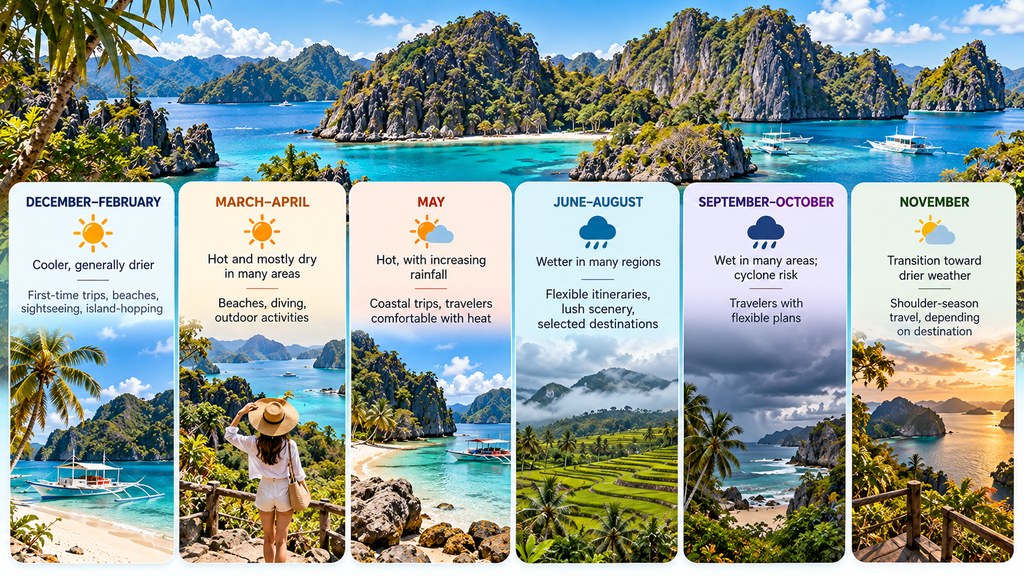
| Travel period | Typical conditions | Best suited for |
| December–February | Cooler, generally drier | First-time trips, beaches, sightseeing, island-hopping |
| March–April | Hot and mostly dry in many areas | Beaches, diving, outdoor activities |
| May | Hot, with increasing rainfall | Coastal trips, travelers comfortable with heat |
| June–August | Wetter in many regions | Flexible itineraries, lush scenery, selected destinations |
| September–October | Wet in many areas; cyclone risk | Travelers with flexible plans |
| November | Transition toward drier weather | Shoulder-season travel, depending on destination |
PAGASA, the Philippines’ national weather service, broadly defines the dry season as December to May and the rainy season as June to November, although individual locations can differ substantially.
Understanding the Philippines’ Weather
The Philippines is an archipelago, so no single weather pattern accurately describes every island. PAGASA recognizes four major climate types based on rainfall distribution, including areas with a distinct dry season, areas without a true dry season, and locations where rainfall is relatively evenly distributed year-round.
This matters when planning a trip. A month that is relatively dry in Manila or Boracay may not produce the same conditions in an eastern-facing destination.
The country’s weather is also affected by the Northeast Monsoon (Amihan) and Southwest Monsoon (Habagat). The southwest monsoon generally brings wetter conditions to western parts of the country from around May to September, while the northeast monsoon can bring rain to eastern areas.
Why December to February Is a Popular Travel Window
December through February combines several advantages:
- Generally drier conditions across many popular tourist areas
- More comfortable temperatures than the hottest months
- Good conditions for sightseeing and island-hopping in many destinations
- Lower heat than March–May in many locations
- Strong suitability for multi-destination itineraries
January and February are within the country’s cooler dry-season period, while March to May make up the hotter portion of the dry season.
Best Time to Visit the Philippines by Month
January: Cooler Dry-Season Weather
January is one of the more favorable months for travelers who want to combine beaches with sightseeing. The cooler dry-season weather makes walking tours, city exploration, and outdoor excursions more comfortable than during the hotter months.
It is also a festival-heavy period. Sinulog in Cebu, Ati-Atihan in Kalibo, and Dinagyang in Iloilo are among the major January celebrations, although exact event schedules can change from year to year.
Good for: Island-hopping, cultural trips, beaches, sightseeing, and festivals.
February: A Strong Choice for General Travel
February continues the cooler dry-season period and can be particularly attractive for travelers who want warm weather without the peak heat of April and May.
It is also a useful month for combining several destinations in one itinerary. Travelers could, for example, pair Cebu and Bohol with Palawan or Boracay, subject to their preferred flight and ferry schedules.
Good for: First-time visits, beaches, island-hopping, sightseeing and outdoor activities.
March: Dry but Increasingly Hot
March remains part of the dry season, but temperatures begin rising. Travelers planning long hikes or extensive sightseeing should account for the heat, particularly in lowland destinations.
March can work well for beach and water-based holidays, but accommodation and transport can become busier around major holiday periods.
Good for: Beaches, diving, island-hopping and outdoor activities, with heat precautions.
April: Hot and Generally Dry
April is typically among the hottest months of the year in the Philippines. It can offer excellent beach conditions in many popular destinations, but travelers should plan outdoor activities around the strongest afternoon heat.
The month can also coincide with Holy Week, when domestic travel demand can increase significantly. Booking accommodation and transportation early is particularly sensible if the itinerary overlaps this period.
Good for: Beach holidays, diving and coastal escapes.
May: Hot With a Transition Toward Wetter Weather
May sits near the end of the broad dry-season period identified by PAGASA. Conditions can still be favorable for travel, but temperatures may be uncomfortable in lowland areas, and rainfall becomes increasingly relevant as the month progresses.
This can be an appealing period for travelers who want to visit before the wetter months become more established.
Good for: Coastal destinations, diving, and travelers comfortable with high temperatures.
June: Rain Becomes More Important
June marks the beginning of the rainy season under PAGASA’s broad national classification. However, rainfall varies considerably by region, and a wet-season trip does not mean continuous rain every day.
Travelers should allow more flexibility for outdoor excursions and ferry or boat activities.
Good for: Flexible itineraries and travelers who do not mind occasional rain.
July: Wetter Conditions in Many Areas
Rainfall generally increases in July, particularly in several western and northern areas affected by the southwest monsoon. PAGASA’s climate research also emphasizes the strong regional differences created by the country’s geography and mountain ranges.
A trip can still be worthwhile, but travelers should avoid building an itinerary around tightly timed outdoor activities.
Good for: Flexible trips, nature experiences and selected regional destinations.
August: Wet Weather and Tropical-Cyclone Considerations
August falls within the wetter part of the year and sits inside the broader period when tropical cyclones can affect the Philippines. PAGASA notes that tropical cyclones in the western North Pacific, including the Philippines region, occur mainly from May to November, with July to October representing the peak period.
This doesn’t mean every August trip will hit a storm, but weather monitoring becomes especially important.
Good for: Flexible travelers who are prepared to adjust plans.
September: One of the Wetter Months
September can bring substantial rainfall across many areas, alongside the possibility of tropical cyclones. Travelers planning boat trips, mountain excursions, or multiple island transfers should allow additional contingency time.
The Philippines remains open to visitors during the rainy season, but September requires more attention to local forecasts and transport conditions.
Good for: Travelers who prioritize flexibility over predictable beach weather.
October: Transition Toward Drier Conditions
October is a transition month. Rainfall can begin easing in some destinations, but the country can still experience tropical weather systems and heavy rain.
Conditions can therefore vary considerably between islands. Travelers considering October should check the forecast for their specific destination rather than relying on a nationwide weather summary.
Good for: Flexible itineraries and travelers seeking the transition season.
November: A Shoulder-Season Option
November is another transition month as many parts of the Philippines move toward the drier period. However, tropical cyclones remain possible, so travelers should continue monitoring official forecasts.
Late November can offer a useful compromise between improving weather and the busier December holiday period.
Good for: Travelers seeking a transition-season trip and flexible schedules.
December: Cooler Weather and Peak Holiday Demand
December marks the beginning of the dry season under PAGASA’s national classification and is generally a popular time to visit. The cooler conditions suit sightseeing, beaches, and island-hopping.
The second half of December can be particularly busy because of Christmas and New Year travel, so you may need to book flights, hotels, and popular excursions early.
Good for: Beach holidays, family vacations, island-hopping, and festive travel.
Best Time to Visit Popular Philippine Destinations
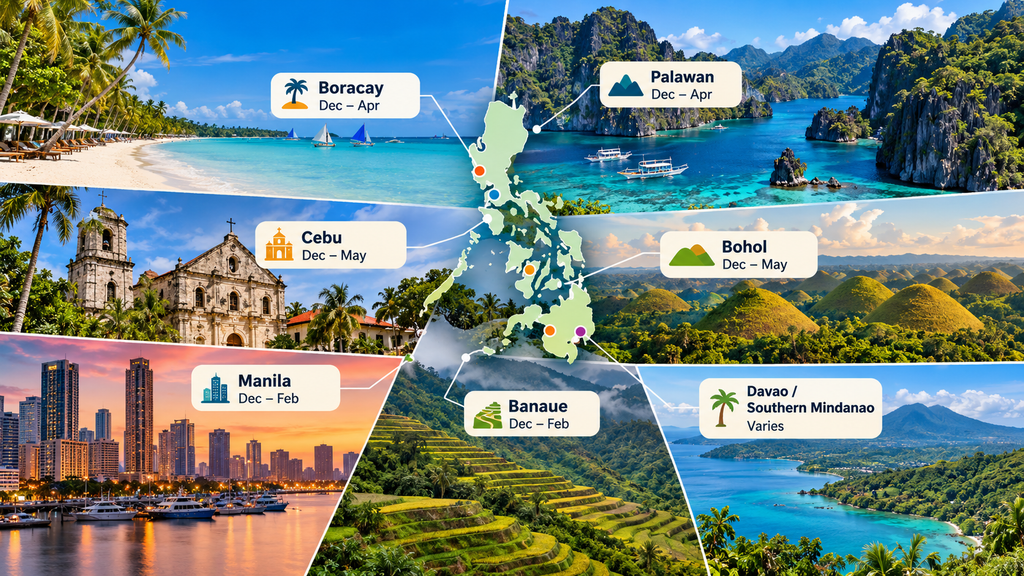
The best month isn’t the same for every destination. The country’s climate classification shows why regional planning matters.
| Destination | Commonly favorable period | Planning consideration |
| Boracay | December–April | Drier conditions generally suit beach activities |
| Palawan | December–April | Useful period for island-hopping and coastal activities |
| Cebu | December–May | Warm year-round; rainfall varies by month |
| Bohol | December–May | Dry-season travel is useful for outdoor sightseeing |
| Manila | December–February | Cooler months can be more comfortable for city exploration |
| Banaue | December–February | Cooler weather; rainfall increases later in the year |
| Davao / southern Mindanao | Varies | Southern areas have different rainfall patterns from much of Luzon and the western Visayas |
Treat the table as a planning guide rather than a guarantee of weather. For example, PAGASA data shows that some parts of Mindanao have climate types with no pronounced dry season, demonstrating why a simple December-to-May rule cannot be applied uniformly nationwide.
When Is the Best Time to Visit Palawan?
For travelers focused on El Nido, Coron, and other Palawan island-hopping destinations, the drier months are generally the more practical choice for boat-based activities.
Palawan is known for limestone landscapes, lagoons, beaches, and marine environments, including destinations around Bacuit Bay and Coron.
December through April is therefore a useful planning window for travelers who want to maximize opportunities for island-hopping and outdoor activities. Weather can still change, so boat operators’ local guidance should take precedence on any given excursion day.
When Is the Best Time to Visit Boracay?
December through April is generally a popular period for a Boracay beach holiday, with the broader dry season providing favorable conditions for activities such as swimming, sailing, and island-hopping.
The Philippine Department of Tourism highlights White Beach, paraw sailing, snorkeling, island-hopping, and other water activities among Boracay’s attractions.
Travelers visiting during Christmas, New Year, or other busy holiday periods should book accommodation and transportation in advance.
What Is the Rainy Season in the Philippines?
The Philippines’ broad rainy season runs from June through November, according to PAGASA. The country’s dry season runs from December through May, divided into the cool dry season from December to February and the hot dry season from March to May.
However, “rainy season” does not mean that every day is continuously wet. Rainfall can be highly localized, and climate patterns vary by region.
For example, eastern parts of the Philippines can have different rainfall patterns from western areas because of interactions among monsoons, tropical cyclones, and the country’s mountainous terrain.
When Is Typhoon Season in the Philippines?
Tropical cyclones can occur in the Philippines region year-round, but May to November is the main period, with July to October typically the peak months. PAGASA states that an average of about 20 tropical cyclones enter the Philippine Area of Responsibility each year, with roughly 8 or 9 crossing the country.
This is one reason travelers planning a multi-island trip during the wetter months should avoid overly tight schedules.
For example, if an itinerary includes a ferry from Cebu to another island in the morning immediately before an international flight from Manila, a weather-related delay could create a missed-connection risk. Leaving a buffer day can make the itinerary more resilient.
Should Travelers Avoid the Philippines During Typhoon Season?
Not necessarily. A tropical cyclone does not affect every part of the country at the same time, and the Philippines remains a year-round destination.
The important difference is flexibility. During the peak cyclone period, travelers should:
- Monitor PAGASA forecasts before excursions.
- Check ferry and domestic-flight status.
- Avoid assuming that a boat tour will operate in poor weather.
- Keep alternative indoor activities available.
- Avoid scheduling critical international connections immediately after an inter-island transfer.
- Consider travel insurance that addresses relevant disruptions.
Best Time to Visit the Philippines for Beaches
For a classic beach-focused vacation, December to April is a practical period to consider, particularly for popular destinations such as Boracay and Palawan.
The Philippine Department of Tourism describes Boracay’s White Beach, island-hopping opportunities, and water activities as major attractions, while Palawan is known for its lagoons, beaches, and marine environments.
Travelers who prioritize predictable outdoor conditions should pay particular attention to the specific island and local forecast, rather than assuming the entire country has identical weather.
Best Time for Diving and Island-Hopping
The best period depends on the exact dive site, sea conditions, and operator, but the drier months can provide a more convenient window for travelers combining several water-based activities.
Island-hopping requires another consideration: sea conditions matter as much as rainfall. A day with limited rainfall can still be unsuitable for a boat excursion if winds or waves are unfavorable.
This is particularly important in destinations such as Palawan, where many popular experiences involve boats traveling between islands and lagoons.
Is the Philippines Worth Visiting During the Off-Season?
Yes. Traveling during the wetter months can still work for travelers who prioritize flexibility, greener landscapes, or potentially quieter conditions over consistently dry weather.
The trade-off is that weather-dependent plans need more flexibility. A traveler staying for a week in one destination has more room to move a boat tour by a day than someone attempting to visit four islands in five days.
The key is to build the itinerary around the weather rather than assuming the weather will adapt to it.
Best Time to Visit the Philippines for Fewer Crowds
International holidays, Christmas and New Year, domestic holidays, and major festivals drive the busiest periods, so crowd levels don’t follow weather seasons perfectly.
February, parts of May, and selected shoulder-season periods can be worth considering for travelers looking for a balance between favorable conditions and lower demand. Exact crowd levels vary considerably by destination.
For example, Boracay’s White Beach and a remote Palawan island should not be expected to have the same visitor patterns during the same week.
Best Time for Festivals in the Philippines
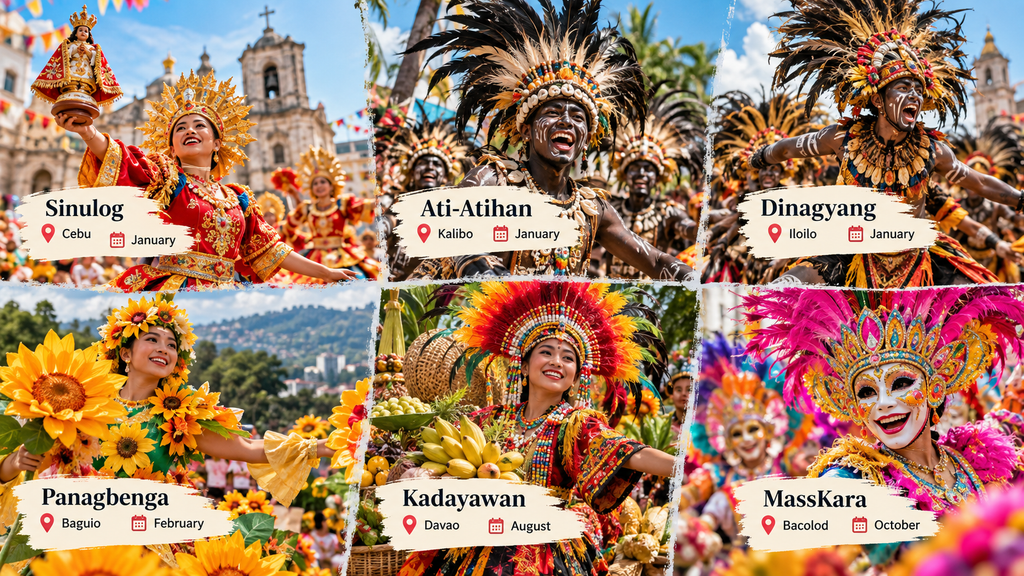
Travelers interested in Filipino festivals may deliberately choose dates outside the conventional beach-weather window.
Notable events include:
- Sinulog — Cebu, January
- Ati-Atihan — Kalibo, January
- Dinagyang — Iloilo, January
- Panagbenga — Baguio, February
- Kadayawan — Davao, August
- MassKara — Bacolod, October
Festival dates and event programs can change, so travelers should verify the current schedule with the relevant local tourism authority before booking flights around a specific celebration. Audley also documents several of these festivals in its month-by-month travel information.
What Is the Cheapest Time to Visit the Philippines?
No single month guarantees the lowest airfare or hotel price nationwide. Prices depend on the destination, origin airport, school holidays, local events, accommodation demand and how far ahead the trip is booked.
Travelers seeking better-value dates can compare shoulder-season periods and travel outside major holiday weeks, but should balance any savings against the increased likelihood of rain or weather-related disruptions.
For example, saving money on a Palawan hotel may have less value if an inflexible island-hopping itinerary has to be changed because of sea conditions.
How Far in Advance Should a Philippines Trip Be Booked?
For travel during December, New Year, Holy Week or major festivals, booking flights and accommodation earlier is sensible because demand can rise sharply.
For quieter periods, travelers generally have more flexibility, although popular island resorts and well-reviewed smaller properties can still sell out.
A useful strategy is to book the international flights and key accommodation first, then leave some flexibility around weather-dependent island transfers and excursions.
What to Check Before Traveling to the Philippines
Weather averages are useful for choosing a travel window, but the forecast becomes more important as departure approaches.
Before leaving, travelers should check:
- PAGASA weather forecasts and tropical-cyclone bulletins
- Weather for each island rather than only Manila
- Domestic flight and ferry schedules
- Conditions for planned boat excursions
- Local advisories for hiking and outdoor attractions
- Accommodation cancellation or change policies
- Any current entry, health, or immigration requirements relevant to their nationality
PAGASA regularly publishes weather forecasts, climate assessments, and seasonal outlook information, making it an important source for current weather planning.
Final Takeaway
For travelers looking for the best overall time to visit the Philippines, December to February is the most straightforward window to consider, particularly for a first trip combining beaches, sightseeing, and island-hopping. The broader dry season extends into May, but March to May becomes hotter, while June to November generally brings greater rainfall and a higher risk of tropical-cyclone disruption.
The most important planning step is to match the month to the specific islands and activities on the itinerary. The Philippines’ climate varies enough that checking destination-level forecasts before departure can be just as important as choosing the right season.
Frequently Asked Questions
December to February are generally strong months for an overall Philippines trip because they fall within the cooler dry-season period. December through May is the broader dry season, but March to May is considerably hotter in many areas.
Yes. January falls within the cooler dry season and can be suitable for beaches, sightseeing, island-hopping, and festivals. Travelers should still check destination-specific forecasts because climate patterns vary across the archipelago.
The two months offer different advantages. February is within the cooler dry season, while March is warmer but remains within the dry season. Travelers who are more sensitive to heat may prefer the earlier month.
Yes. The rainy season does not mean constant rain throughout the country. However, travelers should expect more variable weather and allow flexibility for outdoor and inter-island activities.
PAGASA identifies July through October as the peak period for tropical cyclones, although cyclones can occur outside those months.
December can be busy, particularly around Christmas and New Year. Travelers visiting popular beach destinations during the holiday period should consider booking accommodation and transport in advance.
May can be suitable for a beach trip because it falls within the broader dry season, but it is also one of the hottest months and marks the transition toward wetter conditions.
No. The country’s islands have different rainfall patterns and climate types. Eastern, western, northern, and southern areas can experience substantially different conditions during the same month.