
Discover Borneo: Best Places, Sights & Experiences
The best things to see in Borneo include orangutans at Sepilok and Tanjung Puting, wildlife along the Kinabatangan River, the ancient rainforest of Danum Valley, Mount Kinabalu, Gunung Mulu’s enormous caves, Sarawak’s Bako National Park, and the tropical waters around Sabah. Yet Borneo is too large and varied to experience through wildlife alone: longhouses, Indigenous cultures, river journeys, rainforest trekking, caves, beaches, diving, and food all deserve space in a well-planned trip.
Borneo is also not a country. The island is divided among Malaysia, Indonesia, and Brunei, with the Indonesian portion known as Kalimantan and the Malaysian states of Sabah and Sarawak occupying the north.
For a first visit, Sabah and Sarawak provide some of the easiest combinations of wildlife and landscapes. Travelers with additional time can venture into Kalimantan for river journeys, Dayak culture, and destinations such as Tanjung Puting National Park.
Here’s where to focus when deciding what to see in Borneo.
Borneo Highlights at a Glance
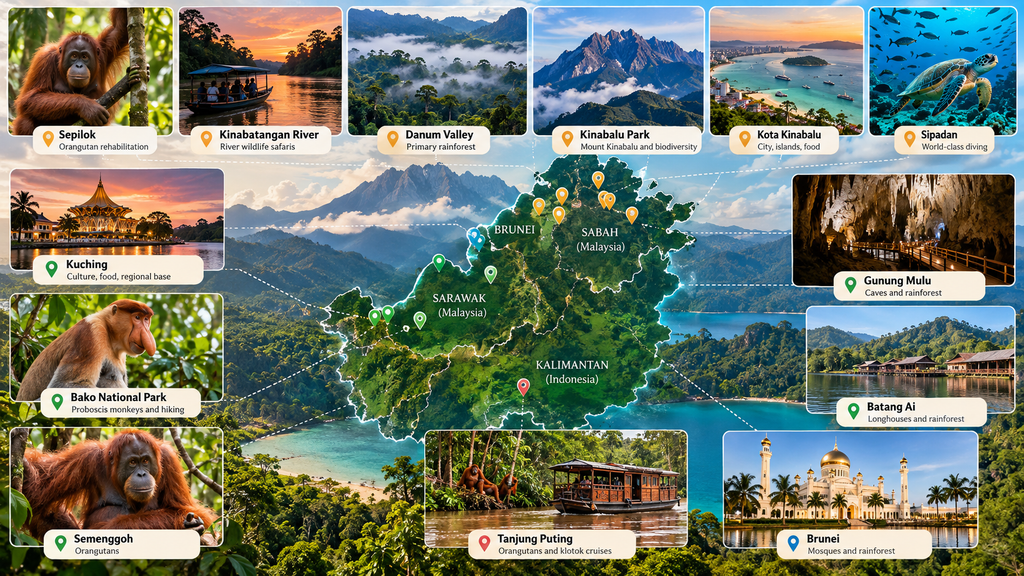
| Place | Region | Main Highlight |
| Sepilok | Sabah, Malaysia | Orangutan rehabilitation |
| Kinabatangan River | Sabah, Malaysia | River wildlife safaris |
| Danum Valley | Sabah, Malaysia | Primary rainforest |
| Kinabalu Park | Sabah, Malaysia | Mount Kinabalu and biodiversity |
| Kota Kinabalu | Sabah, Malaysia | City, islands, food |
| Sipadan region | Sabah, Malaysia | Diving |
| Kuching | Sarawak, Malaysia | Culture, food, regional base |
| Bako National Park | Sarawak, Malaysia | Proboscis monkeys and hiking |
| Semenggoh | Sarawak, Malaysia | Orangutans |
| Gunung Mulu | Sarawak, Malaysia | Caves and rainforest |
| Batang Ai | Sarawak, Malaysia | Longhouses and rainforest |
| Tanjung Puting | Central Kalimantan, Indonesia | Orangutans and klotok cruises |
| Brunei | Northern Borneo | Mosques and rainforest |
1. See Orangutans in Sepilok
Seeing orangutans is one of Borneo’s signature wildlife experiences, and Sepilok in Sabah is among the most accessible places to learn about their rehabilitation and conservation.
The Sepilok Orangutan Rehabilitation Centre lies near Sandakan in northeastern Sabah and cares for orphaned and displaced orangutans before suitable animals can return to the forest.
A visit is not comparable to a zoo.
The surrounding forest is part of the experience, and orangutans have room to move through their natural environment. Sightings and behavior therefore vary.
Visitors should not expect every animal to appear on command.
Allow enough time to observe quietly rather than treating Sepilok as a quick photo stop.
What Else Can You See Near Sepilok?
Sepilok is particularly useful because several wildlife attractions can be combined in the same area.
Depending on your itinerary, consider:
- Bornean Sun Bear Conservation Centre
- Rainforest Discovery Centre
- Birdwatching
- Canopy walks
- Sandakan
- Kinabatangan River
Combining Sepilok with Kinabatangan creates one of the strongest introductory wildlife itineraries in Sabah.
2. Cruise the Kinabatangan River
The Kinabatangan River is one of the best places in Sabah for observing Borneo’s wildlife from a boat.
The Lower Kinabatangan supports an exceptionally rich ecosystem, and 26,000 hectares have been gazetted as the Kinabatangan Wildlife Sanctuary. The river itself stretches around 560 km, making it Malaysia’s second-longest river.
Wildlife that may be encountered includes:
- Proboscis monkeys
- Orangutans
- Hornbills
- Macaques
- Kingfishers
- Crocodiles
- Bornean elephants
- Numerous other birds and mammals
Sightings are never guaranteed.
That unpredictability is part of observing genuinely wild animals.
Morning or Evening River Cruise?
Both are worthwhile.
Early-morning cruises can be particularly atmospheric as the forest becomes active, while late-afternoon outings provide another chance to watch animals moving toward the riverbanks before dusk.
Staying at least 2 nights allows multiple cruises and gives you a much better chance of seeing different species than a rushed single excursion.
3. Enter the Rainforest of Danum Valley
Danum Valley is one of Borneo’s outstanding destinations for travelers who want to experience rainforest rather than simply visit individual wildlife attractions.
Located roughly 80 km from Lahad Datu, the conservation area is protected as a Class 1 Protection Forest Reserve. Sabah Tourism identifies wildlife here including orangutans, banteng, clouded leopards, slow lorises, proboscis monkeys, and Bornean elephants.
Activities can include:
- Guided rainforest walks
- Birdwatching
- Night walks
- Night drives
- Canopy observation
- Wildlife tracking
The forest itself is the highlight.
Expect enormous trees, vines, insects, bird calls, humidity, and the possibility of seeing wildlife rather than guaranteed encounters.
Look Up at the Trees
Danum Valley is also home to extraordinary tropical trees.
Sabah Tourism notes that the yellow meranti tree nicknamed Menara has been measured at 100.8 m (330.7 ft), making it the world’s tallest known tropical tree.
It provides some perspective on the scale of Borneo’s lowland rainforest.
4. Climb Mount Kinabalu
Mount Kinabalu is Borneo’s most famous mountain and rises to 4,095 m within Kinabalu Park.
UNESCO describes it as the highest mountain between the Himalayas and New Guinea.
Kinabalu Park is itself a UNESCO World Heritage Site and covers approximately 75,370 hectares.
Its habitats range from tropical lowland and hill rainforest through montane forest to sub-alpine vegetation.
You do not need to reach the summit to appreciate the area.
Travelers can also visit for:
- Botanical diversity
- Nature trails
- Birdwatching
- Mountain views
- Cooler temperatures
- Photography
Do You Need to Book the Mount Kinabalu Climb?
Summit climbers should plan ahead.
Climbing Mount Kinabalu is controlled, and permits, accommodation, guides, and other arrangements are subject to current park rules and availability.
Do not arrive assuming you can organize a summit climb immediately.
Check current Sabah Parks requirements before finalizing your trip.
5. Spend Time in Kota Kinabalu
Kota Kinabalu is the main gateway to much of Sabah and is worth using as more than an overnight transit point.
The waterfront city offers:
- Night markets
- Seafood
- Local food
- Shopping
- Island excursions
- Sunset views
- Access to Mount Kinabalu
One of its biggest advantages is how quickly a city stay can be combined with the coast.
Nearby islands provide opportunities for:
- Swimming
- Snorkeling
- Beach time
- Short boat trips
Kota Kinabalu therefore works particularly well at the beginning or end of a more demanding wildlife itinerary.
6. Dive in Sabah
Borneo’s appeal extends underwater.
Sabah is internationally known for diving, with the waters around Sipadan particularly associated with rich marine life.
Divers may encounter:
- Sea turtles
- Reef sharks
- Barracuda
- Jackfish
- Reef fish
- Coral ecosystems
Access to Sipadan itself is controlled, and permits are limited.
Travelers planning a diving trip should therefore verify current permit arrangements with licensed operators before choosing accommodation or travel dates.
Nearby diving areas can provide alternatives when Sipadan permits are unavailable.
Even if diving is the main purpose of your trip, consider combining the coast with Sepilok or Kinabatangan for a trip that includes both marine and terrestrial wildlife.
7. Discover Kuching
Kuching is the natural starting point for many trips through Sarawak and provides a relaxed introduction to the region’s history, food, and cultures.
The city sits beside the Sarawak River and works particularly well as a base for several excursions.
Spend time around:
- Kuching Waterfront
- Museums
- Markets
- Historic streets
- Food stalls
- Temples
- Local restaurants
From Kuching, travelers can reach wildlife centers, national parks, and cultural attractions without immediately committing to a remote jungle expedition.
8. Watch Proboscis Monkeys in Bako National Park
Bako National Park is Sarawak’s oldest national park and one of the easiest places near Kuching to combine hiking with wildlife watching.
The park contains mangroves, rainforest, coastal cliffs, beaches, and varied vegetation in a relatively compact area. It is particularly known for proboscis monkeys.
Other possible wildlife includes:
- Bearded pigs
- Macaques
- Monitor lizards
- Numerous birds
Trails vary considerably.
Some are short walks, while others lead farther through forest toward viewpoints and secluded beaches.
Sarawak Tourism identifies March through October as generally better for trekking and wildlife spotting at Bako because conditions tend to be drier, while heavier rain is more common from November through February.
Weather can still be wet at any time in a tropical environment.
9. See Orangutans at Semenggoh
Travelers visiting Kuching can also consider Semenggoh Wildlife Centre, another important place associated with orangutan rehabilitation.
The experience differs from spotting a fully wild orangutan during a long rainforest expedition.
Semi-wild orangutans move through the surrounding forest, and their appearances can vary according to natural food availability and other conditions.
This means a visit should never be treated as a guaranteed wildlife performance.
Semenggoh is especially useful for travelers who want an orangutan-focused experience but do not have time to travel across Sabah or Indonesian Kalimantan.
10. Enter the Caves of Gunung Mulu
Gunung Mulu National Park is one of Borneo’s most extraordinary landscapes, combining primary rainforest, limestone pinnacles, mountains, rivers, and immense cave systems.
The park in Sarawak is a UNESCO World Heritage Site covering approximately 52,864 hectares. UNESCO describes it as the world’s most studied tropical karst area.
Its scale is difficult to appreciate until you encounter the caves.
UNESCO records at least 295 km of explored caves within the park and thousands of plant species across 17 vegetation zones.
Watch the Bat Exodus
One of Mulu’s best-known natural spectacles happens around Deer Cave.
Large numbers of bats can emerge around dusk to feed, creating swirling formations in the sky when conditions are suitable.
Nature determines whether and how the spectacle occurs, so exact timing and visibility can vary.
Trek to the Pinnacles
More adventurous visitors can consider the famous limestone Pinnacles.
This is not a casual sightseeing walk.
The experience involves trekking and requires appropriate fitness, planning, and current arrangements with the park.
Mulu also has more accessible cave experiences for visitors who do not want a demanding multi-day trek.
11. Experience Sarawak’s Longhouse Culture
A visit to Borneo becomes more meaningful when it includes the people who have lived with its rivers and forests for generations.
Sarawak is home to numerous Indigenous communities, including Iban and other Dayak peoples.
Traditional longhouses historically bring multiple families together under one extended structure and remain an important cultural feature in parts of Borneo.
Some itineraries around Batang Ai and other regions include opportunities to visit communities and learn about:
- Longhouse architecture
- Food
- Crafts
- Farming
- Music
- Dance
- Local traditions
- Community life
Approach these visits as cultural exchanges rather than performances staged solely for tourists.
Choose experiences that involve local communities directly and respect photography rules, private areas, customs, and instructions from hosts.
12. Cruise Through Tanjung Puting National Park
For travelers visiting Indonesian Borneo, Tanjung Puting National Park in Central Kalimantan is one of the island’s outstanding orangutan destinations.
The classic experience involves traveling along the Sekonyer River aboard a traditional klotok, a wooden riverboat that can also serve as accommodation during multi-day journeys.
Indonesia’s official tourism site highlights orangutans, proboscis monkeys, crocodiles, and more than 220 bird species in the park.
Visit Camp Leakey
Camp Leakey was established in 1971 and remains closely associated with orangutan research and conservation.
A Tanjung Puting itinerary can include stops at orangutan research or rehabilitation sites as the boat travels deeper into the park.
The river journey is as important as the destination.
From the deck, visitors can watch rainforest slide past, listen for primates, look for birds, and experience a part of Borneo where waterways remain essential transport corridors.
13. Experience Kalimantan Beyond Orangutans
Kalimantan covers the Indonesian portion of Borneo and offers far more than orangutan viewing.
Indonesia’s tourism authority highlights the region’s tropical rainforest, major rivers, traditional wooden-boat journeys, caves, and Dayak cultural heritage.
Travel here can involve:
- River journeys
- National parks
- Rainforest trekking
- Dayak communities
- Longhouses
- Wildlife
- Remote villages
Distances and transport can be more demanding than on a straightforward Sabah itinerary.
Travelers should therefore avoid trying to combine several Kalimantan provinces in a short trip.
14. Add Brunei to a Longer Borneo Trip
Brunei occupies a small part of northern Borneo and provides a very different experience from Sabah, Sarawak, or Kalimantan.
Its highlights include:
- Bandar Seri Begawan
- Omar Ali Saifuddien Mosque
- Jame’ Asr Hassanil Bolkiah Mosque
- Kampong Ayer
- Ulu Temburong National Park
Kampong Ayer is particularly distinctive: an extensive settlement built along the Brunei River, with houses and community facilities connected by waterways and walkways.
For nature-focused travelers, the forest of Temburong offers another opportunity to experience Borneo’s tropical environment.
Brunei fits most naturally into a longer itinerary rather than being essential to every first Borneo trip.
What Wildlife Can You See in Borneo?
Borneo supports extraordinary biodiversity.
Depending on the region, habitat, season, and luck, visitors might encounter:
| Wildlife | Possible Areas |
| Orangutan | Sepilok, Danum Valley, Kinabatangan, Semenggoh, Tanjung Puting |
| Proboscis monkey | Kinabatangan, Bako, Tanjung Puting |
| Bornean elephant | Kinabatangan, Danum Valley and other Sabah habitats |
| Sun bear | Sabah forests and conservation centers |
| Hornbills | Sabah, Sarawak, Kalimantan |
| Crocodiles | Kinabatangan and other rivers |
| Macaques | Widespread |
| Bearded pig | Bako and other forests |
| Sea turtles | Sabah marine areas |
| Reef sharks | Sabah diving sites |
Wildlife lists should never be interpreted as guarantees.
Even expert guides cannot control where wild animals appear.
What Is the Best Place to See Orangutans in Borneo?
There is no single best place because the experiences differ.
Sepilok
Best suited to travelers wanting an accessible conservation and rehabilitation experience.
Kinabatangan
Provides the possibility of seeing wild orangutans as part of a broader river safari.
Danum Valley
Best for travelers who want an immersive primary-rainforest experience where orangutans are one of many possible wildlife sightings.
Semenggoh
Convenient for visitors based around Kuching.
Tanjung Puting
Offers a distinctive multi-day riverboat experience combined with orangutan-focused conservation and research sites.
For a first trip, combining Sepilok + Kinabatangan + Danum Valley creates a particularly varied Sabah wildlife itinerary.
When Is the Best Time to Visit Borneo?
Borneo can be visited throughout the year, but the best period depends on the region and the activities you plan.
The island has an equatorial tropical climate, so heat, humidity, and rain are possible year-round.
There is no single dry season that applies perfectly to every part of Borneo.
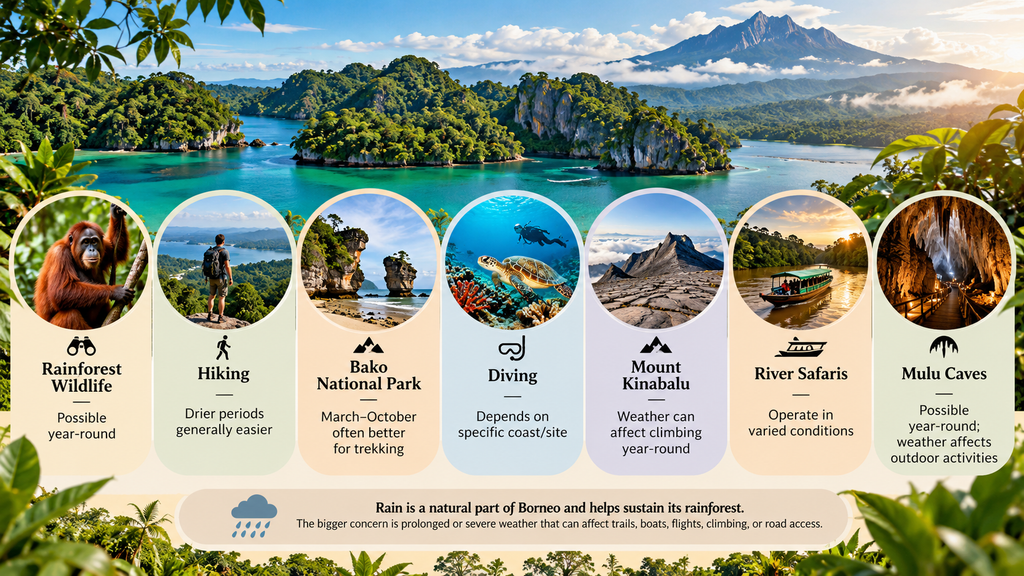
| Trip Type | General Consideration |
| Rainforest wildlife | Possible year-round |
| Hiking | Drier periods generally easier |
| Bako National Park | March-October often better for trekking |
| Diving | Depends on specific coast/site |
| Mount Kinabalu | Weather can affect climbing year-round |
| River safaris | Operate in varied conditions |
| Mulu caves | Possible year-round; weather affects outdoor activities |
Rain should not automatically be considered bad luck.
Rainfall sustains the rainforest you have traveled to see.
The bigger concern is prolonged or severe weather that affects trails, boats, flights, climbing, or road access.
How Long Should You Spend in Borneo?
Around 10 to 14 days works well for a first Borneo trip focused on one Malaysian state, while 2 to 3 weeks allows travelers to combine regions more comfortably.
| Trip Length | Suggested Focus |
| 5-7 days | One compact region |
| 10 days | Sabah wildlife highlights |
| 14 days | Sabah in depth or Sabah + Sarawak |
| 2-3 weeks | Multiple regions |
| 3+ weeks | Malaysia + Kalimantan/Brunei |
Borneo rewards slower travel.
Remote rainforest lodges, river transfers, regional flights, boats, and mountain journeys mean that moving between highlights can take longer than distances on a map suggest.
Sample 10-Day Sabah Wildlife Itinerary
Days 1-2: Kota Kinabalu
Recover from your journey, visit markets, enjoy local food, and take a coastal or island excursion.
Days 3-4: Kinabalu Park
Head inland for mountain views, botanical diversity, and cooler air.
Travelers climbing Mount Kinabalu will need to structure these days around their confirmed climbing arrangements.
Day 5: Sepilok
Travel to the Sandakan region and visit the orangutan rehabilitation center and nearby conservation attractions.
Days 6-7: Kinabatangan
Stay beside the river and take multiple morning and evening wildlife cruises.
Days 8-10: Danum Valley
Finish with a deeper rainforest experience involving guided walks, wildlife observation, and night activities.
This route balances accessible conservation experiences with genuine wilderness.
What Should You Pack for Borneo?
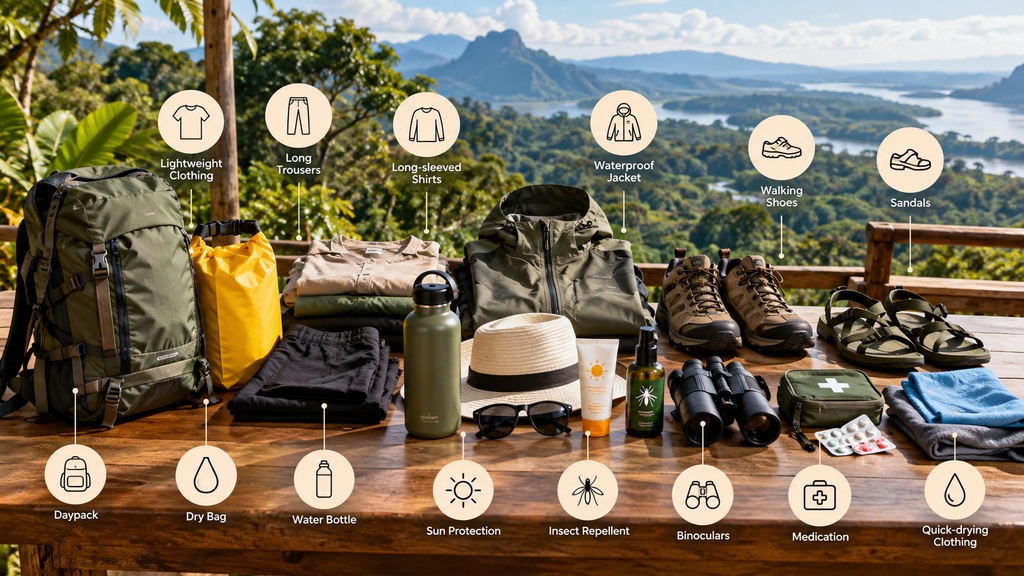
Pack for heat, humidity, rain, insects, and uneven ground.
Useful items include:
- Lightweight breathable clothing
- Lightweight long trousers
- Long-sleeved shirts
- Waterproof jacket
- Comfortable walking shoes
- Sandals
- Small daypack
- Dry bag
- Refillable water bottle
- Sun protection
- Insect repellent
- Binoculars
- Personal medication
- Quick-drying clothing
For serious trekking, climbing, or diving, the packing list will need to be more specialized.
Responsible Wildlife Watching in Borneo
Borneo’s wildlife is one of its greatest attractions, but tourism works best when animals remain wild.
Follow several basic principles:
- Never feed wild animals.
- Do not touch orangutans or other wildlife.
- Maintain the distance requested by guides.
- Keep noise low.
- Avoid flash photography when prohibited.
- Never block an animal’s route.
- Follow park and rehabilitation-center rules.
- Do not pressure guides to approach animals more closely.
- Choose responsible wildlife operators.
- Avoid attractions that encourage unnatural animal handling.
A photograph is never worth disturbing an animal.
Practical Tips for Visiting Borneo
A little preparation makes a substantial difference.
- Choose a region first. Borneo is too large for a rushed island-wide itinerary.
- Book key wildlife lodges early. Small rainforest properties can fill up.
- Allow buffer time. Weather can affect boats, flights, and roads.
- Expect rain. Even relatively dry periods can have tropical downpours.
- Carry cash. Remote areas may have limited payment facilities.
- Bring binoculars. Much rainforest wildlife is high in the canopy.
- Use local guides. Experienced guides dramatically improve wildlife spotting.
- Check health advice before departure. Requirements and recommendations depend on your itinerary and personal circumstances.
- Protect electronics. Humidity and sudden rain can be hard on cameras and phones.
- Do not overpack the itinerary. Moving between remote regions takes time.
Final Thoughts
Borneo works best when you choose a few exceptional experiences rather than trying to cover the entire island.
For a first wildlife-focused journey, Sabah provides a compelling sequence: begin around Kota Kinabalu and Kinabalu Park, see orangutans at Sepilok, cruise the Kinabatangan River, and spend several days inside Danum Valley.
Sarawak adds a different character through Kuching, Bako’s proboscis monkeys, Indigenous cultural experiences, and the monumental caves of Gunung Mulu. Indonesian Kalimantan becomes particularly rewarding for travelers who have more time and want the slower rhythm of a klotok journey through Tanjung Puting.
Wherever you go, leave room for uncertainty. Borneo’s strongest experiences are not scheduled performances: an orangutan appearing between trees, hornbills flying across a river, bats emerging from a cave, or the sound of rainforest after a tropical downpour are memorable precisely because nature determines when they happen.
Frequently Asked Questions
Borneo’s major highlights include orangutans, Kinabatangan River wildlife cruises, Danum Valley, Mount Kinabalu, Gunung Mulu National Park, Bako National Park, Indigenous cultures, tropical islands, and diving.
Sabah is particularly practical for a first trip because travelers can combine Kota Kinabalu, Mount Kinabalu, Sepilok, Kinabatangan, Danum Valley, and coastal experiences within one region.
Kinabatangan, Danum Valley, and Tanjung Puting offer opportunities to see orangutans in rainforest environments, although sightings are never guaranteed. Sepilok and Semenggoh provide different rehabilitation-focused experiences.
Orangutan experiences are possible throughout the year at several destinations, but sightings of genuinely wild animals depend on food availability, weather, location, and animal movements.
No. Borneo also offers mountain climbing, diving, caves, beaches, river journeys, cities, food, Indigenous cultures, longhouses, and rainforest trekking.
Around 10 to 14 days is a useful length for a first trip focused on one region. Allow 2 to 3 weeks if combining Sabah and Sarawak or adding Kalimantan.
The summit climb is physically demanding because of the altitude, elevation gain, terrain, and early summit attempt. Climbers should prepare appropriately and follow current permit, guide, and accommodation requirements.
No. Kinabatangan is rich in wildlife, but animals move freely through their habitat. Multiple morning and evening cruises generally provide more observation opportunities than a single outing.
Yes, particularly for travelers interested in caves, geology, rainforest, hiking, and unusual natural landscapes. UNESCO recognizes Mulu for both its exceptional biodiversity and karst features.
Yes, but allow enough time. Crossing between regions can involve flights and additional immigration procedures, so combining Sabah, Sarawak, and Kalimantan is better suited to a longer itinerary.