
Places to Visit in Canada: Best Cities, Parks & Natural Wonders
The best places to visit in Canada include Vancouver, Banff National Park, Jasper National Park, Toronto, Niagara Falls, Montréal, Québec City, Vancouver Island, Nova Scotia, Prince Edward Island, Newfoundland and Labrador, and the Yukon. The right destinations depend heavily on the type of trip you want: Canada’s huge size means a Rocky Mountain adventure, Québec city break, Atlantic road trip, and northern-lights vacation are very different journeys.
Canada rewards travelers who choose a region rather than trying to see the entire country in one trip. On the west coast, British Columbia combines cities, ocean, mountains, and islands. Alberta offers the Canadian Rockies. Ontario and Québec mix major cities with history and natural attractions, while Atlantic Canada is known for rugged coastlines, fishing communities, seafood, and scenic drives. Farther north, the Yukon and Northwest Territories offer wilderness and aurora-viewing opportunities.
This guide covers some of the most rewarding places to visit in Canada, what each destination is known for, when to go, and how to combine several stops into a realistic itinerary.
Key Places To Visit In Canada
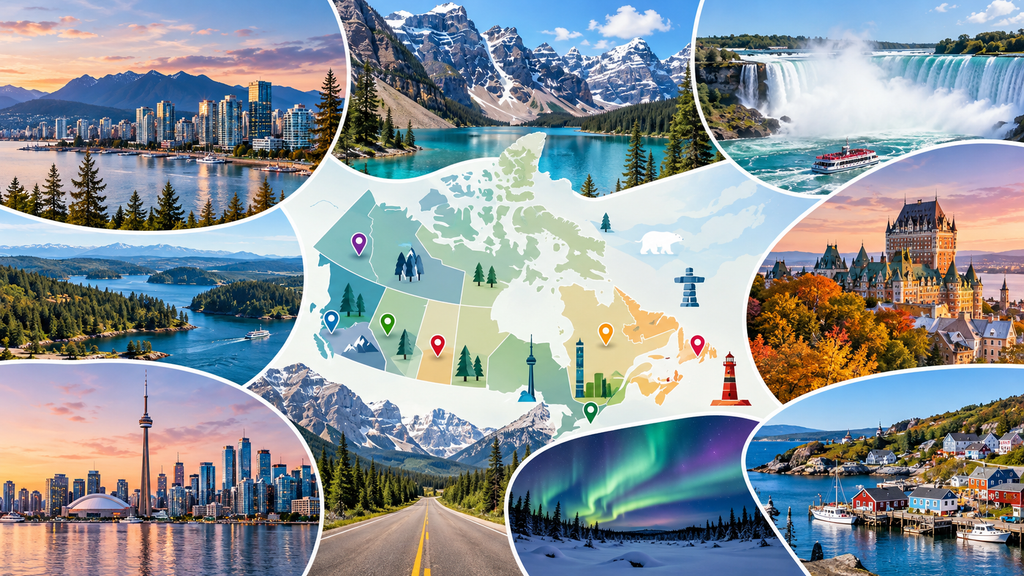
Canada’s official tourism organization highlights destinations stretching from Vancouver and Victoria to Toronto, Montréal, Halifax, Whitehorse, Yellowknife, and Iqaluit, reflecting how geographically varied a Canadian vacation can be.
| Destination | Province/Territory | Best For |
| Vancouver | British Columbia | City + mountains + coast |
| Vancouver Island | British Columbia | Wildlife, coastline, road trips |
| Whistler | British Columbia | Skiing and mountain activities |
| Banff National Park | Alberta | Rockies, lakes, hiking |
| Jasper National Park | Alberta | Wilderness, wildlife, scenic drives |
| Calgary | Alberta | City stop + Rockies gateway |
| Toronto | Ontario | City break, food, culture |
| Niagara Falls | Ontario | Waterfalls, wine country |
| Ottawa | Ontario | Museums, history, national landmarks |
| Montréal | Québec | Food, culture, festivals |
| Québec City | Québec | History and architecture |
| Nova Scotia | Atlantic Canada | Coastal road trips and seafood |
| Prince Edward Island | Atlantic Canada | Beaches and countryside |
| Newfoundland & Labrador | Atlantic Canada | Dramatic coast and wildlife |
| Yukon | Northern Canada | Wilderness and northern lights |
| Northwest Territories | Northern Canada | Aurora and remote landscapes |
1. Vancouver, British Columbia
Vancouver is one of Canada’s most versatile destinations, combining a major city with beaches, forests, mountains, and the Pacific Ocean.
Few Canadian cities make it as easy to move between urban sightseeing and outdoor activities.
Popular experiences include:
- Stanley Park
- Vancouver Seawall
- Granville Island
- Gastown
- Beaches
- Waterfront neighborhoods
- Museums and galleries
- Nearby mountains
Stanley Park alone covers about 1,000 acres and provides access to the Seawall, beaches, forest, and views over Burrard Inlet.
Food is another reason to spend several days here. Vancouver’s culinary scene reflects its multicultural population, with everything from seafood and Japanese cuisine to food trucks, bakeries, and breweries. Destination Canada specifically highlights the city’s combination of outdoor recreation and diverse dining.
How Long Should You Spend in Vancouver?
Allow 3 to 4 days for a first visit.
Stay longer if you want to add day trips or continue toward Whistler or Vancouver Island.
2. Vancouver Island
Vancouver Island works particularly well for travelers interested in coastal scenery, wildlife, small communities, forests, and slower road trips.
The island lies off British Columbia’s Pacific coast and includes the provincial capital, Victoria.
Popular areas include:
- Victoria
- Tofino
- Ucluelet
- Pacific Rim region
- Nanaimo
- Cowichan Valley
Victoria offers gardens, historic architecture, museums, restaurants, and a picturesque harbor, while the island’s western coast becomes dramatically wilder.
Travelers heading toward Tofino and Ucluelet can find beaches, temperate rainforest, surfing, and access to Pacific coastal scenery.
Vancouver Island deserves several days rather than being treated only as a quick extension of Vancouver.
3. Victoria, British Columbia
Victoria combines a walkable waterfront city with gardens, history, food, and easy access to Vancouver Island’s coastal landscapes.
Located at the southern end of Vancouver Island, Victoria is British Columbia’s capital. Destination Canada describes it as a Pacific-coast city rich in West Coast history.
Visitors commonly spend time around:
- Inner Harbour
- British Columbia Parliament Buildings
- Royal BC Museum
- Historic neighborhoods
- Gardens
- Waterfront areas
Victoria can work as a 2- or 3-day city break or as the starting point for a longer Vancouver Island road trip.
4. Whistler, British Columbia
Whistler is one of Canada’s best-known mountain resorts, but it offers much more than winter skiing.
Winter is associated with skiing and snowboarding, while summer brings:
- Hiking
- Mountain biking
- Lakes
- Gondola rides
- Golf
- Outdoor adventure
The village itself has restaurants, accommodation, shops, and entertainment, making Whistler practical even for travelers who do not ski.
It is also relatively easy to combine with Vancouver, turning a city trip into a city-and-mountains itinerary.
5. Banff National Park, Alberta
Banff National Park is one of the best places in Canada for Rocky Mountain scenery, glacial lakes, hiking, wildlife, and scenic drives.
The park combines mountain peaks with famous destinations such as:
- Banff town
- Lake Louise
- Moraine Lake
- Bow Valley
- Icefields Parkway
- Mountain trails
Parks Canada describes Banff as a destination of glacial lakes and mountain peaks and emphasizes the importance of advance planning.
Visiting Lake Louise and Moraine Lake in 2026
Access rules matter.
Moraine Lake Road remains closed to personal vehicles year-round. Visitors must use eligible shuttles, public transit, or licensed commercial transportation.
For the 2026 season, Parks Canada’s Lake Louise Lakeshore shuttle operates through October 12, while Moraine Lake shuttle service runs through October 12, weather permitting. Reservations are required for Parks Canada shuttles.
These are not details to leave until arrival. Shuttle seats can sell out, and parking at Lake Louise is limited.
How Many Days Do You Need in Banff?
Allow at least 3 to 4 days.
A longer stay gives you more flexibility for hiking, changing mountain weather, and visiting both Lake Louise and the Banff town area.
6. Jasper National Park, Alberta
Jasper is a strong alternative or companion to Banff for travelers who want expansive Canadian Rockies scenery, wildlife, hiking, waterfalls, glaciers, and dark skies.
At more than 11,000 square kilometers, Jasper is the largest national park in the Canadian Rockies.
Visitors can experience:
- Icefields Parkway
- Athabasca Falls
- Sunwapta Falls
- Columbia Icefield area
- Lakes
- Hiking trails
- Wildlife
- Stargazing
Jasper is also home to the world’s second-largest dark sky preserve.
What Is Open in Jasper in 2026?
Jasper continues its recovery from the 2024 wildfire.
Most of the park is open, and Parks Canada says virtually all trails have reopened. However, Maligne Canyon and Cavell Road remain closed for the 2026 season while recovery and safety work continues.
Visitors should check Parks Canada’s current closure and trail information immediately before their trip because localized restrictions remain possible.
7. Drive the Icefields Parkway
The Icefields Parkway between Lake Louise and Jasper is one of the most scenic ways to experience the Canadian Rockies.
The route extends approximately 232 km between Lake Louise and Jasper, passing through mountain, glacier, waterfall, and valley scenery.
Potential stops include:
- Bow Lake
- Peyto Lake area
- Columbia Icefield
- Athabasca Falls
- Sunwapta Falls
Do not treat the road simply as transportation from Banff to Jasper.
Allow a substantial part of the day for stops, viewpoints, weather, traffic, and wildlife.
Fuel and services are more limited than in a city, and mountain conditions can change quickly.
8. Calgary, Alberta
Calgary is both a destination in its own right and a practical gateway to the Canadian Rockies.
The city offers:
- Restaurants
- Museums
- River pathways
- Contemporary architecture
- Western heritage
- Annual events
Many travelers fly into Calgary before continuing toward Banff and Lake Louise.
That does not mean the city has to be skipped. One or 2 nights can provide a useful contrast between urban Alberta and the mountain landscapes farther west.
9. Toronto, Ontario
Toronto is Canada’s largest city and one of the country’s strongest choices for food, museums, entertainment, neighborhoods, and multicultural experiences.
Rather than concentrating solely on downtown landmarks, leave time for its different neighborhoods.
Popular stops can include:
- CN Tower
- Toronto Islands
- St. Lawrence Market
- Distillery District
- Royal Ontario Museum
- Art Gallery of Ontario
- Waterfront
Toronto also works well as the starting point for an Ontario trip because Niagara is within reach.
A first-time visitor can comfortably spend 3 to 4 days in the city before adding Niagara Falls or another Ontario destination.
10. Niagara Falls and Niagara Region, Ontario
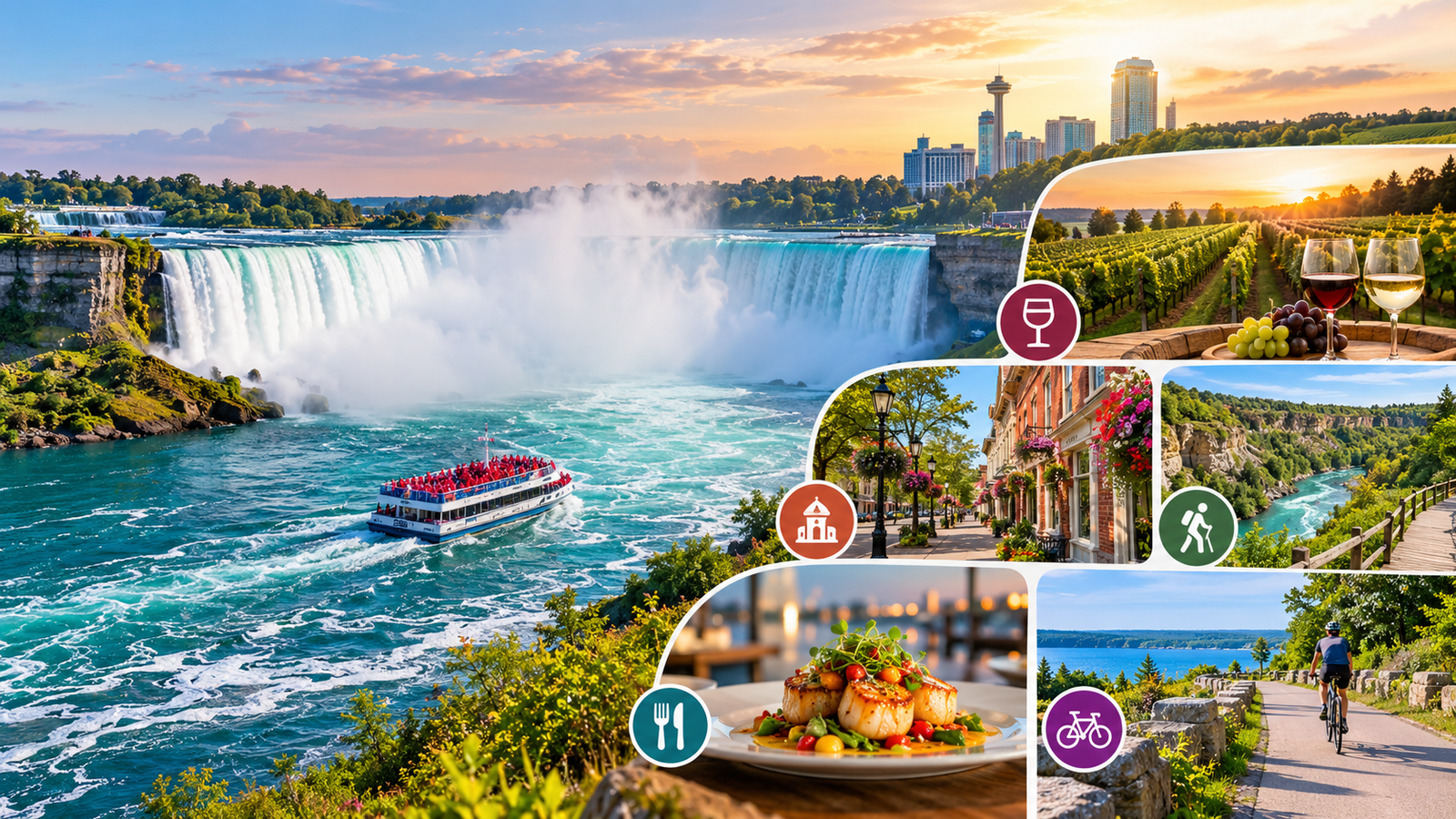
Niagara Falls is one of Canada’s most recognizable natural attractions, but the surrounding Niagara region adds wineries, food, trails, historic communities, and countryside.
The waterfalls sit on the Canada-U.S. border and can be visited as a day trip from Toronto. Destination Canada also highlights the broader Niagara region’s vineyards, farm-to-table dining, trails, and wine industry.
Beyond viewing the falls, travelers can consider:
- Boat experiences
- Niagara Parkway
- Niagara-on-the-Lake
- Niagara Glen
- Winery visits
- Cycling
- Restaurants
Staying overnight gives visitors more time to see the falls after many day-trippers leave and to experience Niagara-on-the-Lake separately.
11. Ottawa, Ontario
Ottawa is Canada’s capital and a particularly useful destination for travelers interested in museums, national history, architecture, and government institutions.
Key attractions include:
- Parliament Hill
- Rideau Canal
- National museums
- ByWard Market
- Ottawa River
- National Gallery of Canada
Ottawa can also fit naturally into an eastern Canada itinerary involving Toronto, Montréal, and Québec City.
The city changes noticeably with the seasons. Summer suits walking and cycling, autumn brings colorful foliage, and winter can transform the Rideau Canal area when weather permits.
12. Montréal, Québec
Montréal combines French-speaking culture, historic neighborhoods, food, festivals, museums, and a lively contemporary arts scene.
Destination Canada describes Montréal as a meeting point between traditional and innovative culture, with cuisine and language central to the experience.
Popular areas and attractions include:
- Old Montréal
- Old Port
- Mount Royal
- Jean-Talon Market
- Museums
- Restaurants
- Neighborhood cafés
Food deserves genuine itinerary space here.
Rather than treating meals as something fitted between sightseeing stops, consider visiting markets, bakeries, casual restaurants, and neighborhoods specifically for their culinary character.
Three days provides a useful introduction, while 4 or 5 days allows for a more relaxed visit.
13. Québec City, Québec
Québec City is one of Canada’s strongest destinations for history, architecture, walkable streets, French-speaking culture, and a distinctly European atmosphere.
Its historic core is characterized by centuries-old architecture and cobblestone streets. Destination Canada notes that the city combines roughly 400 years of history with nearby outdoor experiences.
Spend time around:
- Old Québec
- Château Frontenac surroundings
- Terrasse Dufferin
- Petit-Champlain
- City walls
- St. Lawrence River viewpoints
Outside the historic center, visitors can add nearby natural attractions and communities.
Québec City also works well in winter for travelers who actively want snow, cold weather, and seasonal events rather than simply tolerating them.
14. Charlevoix, Québec
Travelers who want to move beyond Québec’s 2 major cities should consider Charlevoix.
The region follows the St. Lawrence River northeast of Québec City and combines:
- Mountains
- River views
- Villages
- Local food
- Scenic driving
- Outdoor recreation
Destination Canada specifically identifies Charlevoix among the landscapes worth discovering beyond Montréal and Québec City.
It can be added to Québec City for a trip that balances historic urban sightseeing with countryside and natural scenery.
15. Nova Scotia
Nova Scotia is one of Canada’s most rewarding provinces for coastal road trips, seafood, maritime history, lighthouses, and small communities.
Halifax makes a practical starting point.
From there, travelers can build itineraries around:
- Peggy’s Cove
- Lunenburg
- South Shore
- Annapolis Valley
- Cape Breton Island
- Cabot Trail
Nova Scotia works particularly well as a road-trip destination because much of its appeal lies between individual attractions.
A coastal viewpoint, fishing village, café, beach, or roadside stop can become as memorable as the planned destination.
16. Cape Breton Island, Nova Scotia
Cape Breton Island is particularly known for the Cabot Trail, coastal mountains, hiking, and scenic driving.
Rather than attempting the area as a rushed day trip, allow time for stops.
A Cape Breton itinerary can include:
- Cape Breton Highlands
- Coastal viewpoints
- Hiking
- Small communities
- Beaches
- Music and cultural experiences
Weather can affect visibility along the coast, so some itinerary flexibility is useful.
Autumn is especially popular because of the changing foliage, while summer provides longer daylight for hiking and scenic driving.
17. Prince Edward Island
Prince Edward Island is a good choice for beaches, red-sand coastline, seafood, countryside, cycling, and a slower-paced Canadian vacation.
The island’s small size makes it easier to experience than many Canadian regions.
Visitors can divide their time among:
- Charlottetown
- Coastal drives
- Beaches
- Fishing communities
- Farmland
- Anne of Green Gables-related attractions
- Seafood restaurants
PEI can work as a standalone summer trip or as part of a broader Maritime itinerary involving Nova Scotia and New Brunswick.
18. Newfoundland and Labrador
Newfoundland and Labrador stands out for rugged Atlantic coastline, colorful communities, hiking, wildlife, and a strong local culture.
St. John’s provides a natural introduction, but the province rewards travelers who go farther.
Possible highlights include:
- St. John’s
- Signal Hill
- Colorful coastal communities
- Gros Morne National Park
- Whale watching
- Iceberg viewing in season
- Hiking
- Fishing-village landscapes
Distances can be deceptive.
A map may make several Newfoundland destinations appear easy to combine, but road journeys can be long. Build the itinerary around a particular region rather than trying to cover the entire island quickly.
19. Gros Morne National Park, Newfoundland
Gros Morne National Park is one of Canada’s standout destinations for dramatic geology, fjords, mountains, coastal scenery, and hiking.
The park is especially appealing to travelers who prefer natural landscapes to large cities.
Experiences can include:
- Hiking
- Boat excursions
- Geological landscapes
- Coastal communities
- Wildlife viewing
Gros Morne deserves several days because weather can influence both hiking conditions and visibility.
It also sits far from St. John’s, so visitors should account for transportation time rather than treating it as an easy day excursion from the provincial capital.
20. Yukon
The Yukon is one of Canada’s strongest choices for large-scale wilderness, road trips, Indigenous cultural experiences, wildlife, and northern-lights viewing.
Whitehorse is the territorial capital and a common starting point.
From there, trips may involve:
- Klondike history
- Kluane region
- Hiking
- Wildlife
- Remote highways
- Northern lights
- Winter activities
The best season depends heavily on the experience you want.
Summer offers extremely long daylight hours and easier access to outdoor activities. Darker months provide better conditions for aurora viewing.
21. Northwest Territories
The Northwest Territories is particularly well known for wilderness and northern-lights experiences, with Yellowknife serving as the primary tourism gateway for many visitors.
Winter and late-summer/fall aurora trips attract travelers specifically for dark skies.
Visitors should prepare for the north differently from a city vacation in Toronto or Vancouver.
Temperatures, daylight, road access, tour availability, and clothing requirements vary dramatically by season.
Advance reservations are sensible when visiting specifically for guided aurora or wilderness activities.
Which Part of Canada Should You Visit?
Because Canada is so large, choosing the right region matters more than trying to create a list of every famous attraction.
| If You Want… | Consider… |
| Mountains and turquoise lakes | Banff and Jasper |
| City + nature | Vancouver |
| History and French-speaking culture | Québec City |
| Food and nightlife | Montréal |
| Big-city attractions | Toronto |
| Famous natural landmark | Niagara |
| Pacific coast | Vancouver Island |
| Coastal road trip | Nova Scotia |
| Beaches and countryside | Prince Edward Island |
| Rugged Atlantic scenery | Newfoundland |
| Skiing | Whistler or Canadian Rockies |
| Northern lights | Yukon or Northwest Territories |
| Wildlife and wilderness | Rockies or Northern Canada |
| Museums and national history | Ottawa |
The choice should also reflect the season. A destination that works perfectly for hiking in July can offer a completely different experience in January.
Best Places to Visit in Canada for First-Time Visitors
For a first Canadian trip, Vancouver and the Rockies or Toronto, Niagara, Montréal, and Québec City are among the easiest combinations to build into coherent itineraries.
Instead of crossing the country unnecessarily, choose one side.
Western Canada First Trip
A practical route could be:
Vancouver → Banff → Lake Louise → Icefields Parkway → Jasper
This combines city sightseeing with some of Canada’s most recognizable mountain landscapes.
Eastern Canada First Trip
Another option is:
Toronto → Niagara → Ottawa → Montréal → Québec City
This route emphasizes cities, food, culture, history, and Niagara Falls while keeping the journey concentrated in Ontario and Québec.
Best Places in Canada for Nature
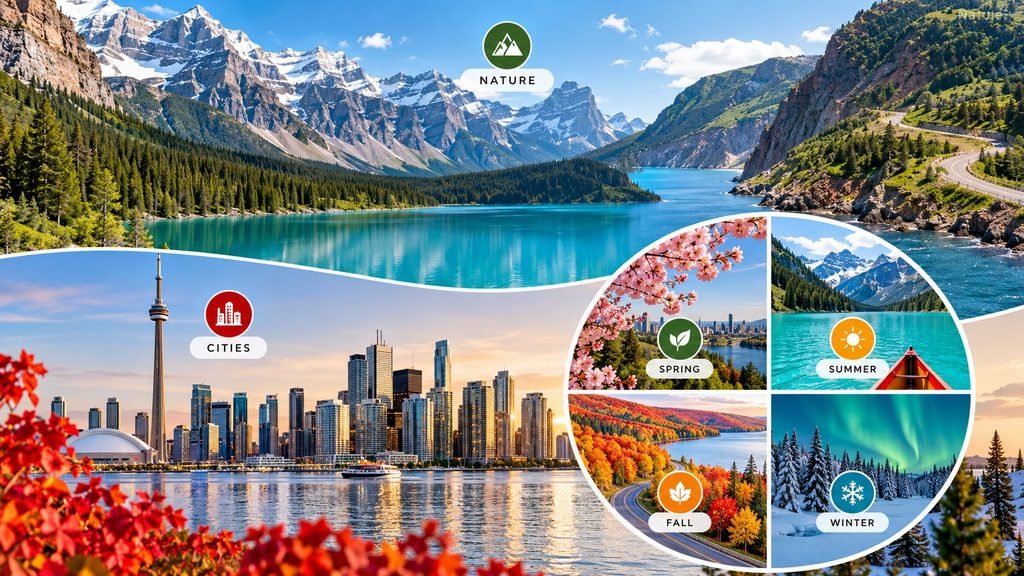
Travelers primarily interested in landscapes should consider:
- Banff National Park
- Jasper National Park
- Vancouver Island
- Gros Morne National Park
- Cape Breton
- Yukon
- Northwest Territories
Canada’s nature trips require more planning than simply reserving accommodation.
Park shuttles, road conditions, wildlife closures, wildfire conditions, trail restrictions, and seasonal access can all affect an itinerary.
For example, current 2026 Jasper conditions include remaining wildfire-related closures, while Moraine Lake cannot be reached in a private vehicle.
Best Cities to Visit in Canada
For travelers focused mainly on urban experiences, strong options include:
- Vancouver
- Toronto
- Montréal
- Québec City
- Ottawa
- Victoria
- Calgary
- Halifax
Destination Canada also highlights cities across the country for their combination of food, arts, Indigenous culture, and proximity to natural landscapes.
Rather than selecting cities solely by size, consider what each contributes to the trip.
Vancouver works particularly well for outdoor access, Montréal for food and culture, Québec City for history, and Halifax as a gateway to Atlantic Canada.
When Is the Best Time to Visit Canada?
June through September is generally the easiest period for broad sightseeing, hiking, road trips, and national parks, but Canada is genuinely a year-round destination.
The ideal time depends on the trip.
| Season | Best For |
| Spring | Cities, blossoms, fewer peak-summer crowds |
| Summer | Hiking, national parks, road trips, coast |
| Fall | Foliage, cities, scenic drives |
| Winter | Skiing, snow activities, northern lights |
| Late winter/early spring | Ski trips and selected winter experiences |
Peak summer also means greater demand.
Parks Canada warns that Jasper receives particularly high visitation from June through September, with busy parking areas and popular locations.
Book accommodation and major park transportation early when visiting the Rockies during summer.
How Many Days Do You Need in Canada?
A first trip to Canada generally benefits from at least 7 to 10 days, but 2 weeks allows travelers to experience a region without rushing.
A realistic breakdown might look like:
| Trip Length | What You Can Reasonably Do |
| 5 days | One city + nearby destination |
| 7 days | Vancouver + nearby BC or Toronto + Niagara |
| 10 days | Vancouver + Rockies or Ontario + Québec |
| 14 days | Deeper western/eastern road trip |
| 3+ weeks | Multiple regions |
Trying to fit Vancouver, Banff, Toronto, Montréal, Québec City, and Atlantic Canada into one short trip creates substantial travel time.
Canada stretches across multiple time zones and enormous distances. Treat it more like several regional trips than one compact destination.
Do You Need a Car to Visit Canada?
Not everywhere. Major cities such as Vancouver, Toronto, Montréal, and Québec City can be visited without renting a car, while national parks and rural regions often require more transportation planning.
Public transportation works well for many urban trips.
A rental vehicle becomes more useful for:
- Nova Scotia road trips
- Newfoundland
- Prince Edward Island
- Rural Québec
- Parts of Vancouver Island
- Scenic regional drives
Even in the Rockies, however, a car does not guarantee access everywhere. Moraine Lake Road, for example, is closed to personal vehicles year-round.
Check the transportation requirements for individual attractions rather than assuming a rental car solves every access issue.
Practical Tips for Planning a Canada Trip
Canada’s scale is the biggest planning consideration.
Keep these points in mind:
- Concentrate on one region during shorter trips.
- Check distances in driving hours, not only kilometers.
- Book popular national-park accommodation early.
- Reserve required park shuttles in advance.
- Check wildfire conditions during fire season.
- Monitor trail and road closures.
- Pack layers for changing weather.
- Leave extra time on mountain drives.
- Keep wildlife at a safe distance.
- Check ferry reservations for island itineraries.
- Do not underestimate winter temperatures.
- Confirm entry requirements according to your nationality.
Destination Canada maintains specific wildfire guidance because fires can affect travel plans in parts of the country during certain times of year.
Final Words!
Canada is better approached as a collection of distinct regions than as a checklist of attractions. Vancouver and the Rockies provide an excellent combination of city and mountain scenery, while Toronto, Niagara, Montréal, and Québec City form a strong eastern itinerary. Atlantic Canada suits slower coastal road trips, and the Yukon and Northwest Territories provide a completely different northern experience.
For a first trip of 7 to 14 days, choose one part of the country and give yourself enough time to experience it properly. That reduces long travel days and creates more room for scenic drives, hiking, food, neighborhoods, and unexpected stops.
For national parks in particular, check current access information shortly before traveling. Shuttle requirements, wildfire recovery, seasonal roads, trail conditions, and closures can change even after the rest of an itinerary has been booked.
Frequently Asked Questions
Vancouver, Banff, Jasper, Toronto, Niagara Falls, Montréal, Québec City, Vancouver Island, Nova Scotia, Prince Edward Island, Newfoundland and the Yukon are among the most useful destinations to consider when planning a first or repeat trip.
Canada has several very different scenic regions. The Canadian Rockies offer glacial lakes and mountain peaks, British Columbia has Pacific coastline and rainforest, Atlantic Canada has rugged ocean scenery, and the north provides vast wilderness and tundra landscapes.
Both can be combined in one Rockies itinerary using the Icefields Parkway. Banff provides convenient access to Lake Louise and Moraine Lake, while Jasper covers a larger, more expansive wilderness area. Current 2026 Jasper visitors should check wildfire-recovery closures before finalizing plans.
Yes. Vancouver combines urban attractions with beaches, forests, mountains, food, and outdoor activities, making it particularly useful for travelers who want both a city break and easy access to nature.
Yes. Québec City is especially suitable for travelers interested in historic architecture, French-speaking culture, food, and walkable old-city streets. Destination Canada highlights its roughly 400 years of history alongside nearby outdoor attractions.
Yes. Niagara is close enough to Toronto to combine the 2 destinations easily. It can be visited as a day trip, although an overnight stay gives travelers more time for Niagara Falls, Niagara-on-the-Lake, and the surrounding wine region.
The Yukon and Northwest Territories are 2 of Canada’s best-known northern destinations for aurora-focused trips. Conditions depend on darkness, weather, solar activity, and season, so sightings can never be guaranteed.
Strong road-trip regions include the Canadian Rockies, Vancouver Island, Nova Scotia and Cape Breton, Newfoundland, and parts of Québec. Choose a route based on available time rather than trying to connect distant regions.
No. Moraine Lake Road is closed to personal vehicles year-round. Visitors need an eligible shuttle, public transit service, or licensed commercial operator.
Yes. Jasper National Park is open, and most trails and visitor areas have reopened following the 2024 wildfire. However, some closures remain, including Maligne Canyon and Cavell Road for the 2026 season.