
Amazon Prime Visa Card: Benefits, Rewards & Fees 2026
The Amazon Prime Visa is a $0-annual-fee credit card that earns eligible Prime members unlimited 5% back at Amazon.com, Audible.com, Whole Foods Market, and on purchases through Chase Travel, making it particularly useful for frequent Amazon shoppers who already pay for Prime. The card also earns unlimited 2% back at gas stations, restaurants, and on local transit and commuting, plus 1% back on other eligible purchases.
The card is issued by Chase and currently comes with a $150 Amazon Gift Card upon approval for eligible Prime members. There is no traditional spending requirement attached to that current offer.
Its appeal extends beyond Amazon shopping. There are no foreign transaction fees, and cardholders receive several travel and purchase protections, including baggage delay insurance, lost luggage reimbursement, auto rental coverage, purchase protection, and extended warranty protection.
However, there is an important distinction: the card itself has no annual fee, but earning 5% in its headline categories requires an eligible Amazon Prime membership. Without eligible Prime membership, the applicable Amazon, Whole Foods, Audible, and Chase Travel earning rate drops to 3%.
Here’s how the Amazon Prime Visa works in 2026, including its rewards, welcome offer, redemption options, travel protections, limitations, and the types of shoppers who can get the most from it.
Amazon Prime Visa Card at a Glance
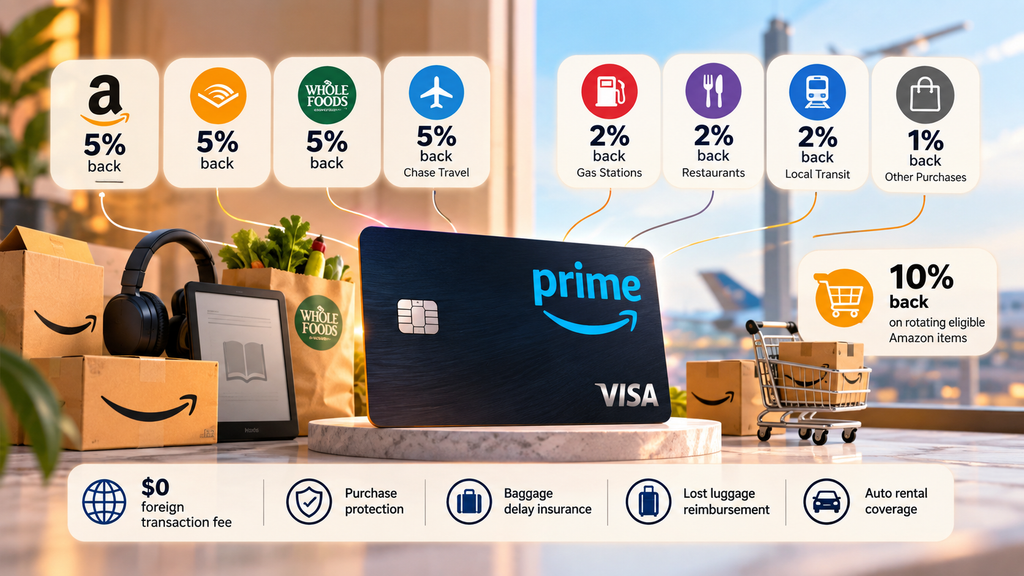
The rewards percentages are unlimited unless the terms of a specific promotional offer state otherwise.
| Feature | Prime Visa |
| Issuer | Chase |
| Annual card fee | $0 |
| Current welcome offer | $150 Amazon Gift Card on approval for eligible Prime members |
| Amazon.com | 5% back with eligible Prime membership |
| Audible.com | 5% back with eligible Prime membership |
| Whole Foods Market | 5% back with eligible Prime membership |
| Chase Travel | 5% back with eligible Prime membership |
| Gas stations | 2% back |
| Restaurants | 2% back |
| Local transit and commuting | 2% back |
| Other eligible purchases | 1% back |
| Prime Card Bonus | 10% back or more on rotating eligible Amazon items/categories |
| Foreign transaction fee | $0 |
| Purchase protection | Yes |
| Baggage delay insurance | Yes |
| Lost luggage reimbursement | Yes |
| Auto rental coverage | Yes |
Amazon Prime Visa Welcome Offer
Eligible Prime members currently receive a $150 Amazon Gift Card immediately upon approval for the Prime Visa. The gift card is loaded into the Amazon account’s Gift Card Balance.
That structure is different from many credit-card welcome bonuses.
There is currently no requirement such as spending $3,000 in 3 months to receive the advertised $150 gift card. Approval triggers the offer, provided the applicant meets the offer’s eligibility requirements.
The advantage is simplicity: cardholders do not need to change their spending habits to meet a large minimum-spend requirement.
The downside is that $150 is smaller than the welcome bonuses available on some cards that charge annual fees or require substantial spending.
Credit-card welcome offers can change, so prospective applicants should confirm the displayed offer before submitting an application.
How Does the Amazon Prime Visa Earn Rewards?
The Prime Visa’s strongest earning categories revolve around the Amazon ecosystem.
5% Back at Amazon.com
Eligible Prime members earn unlimited 5% back on qualifying Amazon.com purchases.
Eligible purchases can include:
- Products sold directly by Amazon
- Eligible products sold by third-party marketplace sellers
- Amazon Fresh orders
- Digital downloads
- Amazon.com Gift Cards
- Eligible Amazon Prime subscription charges
The lack of a spending cap is important.
For example, someone spending $6,000 annually on qualifying Amazon purchases would earn:
$6,000 × 5% = $300 in rewards
Someone spending $12,000 would earn:
$12,000 × 5% = $600 in rewards
This makes the card increasingly useful as Amazon spending rises.
However, not every transaction involving Amazon qualifies. Purchases made through Amazon Pay and purchases at international Amazon retail sites such as Amazon.ca or Amazon.co.uk do not qualify for the headline Amazon earning rate.
5% Back at Whole Foods Market
Eligible Prime members also earn unlimited 5% back on qualifying purchases at Whole Foods Market in the U.S.
That includes eligible purchases at physical Whole Foods locations and qualifying purchases through WholeFoodsMarket.com.
This category can materially increase the card’s usefulness for households that combine frequent Amazon shopping with Whole Foods grocery spending.
For example, spending $500 per month at Whole Foods would produce:
$500 × 12 × 5% = $300 per year in rewards
Some Whole Foods-related transactions do not qualify, including certain purchases through third-party services and certain third-party vendors operating within Whole Foods locations.
5% Back at Audible.com
Audible is also included in the Prime Visa’s current 5% earning category for eligible Prime members.
This makes the card slightly broader than its old reputation as simply an “Amazon and Whole Foods card.”
Regular Audible customers can keep those purchases within the same 5%-back ecosystem.
5% Back Through Chase Travel
Prime Visa cardholders with eligible Prime membership earn unlimited 5% back on qualifying purchases made through Chase Travel.
Potential reservations through the platform can include:
- Flights
- Hotels
- Car rentals
- Other eligible travel
However, the 5% rate applies to eligible purchases through Chase Travel.
Booking directly with an airline, hotel, car rental agency, or cruise company does not trigger the card’s 5% Chase Travel category.
That means travelers should compare prices before booking.
Earning 5% back is useful, but it should not automatically outweigh a cheaper direct price, more flexible cancellation policy, hotel elite benefits, or other booking advantages.
2% Back at Gas Stations
The Prime Visa earns unlimited 2% back at qualifying gas stations.
This provides a reasonable secondary earning category for everyday spending.
However, shoppers primarily interested in maximizing gas rewards may find cards specifically designed around fuel or broader everyday categories more rewarding.
The strength of the Prime Visa remains its 5% categories.
2% Back at Restaurants
Cardholders receive unlimited 2% back on qualifying restaurant purchases.
This provides a useful return for occasional dining but is not an unusually high restaurant rewards rate.
Consumers who spend heavily on dining may therefore choose to use another rewards card for restaurant purchases while keeping the Prime Visa for Amazon, Whole Foods, Audible, and Chase Travel.
2% Back on Local Transit and Commuting
The card also earns 2% back on local transit and commuting, including eligible rideshare purchases.
Depending on merchant coding, this category can cover qualifying commuting expenses.
It gives the card another everyday-use category beyond Amazon shopping, although again the return is less compelling than its 5% categories.
1% Back on Other Purchases
Purchases outside the card’s bonus categories generally earn unlimited 1% back.
This is the card’s weakest earning category.
Suppose you spend $1,000 on an eligible purchase that does not fall under Amazon, Whole Foods, Chase Travel, Audible, gas, restaurants, or local transit.
You would receive approximately:
$1,000 × 1% = $10 in rewards
A card offering 2% back on general purchases could earn twice as much on the same transaction.
For that reason, the Prime Visa can work particularly well as a category-specific card rather than necessarily being the only card in a wallet.
Prime Card Bonus: Earn 10% Back or More
There is another benefit that can occasionally exceed the regular 5% Amazon rate.
Eligible Prime Visa cardmembers can earn 10% back or more on a rotating selection of Amazon.com items and categories.
These are limited-time offers rather than a permanent 10% Amazon earning rate.
The products and categories can change, so shoppers should check current Prime Card Bonus offers instead of assuming a planned purchase qualifies.
For someone who was already going to purchase an eligible product, these promotions can meaningfully increase the card’s return.
Does the Prime Visa Have an Annual Fee?
No. The Prime Visa has a $0 annual card fee.
That makes the rewards structure relatively straightforward because cardholders do not need to earn enough cash back to offset a credit-card annual fee.
However, the Prime membership requirement is separate.
The card’s headline 5% earning rate depends on having an eligible Prime membership linked appropriately to the account.
This distinction is important when evaluating the card.
If you already subscribe to Prime for shipping, streaming, shopping, or other Prime benefits, the credit card adds no separate annual card fee.
Signing up for Prime solely to earn an additional 2 percentage points on Amazon purchases requires a different calculation.
What Happens If You Cancel Amazon Prime?
If the Amazon account associated with the card no longer has an eligible Prime membership, the card generally earns 3% instead of 5% on qualifying Amazon.com, Whole Foods Market, participating Amazon sites, and Chase Travel purchases.
The 2% categories and 1% base earning structure remain available according to the applicable program terms.
Chase also offers the separate Amazon Visa, which uses the 3% structure without requiring eligible Prime membership.
Prime Visa vs. Amazon Visa
The main distinction is therefore the Amazon-related earning rate and current welcome offer.
| Feature | Prime Visa | Amazon Visa |
| Eligible Prime membership | Required for headline rate | Not required |
| Amazon.com | 5% | 3% |
| Audible.com | 5% | 3% |
| Whole Foods Market | 5% | 3% |
| Chase Travel | 5% | 3% |
| Gas | 2% | 2% |
| Restaurants | 2% | 2% |
| Local transit/commuting | 2% | 2% |
| Other purchases | 1% | 1% |
| Annual card fee | $0 | $0 |
| Current gift card offer | $150 for eligible Prime members | $50 |
How Much Can You Earn With the Prime Visa?
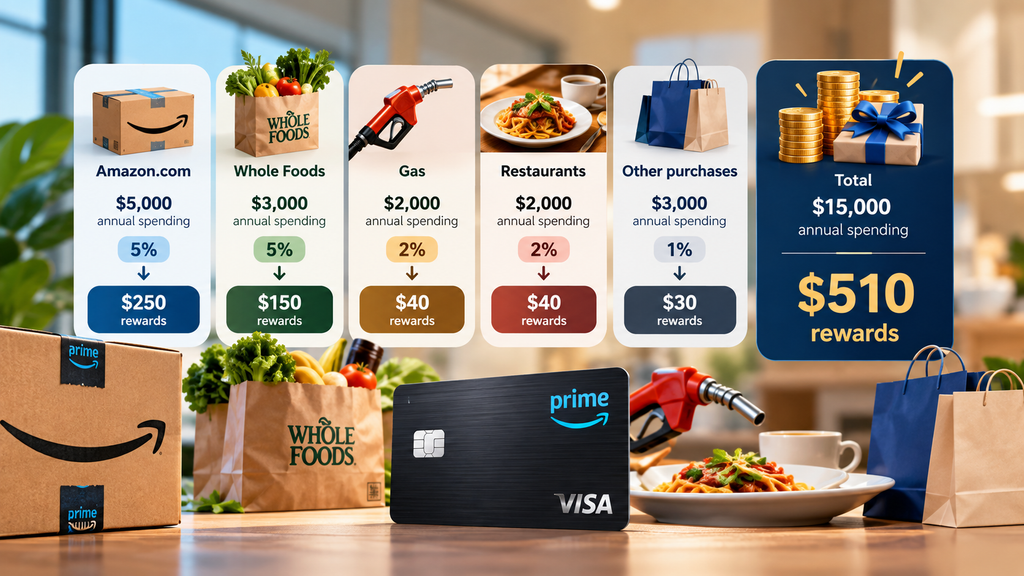
Consider a household with the following annual spending:
| Category | Annual Spending | Rate | Rewards |
| Amazon.com | $5,000 | 5% | $250 |
| Whole Foods | $3,000 | 5% | $150 |
| Gas | $2,000 | 2% | $40 |
| Restaurants | $2,000 | 2% | $40 |
| Other purchases | $3,000 | 1% | $30 |
| Total | $15,000 | — | $510 |
In this example, the card earns $510 in annual rewards, excluding the welcome offer and any Prime Card Bonus promotions.
The important point is where the spending occurs.
A shopper spending $8,000 annually across Amazon and Whole Foods can derive substantially more benefit from the card than someone who spends only $500 annually with Amazon.
How Do Prime Visa Rewards Work?
The Prime Visa technically earns points.
For the standard earning structure:
- 5% back = 5 points per $1
- 2% back = 2 points per $1
- 1% back = 1 point per $1
Cardholders can redeem available points through several options, including Amazon purchases, cash back, travel, and gift cards.
Chase notes that redemption values can vary depending on the selected reward option.
Points do not expire as long as the card account remains open, although they can be forfeited in circumstances described in the rewards agreement, including certain account closures involving misuse or fraud.
Can You Use Rewards Directly at Amazon?
Yes. Prime Visa rewards can be used toward eligible Amazon.com purchases, and Chase states that rewards may be available as soon as the next day.
There is no minimum rewards balance required to redeem toward an eligible Amazon purchase.
At checkout, cardholders can use rewards toward:
- Part of an eligible purchase
- The entire eligible purchase
The convenience is attractive, but frequent Amazon shoppers should understand the opportunity cost of paying with points.
If you use rewards instead of charging a qualifying Amazon purchase to the Prime Visa, the portion paid with rewards does not generate the same new card rewards that charging the purchase would.
For example, using $100 worth of rewards toward an Amazon purchase instead of charging that $100 to the card means giving up the $5 that a qualifying 5% card purchase could otherwise earn.
For that reason, redeeming rewards for cash and continuing to charge eligible Amazon purchases can sometimes preserve more earning potential.
Can Prime Visa Rewards Be Redeemed for Cash Back?
Yes. Rewards can be redeemed for cash back through Chase.
Other available options can include:
- Amazon.com purchases
- Cash back
- Gift cards
- Travel through Chase
Because Chase says redemption values may vary by reward option, cardholders should compare the value before choosing a redemption.
Does the Prime Visa Charge Foreign Transaction Fees?
No. The Prime Visa has no foreign transaction fees.
That means Chase does not add a foreign transaction fee when the card is used for eligible purchases outside the U.S.
This makes the card more travel-friendly than many store-oriented credit cards.
However, purchases from international Amazon websites do not qualify for the card’s 5% Amazon earning rate merely because the Prime Visa is being used.
Chase specifically excludes purchases from international Amazon retail sites such as Amazon.ca, Amazon.co.uk, Amazon.de, Amazon.fr, and Amazon.co.jp from the headline Amazon earning category.
Prime Visa Travel Protections
The Prime Visa includes an unusually useful collection of travel protections for a card with no annual fee.
Baggage Delay Insurance
If covered baggage is delayed for more than 6 hours, the benefit can reimburse essential purchases such as toiletries and clothing for up to $100 per day for up to 3 days.
Coverage requirements and exclusions apply.
Lost Luggage Reimbursement
The card provides reimbursement of up to $3,000 per covered traveler for eligible checked or carry-on baggage that is lost, damaged, or stolen during a covered trip.
Specific limits and exclusions apply, so travelers should consult the current Guide to Benefits before relying on coverage.
Travel Accident Insurance
When eligible air, bus, train, or cruise transportation is paid for with the card, cardholders may qualify for up to $500,000 in accidental death or dismemberment coverage under the applicable terms.
Auto Rental Coverage
The Prime Visa provides eligible rental-car collision and theft coverage when the rental company’s collision insurance is declined and the entire eligible rental cost is charged to the card.
Within the U.S., Chase currently states that the coverage is secondary to personal insurance.
This distinction matters because secondary coverage generally applies after an applicable personal auto insurance policy.
Travel and Emergency Assistance
Cardholders also receive access to travel and emergency assistance services, including certain legal and medical referrals.
The assistance service itself does not mean Chase pays for the medical, legal, transportation, or other services arranged. Cardholders remain responsible for applicable costs.
Prime Visa Shopping Protections
The card’s benefits also extend to eligible purchases.
Purchase Protection
Eligible new purchases are covered for 120 days against damage or theft, with coverage of up to $500 per item.
Terms, exclusions, and claim requirements apply.
This can add useful protection when purchasing electronics, household items, or other eligible goods.
Extended Warranty Protection
The card can extend an eligible manufacturer’s U.S. warranty by 1 additional year when the original eligible warranty is 3 years or less, up to a total of 4 years from the purchase date.
This benefit can be particularly useful for products such as electronics and appliances, provided the item and warranty satisfy the benefit’s requirements.
Zero Liability Protection
Chase also provides Zero Liability Protection for qualifying unauthorized transactions.
Cardholders should report suspected unauthorized use promptly.
What the Prime Visa Does Not Offer
Despite its strong Amazon rewards and no annual card fee, the Prime Visa is not a premium travel card.
Cardholders should not expect major luxury-travel benefits such as:
- Airport lounge membership
- Hotel elite status
- Annual airline credits
- Premium hotel credits
- Broad transferable-points partners
- Elevated rewards on every purchase
- Luxury travel perks
The card’s strength is much narrower: high cash-back-style rewards inside Amazon’s ecosystem without a separate annual card fee.
That focus is important when deciding whether it belongs alongside another general-purpose or travel-rewards card.
Advantages of the Amazon Prime Visa
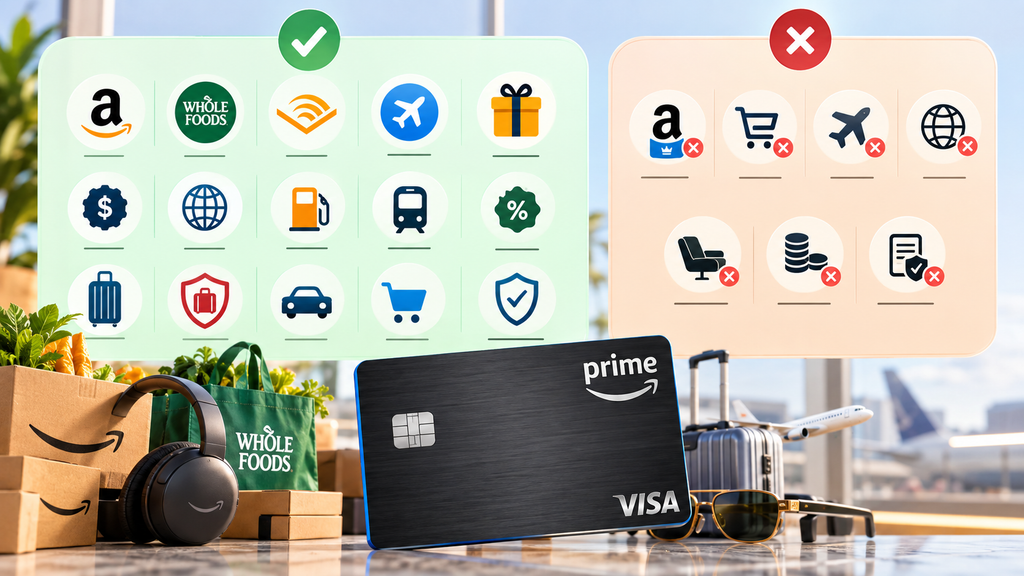
The card’s strongest features include:
- Unlimited 5% back at Amazon.com for eligible Prime members
- 5% back at Whole Foods Market
- 5% back at Audible.com
- 5% back through Chase Travel
- No annual card fee
- No foreign transaction fees
- $150 Amazon Gift Card current welcome offer
- No minimum spending requirement for the current gift card offer
- 2% back at restaurants and gas stations
- 2% back on local transit and commuting
- Occasional 10%-or-more Prime Card Bonus offers
- Baggage delay coverage
- Lost luggage reimbursement
- Auto rental coverage
- Purchase protection
- Extended warranty protection
- Flexible reward redemption options
Limitations to Consider
There are also several limitations:
- 5% requires eligible Prime membership.
- General purchases earn only 1%.
- Restaurant and gas purchases earn only 2%.
- Direct airlines and hotel bookings do not receive the 5% Chase Travel rate.
- International Amazon sites do not receive the 5% Amazon rate.
- Amazon Pay purchases are excluded from the headline Amazon earning category.
- The card does not provide premium airport lounge or hotel benefits.
- It does not function like a transferable-points travel card.
- Some travel benefits are less comprehensive than those on premium travel cards.
Who Can Get the Most Value From the Prime Visa?
The Prime Visa’s structure is particularly relevant to consumers who:
- Already maintain an eligible Prime membership
- Spend regularly at Amazon.com
- Shop at Whole Foods Market
- Use Audible
- Prefer straightforward rewards
- Want a card without an annual card fee
- Can benefit from 5% back through Chase Travel
- Want a card without foreign transaction fees
The calculation changes for someone who does not already subscribe to Prime.
If the only reason for purchasing Prime is to move from 3% to 5% back, compare the additional rewards against the cost of maintaining Prime membership.
For example, the difference between 3% and 5% is 2 percentage points.
On $5,000 in eligible annual Amazon/Whole Foods spending:
$5,000 × 2% = $100 in additional rewards
That additional $100 alone may not justify purchasing Prime solely for the card. But a household already using Prime’s other services evaluates the card differently because the membership cost exists independently of the credit card.
Prime Visa vs. Using a 2% Cash-Back Card
Consider $10,000 of annual spending split as follows:
- $6,000 at Amazon and Whole Foods
- $4,000 in miscellaneous purchases
With the Prime Visa:
- $6,000 × 5% = $300
- $4,000 × 1% = $40
- Total = $340
With a hypothetical flat 2% card:
- $10,000 × 2% = $200
The Prime Visa earns $140 more in this example.
But reverse the spending pattern:
- $1,000 Amazon
- $9,000 miscellaneous
Prime Visa:
- $1,000 × 5% = $50
- $9,000 × 1% = $90
- Total = $140
Flat 2% card:
- $10,000 × 2% = $200
This illustrates why the Prime Visa’s value depends strongly on where you spend.
Final Thoughts
The Amazon Prime Visa concentrates its strongest value where frequent Amazon customers are most likely to spend: Amazon.com, Whole Foods Market, Audible.com, and Chase Travel all earn unlimited 5% back for eligible Prime members.
Its $0 annual card fee, no foreign transaction fees, instant current welcome offer, and collection of travel and purchase protections strengthen the overall package. At the same time, 1% on general purchases means it is not necessarily the strongest option for every expense.
The most important question is therefore not simply whether someone shops at Amazon, but how much eligible spending they already direct toward Amazon and Whole Foods while maintaining Prime for reasons beyond the credit card. The more spending concentrated in the 5% categories, the more significant the card’s rewards can become.
Frequently Asked Questions
The Prime Visa has a $0 annual card fee. However, its headline 5% earning categories require an eligible Amazon Prime membership, which is a separate paid service unless you qualify for another eligible Prime arrangement.
Eligible Prime members earn unlimited 5% back at Amazon.com, Audible.com, Whole Foods Market, and through Chase Travel; 2% at gas stations, restaurants, and on local transit and commuting; and 1% on other eligible purchases.
As of September 2026, Chase advertises a $150 Amazon Gift Card upon approval for eligible Prime members. Offers are subject to change.
The current advertised offer does not require a traditional post-approval minimum-spending threshold. The gift card is loaded into the eligible Amazon account’s Gift Card Balance upon approval, subject to the offer terms.
Yes. Eligible Prime cardholders earn unlimited 5% back on qualifying U.S. Whole Foods Market purchases. Certain third-party and excluded transactions do not qualify.
Eligible Amazon Fresh orders made through Amazon.com can qualify for the card’s 5% Amazon earning rate for eligible Prime members.
Chase’s current terms include qualifying Amazon.com Gift Card purchases within eligible Amazon.com spending for the 5% Prime rate.
No. Chase specifically excludes purchases made from merchants using Amazon Pay from the 5%/3% Amazon earning category.
Yes. It is a Visa card and has no foreign transaction fees. However, international Amazon retail websites are excluded from the headline Amazon rewards category.
Points do not expire while the card account remains open, although Chase’s program agreement allows forfeiture under certain circumstances, including some account closures related to fraud or program misuse.
The account can continue under the applicable Amazon Visa rewards structure, but eligible Amazon, Whole Foods, Audible, and Chase Travel purchases generally earn 3% rather than 5% without eligible Prime membership.
The card provides eligible auto rental collision damage coverage. In the U.S., Chase states that the coverage is secondary to personal insurance. Restrictions and exclusions apply.
Yes. Current benefits include baggage delay insurance and lost luggage reimbursement, subject to eligibility requirements, exclusions, and coverage limits.