
Explore Normandy: D-Day Beaches, Bayeux & Historic Sites
Normandy is one of France most historically significant regions, where travelers can visit the D-Day Landing Beaches, medieval Bayeux, Mont-Saint-Michel, picturesque Honfleur, and landscapes that influenced generations of artists. Situated along the northern coast of France, the region brings together nearly 1,000 years of European history, from William the Conqueror and the Norman conquest of England to the Allied landings of June 1944.
But Normandy is not simply a destination for history enthusiasts. Its coastline includes beaches, cliffs, fishing ports, and seaside towns, while its countryside is known for orchards, dairy farms, cheeses, cider, and traditional villages.
For travelers planning their first trip, Bayeux makes a particularly useful base for exploring several historic attractions. One important point for 2026 visitors, however, is that the Bayeux Tapestry Museum is temporarily closed for renovation and is scheduled to reopen in October 2027.
This guide introduces the major places and experiences that help tell Normandy’s story.
What Is Normandy Best Known For?
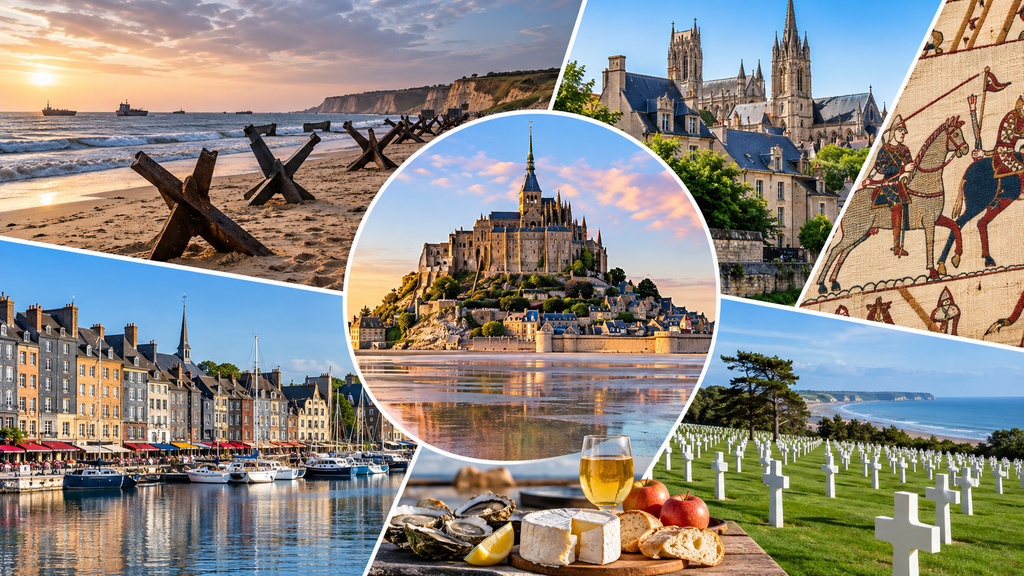
Normandy is particularly known for the D-Day Landing Beaches, Mont-Saint-Michel, the Bayeux Tapestry, medieval towns, Impressionist connections, and distinctive regional food and drink.
The region’s history stretches far beyond World War II. Medieval Normandy was closely connected with England, particularly after William, Duke of Normandy, conquered England in 1066. Centuries later, the coastline became the setting for another event with international consequences: the Allied landings on June 6, 1944.
For a first visit, some of the most notable places include:
| Place | Why Visit? |
| Bayeux | Medieval streets, cathedral, Bayeux Tapestry history, and access to D-Day sites |
| Omaha Beach | One of the five principal D-Day landing sectors |
| Normandy American Cemetery | Major World War II cemetery overlooking Omaha Beach |
| Utah Beach | Westernmost of the five D-Day landing beaches |
| Gold, Juno & Sword Beaches | British and Canadian landing sectors and nearby memorial sites |
| Pointe du Hoc | Dramatic clifftop site associated with the D-Day assault |
| Mont-Saint-Michel | Medieval abbey and UNESCO-listed tidal setting |
| Honfleur | Historic harbor, traditional architecture, and Impressionist heritage |
In July 2026, the D-Day Landing Beaches were added to the UNESCO World Heritage List as a serial property consisting of Utah, Omaha, Gold, Juno and Sword beaches along with Pointe du Hoc.
Start Your Normandy Journey in Bayeux
Bayeux combines medieval Normandy with the history of World War II, making it one of the most convenient places to begin exploring the region. Unlike many communities in Normandy, Bayeux escaped much of the destruction associated with the fighting following D-Day. Its historic center therefore retains medieval streets, old houses, waterways, and religious buildings.
The imposing Bayeux Cathedral, whose history reaches back to the 11th century, dominates the center of town. Walking around the surrounding streets also gives visitors a reason to spend more than a few hours here. More importantly for many travelers, Bayeux is only a short distance from the D-Day coastline and is commonly used as a starting point for tours of the landing beaches.
The Bayeux Tapestry
The Bayeux Tapestry tells the story surrounding the Norman conquest of England and the events culminating in the Battle of Hastings in 1066.
Despite its name, it is technically an embroidery rather than a woven tapestry. UNESCO records its length at 68.80 meters, or approximately 226 feet, and recognizes it through its Memory of the World Programme. Its scenes depict ships, soldiers, horses, political events, battles, and details of medieval life, creating something resembling a long visual narrative.
Can You See the Bayeux Tapestry in 2026?
No. The original Bayeux Tapestry is not currently available for an in-person museum visit.
The Bayeux Tapestry Museum closed in September 2025 for a major renovation project. According to the museum’s current visitor information, reopening is planned for October 2027. Travelers visiting before then can still explore Bayeux’s medieval center, cathedral, Memorial Museum of the Battle of Normandy, and other historic attractions. The Bayeux Museum also provides an online opportunity to examine the tapestry scene by scene.
This temporary closure is especially important to consider when planning a Normandy itinerary specifically around the tapestry.
Visit the D-Day Landing Beaches
The D-Day Landing Beaches are among Normandy’s most significant historical sites and extend across a large section of the coast rather than occupying a single location.
On June 6, 1944, Allied forces landed at five principal sectors:
- Utah Beach
- Omaha Beach
- Gold Beach
- Juno Beach
- Sword Beach
Airborne operations, naval bombardment, the assault on Pointe du Hoc, and fighting farther inland were also essential parts of the operation. Normandy Tourism describes the landings as the largest amphibious and airborne operation in history.
Today, the peaceful coastline can make the scale of what occurred here difficult to imagine. Museums, bunkers, cemeteries, memorials, preserved defensive positions, and interpretation centers help visitors understand the events of 1944.
Omaha Beach
Omaha Beach was one of the American landing sectors and is among the most recognized D-Day locations.
A visit becomes more meaningful when combined with nearby historical sites rather than treating the beach as an isolated stop. The surrounding area contains memorials and remnants connected to the battle, while the Normandy American Cemetery is located at Colleville-sur-Mer above Omaha Beach.
Normandy American Cemetery
The Normandy American Cemetery contains the graves of 9,389 American military dead, while its Walls of the Missing record 1,557 names. It occupies a 172.5-acre site overlooking Omaha Beach and the English Channel.
The cemetery is both a historical location and a place of remembrance, so visitors should allow time to experience it respectfully rather than rushing through.
As currently published by the American Battle Monuments Commission, it is open daily from 9 a.m. to 5 p.m., except January 1 and December 25. Admission ends 30 minutes before closing.
Pointe du Hoc
Between Utah and Omaha beaches, Pointe du Hoc adds another dimension to understanding the D-Day assault.
Its clifftop location and surviving battlefield landscape help illustrate the physical challenges involved in the operation. Travelers interested in military history frequently combine Pointe du Hoc with Omaha Beach and the Normandy American Cemetery.
Gold, Juno, and Sword Beaches
The eastern sectors add British and Canadian perspectives to a D-Day itinerary. Gold Beach was assigned primarily to British forces, while Juno Beach was the principal Canadian landing sector and Sword Beach the easternmost of the five main landing areas.
Seeing several sectors is worthwhile because the D-Day operation was not one battle occurring at one beach. The coastline, airborne landing areas, ports, villages, roads, bridges, and inland objectives formed parts of a much larger military operation.
How Much Time Do You Need for the D-Day Beaches?
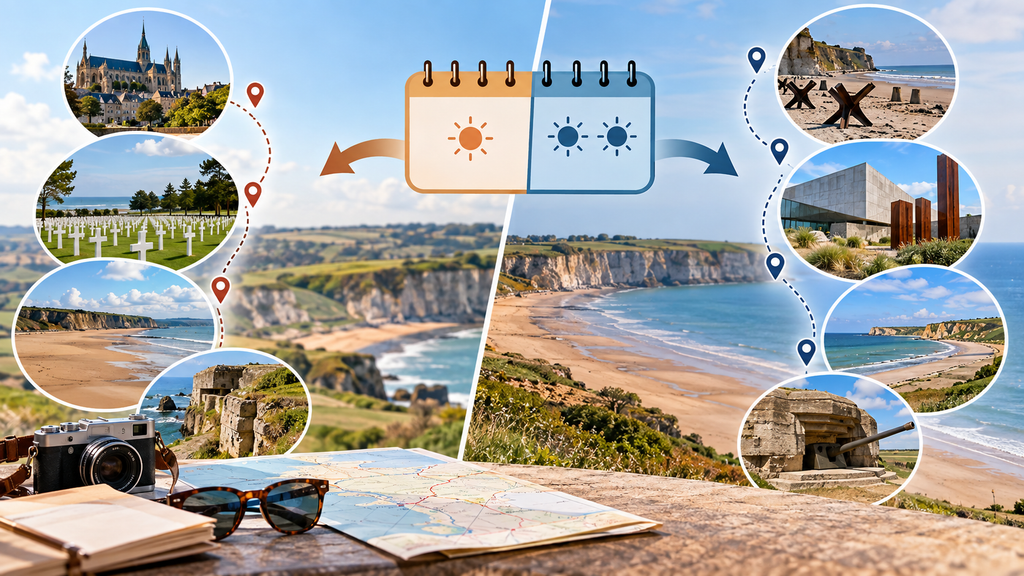
A full day is a reasonable minimum for a focused selection of D-Day sites, while two or more days allow travelers to understand the different sectors in greater depth. The landing area extends for roughly 80 km (50 miles), and Normandy Tourism identifies numerous museums, cemeteries, memorials, and natural landmarks along the route.
Trying to cover every major location in a few hours can turn an important historical visit into a sequence of hurried stops. For example, one day could concentrate on:
Bayeux → Normandy American Cemetery → Omaha Beach → Pointe du Hoc
A second day could then focus on other landing sectors and museums. Travelers without a rental car should research transportation carefully. Normandy Tourism provides car-free options from train stations including Caen, Bayeux, and Carentan, although organized or guided excursions can simplify travel between dispersed historical sites.
Experience Mont-Saint-Michel
Normandy history changes character dramatically at Mont-Saint-Michel, where a medieval abbey rises above a tidal bay.
The fortified village and abbey occupy a rocky islet surrounded by enormous sandbanks and tides. UNESCO describes the Benedictine abbey, built between the 11th and 16th centuries, as an exceptional architectural achievement adapted to an unusually challenging natural setting.
The combination of architecture and landscape is what makes Mont-Saint-Michel so distinctive. From a distance, the abbey appears to rise almost vertically from the bay. Inside the village, narrow streets and stone staircases lead upward toward the abbey.
What Should You Know Before Visiting Mont-Saint-Michel?
Wear comfortable footwear and allow more time than the abbey tour itself requires. Numerous steps lead through the monument, and the Centre des Monuments Nationaux advises visitors to allow around one hour between the parking areas and the abbey entrance.
The monument’s published 2026 opening schedule is:
- May 2 to August 31: 9 a.m. to 7 p.m.
- September 1 to April 30: 9:30 a.m. to 6 p.m.
The abbey is closed on January 1, May 1, and December 25, and schedules can change.
Rather than visiting only the abbey, leave time to see the island from the surrounding landscape. The changing tides and views across the bay are fundamental parts of the experience.
Discover Honfleur and Normandy’s Artistic Side
Not every Normandy itinerary needs to revolve around medieval battles and World War II.
Honfleur shows a very different side of the region with its old harbor, narrow buildings, cobbled streets, art galleries, restaurants, and maritime heritage. The Vieux Bassin, or Old Harbour, forms the visual center of town.
Honfleur also occupies an important place in art history. The changing light around the Seine Estuary attracted painters including Claude Monet, Eugène Boudin, and Gustave Courbet, contributing to the area’s strong association with Impressionism. Visitors can therefore spend part of a Normandy trip moving away from battlefields and medieval monuments to explore the landscapes and coastal light that inspired artists.
Look Beyond Normandy’s Famous Historical Sites
Normandy rewards travelers who leave some space between major attractions. Its coastline stretches for more than 620 km, ranging from broad sandy beaches to white cliffs, pebble shores, dunes, bays, fishing villages, and seaside resorts.
The countryside brings another change of scenery. Orchards, traditional villages, farms, and pastoral landscapes make driving between destinations part of the experience rather than simply transportation.
Travelers interested in regional culture can also look for:
- local apple cider
- Calvados apple brandy
- Camembert and other Norman cheeses
- seafood
- traditional markets
- half-timbered architecture
- coastal walking routes
- Impressionist sites
Honfleur, for example, provides access to both a Cider Route and Cheese Route in the surrounding Pays d’Auge countryside.
When Is the Best Time to Visit Normandy?
Late spring through early autumn generally provides the most convenient conditions for sightseeing in Normandy, but the right time depends on what you want to experience.
Spring
Spring can be a good compromise between weather and visitor numbers. The countryside becomes greener, and major destinations may feel less congested than during peak summer.
Early June
Travelers interested specifically in World War II history may choose early June because annual D-Day commemorations take place around June 6.
However, ceremonies and special events can also affect traffic, parking, accommodation availability, and access to individual sites.
Summer
Summer provides long daylight hours that are particularly useful for road trips and sightseeing. Mont-Saint-Michel and other major attractions can, however, become busy.
Autumn
Early autumn offers another attractive balance, especially for travelers who prefer fewer peak-season crowds.
Winter
Normandy can still be visited in winter, particularly for museums and historical trips, although shorter daylight hours and variable coastal weather require more flexible planning.
For the D-Day beaches specifically, Normandy Tourism notes that the sites can be visited throughout the year and suggests spring, autumn, and winter for travelers seeking quieter conditions.
How Many Days Should You Spend in Normandy?
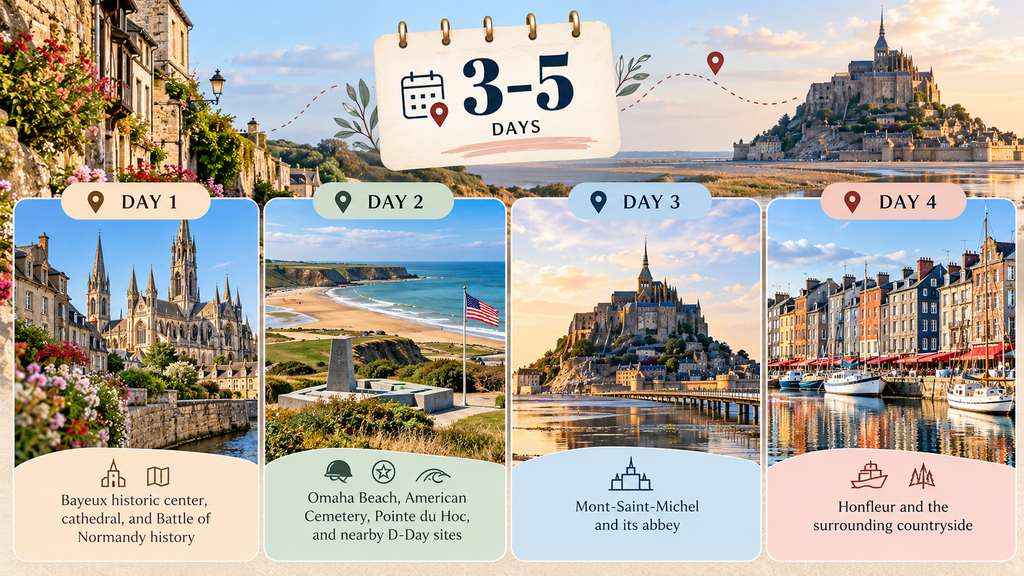
Three to five days is a practical starting point for a first Normandy trip, although history enthusiasts can easily stay longer.
A sample four-day itinerary could look like this:
| Day | Suggested Focus |
| Day 1 | Bayeux historic center, cathedral, and Battle of Normandy history |
| Day 2 | Omaha Beach, American Cemetery, Pointe du Hoc, and nearby D-Day sites |
| Day 3 | Mont-Saint-Michel and its abbey |
| Day 4 | Honfleur and the surrounding countryside |
Travelers particularly interested in World War II should consider adding extra time for Utah, Gold, Juno, and Sword beaches, museums, military cemeteries, and inland battle sites.
Likewise, those interested in art, architecture, and coastal scenery may want additional days for Rouen, Étretat, Deauville, or other parts of Normandy.
Practical Tips for Visiting Normandy
A little preparation can make a major difference when exploring the region. Choose your base carefully: Bayeux is particularly practical for D-Day-focused trips, while other destinations may work better for exploring eastern Normandy.
- Avoid overloading your D-Day itinerary: Select a manageable number of museums, beaches, cemeteries, and memorials rather than attempting to see everything in one day.
- Check attraction information shortly before traveling: Museum closures, commemorations, renovation projects, and seasonal opening times can affect an itinerary.
- Reserve enough time for Mont-Saint-Michel: Getting from the parking area to the abbey takes time, and the stairs make a rushed visit uncomfortable. Pack for changing weather: Coastal conditions can shift quickly, so layers and rain protection are useful even outside winter.
- Treat memorial locations respectfully: Many D-Day attractions are also cemeteries and places of remembrance rather than conventional tourist sights.
Is Normandy Worth Visiting?
Yes, Normandy offers an unusually broad combination of European history, architecture, coastal scenery, art, food, and places of remembrance.
A single journey can connect the events of 1066 and the Bayeux Tapestry with those of June 1944, before moving to the medieval architecture of Mont-Saint-Michel or the artistic heritage of Honfleur. That variety is the region’s greatest strength. Normandy is not simply about checking historic landmarks off a list; understanding how its towns, coastline, monuments, and landscapes connect makes the journey much more rewarding.
Travelers planning a 2026 visit should remember one significant limitation: the original Bayeux Tapestry cannot currently be viewed at its museum because of the renovation closure through 2027. Bayeux itself, however, remains an excellent destination and base for discovering the wider region.
Conclusion
Normandy brings together centuries of history, remarkable architecture, coastal landscapes, and cultural heritage in one region. From walking along the D-Day Landing Beaches and learning about the events of June 1944 to exploring medieval Bayeux and visiting the spectacular Mont-Saint-Michel, travelers can experience many different sides of northern France. Honfleur, the countryside, regional cuisine, and Normandy’s artistic heritage add even more variety to the journey.
For a first visit, spending at least three to five days gives you enough time to experience several major attractions without rushing. Travelers visiting in 2026 should also remember that the Bayeux Tapestry Museum is temporarily closed, with reopening planned for October 2027. Even with this closure, Bayeux remains a worthwhile base for discovering Normandy’s historic sites and D-Day coastline.
Frequently Asked Questions
The five principal D-Day landing sectors—Utah, Omaha, Gold, Juno, and Sword—stretch along the Normandy coast in northern France. Pointe du Hoc is another major D-Day location between Utah and Omaha.
Bayeux is one of the most practical bases because it is close to the landing beaches and has accommodation, restaurants, historic attractions, and transportation connections.
It is physically possible to drive past multiple sectors in one day, but doing so leaves limited time for museums, cemeteries, memorials, and historical interpretation. One or two selected sectors generally make for a more meaningful day trip.
No. The Bayeux Tapestry Museum is closed for renovation. Its official visitor information currently lists October 2027 as the planned reopening.
Technically, no. It is an embroidery made by stitching colored threads onto linen rather than creating the images through weaving. UNESCO records the work at 68.80 meters long.
No. In addition to its D-Day heritage, Normandy offers medieval architecture, Mont-Saint-Michel, historic towns, Impressionist connections, beaches, countryside, regional cuisine, cider, cheese, and seaside destinations.
Not necessarily, but a car can make it easier to connect dispersed countryside and D-Day locations. Bayeux and other major towns can be reached by train, and guided tours or other transportation options can be used for selected attractions.