
Qantas to Launch Sydney-New York Nonstop Flights in 2028
Qantas has confirmed that its first nonstop Sydney–New York service will launch in mid-2028, giving travelers the option to fly between Australia’s east coast and New York without a stop. Qantas will operate the route on a specially configured Airbus A350-1000ULR as part of Project Sunrise, and it is expected to take around 18 hours.
The announcement marks the second confirmed route for Project Sunrise, following Qantas’ Sydney–London service, scheduled to begin in October 2027. Tickets for the new Sydney–New York service are expected to go on sale from August 2027, although the exact inaugural date, schedule, and fares have not yet been announced.
For travelers, the significance goes beyond eliminating a connection. Qantas is building an aircraft and onboard environment designed for journeys lasting 18 to 22 hours, with a low-density four-cabin layout, a dedicated Wellbeing Zone, and additional fuel capacity for ultra-long-haul operations.
What Is Project Sunrise?
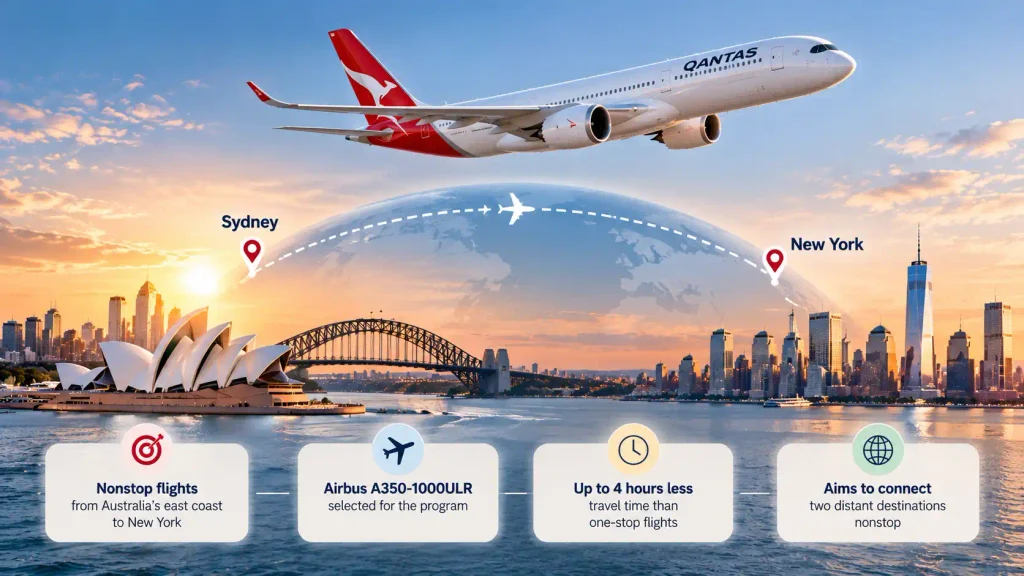
Project Sunrise is Qantas’ program to operate nonstop flights from Australia’s east coast to destinations that have traditionally required a stopover. The airline originally announced the project in 2017, identifying London and New York as its initial targets. Qantas subsequently selected the Airbus A350-1000ULR and ordered 12 aircraft for the program in May 2022.
The concept addresses one of the biggest challenges facing Australian aviation: geography. Sydney is thousands of miles from Europe and the eastern United States, making connecting itineraries the norm for decades.
Project Sunrise changes that model by combining an ultra-long-range aircraft with a cabin designed specifically for extended time in the air. Qantas says the nonstop services can reduce point-to-point travel time by up to four hours compared with one-stop alternatives, depending on the route and connection.
The name also has historical roots. During World War II, Qantas operated extremely long nonstop Catalina flying-boat services between Western Australia and Sri Lanka. Those flights lasted roughly 33 hours, and crews and passengers sometimes saw the sun rise twice, inspiring the modern Project Sunrise name.
Related: First Look: Qantas’ New Business Class Suites Unveiled
When Will Qantas Start Flying Nonstop From Sydney to New York?
Qantas plans to begin Sydney–New York nonstop flights in mid-2028. The airline has not yet published the precise inaugural flight date or a complete operating schedule.
The current Project Sunrise timeline is:
| Milestone | Expected timing |
| First Project Sunrise A350 delivery | April 2027 |
| Sydney–London nonstop launch | October 2027 |
| Sydney–New York tickets on sale | August 2027 |
| Sydney–New York nonstop launch | Mid-2028 |
| Project Sunrise fleet | 12 Airbus A350-1000ULRs |
The dates remain subject to the necessary aircraft certification and regulatory approvals. Qantas and Airbus have already passed key testing milestones, but certification is still required before commercial operations can begin.
How Long Will the Sydney–New York Flight Take?
The nonstop Sydney–New York flight is expected to take around 18 hours, according to Qantas. The airline says the service will cut more than three hours from the fastest current travel time between the two cities.
The advantage isn’t just the time spent in the air. A one-stop itinerary requires passengers to land, leave or remain in the connecting airport, wait for the next flight, and then board again. A nonstop service removes that interruption.
For example, a traveler currently connecting through another city could spend several hours between flights even when the actual flying time is relatively efficient. Project Sunrise is designed to replace that stop with one continuous journey.
Qantas describes the Sydney–New York route as roughly 9,942 miles (16,000 kilometers). The exact flight time will naturally vary because of winds, routing, weather, air traffic, and operational conditions.
Is Sydney–New York the Longest Flight in the World?
It will be one of the world’s longest commercial passenger flights. Qantas designed the Project Sunrise A350 specifically for sectors lasting up to about 22 hours, while the Sydney–New York service is expected to run for around 18 hours.
The distinction matters because the aircraft has substantially more range than the scheduled flight requires under normal operating conditions. That additional capability provides operational flexibility for long-distance flying rather than meaning every Sydney–New York flight will spend 22 hours airborne.
Which Aircraft Will Fly Sydney to New York?
Qantas will use the Airbus A350-1000ULR, an ultra-long-range version of Airbus’ A350-1000 developed for the airline’s Project Sunrise operation. Qantas has ordered 12 aircraft for the program.
The aircraft has been modified for exceptionally long missions. One of its most important changes is an additional 20,000-liter rear-center fuel tank, which helps provide the range needed for flights of up to 22 hours. Airbus began certification testing of the A350-1000ULR in 2026.
The first production aircraft assigned to the certification campaign completed its maiden flight in June 2026. Airbus said the aircraft would undergo an extensive testing and certification program before entering commercial service.
Read This Blog: How To Get Between Washington, DC & New York?
Qantas A350-1000ULR at a Glance
| Feature | Project Sunrise A350-1000ULR |
| Aircraft | Airbus A350-1000ULR |
| Qantas aircraft ordered | 12 |
| Total seats | 238 |
| First Class | 6 suites |
| Business Class | 52 suites |
| Premium Economy | 40 seats |
| Economy | 140 seats |
| Maximum nonstop capability | Up to 22 hours |
| Additional fuel | 20,000-liter rear-center tank |
| Engines | Rolls-Royce Trent XWB-97 |
| Cruise speed | Mach 0.85 |
The 238-seat configuration is deliberately low-density for an aircraft of this size. Rather than maximizing passenger numbers, Qantas has allocated more space to premium cabins and passenger comfort.
What Will the Qantas Project Sunrise Cabin Be Like?
The Project Sunrise A350 will have four cabins: First, Business, Premium Economy, and Economy. The aircraft’s relatively small passenger count is one of its defining characteristics.
The configuration includes:
- 6 First Class suites
- 52 Business Class suites
- 40 Premium Economy seats
- 140 Economy seats
Qantas has worked with the University of Sydney’s Charles Perkins Center, along with designers and food specialists, to develop the cabin around passenger comfort and wellbeing during ultra-long-haul flights.
First Class
The six First suites will be arranged in a 1-1-1 configuration. Each suite features a separate reclining armchair and a full-length bed, giving passengers a more private environment for sleeping and working during the lengthy flight.
Business Class
The 52 Business suites will use a 1-2-1 configuration, allowing direct aisle access. Each suite features a sliding door for added privacy.
For a journey approaching 18 hours, that distinction is significant. A passenger can work, dine, relax, and sleep without sharing the open seating environment found on many conventional long-haul aircraft.
Premium Economy
The aircraft will feature 40 Premium Economy seats in a 2-4-2 configuration. Qantas has also developed a new Premium Economy seat for its next-generation long-haul aircraft, aiming to give passengers more space and comfort on extended journeys.
Economy
Economy will account for 140 seats in a 3-3-3 configuration. Although it remains the largest cabin, the relatively low total aircraft capacity means the A350 is not configured like a high-density long-haul jet.
What Is the Project Sunrise Wellbeing Zone?
One of the most distinctive features of the Qantas A350 is its Wellbeing Zone, located between the Premium Economy and Economy cabins. It is intended to give passengers a place to leave their seats, move around, hydrate, and access refreshments during the flight.
The space includes:
- Stretch handles integrated into the design
- Guided movement content
- A hydration station
- Premium refreshments
- Dedicated space away from the passenger seats
That feature is particularly relevant on Sydney–New York because spending 18 hours in the air creates different comfort challenges from a conventional 10- to 14-hour international flight.
Qantas has worked with the Charles Perkins Center on cabin design, lighting, sleep, movement, and other elements intended to support passenger wellbeing. The objective is not simply to make the aircraft feel luxurious; it is to make a very long flight more manageable.
Will Passengers Get Wi-Fi on the Sydney–New York Flight?

Qantas has said that passengers across all four cabins will have access to complimentary high-speed Wi-Fi, while Bluetooth audio connectivity will also be available.
That could be particularly valuable on Project Sunrise flights because passengers may want to break up an 18-hour journey with different activities rather than sleep for most of the flight.
For example, a traveler might use the first part of the flight for work, take a meal break, watch entertainment, visit the Wellbeing Zone, and then sleep longer before arrival. As with any future aircraft product, specific onboard services may change before commercial launch.
How Much Will Qantas Sydney–New York Tickets Cost?
Qantas has not yet announced the fares for the nonstop Sydney–New York Project Sunrise service. Tickets are scheduled to go on sale from August 2027, so travelers will need to wait for the route to enter the booking system before official pricing becomes available.
Project Sunrise fares are likely to carry a premium. Qantas has previously indicated that nonstop ultra-long-haul services can command higher fares than comparable one-stop itineraries, reflecting the value of saving a connection and the economics of operating a specialized aircraft.
However, a specific percentage or dollar amount should not be treated as the future Sydney–New York fare until Qantas publishes it.
Several factors will affect the eventual price:
- Cabin class
- Travel dates
- Demand
- Fare flexibility
- Booking timing
- Availability
- Frequent-flyer award inventory
- Taxes and carrier charges
Travelers should therefore compare the complete itinerary rather than looking only at the headline fare.
Can Travelers Use Qantas Points for Project Sunrise?
Potentially, but the exact Project Sunrise award pricing and availability for 2028 should not be assumed yet.
Qantas currently publishes distance-based Classic Flight Reward tables. Under its current table, journeys in the 9,601- to 15,000-mile zone require 63,500 Qantas Points in Economy, 124,700 in Premium Economy, 166,300 in Business, and 249,400 in First for a one-way Qantas Classic Flight Reward. Taxes, fees, and carrier charges are additional.
Sydney–New York falls within the enormous distance range covered by that zone, but travelers should not assume those numbers will automatically apply to Project Sunrise in 2028. Qantas can change award tables and terms, and reward availability is capacity-controlled.
Qantas also states that Classic Flight Reward availability is limited and that the points and associated charges are subject to change.
For points travelers, the most practical strategy is to monitor the route when reservations open rather than transferring or spending points based on an unconfirmed future award price.
How Does Project Sunrise Compare With Current Sydney–New York Options?
At present, travelers between Sydney and New York generally need to use a connecting itinerary. Qantas itself already operates a nonstop Auckland–New York service, giving the airline experience with extremely long flights into the New York market.
Project Sunrise changes the equation by eliminating the need to position through another city.
| Travel option | Connection | Main advantage |
| Qantas Project Sunrise | None | Fastest point-to-point journey |
| Current one-stop itineraries | Yes | More established schedules and potentially lower fares |
| Qantas Auckland–New York option | Requires travel to Auckland first | Existing Qantas nonstop U.S. service |
For travelers already in Australia, the nonstop Sydney–New York service should be particularly attractive because it removes the need to coordinate a separate connecting flight.
The trade-off is likely to be price. A nonstop service on a specially configured A350 with a high premium-cabin proportion will have a different cost structure from a conventional connecting itinerary.
Why Is the Sydney–New York Route Important for Qantas?
Project Sunrise is more than a single new route. Qantas sees ultra-long-haul flying as a major part of its future international network.
The airline’s 2026 investor materials say the 12 Project Sunrise aircraft are expected to support Sydney–London and Sydney–New York services while contributing to network growth and an estimated A$400 million in annual EBIT uplift at scale.
The aircraft also give Qantas more flexibility to redeploy other widebody aircraft elsewhere in the network. The airline has described Project Sunrise as involving three main value areas: new nonstop flying, network optimization, and additional freight capacity.
That means the A350S’s impact could extend beyond the two headline routes.
Could Qantas Add More Project Sunrise Routes?
Potentially, but Sydney–London and Sydney–New York are the only Project Sunrise destinations currently confirmed.
Qantas has repeatedly described the A350-1000ULR as capable of opening more nonstop routes from Australia’s east coast. However, the airline has not confirmed additional Project Sunrise destinations yet.
That distinction matters. The aircraft’s range makes many city pairs technically interesting, but a commercially viable route also requires sufficient demand, appropriate airport access, regulatory approval, aircraft availability, and acceptable operating economics.
For now, travelers can treat London and New York as the confirmed Project Sunrise network rather than assuming other destinations will launch at the same time.
How Project Sunrise Changes Travel Between Australia and the U.S.
The Sydney–New York service could influence more than passengers traveling between those two cities.
New York is a major gateway for the U.S. Northeast and an important destination for business, leisure, and connecting traffic. A nonstop Sydney service therefore creates a new option for travelers who previously had to build a connection into their itinerary.
It also reinforces Qantas’ strategy of using long-range aircraft to connect Australia directly with major international markets.
The airline’s broader fleet-renewal program includes the Boeing 787-9 and 787-10, Airbus A321XLR, Airbus A220, and additional A350 variants. The Project Sunrise A350-1000ULR is the specialist aircraft within that broader strategy, intended for the most demanding ultra-long-haul routes.
What Travelers Should Watch Before Booking
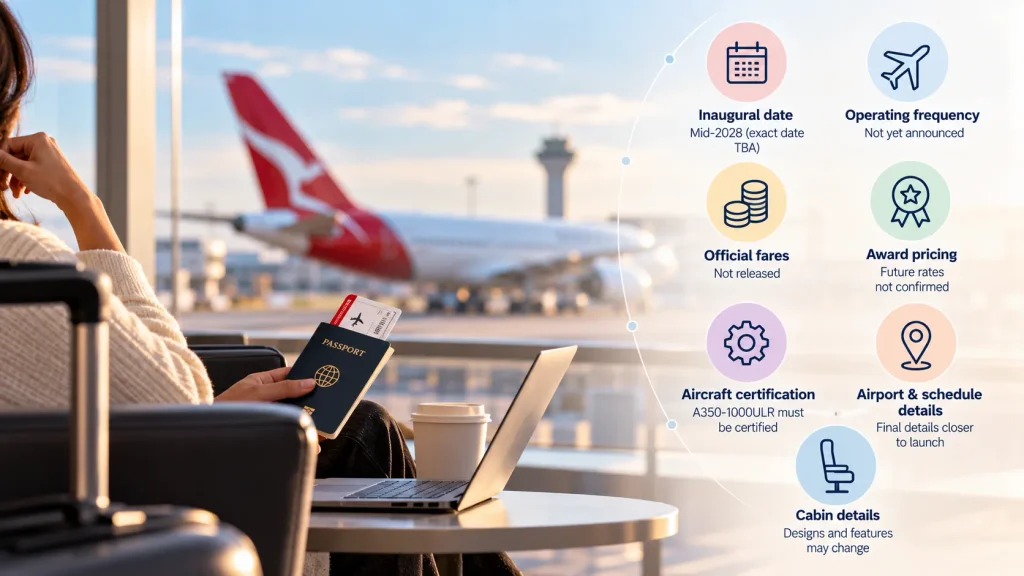
Because Sydney–New York flights will not open for sale until August 2027, several important details remain outstanding.
Travelers should watch for announcements covering:
- Exact inaugural flight date — Qantas has only confirmed mid-2028.
- Operating frequency — the airline has not yet published the final frequency for Sydney–New York.
- Official fares — cash pricing has not been released.
- Award pricing — future Project Sunrise redemption rates should not be assumed from today’s tables.
- Aircraft certification — the A350-1000ULR must complete the required certification process.
- Airport and schedule details — the final operating pattern will become clearer closer to launch.
- Cabin details — Qantas notes that A350 designs and features can be subject to change.
This is particularly important for travelers planning well in advance. Evaluate a 2028 itinerary using the fare rules, schedule, aircraft assignment, and award availability shown when you make the booking.
Final Takeaway
Qantas’ planned mid-2028 Sydney–New York nonstop service will be one of the most ambitious additions to the airline’s international network, bringing the second major Project Sunrise route after Sydney–London. The roughly 18-hour journey will use the specially configured A350-1000ULR, with only 238 passengers, four cabin classes, and a dedicated Wellbeing Zone designed around ultra-long-haul travel.
The greatest details still to come are the inaugural date, operating frequency, cash fares, and award availability. Travelers interested in experiencing the route should mark August 2027 as the key date for ticket sales and monitor Qantas’ official announcements before making plans.
Frequently Asked Questions
Qantas plans to launch nonstop Sydney–New York flights in mid-2028 as the second confirmed Project Sunrise route. Qantas has not yet announced the exact inaugural date.
Qantas says tickets for the new nonstop service will go on sale from August 2027.
The nonstop service is expected to take around 18 hours, although actual flight time will vary with winds, routing, weather, and operational conditions.
The route will use the specially configured Airbus A350-1000ULR, an ultra-long-range aircraft designed for Qantas’ Project Sunrise operation.
The aircraft is planned to have 238 seats: six First suites, 52 Business suites, 40 Premium Economy seats, and 140 Economy seats.
Yes. The Project Sunrise A350 features six First Class suites in a 1-1-1 configuration.
Yes. The Project Sunrise A350 includes a dedicated Wellbeing Zone between Premium Economy and Economy, with space for movement, hydration, and refreshments.
Yes. Qantas has confirmed the route as a nonstop Project Sunrise service, although it has yet to publish the final schedule.
No. Future Project Sunrise award pricing has not been published. Current Qantas Classic Flight Reward rates provide a useful reference point but should not be treated as guaranteed 2028 pricing.