
Norse Atlantic Cancels Most U.S. Routes: What to Know
Norse Atlantic Airways is reducing its scheduled U.S. network to one route starting October 25, 2026, when it removes New York–London and New York–Rome services from its winter schedule, leaving Orlando–London Gatwick as its only scheduled transatlantic U.S. route.
The change marks another major step in Norse Atlantic’s shift away from a broad U.S.-Europe network and toward a more focused business model built around selected leisure routes, ACMI flying, and charter operations. For travelers, it means fewer opportunities to use Norse for inexpensive nonstop trips between the U.S. and Europe—particularly from New York.
What Is Happening to Norse Atlantic’s U.S. Routes?
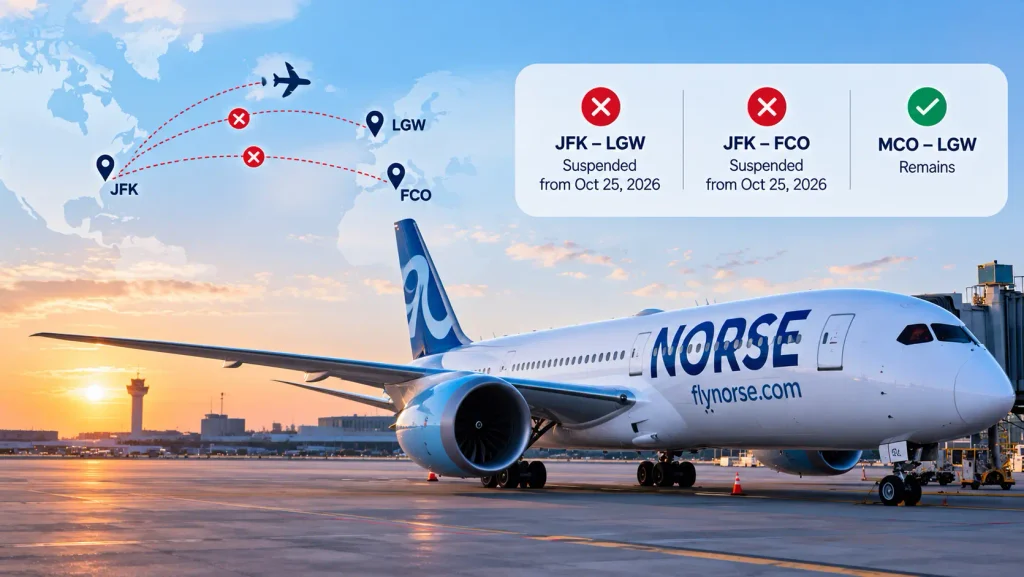
Norse Atlantic is removing its planned winter 2026-27 services between New York John F. Kennedy International Airport (JFK) and both London Gatwick Airport (LGW) and Rome Fiumicino Airport (FCO).
The changes take effect October 25, 2026, at the beginning of the carrier’s winter schedule. AeroRoutes reported that both JFK-LGW and JFK-FCO were scheduled to operate through the end of the summer season but have now been removed for winter. Each route was planned for up to three flights per week using Boeing 787-9 aircraft.
That leaves Orlando International Airport (MCO) to London Gatwick as Norse Atlantic’s only scheduled U.S. route during the winter 2026-27 season.
Norse Atlantic U.S. Network: Before and After
| Route | Status for winter 2026-27 | Key airport |
| New York JFK – London Gatwick | Suspended from October 25 | JFK |
| New York JFK – Rome Fiumicino | Suspended from October 25 | JFK |
| Orlando – London Gatwick | Remains | MCO |
| Los Angeles – Norse destinations | Previously withdrawn | LAX |
The wording matters: the New York routes are being suspended from the winter schedule, rather than necessarily being permanently abandoned. AeroRoutes lists the suspension period as October 25, 2026, through March 27, 2027.
That distinction is impo’rtant for travelers planning beyond winter 2026-27 because airline schedules can change again.
Which U.S. Route Will Norse Atlantic Keep?
The remaining route is Orlando International (MCO) to London Gatwick (LGW), operated by Norse Atlantic UK.
The route has particular strategic value because Orlando is one of the world’s major leisure destinations, with substantial demand for travel between Florida and the United Kingdom. Gatwick also has a strong leisure-oriented long-haul network, making the city pair more closely aligned with Norse’s current strategy than some of its previous U.S. routes.
The Orlando-London service operates with the Boeing 787-9 Dreamliner. Current schedule data shows the route continuing beyond October 25, although the frequency changes compared with the summer schedule.
For example, Norse’s schedule shows daily MCO-LGW service through October 23, with a reduced pattern beginning later in the month. The exact operating days and departure times can vary by date, so travelers should check the airline’s booking system before making plans.
Orlando-London Route at a Glance
| Detail | Information |
| U.S. airport | Orlando International Airport (MCO) |
| U.K. airport | London Gatwick Airport (LGW) |
| Airline | Norse Atlantic UK |
| Aircraft | Boeing 787-9 |
| Approx. distance | 4,368 miles / 7,028 km |
| Flight time | Roughly 8–10 hours, depending on direction and schedule |
| Winter status | Scheduled to continue |
Independent schedule data puts the route distance at about 4,368 miles and lists the Boeing 787-9 as the aircraft type used by Norse Atlantic UK.
What Happens to the New York-London Route?
The New York-JFK to London-Gatwick route will continue through the closing weeks of the summer schedule but is removed from the winter timetable beginning October 25.
This is significant because the route was one of Norse Atlantic’s most visible U.S.-Europe offerings. It connected two major cities without requiring travelers to use a traditional hub-and-spoke connection.
According to OAG schedule data cited by Aviation Week, the two New York routes—JFK-LGW and JFK-FCO—had represented approximately 41,600 two-way seats in the planned winter 2026-27 schedule. Each had been scheduled for as many as three weekly flights.
The withdrawal therefore represents more than simply removing a couple of flight numbers. It substantially reduces Norse’s exposure to one of the world’s most competitive transatlantic markets.
What About New York-Rome?
Norse Atlantic’s New York JFK-Rome Fiumicino service is also being removed from the winter schedule.
Like the London service, the route was scheduled to operate with Boeing 787-9 aircraft and is suspended from October 25 through the end of the winter scheduling period identified by AeroRoutes.
For travelers, the immediate effect is straightforward: passengers looking for a Norse nonstop between New York and Rome during the winter will need to consider other airlines or connecting itineraries.
The route’s withdrawal also illustrates how Norse is concentrating its limited scheduled capacity rather than trying to maintain a large network across multiple European gateways.
Norse Already Left Los Angeles
The reduction in the U.S. network did not begin with New York. In April 2026, Norse Atlantic cut its Los Angeles operations amid a sharp increase in jet-fuel costs. Bloomberg reported that the airline halted all flights to and from Los Angeles, eliminating 12 weekly departures and arrivals at the time.
AeroRoutes subsequently reported that Norse closed reservations for several Los Angeles services, including London Gatwick-Los Angeles, Paris-Los Angeles, and Rome-Los Angeles.
That earlier decision is important context for the current changes. Norse’s U.S. footprint has not disappeared suddenly; it has been progressively reduced as the airline has reassessed where its aircraft can generate stronger returns.
Why Is Norse Atlantic Shrinking Its U.S. Network?
There is no single factor that fully explains the changes, but Norse’s own financial reporting provides useful context.
The airline has been moving toward a dual business model, with roughly half of its fleet involved in ACMI and charter operations and the remainder used on a more focused scheduled network. Norse said this model reduces exposure to fuel-price volatility and provides more stable earnings.
ACMI stands for aircraft, crew, maintenance, and insurance. Under an ACMI arrangement, an airline supplies an aircraft and the operational resources needed to fly it for another carrier. This can give an airline like Norse a steadier source of revenue than relying entirely on selling individual passenger tickets.
Norse’s Q1 2026 report said its own network was being adjusted through “route high-grading”—essentially directing capacity toward markets with better demand and revenue potential. The company also said growing demand for Europe-to-Asia travel could shift capacity away from the transatlantic market.
The airline’s Q4 2025 report had already indicated that future capacity could move from transatlantic flying toward destinations with stronger growth and less competition, particularly in Southeast Asia.
That strategy helps explain why Norse is not simply abandoning long-haul flying. Instead, it is becoming more selective about where it deploys its aircraft.
Why the Low-Cost Transatlantic Model Is Difficult
Norse Atlantic was created to offer relatively affordable long-haul flying using Boeing 787 Dreamliners. The basic proposition was attractive: use efficient widebody aircraft to connect cities directly while keeping fares competitive.
The problem is that transatlantic aviation is an unusually competitive market.
Travelers can choose among large network airlines, joint ventures, established low-cost carriers, and connecting itineraries. On major city pairs such as New York-London, the competition is especially intense.
Norse could sometimes advertise a lower headline fare, but the total cost could become less compelling once passengers added optional services such as checked baggage and seat selection. The reference analysis noted that Norse fares could be more than $100 below some legacy competitors before extras.
This distinction is central to understanding the low-cost long-haul model.
A traveler comparing two tickets might see:
- Norse: lower base fare, with selected services charged separately
- Traditional carrier: higher initial fare, potentially including more baggage or onboard services
- Low-cost competitor: similarly unbundled pricing, but potentially from a different airport or on a different schedule
The cheapest advertised fare is therefore not always the cheapest overall trip.
Norse’s Boeing 787 Fleet Is Still Important
The network cuts do not mean Norse is abandoning its Boeing 787 fleet. Norse has a fleet of 12 Boeing 787-9 Dreamliners, according to its corporate reporting. The company has emphasized the aircraft’s fuel efficiency and operational flexibility as important parts of its business model.
The airline has also highlighted the 787’s ability to support long-haul flying while maintaining a comparatively efficient cost structure.
Norse’s corporate materials say the aircraft have approximately 25% lower fuel consumption than other long-haul aircraft, although the actual economics of any route depend on factors such as fuel prices, load factors, aircraft utilization, airport costs, and ticket revenue. The aircraft therefore remains an asset even as the airline changes where it flies.
Where Is Norse Atlantic Focusing Its Network?
With fewer U.S. routes, Norse is increasingly emphasizing markets that fit its leisure-focused strategy.
The carrier’s network has included destinations in Norway, Sweden, and the U.K., along with long-haul leisure markets such as:
- Bangkok
- Phuket
- Cape Town
- London
- Oslo
- Stockholm
Norse’s corporate reporting has specifically pointed to strong demand for Europe-to-Thailand travel and the potential to shift capacity toward Southeast Asia.
This approach is different from trying to build a large network around major U.S. business markets.
For example, New York-London has a large pool of corporate and leisure travelers, but it also has intense competition. A leisure-focused route to a destination where nonstop alternatives are less numerous can offer a different commercial proposition.
What Does This Mean for Travelers?

For most U.S. travelers, the biggest impact is the loss of another low-cost option for transatlantic travel.
Passengers who were planning to use Norse from New York should pay particular attention to the date of travel. A booking that works during the summer 2026 schedule may no longer be available after October 25.
Travelers should also distinguish between Norse’s route availability and its overall business operations. The airline is not disappearing from the U.S. completely. Orlando-London remains scheduled, while the company continues to operate international routes and ACMI and charter services.
Travelers With Existing Reservations
Anyone holding a Norse reservation on an affected route should check the airline’s latest booking information and communications rather than relying on an older itinerary or third-party schedule.
This is particularly important because the current changes concern the winter 2026-27 schedule. Airlines can revise, reinstate, or adjust schedules as demand and fleet requirements change.
Travelers should confirm:
- The exact flight date.
- Whether the flight remains ticketed and scheduled.
- The operating carrier.
- Departure and arrival airports.
- Any rebooking or refund options provided by the airline.
For future travel, checking the airline’s current timetable immediately before booking is more reliable than assuming a summer route will operate through winter.
Is Norse Atlantic Still a Low-Cost Airline?
Yes, Norse Atlantic continues to position itself around affordable long-haul travel, but its business model is broader than simply selling cheap transatlantic tickets.
The company now combines its own scheduled network with ACMI and charter flying, which gives it another way to monetize its Boeing 787 fleet.
Norse’s corporate website describes the airline as a provider of direct long-haul flights, while its ACMI operation makes its Dreamliners available to other aviation companies. The airline says its ACMI and charter capacity includes 338 seats, with 56 in Premium and 282 in Economy.
That diversification is one of the most important developments in understanding Norse in 2026.
Instead of depending entirely on passengers booking individual transatlantic journeys, the airline can use aircraft on contracted operations when that produces a more attractive financial result.
Check Out This Blog: 29K-Point Virgin Atlantic Upper Class Awards to the U.K.
Does This Mean Cheap Transatlantic Flights Are Disappearing?
Not necessarily. Norse’s retreat from New York does reduce one source of low-fare competition, but it does not mean affordable transatlantic tickets have disappeared.
Major airlines continue to compete aggressively on Europe-U.S. routes, while other low-cost or value-focused carriers remain active. The market also changes considerably by season.
Norse’s experience shows why the economics are challenging: a low-cost airline must balance fuel, aircraft leases, airport charges, labor, maintenance, distribution, and ancillary revenue against fares customers are willing to pay.
A low headline fare alone cannot make a route profitable. The airline’s strategy therefore appears to be moving toward markets where it believes it can generate stronger revenue or operate under more favorable commercial arrangements.
How Norse’s U.S. Network Has Changed
The progression is easier to understand when viewed chronologically.
| Period | Major development |
| 2022 | Norse begins commercial operations and builds a transatlantic network |
| 2023–25 | U.S.-Europe network expands across several cities and European gateways |
| April 2026 | Los Angeles services are cut amid higher fuel costs |
| Summer 2026 | New York remains an important U.S. market |
| October 25, 2026 | JFK-LGW and JFK-FCO are removed from the winter schedule |
| Winter 2026-27 | Orlando-London Gatwick remains Norse’s only scheduled U.S. route |
Norse itself reported that its commercial operations began in June 2022 and that it had carried more than 4 million passengers by summer 2025.
The speed of the network transformation is therefore notable. An airline that initially built its identity around long-haul transatlantic expansion is now pursuing a considerably more selective route strategy.
What Should Travelers Expect Next?
The biggest question is whether the New York routes will return after winter 2026-27. For now, travelers should not assume they will. The published schedule change establishes a suspension through the winter period, but future schedules can change based on demand, aircraft availability, airport slots, fuel prices, and the airline’s financial strategy.
Norse’s own corporate materials emphasize flexibility and the ability to adjust scheduled flying, ACMI, and charter operations in response to market conditions.
That makes future route decisions difficult to predict with certainty. The airline’s focus on leisure-heavy routes and international destinations outside the U.S. suggests that any future expansion will likely be evaluated against those priorities rather than simply returning to the previous network.
What Does the Norse Atlantic Cut Mean for the U.S. Aviation Market?
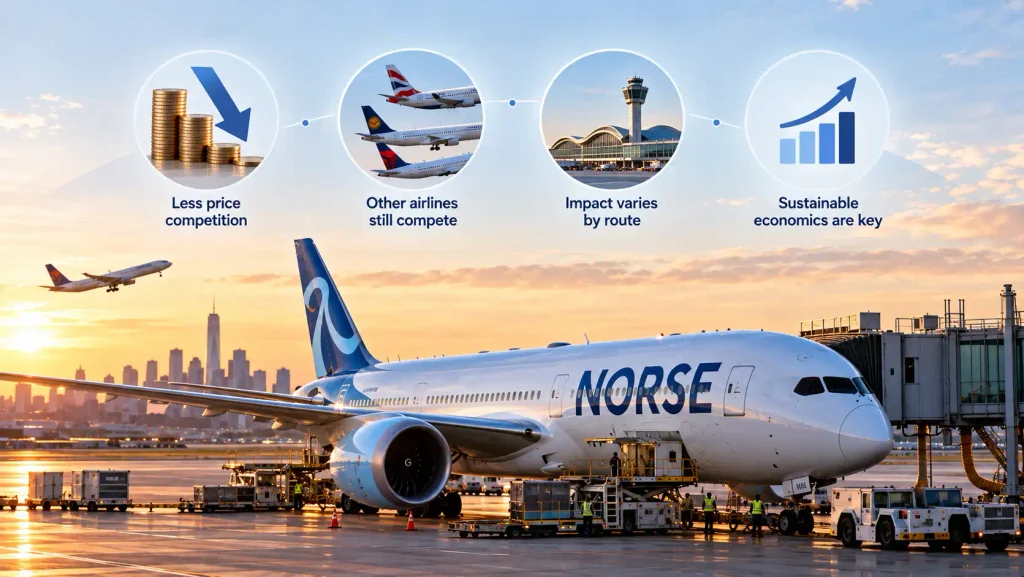
Norse Atlantic’s retreat is significant beyond the airline itself because low-cost long-haul carriers can put downward pressure on fares when they enter highly competitive markets.
When a carrier removes capacity, competitors have one less source of price competition. However, the effect on travelers depends heavily on the route.
For New York-London, the market remains large and highly competitive, so Norse’s disappearance does not eliminate nonstop choices. Travelers can still compare multiple airlines and airport combinations.
For other city pairs, the effect could be more noticeable if Norse was one of only a few nonstop operators.
The bigger lesson is that low-cost long-haul aviation requires more than inexpensive aircraft and low advertised fares. An airline needs sufficient demand, efficient aircraft utilization, competitive airport costs, and enough ancillary revenue to make the economics work.
Read This Blog: U.S. Bank Altitude Reserve Card
Final Takeaway
Norse Atlantic’s decision to reduce its winter U.S. network to a single scheduled route is a major shift for the low-cost transatlantic carrier. From October 25, 2026, New York-JFK loses its Norse services to London Gatwick and Rome, while Orlando-London remains on the schedule.
For travelers, the practical takeaway is to treat Norse’s network as a more selective leisure operation rather than the broad U.S.-Europe challenger it initially aimed to be. Anyone planning a trip on an affected route should verify the latest schedule directly with the airline, particularly for travel after October 25.
Frequently Asked Questions
No. From October 25, 2026, Norse Atlantic is scheduled to retain Orlando (MCO)-London Gatwick (LGW) as its only scheduled U.S. route for the winter 2026-27 season.
The affected routes are New York JFK-London Gatwick and New York JFK-Rome Fiumicino. The winter suspension begins October 25, 2026.
Norse’s New York services continue through the end of the summer 2026 schedule, but the airline has removed JFK-LGW and JFK-FCO from its winter 2026-27 schedule.
The remaining scheduled U.S. route is Orlando International Airport to London Gatwick Airport.
Norse is restructuring its business around a more focused scheduled network while expanding ACMI and charter operations. Its financial reports also point to route optimization, fuel costs, and stronger demand in markets such as Europe-to-Asia travel as factors shaping capacity decisions.
Yes. Norse cut its Los Angeles operations in April 2026. Bloomberg reported that the airline cited sharply higher jet-fuel costs as a major factor in the decision.
Yes. Norse operates a fleet of 12 Boeing 787-9 Dreamliners, which remain central to its scheduled, ACMI, and charter operations.
It is too early to say. The current change removes the New York routes from the winter 2026-27 schedule, but airlines can revise future schedules as demand and operating conditions change.