
Can the Right Backpack Save You From Low-Cost Carrier Bag Fees?
A compact, soft-sided backpack that fits beneath an airplane seat is one of the most practical ways to avoid baggage fees on low-cost airlines. The right bag allows travelers to carry clothing, electronics, toiletries, and travel essentials without purchasing a separate overhead cabin bag, provided it meets the airline’s personal-item restrictions.
Low-cost carriers often advertise attractive base fares, but baggage allowances can be considerably more restrictive than travelers expect. A ticket may include only one small personal item, while a conventional cabin suitcase requires an additional purchase.
That makes backpack selection particularly important. The ideal bag is not necessarily the largest or most expensive. It is one that balances airline-approved dimensions, usable storage space, comfortable straps, and practical organization.
This guide examines the backpack features worth prioritizing, how personal-item rules differ between airlines, and how travelers can pack efficiently without paying unnecessary baggage charges.
Read the Full Guide: How Much Does It Cost to Check a Bag on a Flight?
Why Can the Right Backpack Help Travelers Avoid Baggage Fees?
A properly sized backpack can help travelers avoid baggage fees because many low-cost airlines include one small personal item in their lowest fares.
Unlike a larger carry-on suitcase, a personal item is intended to fit beneath the seat in front of the passenger. Airlines may use baggage sizers or check dimensions at the gate to determine whether a bag qualifies.
The distinction matters because a backpack is not automatically considered a personal item. A large hiking backpack, for example, may exceed the permitted dimensions even if it has shoulder straps.
A smaller travel backpack, however, can offer enough space for a short trip while remaining within the airline’s free baggage allowance.
The most effective strategy is to select a bag based on the strictest personal-item limit among the airlines a traveler regularly uses.
Which Backpack Is Featured for Avoiding Low-Cost Carrier Baggage Fees?
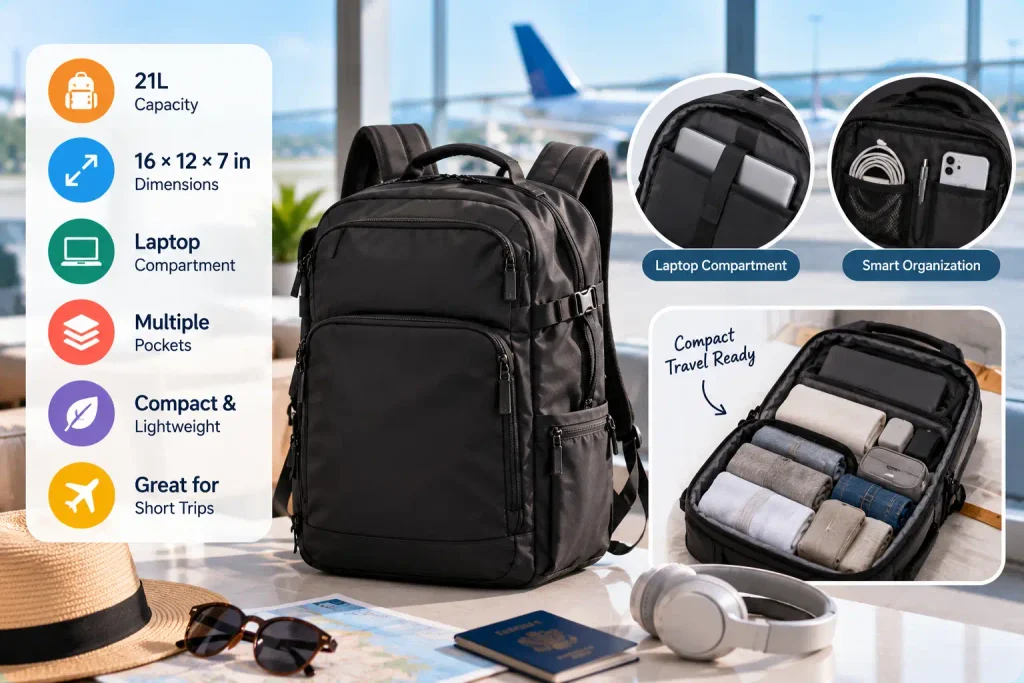
The backpack featured in the reference article is the Rangeland New Business Trip Backpack, a 21-liter daypack designed for compact travel, commuting, and carrying everyday essentials.
The original article identifies this model as an alternative to a much larger 55-liter Osprey backpack, which would exceed typical low-cost carrier personal-item limits. The Rangeland bag was reported to cost approximately $40 at the time of that article, but this is a historical price rather than a verified current offer.
What Are the Main Features of the Rangeland 21L Backpack?
The Rangeland backpack’s main advantage is its combination of a relatively compact shape and usable storage capacity.
| Feature | Rangeland New Business Trip Backpack |
| Backpack type | Compact travel and commuter backpack |
| Advertised capacity | 21 liters |
| Reported dimensions | Approximately 16 × 12 × 7 inches |
| Design | Rectangular, soft-sided construction |
| Laptop storage | Dedicated laptop compartment |
| Organization | Multiple pockets for smaller belongings |
| Intended use | Short trips, commuting, and everyday travel |
| Airline compatibility | Depends on dimensions, packing, and individual airline rules |
The dimensions and product details are based on third-party listings rather than a newly verified manufacturer specification. Travelers should confirm the measurements of the exact model before purchasing.
Why Does a 21-Liter Backpack Work Well for Short Trips?
A 21-liter backpack offers a practical compromise between storage space and portability.
It can accommodate a carefully selected collection of clothing and essentials for a short trip without encouraging the overpacking associated with larger luggage.
The rectangular design is also useful because folded clothing and packing cubes can fit more efficiently than they would in a narrow or irregularly shaped bag.
For example, a traveler taking a two-night city break may be able to pack two changes of clothing, underwear, a small toiletry pouch, chargers, and a compact jacket.
The exact amount depends on clothing size, fabric thickness, and whether bulky items such as shoes or electronics are included.
Is the Rangeland Backpack Guaranteed to Fit Every Low-Cost Airline?
No. The Rangeland 21L backpack is not universally approved by all airlines.
Even if its advertised measurements meet an airline’s requirements, a fully packed bag may become thicker than the permitted depth. Exterior pockets, handles, and straps may also count toward the measured dimensions.
Its reported dimensions are also too large in at least one direction for certain particularly restrictive personal-item policies.
The safest approach is to measure the actual packed backpack and compare it with the airline’s published allowance before departure.
What Are the Personal-Item Size Limits on Popular Low-Cost Airlines?
Personal-item size limits vary between airlines, making it important to check the specific carrier rather than relying on a universal backpack measurement.
| Airline | Maximum personal-item dimensions | General allowance |
| Frontier Airlines | 18 × 14 × 8 in (45.7 × 35.6 × 20.3 cm) | One personal item included |
| Spirit Airlines | 18 × 14 × 8 in (45.7 × 35.6 × 20.3 cm) | One personal item included |
| Ryanair | 40 × 30 × 20 cm (15.7 × 11.8 × 7.9 in) | One small personal bag included |
| easyJet | 45 × 36 × 20 cm (17.7 × 14.2 × 7.9 in) | One small under-seat bag included |
Dimensions are listed in the airlines’ published formats. Policies may change, and baggage allowances can differ according to the purchased fare, bundle, or membership.
Frontier Airlines+3
How Strict Is Frontier Airlines With Personal-Item Backpacks?
Frontier Airlines includes one personal item with its tickets, subject to a maximum size of 18 × 14 × 8 inches.
The airline specifies that the measurement includes handles, wheels, and straps. It also states that personal-item dimensions may be checked during boarding and oversized bags can incur additional charges.
Frontier publishes a maximum personal-item weight of 35 pounds, although most travelers will find the size restriction more limiting than the weight allowance.
A backpack measuring 16 × 12 × 7 inches would fit within the published dimensional limits if those were its actual packed exterior measurements.
Related: Frontier Airlines Review: Fares, Seats & Baggage
What Are Spirit Airlines’ Personal-Item Rules?
Spirit Airlines permits one personal item measuring no more than 18 × 14 × 8 inches, including external components.
The bag must fit in the under-seat storage area. A larger backpack may be classified as a carry-on or checked bag, depending on its size and the applicable rules.
Spirit’s published contract of carriage identifies backpacks as acceptable personal items when they meet these conditions.
content.spirit.com
Travelers should also check their fare benefits, since certain ticket options include additional baggage allowances.
Can the Same Backpack Be Used on Ryanair?
A backpack suitable for Frontier or Spirit may be too large for Ryanair.
Ryanair‘s published free small-bag allowance is 40 × 30 × 20 centimeters. This makes the airline’s size restriction slightly different from those of the two US carriers.
A backpack advertised as 16 inches tall is approximately 40.6 centimeters, meaning it could exceed Ryanair’s 40-centimeter limit before allowing for measurement variation.
Travelers should not assume that a bag described as flight-approved is guaranteed to comply with Ryanair’s requirements.
Is easyJet More Generous With Under-Seat Bags?
easyJet permits one small cabin bag measuring up to 45 × 36 × 20 centimeters, including handles and wheels.
The airline also specifies a maximum weight of 15 kilograms, provided the passenger can lift and carry the bag independently.
Larger cabin bags may be included through eligible fares or memberships, or purchased separately when available.
This makes easyJet’s published small-bag dimensions more accommodating than Ryanair’s in certain directions, although the exact backpack must still fit beneath the seat.
What Features Should Travelers Look for in a Backpack That Avoids Baggage Fees?
The best personal-item backpack combines compact exterior dimensions with efficient storage, durable materials, and comfortable carrying features.
Several design details can make a noticeable difference.
Why Is a Rectangular Backpack Better for Packing?
A rectangular backpack generally makes more efficient use of the available space than a rounded or unusually shaped bag.
Flat compartments can accommodate folded clothing, packing cubes, and electronic devices without creating large unused gaps.
A suitcase-style opening is particularly useful because it allows travelers to see the contents without unpacking everything from the top.
How Important Are Adjustable Shoulder Straps?
Adjustable, padded shoulder straps make a backpack more comfortable when walking through airport, using public transport, or navigating city streets.
A supportive back panel can also improve weight distribution, particularly when the bag contains a laptop or several days of clothing.
However, travelers should remember that bulky straps and external attachments may affect the bag’s measured size.
Should a Personal-Item Backpack Have a Laptop Compartment?
A dedicated laptop compartment is useful for travelers carrying work devices, tablets, or other electronics.
It keeps the device separate from clothing and may make airport security checks more convenient when removal is required.
However, a laptop compartment also occupies space. Travelers who do not carry electronics may prefer a bag with a larger uninterrupted main compartment.
Are Compression Straps Useful on Small Backpacks?
Compression straps can help reduce unnecessary bulk and keep clothing from shifting during travel.
They are especially helpful when the bag is only partially filled.
However, compression straps do not guarantee that an overpacked backpack will meet airline limits. The bag must remain within the permitted exterior dimensions after compression.
How Can Travelers Pack a Small Backpack for a Three-Day Trip?
A 20–25-liter backpack can be sufficient for a three-day trip when travelers prioritize lightweight clothing, versatile outfits, and compact essentials.
The goal is to avoid carrying duplicate items that serve the same purpose.
What Should Go Inside a Personal-Item Backpack?
A practical packing list for a short trip might include:
- Two lightweight shirts or tops
- One additional pair of trousers, shorts, or a skirt
- Three sets of underwear and socks
- Compact sleepwear
- A small toiletry pouch
- Phone charger and travel adapter
- Travel documents and essential medication
- A foldable rain jacket or light sweater
- A tablet or compact laptop, if necessary
The clothing worn during travel should also be considered part of the packing strategy.
For example, wearing the bulkiest shoes and jacket on the flight can free up valuable space inside the backpack.
How Can Packing Cubes Help Save Space?
Packing cubes help organize clothing and reduce the time spent searching through a small backpack.
Smaller cubes work particularly well because they fit into compact compartments without creating excessive bulk.
Compression packing cubes can reduce the volume of soft clothing, but they do not reduce its weight. They may also encourage travelers to overfill the bag.
A useful approach is to reserve separate spaces for clothing, toiletries, and electronics rather than filling every compartment without a plan.
What Toiletries Can Travelers Carry in a Backpack?
Travelers must follow the liquid restrictions applicable at their departure airport and any connecting security checkpoints.
For US airport screening, the Transportation Security Administration generally applies its 3-1-1 rule to carry-on liquids: containers of 3.4 fluid ounces (100 milliliters) or less must fit in one quart-sized clear bag, subject to permitted exceptions.
Transportation Security Administration
Rules and screening arrangements can differ internationally, so travelers should check the relevant airport’s official guidance.
Solid toiletries, travel-size products, and refillable containers can help conserve space.
How Much Money Can a Personal-Item Backpack Save?
A personal-item backpack can save travelers the cost of purchasing a separate carry-on bag, potentially across multiple flights.
The actual savings depend on the airline, itinerary, baggage purchase timing, and fare benefits.
Consider a hypothetical round-trip journey where an additional cabin bag costs $40 per flight.
| Expense | With paid carry-on | With compliant personal item |
| Outbound baggage charge | $40 | $0 |
| Return baggage charge | $40 | $0 |
| Total baggage charges | $80 | $0 |
| Potential savings | — | $80 |
Illustrative example only. The $40 charge is hypothetical, not a quoted airline fee.
For travelers taking several short trips annually, avoiding optional baggage purchases can produce meaningful savings.
However, the cost of the backpack itself should also be considered. A $60 bag that prevents $120 in otherwise necessary baggage charges would provide a net saving of $60 across those trips.
Why Is Buying Baggage at the Airport Often More Expensive?
Low-cost airlines frequently charge more for baggage purchased at the airport than for baggage added during the original booking.
Frontier explicitly recommends purchasing baggage before departure because airport prices are higher. easyJet similarly advises travelers to purchase additional bags online rather than waiting until the airport.
This matters when a traveler discovers that a backpack exceeds the personal-item limit.
Instead of risking an unexpected gate charge, purchasing the appropriate baggage allowance in advance is generally the safer option.
Is a Backpack Better Than a Carry-On Suitcase for Budget Travel?
A backpack is often more convenient for short, low-cost trips, while a carry-on suitcase can be better for longer journeys or travelers carrying heavier belongings.
| Feature | Personal-item backpack | Carry-on suitcase |
| Storage capacity | Limited | Usually greater |
| Free baggage eligibility | Often included when compliant | Depends on fare and airline |
| Airport mobility | Easy to carry | Easy to roll on smooth surfaces |
| Stairs and uneven roads | Generally convenient | Can be less convenient |
| Organization | Depends on compartments | Often easier for structured packing |
| Clothing capacity | Best for short trips | Better for larger wardrobes |
| Under-seat storage | Designed for this purpose | Most conventional models are too large |
| Physical effort | Weight carried on shoulders | Weight supported by wheels |
A backpack is particularly useful for travelers who frequently change transport, walk through cities, or take short flights with limited baggage allowances.
A suitcase may be preferable when the journey involves formal clothing, specialized equipment, or a longer stay.
The most economical option is the one that accommodates the necessary belongings without creating extra fees or inconvenience.
What Common Mistakes Can Lead to Unexpected Backpack Baggage Fees?
Even a carefully chosen travel backpack can create additional charges when travelers overlook the airline’s rules.
The most common mistakes involve dimensions, packing habits, and incorrect assumptions about baggage allowances.
- Trusting a flight-approved label: A backpack marketed as airline-approved may not meet every carrier’s personal-item dimensions.
- Measuring an empty bag: The actual packed dimensions may be larger, particularly around expandable compartments.
- Ignoring external pockets: Water bottles, bulky accessories, and protruding attachments can increase the bag’s overall size.
- Assuming backpacks are always free: Airlines assess the item’s dimensions and fare allowance, not simply its style.
- Carrying an extra handbag: Some low-cost fares permit only one personal item, so a separate purse or laptop bag may count as an additional item.
- Overlooking weight restrictions: Some airlines impose weight limits on small cabin bags as well as size limits.
- Waiting until boarding to purchase baggage: Airport and gate charges can be higher than advance purchase prices.
The simplest precaution is to measure the backpack after packing and compare it with the strictest applicable airline allowance.
Read More: Carry-On Luggage Size Chart for 64 Major Airlines
Conclusion: Is a Compact Backpack Worth Using to Avoid Baggage Fees?
A compact personal-item backpack can be a worthwhile investment for travelers who regularly book low-cost flights and prefer traveling with minimal luggage.
The Rangeland 21L backpack featured in the reference article illustrates how a smaller, rectangular travel bag can provide practical storage without the bulk of conventional luggage. However, its suitability depends on the actual packed measurements and the airline’s specific baggage rules.
For the greatest flexibility, travelers should prioritize a lightweight, soft-sided backpack with efficient compartments and dimensions that comply with their most frequently used airlines.
Before departure, checking the latest baggage allowance, measuring the packed bag, and reviewing any applicable weight restrictions can help ensure that an inexpensive airfare remains inexpensive.
Related FAQs!
Can a Backpack Count as a Free Personal Item on a Budget Airline?
Yes. Many low-cost airlines allow one free personal item, and a backpack can qualify if it meets the airline’s dimensions, weight rules, and under-seat storage requirements.
Is a 20-Liter Backpack Enough for a Weekend Trip?
A 20-liter backpack can be sufficient for a two- or three-day trip when travelers pack lightweight clothing and limit bulky items. Capacity requirements vary with climate, activities, and personal needs.
Can a 30-Liter Backpack Fit Under an Airplane Seat?
Some 30-liter backpacks may fit beneath an airplane seat, but capacity alone does not determine compliance. Travelers must check the bag’s packed exterior dimensions against the airline’s allowance.
Do Airlines Measure Backpacks at the Gate?
Yes. Some airlines use baggage sizers or conduct visual checks during boarding. Frontier, for example, states that personal-item dimensions may be checked and oversized items can incur charges.
Can Travelers Bring a Backpack and a Purse for Free?
Not necessarily. If the fare includes only one personal item, a separate purse may count as a second bag unless an exception applies. Travelers should check their airline’s baggage rules.
Are Backpacks With Wheels Allowed as Personal Items?
A wheeled backpack can qualify if its total dimensions, including wheels and handles, remain within the personal-item limit. However, wheels and rigid frames may reduce usable packing space.
Does a Personal-Item Backpack Need to Be Stored Under the Seat?
Generally, yes. Low-cost airlines commonly require the included personal item to fit beneath the seat in front. Passengers seated in certain rows may receive different stowage instructions from cabin crew.
Can a Backpack Help Avoid Checked Baggage Fees on International Flights?
Yes, provided the traveler can fit their belongings within the permitted cabin baggage allowance. International itineraries may involve different airline rules, security requirements, and weight restrictions.
Yes. Many low-cost airlines allow one free personal item, and a backpack can qualify if it meets the airline’s dimensions, weight rules, and under-seat storage requirements.
A 20-liter backpack can be sufficient for a two- or three-day trip when travelers pack lightweight clothing and limit bulky items. Capacity requirements vary with climate, activities, and personal needs.
Some 30-liter backpacks may fit beneath an airplane seat, but capacity alone does not determine compliance. Travelers must check the bag’s packed exterior dimensions against the airline’s allowance.
Yes. Some airlines use baggage sizers or conduct visual checks during boarding. Frontier, for example, states that personal-item dimensions may be checked and oversized items can incur charges.
Not necessarily. If the fare includes only one personal item, a separate purse may count as a second bag unless an exception applies. Travelers should check their airline’s baggage rules.
A wheeled backpack can qualify if its total dimensions, including wheels and handles, remain within the personal-item limit. However, wheels and rigid frames may reduce usable packing space.
Generally, yes. Low-cost airlines commonly require the included personal item to fit beneath the seat in front. Passengers seated in certain rows may receive different stowage instructions from cabin crew.
Yes, provided the traveler can fit their belongings within the permitted cabin baggage allowance. International itineraries may involve different airline rules, security requirements, and weight restrictions.