
What’s the Best Way to Book Delta Multi-City Flights?
Delta multi-city flights can be booked by visiting Delta Air Lines’ official website, selecting the Multi-City trip option, entering each flight segment, and choosing available flights before completing payment. This booking method allows travelers to include multiple destinations in one itinerary instead of purchasing a separate round-trip ticket for every city.
For example, a passenger planning to travel from New York to Atlanta, continue to Los Angeles, and return to New York can search for all three flight segments together. This makes it easier to compare schedules, coordinate travel dates, and review the total fare before booking.
Multi-city reservations are particularly useful for business trips, vacations involving several destinations, and journeys where the return flight departs from a different airport.
However, booking multiple flights together does not automatically guarantee a cheaper ticket. Prices, baggage allowances, cancellation conditions, and flight-change rules can vary depending on the selected fare, route, and operating airline.
This guide explains how Delta’s multi-city booking process works, how it compares with one-way and round-trip reservations, and what travelers should check before confirming their itinerary.
Read Our Latest Blog: What Is the Value of Delta Silver Medallion Status?
What Are Delta Multi-City Flights?
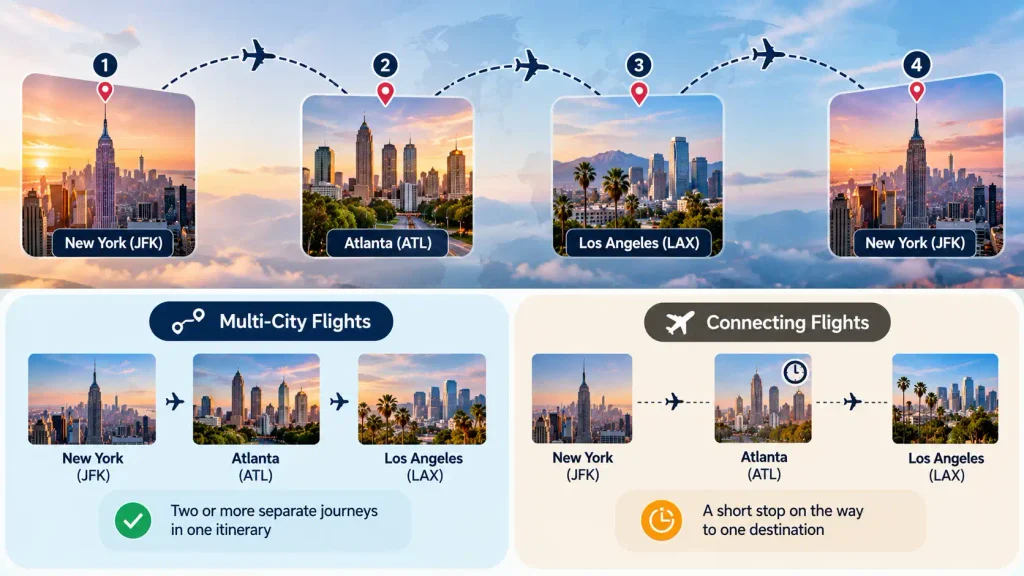
Delta multi-city flights are reservations that combine two or more flight journeys involving different cities into a planned itinerary.
Unlike a traditional round-trip ticket, which typically takes a passenger from one city to another and back, a multi-city booking allows the traveler to choose different departure and arrival airports for individual parts of the journey.
For example, a passenger could arrange the following trip:
| Flight segment | Route | Example travel date |
| Flight 1 | New York (JFK) → Atlanta (ATL) | March 5 |
| Flight 2 | Atlanta (ATL) → Los Angeles (LAX) | March 9 |
| Flight 3 | Los Angeles (LAX) → New York (JFK) | March 15 |
Illustrative itinerary only; dates and routes are not a live availability quote.
Instead of returning to New York after visiting Atlanta, the passenger continues directly to Los Angeles before traveling home.
Delta’s official flight-search page provides a dedicated Multi-City option alongside Round Trip and One Way.
How Are Multi-City Flights Different From Connecting Flights?
A multi-city itinerary includes separately planned travel segments, often with extended stays at intermediate destinations. A connecting flight, by contrast, is usually part of a journey toward one destination.
For instance, traveling from New York to Los Angeles with a two-hour connection in Atlanta is ordinarily a connecting itinerary. Staying in Atlanta for four days before flying to Los Angeles is a multi-city journey.
This distinction matters because baggage handling, airport transfers, and ticket conditions can differ depending on how the itinerary is booked.
How Can Travelers Book Delta Multi-City Flights Online?
Travelers can book Delta multi-city flights through the airline’s official website by selecting the Multi-City search option and entering the required flight segments.
Delta’s booking interface includes passenger count, cabin preferences, flexible-date options, and a Shop with Miles setting.
What Are the Steps to Book a Delta Multi-City Ticket?
- Visit Delta’s official website. Open the Book a Flight section and select Multi-City from the available trip types.
- Enter the first flight segment. Choose the departure airport, destination airport, and preferred travel date.
- Add the remaining destinations. Enter the next route and date for each additional flight. The number of segments supported may depend on the booking interface.
- Select the passenger count and preferences. Choose the number of travelers, available cabin options, and any relevant search settings.
- Search for available flights. Review schedules, connections, operating airlines, and available fares for the itinerary.
- Compare ticket conditions. Check baggage allowances, seat-selection options, cancellation rules, and the total price before choosing flights.
- Enter passenger information. Provide names matching the applicable travel documents and complete any required contact or travel details.
- Review and pay. Confirm the route order, dates, airports, passenger names, and final cost before completing payment.
- Save the booking confirmation. Check the confirmation email and ticket details to ensure that every intended flight segment appears.
The exact appearance of Delta’s booking interface may vary by device, country, or website update.
Can Delta Multi-City Flights Be Booked Through the Fly Delta App?
The Fly Delta app provides flight-search and trip-management functions, but travelers should confirm whether their required multi-city combination is supported in the current app version.
If the desired booking cannot be completed in the app, Delta’s website offers a dedicated multi-city search interface.
Complex itineraries involving several partner airlines, unusual routing, or special ticket requirements may require assistance from Delta Reservations.
Can Travelers Book Multi-City Flights by Phone?
Yes. Travelers can contact Delta Reservations for assistance with eligible multi-city bookings, particularly when the itinerary is difficult to construct online.
An agent may help review available routes, fare conditions, and ticketing options.
However, booking assistance does not guarantee a lower fare, and certain phone or ticketing services may involve additional charges depending on the circumstances.
What Are the Different Types of Delta Multi-City Itineraries?
Delta’s multi-city search can accommodate several common travel patterns, subject to route availability and applicable ticketing rules.
| Itinerary type | Example | Best suited for |
| Multi-stop journey | New York → Atlanta → Miami → New York | Visiting several cities |
| Open-jaw trip | New York → Paris; London → New York | Returning from a different city |
| International multi-city | Atlanta → Paris → Rome → Atlanta | Visiting multiple countries |
| Business itinerary | Boston → Chicago → Seattle → Boston | Meetings in different locations |
| One-way multi-city | Los Angeles → Seattle → Vancouver | Traveling onward without returning to the starting city |
What Is an Open-Jaw Flight on Delta?
An open-jaw itinerary allows a traveler to arrive in one city and depart from another, without necessarily purchasing a flight between those two cities.
For example, a passenger might fly from New York to Paris, travel independently by train to London, and then return to New York from London.
The Paris-to-London portion is not automatically included in the airline ticket. The traveler must arrange that transportation separately.
Open-jaw itineraries can be useful when visiting several destinations within one region without retracing the original route.
Can Travelers Book International Multi-City Flights With Delta?
Yes. Delta’s booking network includes international destinations and flights operated by eligible airline partners.
A multi-city itinerary may combine Delta-operated flights with partner-operated services, depending on availability and ticketing rules.
However, travelers should verify the operating carrier for each segment. Seat selection, baggage services, check-in procedures, and onboard products may differ from one airline to another.
Are Delta Multi-City Flights Cheaper Than Separate One-Way Tickets?
Delta multi-city flights can sometimes cost less than booking separate one-way tickets, but there is no universal pricing advantage.
Airline pricing depends on route demand, travel dates, fare availability, fare construction, and ticket restrictions.
In some cases, a multi-city itinerary may be priced favorably as a combined ticket. In others, separate one-way reservations may be less expensive.
How Can Travelers Compare Multi-City Flight Prices?
The most useful comparison is between the final prices of different booking structures, including the services needed.
Consider this hypothetical example:
| Booking option | Illustrative total |
| One multi-city reservation | $720 |
| Three separate one-way tickets | $685 |
| Alternative dates using multi-city search | $640 |
Example amounts only; these are not current Delta fare quotes.
In this example, adjusting the travel dates produces the lowest advertised total. However, travelers would still need to compare baggage charges, fare restrictions, and connection arrangements.
Separate tickets can introduce additional risks when one flight is delayed or canceled, especially if the disruption affects a later flight on another reservation.
When Is a Multi-City Booking Worth Considering?
A multi-city booking is particularly useful when travelers want to coordinate several destinations, compare an open-jaw journey, or keep eligible flight segments together under one reservation.
It may also simplify certain itinerary changes and customer-service interactions compared with managing unrelated bookings.
Nevertheless, a single reservation does not mean every flight segment has identical baggage rules, fare conditions, or disruption protections.
How Can Travelers Find Better Deals on Delta Multi-City Flights?
Travelers can improve their chances of finding affordable multi-city fares by comparing travel dates, checking alternative airports, and reviewing different itinerary combinations.
Delta’s booking search includes options such as flexible dates and nearby airports, although the availability of individual search features can depend on the selected itinerary.
Does Changing the Order of Destinations Affect the Fare?
Yes. The order of destinations can influence airfare because flight demand and available fare combinations differ by route.
For example, a traveler planning to visit Atlanta and Miami from New York could compare New York–Atlanta–Miami–New York with New York–Miami–Atlanta–New York.
The two itineraries visit the same cities but may produce different prices, flight durations, and connection requirements.
Travelers should also account for hotel bookings and other fixed arrangements before changing their route order.
Can Flexible Travel Dates Reduce Multi-City Ticket Prices?
Flexible dates may help travelers identify less expensive departures, but savings are not guaranteed.
Moving one segment by a day or two can change the overall price of the itinerary.
This is particularly relevant when a trip includes popular destinations during holidays, festivals, or other periods of high demand.
Should Travelers Compare Nearby Airports?
Yes. Comparing nearby airports can reveal different flight schedules and fare options.
For example, travelers visiting the New York area might compare suitable flights involving JFK, LaGuardia, or Newark, depending on their itinerary.
However, airports serving the same metropolitan area are not always interchangeable. Ground transportation costs, airport transfer times, and operating airlines should be considered.
Can Delta Multi-City Flights Be Booked Using SkyMiles?
Yes, eligible multi-city award itineraries may be booked using Delta SkyMiles, subject to award availability, routing rules, and booking-system support.
Delta’s official booking interface includes a Shop with Miles option, allowing travelers to search for eligible award flights.
How Can Travelers Search for Multi-City Award Flights?
Travelers can begin by signing in to their SkyMiles account, opening Delta’s flight-search page, selecting Multi-City, and enabling Shop with Miles.
They can then enter the desired destinations and travel dates to see whether an eligible itinerary is available.
If the full multi-city award journey cannot be priced online, travelers can search individual segments to understand availability and contact Delta for help with eligible award-ticket options.
Separate award tickets should not be assumed to offer the same connection protections as one ticket.
Are Taxes and Fees Included in SkyMiles Redemptions?
Not necessarily. Award tickets may require payment of applicable government taxes, fees, and other charges in addition to the miles redeemed.
Delta’s SkyMiles rules specify that applicable taxes and fees must be paid when an award ticket is issued.
The mileage requirement can also vary significantly by destination, travel date, and available award inventory.
Which Delta Fare Type Is Best for a Multi-City Trip?
The best fare depends on how certain the travel dates are, whether passengers need advance seat selection, and how much flexibility they want if plans change.
Delta currently uses Basic, Classic, and Extra designations across applicable travel experiences. Availability and included benefits vary by cabin and route.
| Fare option | General characteristics | Suitable for |
| Basic | Lower-priced, restrictive option; change or cancellation charges may apply | Travelers with firm plans |
| Classic | Standard benefits with greater flexibility on eligible routes | Travelers balancing price and flexibility |
| Extra or refundable | More flexible ticket conditions, including refundability where offered | Travelers whose plans may change |
Delta states that Classic and Extra experiences on flights originating in the United States and Canada generally have no change or cancellation fees, while Basic tickets remain more restrictive. Exceptions apply, particularly for certain international origins.
Why Can Basic Fares Be Riskier for Multi-City Travel?
Basic fares can be less suitable for complicated trips because changes or cancellations may involve additional restrictions and charges.
If one part of a multi-city journey needs to be moved, the traveler may have to review the conditions affecting the entire ticket.
For example, a passenger attending meetings in three cities may benefit from a more flexible fare if the dates of those meetings are uncertain.
The lowest upfront price should therefore be weighed against the potential cost of changing plans.
What Is Delta’s Baggage Policy for Multi-City Flights?
Delta’s multi-city baggage allowance depends on the selected fare, cabin, route, loyalty benefits, and operating airline.
Booking several destinations together does not automatically provide extra checked baggage or guarantee identical allowances on every segment.
Delta’s published baggage information includes the following standard allowances for many Delta-operated flights:
| Baggage category | General Delta allowance |
| Personal item | One included |
| Carry-on bag | One included |
| Standard checked-bag size | Up to 62 linear inches |
| Standard checked-bag weight | Generally 50 lb (23 kg) in Delta Main, Delta Comfort, and Delta Premium Select |
| Delta First and Delta One standard weight | Generally 70 lb (32 kg) |
| Checked-bag charges | Vary by route, fare, status, and other eligibility |
Delta currently lists a first standard checked-bag fee of $45 and a second-bag fee of $55 for specified domestic U.S. itineraries in Delta Main and Delta Comfort without qualifying exemptions. These are not universal multi-city baggage fees.
Do Checked Bags Automatically Transfer Between Multi-City Flights?
No. If a passenger intentionally stops in a city for several days, checked baggage is ordinarily collected at that destination and checked again for the next flight.
For connecting flights on a single ticket, Delta generally accepts checked baggage through to the ticketed destination, subject to customs procedures and other exceptions.
Separate-ticket itineraries may require passengers to collect and recheck their bags, although Delta publishes limited partner-airline exceptions.
What Happens When a Partner Airline Operates One Segment?
Partner-operated flights may have different carry-on restrictions, baggage charges, and check-in requirements.
For international interline journeys, the applicable checked-baggage rules may be determined under relevant carrier-selection and regulatory provisions.
Passengers should check the baggage information displayed on their ticket and confirm any uncertainties with the operating airline.
Can Travelers Change or Cancel Delta Multi-City Flights?
Yes. Eligible Delta multi-city reservations can be changed or canceled, but the available options depend on the fare conditions, booking channel, ticket origin, and whether travel has already started.
Passengers can generally begin by accessing the reservation through Delta’s My Trips section.
How Can Passengers Change One Flight in a Multi-City Booking?
Travelers should open My Trips, select the reservation, and review the available change options.
If online modification is supported, they can choose the relevant flights and review the updated fare before confirming.
For complicated itineraries, especially those involving partner airlines or partially used tickets, Delta Reservations may need to assist.
Changing one segment can affect the pricing or validity of other segments. Passengers should review the entire revised itinerary rather than assuming the requested flight can be modified independently.
Are There Change Fees for Delta Multi-City Tickets?
Change fees depend on the ticket and itinerary.
For eligible Delta Classic and Extra tickets originating in the United States or Canada, Delta generally waives standard change fees. Passengers may still have to pay a fare difference.
Basic tickets and certain tickets originating in other regions may be subject to charges. Delta’s published change-fee overview shows that applicable fees can vary considerably by fare type and market.
Does Delta Offer a 24-Hour Cancellation Policy?
Delta offers a 24-Hour Risk-Free Cancellation policy for qualifying tickets booked directly through Delta.
Eligible passengers can cancel within 24 hours after purchase and receive a refund to the original payment method, subject to the policy’s conditions.
The protection can apply to qualifying multi-city tickets, but passengers should verify eligibility, particularly for reservations involving third-party booking channels.
What Happens If a Passenger Misses One Segment?
Missing a scheduled segment without making arrangements can affect the remaining flights on the reservation.
Delta advises passengers to change or cancel their travel before departure to preserve any remaining ticket value under the applicable rules.
For example, a traveler who decides to take a train instead of flying from Atlanta to Miami should contact Delta before the scheduled flight rather than simply skipping that segment.
Otherwise, subsequent flights on the ticket may be canceled.
What Should Travelers Check Before Confirming a Delta Multi-City Booking?
Travelers should review the complete itinerary, including the order of destinations, fare conditions, connection times, and baggage arrangements.
A multi-city journey introduces more opportunities for mistakes than a simple round-trip reservation because each segment has its own date, airport, and operating details.
| Booking detail | What to verify | Potential issue |
| Departure and arrival airports | Exact airport codes | Booking the wrong airport |
| Flight dates | Date of each individual segment | Overlapping or incorrect travel dates |
| Connection times | Time between connecting flights | Missing onward flights |
| Fare conditions | Change and refund restrictions | Unexpected modification costs |
| Baggage rules | Allowance for each relevant journey | Additional charges |
| Operating airline | Carrier operating each flight | Different check-in or onboard rules |
| Travel documents | Passport, visa, and transit requirements | Denied boarding or entry |
| Passenger details | Names matching travel documents | Ticket correction complications |
Why Are Visa and Transit Requirements Important for Multi-City Flights?
International multi-city trips may involve several countries, each with different entry or transit requirements.
For example, a traveler visiting Paris, London, and Amsterdam may need to consider the immigration requirements for both the United Kingdom and the Schengen Area.
Requirements depend on nationality, residence status, travel documents, and the purpose and duration of each visit.
Passengers should confirm applicable requirements with official government sources before purchasing nonrefundable tickets.
Why Should Travelers Avoid Very Short Connections?
Short connections increase the risk of missing onward flights when the first flight is delayed.
Travelers should consider airport size, terminal changes, immigration procedures, security screening, and baggage collection.
A connection that appears sufficient for a domestic transfer may not be suitable when the passenger must enter a country, collect baggage, or change airports.
For separately ticketed flights, extra time is particularly important because missed-connection protections may be limited.
Related: 7 Best Ways to Use the Delta Reserve Business 200K Offer
Conclusion: What Is the Best Way to Book Delta Multi-City Flights?
Booking Delta multi-city flights is a practical way to organize journeys involving several destinations, open-jaw routes, or international travel plans. The airline’s online Multi-City search allows passengers to enter individual flight segments, compare available fares, and review the complete itinerary before payment.
However, the convenience of one booking does not guarantee the lowest airfare or identical conditions across every flight. Travelers should compare multi-city pricing with separate tickets, consider flexible dates, and verify baggage allowances, operating airlines, and change restrictions.
For complicated itineraries, particularly those involving international connections or partner carriers, reviewing the complete ticket conditions before purchase can help avoid costly adjustments later.
Related FAQs!
Delta supports multiple flight segments through its Multi-City search option, but the maximum number that can be booked online may vary. Travelers with more complex itineraries may need assistance from Delta Reservations.
Different cabin products may be available on different segments, depending on the booking options and fare rules. Travelers should review each flight’s cabin selection and included benefits before completing payment.
Eligible Delta eCredits may be applied toward qualifying tickets, subject to their terms, expiration dates, and booking-system restrictions. Travelers should verify the accepted payment options during checkout.
Adding a destination may be possible through an eligible ticket change or reissue. The itinerary may need to be repriced, and additional fare amounts or applicable fees may apply.
Eligible Delta eCredits may be applied toward qualifying tickets, subject to their terms, expiration dates, and booking-system restrictions. Travelers should verify the accepted payment options during checkout.
Yes. Eligible itineraries may include flights operated by Delta’s partner airlines. The operating carrier’s baggage, check-in, and service policies should be reviewed separately.
Not necessarily. SkyMiles earning depends on the fare type, ticket eligibility, operating airline, and program rules. Delta Basic experiences generally do not earn SkyMiles, while eligible Classic and premium fares may qualify.
Not exactly. Multi-city describes a booking structure containing multiple planned flight journeys, while a stopover refers to an extended stay at an intermediate location under applicable fare and routing rules. A multi-city search does not automatically guarantee a permitted or free stopover.
It may be possible, depending on the fare and ticket status. However, canceling one segment can affect the pricing and validity of the remaining itinerary. Passengers should request a revised ticket quotation before confirming a partial cancellation.