
How Does Volaris’ Pet Policy Work? Cargo Hold & Breed Ban
The Volaris pet policy allows eligible dogs and cats to travel in the passenger cabin or as checked pets in the aircraft hold, depending on their combined weight with the carrier, size, health, and destination requirements. However, flat-faced breeds need special attention because Volaris’s published policies include breed restrictions and newer guidance that requires a liability waiver for certain animals.
Traveling with a pet on Volaris involves more than selecting a suitable carrier. A small dog may qualify for cabin travel but still require additional documents, while a larger pet may need to travel in the aircraft hold. Breed restrictions, international entry requirements, and limited pet capacity can also affect the booking.
So, which pets qualify for cabin travel? What happens when a dog exceeds the cabin weight limit? And can a pug, bulldog, or Persian cat fly with Volaris? This guide covers the airline’s pet transportation rules, carrier requirements, documentation, fees, and key restrictions before departure.
Related: What It’s Like Flying Volaris: September 2026 Review
What Are the Main Rules Under the Volaris Pet Policy?
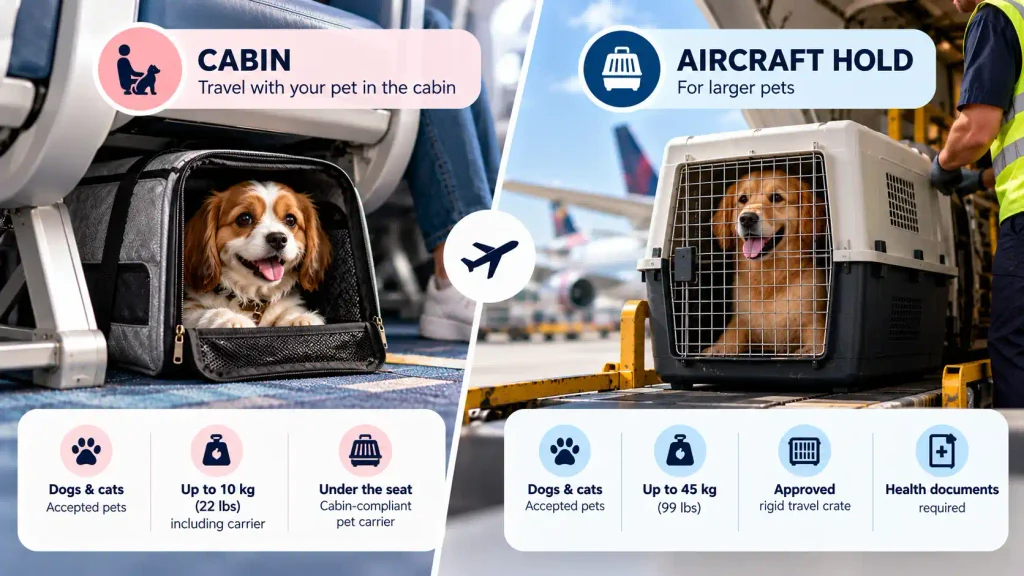
Volaris provides two standard transportation options for eligible pets: traveling in the passenger cabin or being checked into the aircraft hold. Both services are subject to availability, carrier requirements, and applicable health regulations.
The following overview highlights the main differences.
| Pet travel requirement | Cabin | Aircraft hold |
| Accepted pets | Dogs and cats | Dogs and cats |
| Published weight limit, including carrier | Up to 10 kg (22 lbs) | Up to 45 kg (99 lbs) |
| Pet location | Under the seat | Designated aircraft compartment |
| Carrier | Cabin-compliant pet carrier | Approved rigid travel crate |
| Additional fee | Yes | Yes |
| Reservation | Recommended | Recommended |
| Health documents | Required | Required |
| Breed restrictions | Must be verified | Must be verified |
Weight figures come from Volaris’s published pet-service terms. Check its current booking guidance for updated limits, carrier dimensions, and breed eligibility.
Can Pets Travel Inside the Volaris Cabin?
Yes, eligible dogs and cats can travel in the Volaris passenger cabin if they meet the airline’s weight, carrier, documentation, and reservation requirements. Cabin transportation lets the animal stay near its owner throughout the journey, but it must remain in its approved carrier.
The airline’s published pet-service terms specify a combined cabin weight limit of 10 kg, including the pet and its container. However, check the airline’s current booking requirements before purchasing a carrier or reserving the service.
What Size Pet Carrier Is Allowed in the Volaris Cabin?
A cabin pet carrier must fit in the designated under-seat storage area and give the animal enough room to stay comfortable.
The carrier should be properly ventilated, secure, and sized for the pet. Volaris’s published rules also prohibit certain container features, including wheels and padlocks.
For example, a dog weighing 8 kg in a 1.5 kg carrier weighs 9.5 kg combined. That falls within the published 10 kg allowance, but the carrier must still meet the airline’s current dimensional and safety requirements.
Can a Passenger Bring More Than One Pet in the Cabin?
Volaris’s published terms allow one pet per passenger and one pet per carrier. The same terms limit cabin pets to two per flight.
Because pet space is limited, adding an animal after booking the passenger ticket may leave fewer options available. Travelers should confirm pet availability before finalizing a nonrefundable itinerary.
Can Larger Dogs and Cats Travel in the Volaris Aircraft Hold?
Yes, eligible pets that exceed the cabin allowance may travel as checked pets in the aircraft hold, provided they satisfy the airline’s acceptance conditions.
Volaris’s published service terms specify a maximum combined weight of 45 kg for the animal and its transport container. However, meeting the weight limit does not automatically guarantee acceptance.
Aircraft capacity, route restrictions, carrier construction, breed eligibility, and the animal’s physical condition can all affect whether the pet is permitted to travel.
What Type of Crate Is Required for Checked Pets?
A pet traveling in the aircraft hold requires a secure transport crate designed to protect the animal during handling and flight.
The crate should give the pet enough space to stand naturally, turn around, and lie down without being compressed. It should also have appropriate ventilation, secure closures, and a leak-resistant base.
A soft-sided cabin bag is not suitable for checked pet transportation.
For example, a 30 kg dog may fall comfortably within the published checked-pet weight allowance. However, if the required crate adds substantial weight or doesn’t provide adequate space, the animal may not qualify for transport.
How Many Pets Can Travel in the Hold?
Volaris’s older published service terms specify a limit of four checked pets per flight. Actual acceptance also depends on the aircraft and operational conditions.
Passengers should confirm availability for the specific flight rather than treating the published maximum as guaranteed space.
Are Flat-Faced Dog and Cat Breeds Banned on Volaris?
Flat-faced, or brachycephalic, breeds face special restrictions because their shortened airways can increase the risk of breathing difficulties, overheating, and other complications during air travel.
There is an important distinction between Volaris’s published policy documents:
- Older pet transportation terms: State that brachycephalic dogs and cats are prohibited from both the cabin and the aircraft hold.
- Current public pet guidance: Advises against flying with brachycephalic and certain small breeds but describes a liability-waiver requirement for passengers wishing to transport them.
These official sources are not fully consistent. Therefore, a blanket statement that every flat-faced pet is currently prohibited would be misleading. Owners should confirm with Volaris whether their animal’s breed, flight, and eligibility allow them to purchase tickets.
Which Flat-Faced Breeds Are Listed by Volaris?
Volaris identifies several breeds that may face additional restrictions or require special consideration.
| Dogs | Cats |
| Pug | Persian |
| Bulldog | Himalayan |
| Boxer | Burmese |
| Boston Terrier | Exotic Shorthair |
| Pekingese | — |
| Shih Tzu | — |
| Brussels Griffon | — |
| Japanese Chin | — |
This table highlights examples rather than the airline’s complete list. Other listed breeds include Affenpinschers, Shar-Peis, Mastiffs, and several terrier breeds.
Why Are Flat-Faced Pets Considered Higher-Risk Passengers?
Brachycephalic animals have shortened faces that can restrict airflow, especially when they are stressed or exposed to heat.
Airport and aircraft environments can introduce unfamiliar sounds, temperature changes, and handling procedures. For pets with existing respiratory difficulties, these conditions may increase the risk of complications.
For example, a pug weighing only 6 kg may meet the cabin weight requirement but still face breed-specific restrictions. Meeting the weight limit does not mean the animal is medically fit or authorized to fly.
A veterinarian should assess the animal’s fitness for air travel, and the airline should confirm acceptance before finalizing a reservation.
How Old Must a Pet Be to Fly on Volaris?
Volaris’s current public pet guidance lists a minimum age of eight weeks for several destinations, including domestic travel within Mexico. For travel to the United States, the listed minimum age is six months.
This is a notable change from older Volaris pet-service terms, which excluded animals younger than four months.
| Destination | Minimum age in current guidance |
| Mexico | 8 weeks |
| United States | 6 months |
| Central America | 8 weeks |
| South America | 8 weeks |
These are the minimum ages displayed in Volaris’s current route guidance. Additional destination regulations and airline conditions may apply.
A three-month-old puppy might meet the published minimum age for a domestic Mexican flight but would not meet the United States’ six-month entry requirement.
What Documents Are Required to Fly With a Pet on Volaris?
Passengers traveling with pets must provide the documentation required by Volaris and the destination’s animal health authorities. The exact paperwork depends on the route, animal, vaccination history, and country of entry.
Common requirements include:
- Vaccination records: Evidence of current required vaccinations, particularly rabies.
- Veterinary health certificate: Required for specified routes, with a validity period that may be as short as five days.
- Deworming records: Proof of treatment within the applicable period.
- Pet travel form: Passenger and animal details required by Volaris.
- Import or export permits: Additional documentation where required by the destination country.
For domestic Mexican travel, Volaris specifies vaccination and deworming requirements. It also provides separate instructions for veterinary documentation for certain international routes.
What Documents Does a Dog Need When Flying to the United States?
Dogs entering or returning to the United States must satisfy the Centers for Disease Control and Prevention (CDC) import requirements.
These include a minimum age of six months, an identifiable microchip, a healthy appearance on arrival, and a receipt for the CDC Dog Import Form.
Additional documents may be required depending on the dog’s rabies vaccination history and whether it has visited a country classified as high-risk for dog rabies during the preceding six months.
For example, a dog traveling from Mexico to Los Angeles after remaining exclusively in Mexico during the preceding six months generally follows the CDC’s low-risk-country process. A dog that recently visited a high-risk country may need additional certification and entry arrangements.
How Much Does Volaris Charge to Travel With a Pet?
Volaris charges an additional fee for transporting pets, whether they travel in the passenger cabin or as checked animals.
The amount depends on the transportation service, route, and applicable booking conditions. Pet charges should not be assumed to be included in a passenger’s regular baggage allowance.
| Pet service | Fee arrangement |
| Pet in cabin | Additional pet transportation charge |
| Checked pet in hold | Additional checked-pet transportation charge |
| Pet stroller | May incur an additional baggage fee |
| Additional travel documents | Veterinary or government costs may apply |
Because official guidance does not provide a reliable universal price, travelers should confirm the exact amount during booking or through Volaris’s reservation management system.
For example, a traveler flying with a cat from Guadalajara to Tijuana should compare the total airfare and pet service charge before paying, rather than assuming the same fee applies to a flight from Mexico to the United States.
How Can Passengers Add a Pet to a Volaris Reservation?
Volaris lets eligible passengers request pet transportation during booking or afterward through the My Trips section.
The airline’s booking instructions list pet service as an optional add-on, with separate options for cabin and checked transportation.
The general procedure is:
- Select the desired Volaris flight and review its pet eligibility.
- Choose the pet transportation service during booking, or access the existing reservation through My Trips.
- Provide the requested animal and carrier details.
- Review availability and the applicable transportation charge.
- Complete the required pet travel form and prepare the necessary health documents.
- Confirm the service is included in the reservation before departure.
Travelers with flat-faced breeds should contact Volaris to confirm acceptance before completing the booking because published breed guidance conflicts.
How Early Should Passengers Arrive at the Airport With a Pet?
Volaris advises passengers traveling with pets to report to its airport counters at least two hours before domestic departures and three hours before international departures.
This extra time lets staff review documents, inspect the carrier, verify the animal’s eligibility, and complete any remaining service formalities.
| Flight type | Minimum recommended arrival |
| Domestic | 2 hours before departure |
| International | 3 hours before departure |
For instance, a passenger departing on an international flight at 11:00 a.m. should plan to reach the Volaris check-in counter by approximately 8:00 a.m.
Allow extra time during busy travel periods, especially when pets require document inspections or special handling.
What Happens to Pets During a Volaris Flight?
The travel experience differs depending on whether the animal is accepted in the cabin or checked into the hold.
How Do Pets Travel Inside the Cabin?
Cabin pets must remain in their approved carriers, which are placed beneath the seat in front of their owners. The carrier should provide adequate ventilation and prevent the animal from escaping.
Passengers should not open the carrier during the flight unless authorized personnel direct them to do so.
How Are Checked Pets Transported?
Checked pets travel in their approved crates in the designated aircraft compartment. They handle their containers separately from passengers’ ordinary cabin baggage.
Volaris instructs passengers to collect checked pets promptly upon arrival. Its current guidance refers to the baggage claim area, so travelers should follow airport staff instructions for the specific flight.
How Can Passengers Prepare Their Pets for Air Travel?
Preparing a pet for a flight involves more than purchasing an approved container. The animal must also be comfortable with confinement, handling, and unfamiliar environments.
Volaris recommends letting pets get used to their carriers before departure, using appropriate absorbent material, and avoiding sedation.
The airline also advises feeding and watering pets approximately four hours before the flight. Follow your veterinarian’s advice on feeding and hydration, especially for animals with medical conditions.
A useful preparation checklist includes:
- Introduce the travel carrier well before departure.
- Check that the animal can move comfortably inside.
- Verify the combined pet and carrier weight.
- Keep vaccination and health records readily accessible.
- Attach identification and contact information to the carrier.
- Confirm the airport’s pet relief facilities.
- Seek veterinary advice about anxiety, respiratory conditions, or other health concerns.
Sedating a pet without appropriate veterinary guidance can increase travel-related risks. Volaris specifically advises against sedation because of potential respiratory and cardiovascular complications.
What Are the Most Common Reasons Volaris May Refuse a Pet?
Even when a pet service has been added to a reservation, Volaris may refuse transportation if the animal does not satisfy the applicable safety or documentation requirements.
Potential reasons include an unsuitable carrier, missing documents, exceeding weight restrictions, or concerns about the animal’s health or behavior.
| Potential issue | What passengers should check |
| Carrier exceeds permitted dimensions | Measure the carrier before departure |
| Pet exceeds the applicable weight limit | Weigh the pet and carrier together |
| Missing health documents | Verify route-specific paperwork |
| Breed eligibility is uncertain | Obtain confirmation directly from Volaris |
| Animal appears ill or distressed | Consult a veterinarian before travel |
| Pet capacity has been reached | Reserve pet transportation early |
| Destination entry requirements are unmet | Check official import regulations |
A confirmed pet reservation does not override mandatory health, safety, or immigration requirements.
What Should Passengers Know About Volaris Service Dogs?
Volaris handles trained service dogs under a different policy than ordinary household pets.
Volaris provides separate requirements for service animals, including eligibility criteria, documentation, and onboard behavior standards. Rules may also differ for flights involving the United States.
A service dog is not automatically subject to the same carrier and weight arrangements as a pet booked under the standard cabin service.
Conclusive Thoughts
The most important decision is not simply whether the animal fits inside a carrier, but whether the pet qualifies for the entire journey. Confirm breed eligibility, aircraft capacity, destination requirements, and veterinary documentation before payment.
Passengers with flat-faced breeds should pay particular attention to the difference between Volaris’s older prohibition and its newer liability-waiver guidance. Written confirmation from the airline is advisable before making nonrefundable travel arrangements.
For other eligible dogs and cats, review the carrier dimensions, check the pet’s combined weight, and complete documentation within the required time frame to help prevent check-in issues.
Frequently Asked Questions
A Chihuahua may qualify for cabin travel if it meets the carrier’s applicable weight, health, and reservation requirements. Volaris also identifies Chihuahuas among small breeds requiring additional travel precautions.
Persian cats appear on Volaris’s brachycephalic breed list. Older terms prohibit their transportation, while newer public guidance describes a liability waiver. Passengers must obtain confirmation of current eligibility before booking.
Emotional support animals are not automatically entitled to the same treatment as trained service dogs. Eligibility and documentation depend on Volaris’s applicable rules and the route.
Volaris’s published pet transportation terms specify one pet per container. Passengers traveling with two cats should confirm with Volaris whether it can accommodate separate carriers and reservations.
The standard checked-pet service is intended for animals accompanying passengers on the same flight. Unaccompanied animal transportation requires separate arrangements; confirm availability with the airline.
Volaris’s standard pet transportation service covers dogs and cats. The standard cabin or checked-pet options don’t cover rabbits, birds, or other species.
Yes, but Volaris may charge the stroller as additional baggage. Volaris also allows eligible strollers to replace an included carry-on or checked baggage item when the relevant requirements are satisfied.
Not necessarily. Requirements differ by route and destination. Some journeys require a veterinary health certificate issued within a specified period, while others emphasize vaccination records and the airline’s travel form.
Flight changes may affect pet availability because the service is subject to aircraft and reservation limits. Passengers should confirm pet transportation on the replacement flight before completing changes.
The aircraft hold is an established transportation option for eligible animals, but it carries risks related to handling, temperature exposure, stress, and the animal’s individual health. Veterinary assessment and airline approval are particularly important for vulnerable pets.