
Carry-On Luggage Size Chart for 64 Major Airlines – Dimensions, Sizes, & More
A carry-on bag can make travel faster, lighter, and far less stressful but only if it fits the airline’s rules. While many airlines use a cabin-bag limit close to 22 x 14 x 9 inches (56 x 36 x 23 cm), no single worldwide standard exists, and weight limits, fare types, aircraft, and connecting flights can all change what you may bring onboard.
The International Air Transport Association (IATA) uses 56 x 45 x 25 cm (22 x 18 x 10 in) as a general cabin-baggage reference, including wheels and handles. However, travelers should always follow the operating airline’s current policy.
Quick Carry-On Size Chart
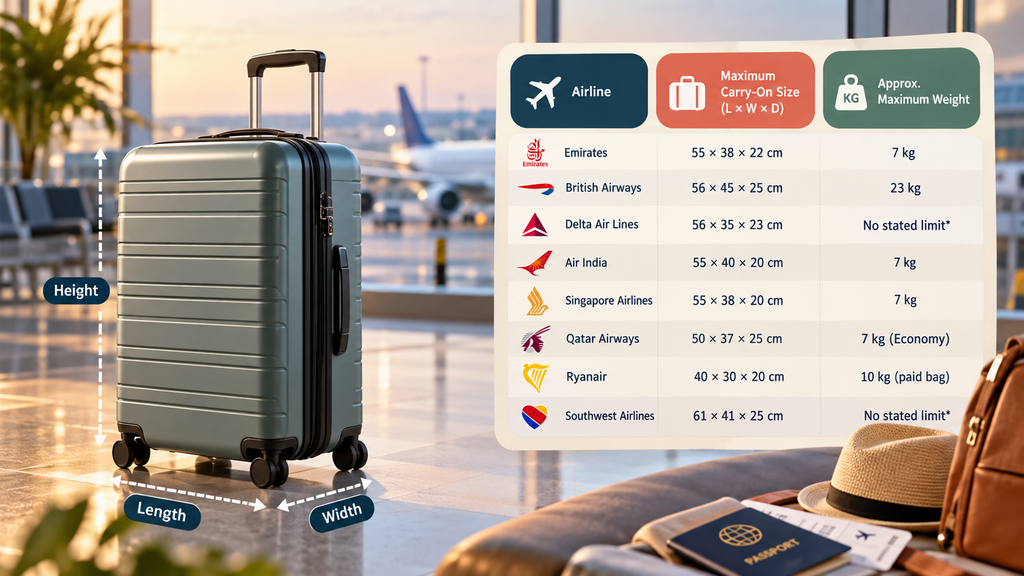
Dimensions below are generally shown as length x width x depth. Airlines may present the same measurements in a different order, so compare every external part of the bag, including wheels, handles, pockets, and straps, with the airline’s stated maximum.
| Airline | Maximum Carry-On Size | Approx. Maximum Weight |
| Aer Lingus | 55 x 40 x 24 cm | 10 kg |
| Aeromexico | 55 x 40 x 25 cm | 10 kg |
| Air Arabia | 55 x 40 x 20 cm | 10 kg |
| Air Asia | 56 x 36 x 23 cm | 7 kg |
| Air Austral | 55 x 35 x 25 cm | 10 kg |
| Air Canada | 55 x 40 x 23 cm | No stated limit* |
| Air China | 55 x 40 x 20 cm | 5–10 kg |
| Air Europa | 55 x 35 x 25 cm | 10 kg |
| Air France | 55 x 35 x 25 cm | 12 kg combined** |
| Air India | 55 x 40 x 20 cm | 7 kg |
| Air New Zealand | 55 x 40 x 23 cm | 7 kg |
| Air Serbia | 55 x 40 x 23 cm | 8 kg |
| Air Transat | 55 x 40 x 23 cm | 10 kg |
| Alaska Airlines | 56 x 36 x 23 cm | No stated limit* |
| Allegiant Air | 55 x 40 x 25 cm | No stated limit* |
| All Nippon Airways (ANA) | 55 x 40 x 25 cm | 10 kg |
| Austrian Airlines | 55 x 40 x 23 cm | 8 kg |
| British Airways | 56 x 45 x 25 cm | 23 kg |
| Brussels Airlines | 55 x 40 x 23 cm | 8 kg |
| Cathay Pacific | 56 x 36 x 23 cm | 7–10 kg |
| China Airlines | 56 x 36 x 23 cm | 7 kg |
| China Eastern | 56 x 36 x 23 cm | 10 kg |
| China Southern | 55 x 40 x 20 cm | 5–10 kg |
| Condor | 55 x 40 x 20 cm | 8 kg |
| Copa Airlines | 56 x 36 x 23 cm | 10 kg |
| Delta Air Lines | 56 x 35 x 23 cm | No stated limit* |
| easyJet | 45 x 36 x 20 cm | 15 kg |
| EL AL | 56 x 45 x 25 cm | 8 kg |
| Emirates | 55 x 38 x 22 cm | 7 kg |
| Ethiopian Airlines | 55 x 40 x 23 cm | 7 kg |
| Etihad Airways | 56 x 36 x 23 cm | 7 kg |
| EVA Air | 56 x 36 x 23 cm | 7 kg |
| Finnair | 55 x 40 x 23 cm | 8 kg |
| Flair Airlines | 55 x 40 x 23 cm | 10 kg |
| Frontier Airlines | 61 x 41 x 25 cm | 35 lb / 15.9 kg |
| Garuda Indonesia | 56 x 36 x 23 cm | 7 kg |
| Hawaiian Airlines | 56 x 36 x 23 cm | 11.5 kg |
| Iberia | 56 x 40 x 25 cm | 10 kg |
| Icelandair | 55 x 40 x 20 cm | 10 kg |
| IndiGo | 55 x 35 x 25 cm | 7 kg |
| ITA Airways | 55 x 35 x 25 cm | 8 kg |
| Japan Airlines (JAL) | 55 x 40 x 25 cm | 10 kg |
| JetBlue | 56 x 36 x 23 cm | No stated limit* |
| KLM | 55 x 35 x 25 cm | 12 kg combined** |
| Korean Air | 55 x 40 x 20 cm | 10–12 kg |
| LATAM Airlines | 55 x 35 x 25 cm | 10 kg |
| Lufthansa | 55 x 40 x 23 cm | 8 kg |
| Malaysia Airlines | 56 x 36 x 23 cm | 7 kg |
| Norwegian | 55 x 40 x 23 cm | 10 kg |
| Oman Air | 56 x 36 x 23 cm | 7 kg |
| Philippine Airlines | 56 x 36 x 23 cm | 7 kg |
| Porter Airlines | 55 x 40 x 23 cm | No stated limit* |
| Qantas | 56 x 36 x 23 cm | 7 kg |
| Qatar Airways | 50 x 37 x 25 cm | 7 kg Economy |
| Ryanair | 40 x 30 x 20 cm free personal bag | 10 kg for paid cabin bag |
| SAS Scandinavian Airlines | 55 x 40 x 23 cm | 8 kg |
| Singapore Airlines | 55 x 38 x 20 cm | 7 kg |
| South African Airways | 56 x 36 x 23 cm | 8 kg |
| Southwest Airlines | 61 x 41 x 25 cm | No stated limit* |
| Spirit Airlines | 56 x 46 x 25 cm | No stated limit* |
| Swiss International Air Lines | 55 x 40 x 23 cm | 8 kg |
| TAP Air Portugal | 55 x 40 x 20 cm | 10 kg |
| Thai Airways | 56 x 45 x 25 cm | 7 kg |
| Turkish Airlines | 55 x 40 x 23 cm | 8 kg |
| Vietnam Airlines | 56 x 36 x 23 cm | 10–12 kg |
| Virgin Atlantic | 56 x 36 x 23 cm | 10 kg |
| Vistara | 55 x 40 x 20 cm | 7 kg |
| WestJet | 56 x 36 x 23 cm | No stated limit* |
| Wizz Air | 40 x 30 x 20 cm free personal bag | 10 kg for paid trolley bag |
“No stated limit” does not mean unlimited weight. The traveler must generally be able to lift and stow the bag safely without assistance. Air Canada specifically notes that cabin bags must be light enough for the passenger to place in the overhead bin unassisted.
Some airlines publish a combined limit for a cabin bag and personal item rather than a separate weight cap for each item. Air France, for example, applies a combined hand-baggage allowance that varies by travel class and fare.
Why Carry-On Limits Differ
Airline carry-on rules depend on more than cabin space. Aircraft design, overhead-bin capacity, safety requirements, route type, ticket class, and the airline’s low-cost or full-service model all influence the permitted dimensions and weight.
In the United States, 22 x 14 x 9 inches is the practical standard for many major airlines, including Alaska, Delta, JetBlue, and Hawaiian.
International carriers often impose stricter weight rules than U.S. airlines. Qatar Airways, for example, limits Economy Class passengers to one hand-baggage piece up to 50 x 37 x 25 cm and 7 kg, while Emirates lists 55 x 38 x 22 cm as the carry-on size limit.
The Best Universal Carry-On Size
If you fly different airlines regularly, buy conservatively rather than choosing the largest suitcase one carrier accepts. A bag around 55 x 35 x 20 cm is one of the safest choices for international trips because it aligns closely with the more restrictive limits used by airlines such as Air France, KLM, ITA Airways, and several Asian and Middle Eastern carriers.
For domestic U.S. trips, a 22 x 14 x 9-inch case is usually appropriate. Still, it may be too large for certain international airlines, regional aircraft, and low-cost carrier basic fares.
A flexible soft-sided carry-on can be particularly useful because it can compress slightly when placed in a baggage sizer. Hard-shell spinner cases may protect belongings better, but their wheel housings and rigid corners can cause an otherwise “standard” bag to exceed the allowed dimensions.
Personal Item vs Carry-On Bag
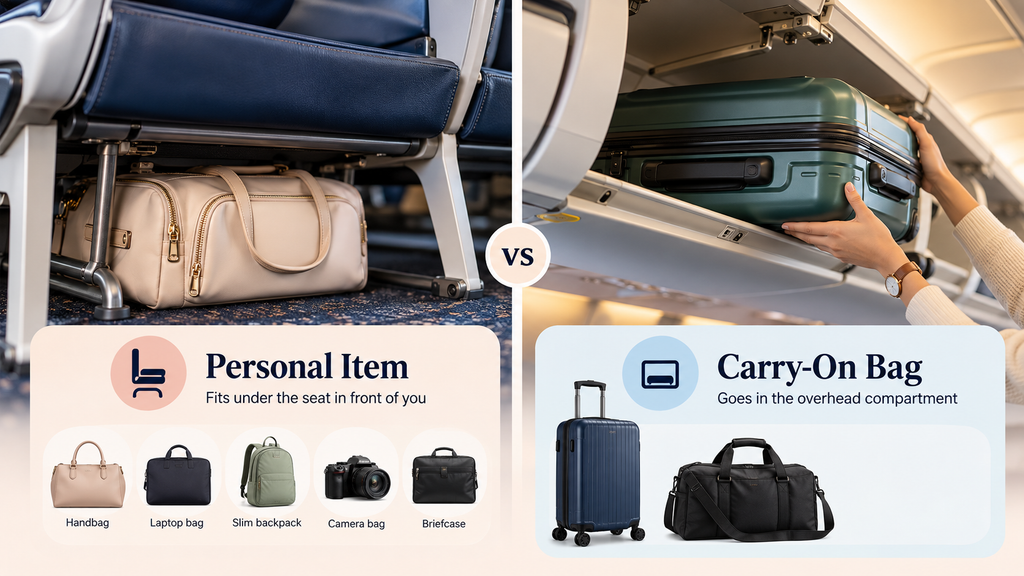
A carry-on bag normally goes in the overhead compartment. A personal item must fit under the seat in front of you and is typically a handbag, laptop bag, slim backpack, camera bag, or briefcase.
Many airlines allow one of each, but basic fares may be different. Ryanair’s standard free allowance is a small under-seat bag measuring 40 x 30 x 20 cm; a larger cabin bag requires an eligible fare or paid option.
easyJet similarly includes a small cabin bag up to 45 x 36 x 20 cm. In contrast, its larger 56 x 45 x 25 cm cabin bag is available only with an eligible booking option, membership, or added service.
This distinction matters because a traveler may technically have “two bags” but still be asked to pay if the larger one is not included in the purchased fare.
How to Measure Correctly
Do not measure only the fabric body of a suitcase. Airline limits normally include every external feature that could prevent a bag from fitting into an overhead bin or baggage sizer.
Measure your packed bag in this order:
- Place the fully packed bag upright on a level floor.
- Measure the full height from the ground to the highest point of the handle or wheel.
- Measure the widest point, including side handles, bulging pockets, and corner guards.
- Measure depth from the front of the bag to the farthest rear point.
- Weigh the bag after adding chargers, toiletries, shoes, electronics, and documents.
The FAA notes that many airlines use a maximum carry-on measurement of 45 linear inches, the total of height, width, and depth, but individual airline policies remain more important than this general rule.
Smart Packing for Cabin-Only Travel
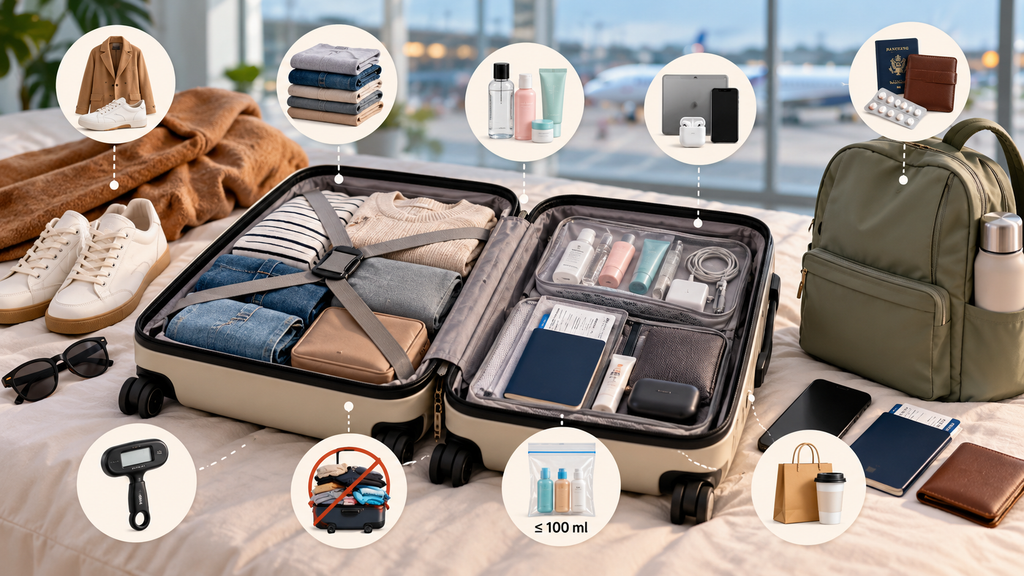
Packing for a carry-on is less about owning fewer things and more about choosing items that do more than one job. Prioritize versatile clothing, compact toiletries, and a personal item that keeps essentials reachable during the flight.
Use these strategies to protect your allowance:
- Wear bulky footwear, a coat, or heavier layers instead of packing them.
- Use packing cubes to compress and organize clothing.
- Place fragile electronics, documents, medication, and valuables in your personal item.
- Keep liquids in containers of 100 ml or less where airport security rules require it.
- Avoid overfilling expandable luggage; extra depth often causes a bag to fail a sizer check.
- Weigh your case at home with a portable luggage scale.
- Leave room for the items you may buy after security, such as snacks or souvenirs.
The most frequent carry-on mistake is assuming an airline will overlook an oversized or overweight bag. Gate agents may require you to check the bag, and low-cost carriers can charge significantly more at the airport than when you buy baggage online.
Connecting-Flight Rules Matter
On an itinerary involving multiple airlines, the safest approach is to pack to the strictest carry-on policy in the journey. This matters most when a long-haul ticket includes a short regional connection, where smaller aircraft may have tighter bins and stricter restrictions.
The operating carrier, not necessarily the airline whose logo appears on the ticket, often determines onboard baggage rules. A codeshare flight can therefore have a different cabin-bag policy than travelers expect.
For example, a 22 x 14 x 9-inch roller may be accepted on a U.S. domestic segment but exceed the hand-luggage allowance on a connecting international airline. Check both the ticketed airline and the operating airline before departure to avoid surprise repacking at the gate.
Final Thoughts!
The right carry-on luggage isn’t simply the largest bag you can buy; it is the bag that fits your most restrictive airline, stays easy to lift, and leaves enough flexibility for changing fares and connections. A compact 55 x 35 x 20 cm cabin case and a properly sized under-seat personal item provide one of the most reliable combinations for frequent international travel. Airline baggage rules can change, so confirm the exact allowance shown for your fare and operating flight before every trip.
Frequently Asked Questions
There is no universal mandatory size, but 22 x 14 x 9 inches (56 x 36 x 23 cm) is widely used by major U.S. airlines. IATA’s general reference is slightly wider at 56 x 45 x 25 cm, including wheels and handles.
Yes. Airlines generally measure the complete external bag, including wheels, handles, outside pockets, and protruding parts.
The airline may require you to check the bag at the gate. Depending on the carrier, fare, and timing, this can result in a gate-baggage fee, especially with low-cost airlines that sell cabin-bag allowances separately.
Low-cost airlines frequently have the most restrictive free allowances. Ryanair’s included bag is limited to 40 x 30 x 20 cm, while easyJet’s included small cabin bag is limited to 45 x 36 x 20 cm.
Usually, yes, if your fare includes both a full-sized carry-on and a personal item. The backpack must fit beneath the seat, but basic economy and low-cost fares may include only one small personal item, so review your booking’s baggage terms before traveling.