
How Much Does It Cost to Check a Bag on a Flight?
The fee for checking a bag on major U.S. airlines in 2026 generally starts around 45–$ 50 for the first standard suitcase on domestic flights. However, low-cost carriers, premium fares, international routes, and baggage benefits can raise charges significantly. Delta Air Lines charges $45 for a standard first domestic checked bag for eligible Main Cabin tickets.
Baggage charges have become a key factor when comparing airline ticket prices. A passenger booking a $180 flight might spend another $100 or more on round-trip checked luggage, while someone traveling on a fare with baggage included could avoid that expense entirely. The difference is particularly noticeable when families travel with multiple suitcases or passengers carry sports equipment.
Understanding airline baggage policies requires looking beyond the advertised fee. Ticket purchase dates, fare categories, payment methods, baggage dimensions, and loyalty benefits can all affect the final amount. This guide compares checked baggage fees across major U.S. airlines, explains international allowances, and identifies the charges that can make an ordinary suitcase unexpectedly expensive.
Related: How Much Does Delta Air Lines Charge for Checked Bags?
How Much Do Major Airlines Charge for Checked Baggage in 2026?
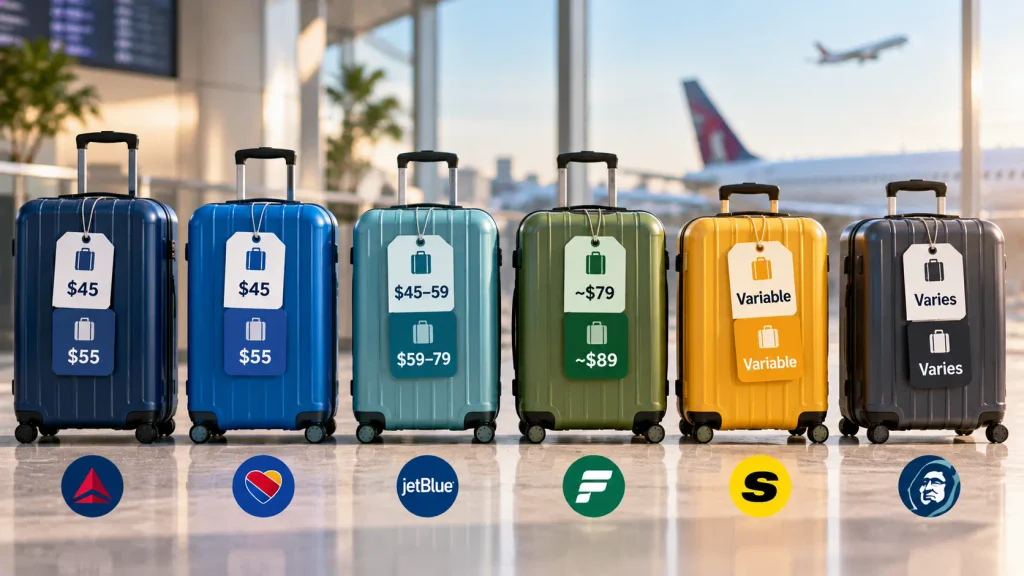
Checked baggage fees vary by airline, but several major U.S. carriers now charge approximately $45 for the first standard domestic checked bag. Second bags generally cost more, and low-cost airlines often use variable pricing based on the flight and purchase timing.
The following comparison covers typical domestic economy travel without elite status, qualifying credit card benefits, or other baggage exemptions.
| Airline | First checked bag | Second checked bag |
| Delta Air Lines | $45 | $55 |
| Southwest Airlines | $45 | $55 |
| JetBlue | 45–59 | 59–79 |
| Frontier Airlines | Variable; approximately $79 in a published comparison | Variable; approximately $89 in that comparison |
| Spirit Airlines | Dynamic pricing | Dynamic pricing |
| Alaska Airlines | Depends on ticket date, fare, and route | Depends on ticket date, fare, and route |
Illustrative standard domestic fees, based on published airline policies and an industry comparison. JetBlue pricing varies by travel date and payment timing; Frontier and Spirit prices can change by itinerary. Older tickets may retain earlier baggage rates.
The Points Guy+2
These figures should be treated as a comparison starting point, not a guaranteed price for every reservation. The airline’s booking or check-in system provides the applicable charge for a specific journey.
What Is the Checked Baggage Fee on Delta Air Lines?
Delta Air Lines generally charges $45 for the first checked bag and $55 for the second on qualifying domestic Delta Main and Delta Comfort tickets purchased under its updated baggage fee schedule.
The standard allowance is 50 pounds (23 kg) per suitcase, with maximum dimensions of 62 linear inches. Premium cabin passengers and eligible SkyMiles members may receive additional baggage benefits.
For example, a traveler checking two standard bags on a domestic Delta flight would pay $100 each way, or $200 for a round trip, assuming no exemptions apply.
Delta also says baggage fees can depend on when you purchased the ticket, so that older reservations may have different charges.
Does Southwest Airlines Still Offer Two Free Checked Bags?
No. Southwest Airlines no longer provides two complimentary checked bags as a universal benefit on ordinary fares.
Under its updated fee schedule, the first checked bag costs $45 and the second costs $55, unless a qualifying fare, loyalty benefit, or credit card benefit exempts you.
Southwest continues to offer complimentary checked baggage to certain eligible passengers, including qualifying Rapid Rewards members and cardholders.
For example, a passenger with an eligible Southwest credit card may receive a first checked bag benefit that is not available to another passenger purchasing the same standard fare without that benefit.
How Much Does JetBlue Charge for Checked Baggage?
JetBlue uses variable checked baggage pricing based on travel dates, fare categories, and when you purchase the bag.
For standard domestic travel, its published off-peak first-bag price starts at $45 under specified advance-purchase conditions, while peak-period and later-purchase charges can be higher.
| JetBlue domestic baggage | Off-peak | Peak |
| First bag | From $45 | From $49 |
| Second bag | From $59 | From $69 |
Illustrative published rates for eligible domestic fare categories when purchased more than 24 hours before departure. Other purchase windows and fares may differ.
JetBlue
JetBlue Mint, eligible Mosaic members, and certain cardholders may receive complimentary baggage benefits.
The airline’s pricing model makes early baggage planning especially useful because costs may rise closer to departure.
What Are Alaska Airlines’ Checked Baggage Fees?
Alaska Airlines increased its standard checked baggage fees for qualifying tickets purchased on or after April 10, 2026. The airline charges $45 for the first checked bag and $55 for the second on applicable North American flights.
The third and additional checked bag fee is $200 per bag. Certain routes within Hawaii and Alaska have different allowances, while eligible Atmos Rewards members and qualifying cardholders may receive free checked bags.
For passengers comparing Alaska with other full-service airlines, the standard first-bag fee is now broadly similar. However, regional travel benefits and frequent-flyer status can change the overall cost.
How Much Do Frontier and Spirit Airlines Charge for Baggage?
Frontier and Spirit use a different baggage pricing approach from many traditional carriers. Instead of a single fixed fee for all domestic flights, charges vary by route, travel date, purchase timing, and selected fare or bundle.
How Does Frontier Airlines Calculate Checked Baggage Fees?
Frontier prices checked bags dynamically and typically charges more when passengers add luggage at the airport than when they buy it in advance.
One important difference is the weight allowance. Frontier’s standard checked baggage limit is 40 pounds (18.1 kg), compared with the 50-pound limit used by several other U.S. airlines.
According to Frontier’s published rules, the following additional charges apply:
| Checked bag weight | Additional fee |
| Up to 40 lbs | No overweight charge |
| 41–50 lbs | $75 |
| 51–99.99 lbs | $100 |
| 100 lbs or more | Not accepted |
For example, a 48-pound suitcase that meets Delta’s standard weight allowance may trigger a $75 overweight charge on Frontier, in addition to the checked baggage fee.
Does Spirit Airlines Have a Fixed Checked Bag Fee?
Spirit Airlines does not apply one universal checked baggage fee across all bookings. The price depends on the itinerary, purchase stage, and available fare options.
Some bundles include baggage benefits, while other reservations require passengers to purchase checked luggage separately.
Travelers should review the baggage price displayed during booking rather than assuming a published average represents their actual charge.
What Is the Standard Checked Baggage Size and Weight Limit?
Most major U.S. airlines permit standard checked luggage measuring up to 62 linear inches (158 cm), including handles and wheels. The common economy weight allowance is 50 pounds (23 kg), though exceptions apply.
| Airline | Typical standard weight limit | Maximum standard size |
| Delta Air Lines | 50 lbs | 62 linear inches |
| Southwest Airlines | 50 lbs | 62 linear inches |
| JetBlue | 50 lbs | 62 linear inches |
| Alaska Airlines | 50 lbs | 62 linear inches |
| Frontier Airlines | 40 lbs | 62 linear inches |
Premium cabins and qualifying loyalty benefits may provide higher weight allowances. These figures apply to standard checked bags, not special equipment or oversized luggage.
How Are Linear Inches Calculated?
Airlines use linear inches to measure a suitcase’s total exterior size. The calculation is:
Length + Width + Height = Total linear inches
For example, a suitcase measuring 28 × 20 × 14 inches totals 62 linear inches and meets the common size limit.
A suitcase measuring 30 × 20 × 15 inches totals 65 linear inches and may incur an oversized baggage fee even if it weighs less than 50 pounds.
Passengers should measure the fully packed suitcase, including protruding wheels, handles, and external pockets.
How Much Do Airlines Charge for Overweight and Oversized Bags?
Overweight and oversized baggage fees are separate from the ordinary checked bag charge. An airline may impose additional penalties when a suitcase exceeds its permitted weight, dimensions, or both.
For example, Southwest charges $100 for standard bags weighing 51–70 pounds and $200 for bags weighing 71–100 pounds on qualifying mainland itineraries. Its standard oversized baggage fee is $200 for bags measuring 63–80 linear inches, with certain special-item exceptions.
A suitcase may therefore attract more than one fee. However, airlines differ in how they combine size and weight penalties, so passengers should not assume that every carrier adds all charges in the same way.
Are International Checked Baggage Fees Different From Domestic Fees?
Yes. International baggage allowances frequently differ from domestic policies because airlines consider the destination, cabin, fare type, and operating carrier.
Some international economy fares include one checked suitcase, while more restrictive tickets may charge for the first bag. Premium cabins and certain long-haul routes can also provide additional complimentary baggage.
How Do International Baggage Allowances Vary?
| International journey | What passengers should check |
| United States to Europe | Fare type and first-bag inclusion |
| United States to Asia | Destination-specific allowance |
| United States to Mexico | Regional baggage fees |
| United States to South America | Country and fare restrictions |
| United States to India | Operating airline and fare category |
| Multi-airline international journey | Applicable interline baggage rules |
Therefore, check international baggage allowances against the actual ticket rather than infer them from the airline’s domestic fee table.
Why Do Some Airlines Use a Piece Concept and Others a Weight Concept?
Airlines generally organize checked baggage allowances using either a piece-based system or a total-weight system.
Under the piece concept, passengers receive an allowance expressed as several bags, each with an individual weight limit. For example, an allowance of two pieces at 23 kg each means two separate bags, with neither normally exceeding 23 kg.
Under the weight concept, the allowance is expressed as a total permitted weight, such as 30 kg. The number of bags may be flexible, subject to the airline’s maximum per-piece weight and other restrictions.
This distinction matters when travelers are deciding how to distribute their belongings.
A passenger entitled to two 23 kg bags cannot automatically replace them with one 46 kg suitcase. Likewise, a 30 kg total allowance does not necessarily mean the airline accepts one 30 kg bag without restrictions.
Do Airlines Charge for Carry-On Bags?
Some airlines charge for full-sized carry-on bags, while others include one carry-on and one personal item in their standard ticket allowance.
Traditional full-service U.S. carriers generally include a carry-on bag in eligible fares. Low-cost airlines may charge separately for overhead-bin baggage, especially on basic or unbundled tickets.
| Airline category | Typical carry-on arrangement |
| Major full-service U.S. airlines | Usually one carry-on and one personal item included |
| Low-cost airlines | Personal item may be included; full-sized carry-on may cost extra |
| Premium fare products | Carry-on and additional baggage benefits may be included |
| Small regional aircraft | Cabin storage restrictions may require gate-checking |
Passengers should distinguish between a personal item and a carry-on suitcase. A small backpack that fits beneath the seat may qualify as a personal item, while a roller bag intended for the overhead compartment may be treated differently.
Who Can Check Bags for Free?
Complimentary checked baggage is available through several airline programs and ticket benefits. However, eligibility depends on the specific airline, reservation, and passenger.
Common qualifying categories include:
- Premium cabin passengers: Business and First Class tickets often include checked baggage.
- Frequent-flyer members: Elite status can provide one or more complimentary checked bags.
- Airline credit cardholders: Certain co-branded cards offer baggage benefits.
- Active-duty military travelers: Eligible military passengers may receive additional baggage allowances.
- Selected fare bundles: Higher-priced fare products sometimes include luggage that would otherwise cost extra.
For example, Southwest’s Choice Extra fare includes two standard checked bags, while its Basic, Choice, and Choice Preferred fares generally charge separately unless another exemption applies.
Check In
The value of a baggage benefit depends on how often a passenger travels and how much luggage is usually required.
Is It Cheaper to Pay for Checked Bags Online or at the Airport?
Paying for checked baggage online can be cheaper, particularly on airlines that offer advance-purchase discounts or dynamic pricing.
The best approach is to compare baggage charges at booking, during online check-in, and at the airport, where published prices are available.
How Much Can Checked Baggage Add to a Round-Trip Flight?
Checked baggage fees are generally assessed for each direction of travel. As a result, a passenger may pay twice the one-way baggage charge on a round-trip ticket.
Consider a family of four traveling on an airline charging $45 for the first checked bag each way.
| Baggage arrangement | Round-trip cost |
| One checked bag for one passenger | $90 |
| Two passengers checking one bag each | $180 |
| Four passengers checking one bag each | $360 |
| Four passengers checking two bags each, at $45 and $55 | $800 |
These calculations assume the same fee applies in both directions and no baggage exemptions are available.
A family booking four discounted tickets might discover that checked luggage adds several hundred dollars to the trip. Comparing fares with baggage included could therefore produce a different result from comparing base airfare alone.
What Happens When a Flight Includes More Than One Airline?
Baggage policies can become more complicated when passengers travel on connecting flights operated by different carriers.
For example, a passenger may buy one international ticket that includes a domestic U.S. flight followed by an overseas connection. The baggage allowance may be determined by applicable interline rules rather than simply applying each airline’s domestic policy independently.
The operating airline, marketing airline, itinerary structure, and governing regulations can affect which rules apply.
Passengers should check:
- The baggage allowance printed on the ticket.
- Which airline operates each flight.
- Whether the flights are included in one reservation.
- Whether checked bags are transferred automatically.
- Whether additional baggage payment is required during a connection.
A single booking does not always mean that every carrier has identical cabin baggage dimensions or special-item rules.
For U.S.-origin or U.S.-destination itineraries, specific regulatory requirements can affect the disclosure and application of baggage allowances.
Can Passengers Get a Refund if Checked Baggage Is Lost or Delayed?
Yes. Under U.S. Department of Transportation rules, passengers who pay checked baggage fees may qualify for refunds when their luggage is lost or significantly delayed.
The refund eligibility thresholds depend on whether the journey is domestic or international.
| Flight type | Significant baggage delay |
| Domestic U.S. flight | More than 12 hours |
| International flight lasting 12 hours or less | More than 15 hours |
| International flight lasting over 12 hours | More than 30 hours |
Passengers must file a mishandled baggage report with the airline. Certain exceptions apply, including situations where travelers fail to collect and recheck luggage as required during an international connection.
Can Passengers Claim Expenses for Delayed Luggage?
Airlines may also be responsible for reasonable, verifiable expenses incurred because of delayed baggage, subject to applicable liability limits.
For example, a passenger whose checked suitcase fails to arrive at the destination may need to purchase essential toiletries or basic clothing.
Travelers should retain receipts, file a baggage report promptly, and follow the airline’s claim procedure.
A baggage fee refund and reimbursement for necessary expenses are separate matters.
How Can Travelers Reduce Checked Baggage Costs?
Reducing baggage expenses requires comparing the full journey cost and understanding the limitations attached to each fare.
The following practices can help:
- Compare fares with baggage included. A more expensive ticket may offer better value if you need checked luggage.
- Check the airline’s weight limit. A 45-pound suitcase may be acceptable on one carrier but overweight on another.
- Pay in advance when cheaper. Some airlines offer lower baggage prices during booking.
- Use eligible loyalty benefits. Frequent-flyer status and qualifying credit cards may provide complimentary bags.
- Measure the suitcase before departure. Oversized baggage fees can exceed the cost of checking a standard bag.
- Avoid unnecessary additional bags. Packing efficiently can reduce the number of paid pieces.
- Review international allowances. Some long-haul fares already include checked luggage.
Passengers should also consider carrying essential items in a permitted cabin bag, especially on journeys with tight connections.
Wrapping Up!
Airline baggage policies in 2026 show that the cost of checking a suitcase can vary substantially, even between airlines with similar ticket prices. Standard domestic first-bag charges typically start around $45, but additional bags, overweight luggage, international routes, and low-cost carrier pricing can raise the total.
Before completing a reservation, passengers should check the baggage allowance attached to the selected fare, compare advance-payment options, and confirm whether any complimentary baggage benefits apply.
The most useful comparison isn’t just the flight price, but the total cost of transporting the passenger and the luggage needed for the journey.
Frequently Asked Questions!
No. Some international fares include one checked bag, while others charge for it. The allowance depends on the airline, destination, cabin, and ticket category.
Some airlines permit limited baggage pooling under specific conditions, but others apply individual bag limits. Passengers should not assume that two separate allowances can be combined into one overweight suitcase.
Airlines commonly assess checked baggage charges by journey or check-in direction, but the rules depend on the ticket and carriers involved. Separate tickets may result in additional baggage charges.
No. Although 23 kg is a common economy checked baggage limit, some airlines allow less. Frontier, for example, has a standard checked baggage limit of 40 pounds (about 18.1 kg).
Most airlines assess checked baggage fees per passenger and per checked bag, generally for each direction of travel. Complimentary allowances may differ between passengers on the same reservation.
Some airlines accept properly packaged boxes as checked baggage, subject to size, weight, destination, and seasonal restrictions. Some routes prohibit boxes or limit how many you can check.
Many airlines allow qualifying strollers and child safety seats to be checked without an additional standard baggage charge. The exact conditions depend on the carrier and equipment.
Yes. Many airlines let passengers add checked baggage after booking through their website, mobile app, or at the airport check-in counter. The price may vary depending on when you purchase the bag.
On airlines with a 50-pound standard checked baggage allowance, a suitcase weighing exactly 50 pounds generally meets the weight limit. Other restrictions, including size and piece allowance, still apply.
Not always. Refund eligibility depends on the airline’s terms, the cancellation circumstances, and applicable consumer-protection regulations. Fees paid for baggage that is lost or significantly delayed are subject to separate protections.