
Is Paying More to Fly Into a Closer Airport Worth It?
Paying more to fly into the closest airport can be worthwhile because it reduces ground transportation costs, saves travel time, and makes the journey less tiring. A cheaper flight to a distant airport may look attractive when booking, but the savings can disappear once you factor in train tickets, taxis, rental cars, and extra travel time.
However, the closest airport is not always the most convenient. A larger, farther airport may offer faster rail connections, more frequent flights, or nonstop service that makes the overall journey easier.
For example, a traveler booking a hotel in central London might compare Heathrow, Gatwick, Stansted, and Luton. The lowest airfare doesn’t necessarily mean the lowest total cost to reach the hotel.
Choosing the right airport requires looking beyond the ticket price. This guide explains why airport proximity matters, when paying a premium makes financial sense, how to compare airport transfers, and when a farther airport may actually be the better choice.
Explore More: Can You Reserve a Flight Without Making a Payment?
Why Does the Airport Closest to a Destination Matter?
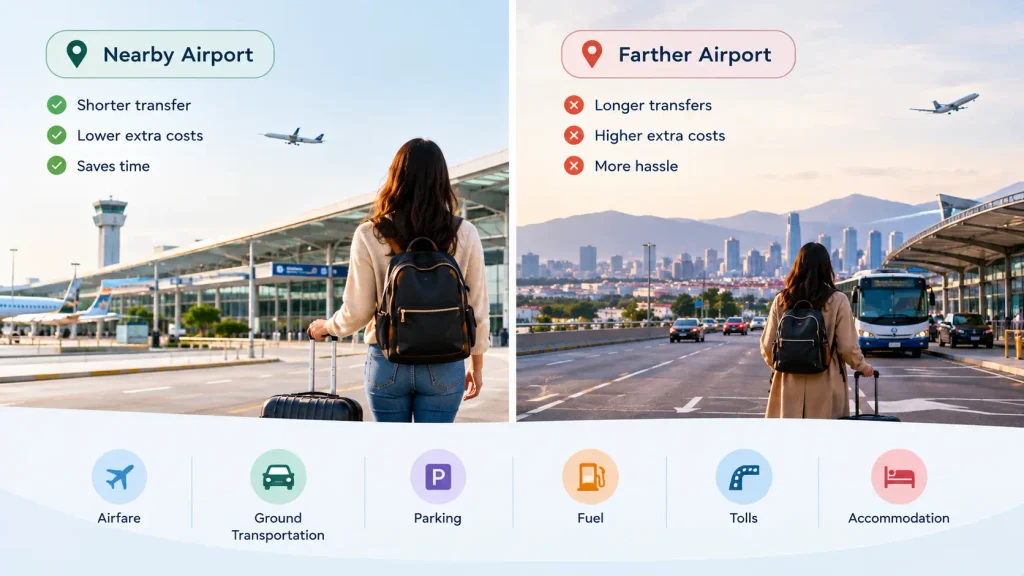
The closest airport matters because the journey continues after the aircraft lands. Travelers still need to collect their baggage, leave the airport, and reach their accommodation or final destination.
A farther airport can add transportation costs, longer transfers, and greater exposure to traffic or service disruptions.
How Does Airport Distance Affect the Total Cost of a Trip?
Airport distance affects the total cost through ground transportation, parking, fuel, tolls, and sometimes accommodation.
Consider two hypothetical flights to the same destination:
| Expense | Nearby airport | Distant airport |
| Airfare | $260 | $185 |
| Airport transfer | $20 | $75 |
| Additional transportation | $0 | $25 |
| Total one-way cost | $280 | $285 |
Although the distant airport saves $75 on airfare, the final journey costs $5 more.
These figures are illustrative rather than live prices. Actual transfer costs depend on the city, travel time, and transportation provider.
Can a Nearby Airport Save More Time Than a Cheaper Flight?
Yes. A nearby airport can save several hours when the alternative requires a long bus journey, multiple train changes, or a rental car.
For a short weekend trip, an extra two-hour transfer each way eats up four hours you could otherwise spend at the destination.
That difference matters most when the traveler has only a limited number of days.
Why Can Paying More for a Nearby Airport Be Worth It?
Higher airfare can offer better overall value by eliminating an expensive or inconvenient transfer. This benefit is especially noticeable on short trips, late arrivals, and journeys with several passengers.
1. Can a Nearby Airport Reduce Ground Transportation Expenses?
Yes. Airports closer to your destination may require only a short taxi ride or public transit trip, while distant airports can mean costly transfers.
The difference becomes more important for families and groups. A per-passenger shuttle service may cost four travelers considerably more than one.
For example, a family choosing a distant airport might save $40 per person on airfare but spend $180 on an additional private transfer. The apparent $160 airfare saving would disappear.
2. Why Is Travel Time Just as Important as Ticket Price?
Travel time matters because a lower fare doesn’t compensate every traveler equally for extra hours spent getting to the destination.
For someone taking a three-day vacation, losing half a day to airport transfers can significantly reduce the available sightseeing time.
Business travelers may value time even more when a delayed arrival affects meetings or professional commitments.
3. Does a Shorter Airport Transfer Reduce Travel Fatigue?
A shorter transfer can make the journey less tiring, particularly after a long-haul flight.
Passengers may already have spent several hours navigating departure procedures, flying, and collecting baggage. Adding a long drive or multiple public transportation connections can make the final stage unnecessarily demanding.
This is especially relevant for travelers with young children, older passengers, or those carrying substantial luggage.
4. Can Nearby Airports Make Late-Night Arrivals Easier?
Yes. A nearby airport may be more convenient when flights arrive after public transportation becomes less frequent.
At a distant airport, a late arrival could require an expensive taxi or an overnight hotel stay.
Before booking, travelers should check whether their intended bus or train service operates at the actual arrival time, allowing for baggage collection and possible delays.
5. Can Flying Closer Reduce the Risk of Missing Important Events?
Yes. A shorter journey from the airport reduces the number of transfers that traffic, weather, or transportation delays could disrupt.
For example, someone attending a wedding or conference may prefer a flight that arrives near the venue rather than relying on a long onward journey.
However, the closest airport is not automatically the most reliable choice. Flight frequency and available backup services also matter.
6. Is a Nearby Airport Better for Travelers With Heavy Luggage?
Often. Traveling with several suitcases makes every train change, bus transfer, and long walk more demanding.
A slightly more expensive flight into a convenient airport may let travelers reach their accommodation with a single taxi or direct train.
This can be particularly valuable for families, passengers with mobility requirements, and people transporting equipment.
How Can Travelers Calculate Whether a Higher Airfare Is Worth Paying?
Travelers can compare airports by adding the airfare, ground transportation, baggage charges, and other necessary expenses. They should then consider the time and inconvenience associated with each journey.
A useful calculation is:
TotalTripCost=Airfare+Transfers+OtherTravelExpenses
The financial calculation identifies the cheaper option, while travel time helps determine which option offers better overall value.
What Is the Break-Even Point for Choosing a Closer Airport?
The break-even point is the maximum airfare premium you can pay before the nearby airport becomes more expensive in direct monetary terms.
For example:
| Expense | Closest airport | Farther airport |
| Airfare | $320 | $240 |
| Ground transportation | $25 | $90 |
| Additional transfer expenses | $0 | $20 |
| Total | $345 | $350 |
| Transfer time | 25 minutes | 2 hours |
Hypothetical figures for illustration, not live flight or transfer quotes.
In this example, the closer airport costs $80 more in airfare but saves $85 in ground transportation and related expenses.
It is therefore $5 cheaper overall and saves 95 minutes.
How Much Extra Should Travelers Pay to Save Time?
There is no universal amount. The appropriate premium depends on the traveler’s budget, trip purpose, and the value of the time saved.
Airport Convenience Calculator
Estimate whether a closer airport is worth the additional airfare. Values are illustrative and can be adjusted.
Extra airfare for closer airport
$100
Ground transportation savings
$40
Time saved
120 minutes
Personal value of time per hour
$25
Extra direct cost
$60
Estimated time value
$50
The farther airport may offer better value under these assumptions.
Time value is a personal planning estimate, not money actually saved. Use consistent one-way or round-trip figures.
When Might a Larger Airport Farther Away Be the Better Choice?
A larger airport may be the better choice when it offers substantially cheaper flights, nonstop routes, more frequent departures, or convenient ground transportation.
Distance alone does not determine airport convenience. Travelers should consider the entire journey from departure airport to their final destination.
Can Nonstop Flights Make a Distant Airport More Convenient?
Yes. A nonstop flight to a farther airport may be preferable to a connecting flight into a smaller airport.
For example, consider a hypothetical journey with two options:
| Travel component | Smaller nearby airport | Larger distant airport |
| Flight itinerary | One connection | Nonstop |
| Total flying and connection time | 6 hours | 3 hours 30 minutes |
| Ground transfer | 20 minutes | 1 hour |
| Combined travel time | 6 hours 20 minutes | 4 hours 30 minutes |
Even though the larger airport is farther from the destination, it provides a shorter overall journey.
Do Larger Airports Offer Better Flight Availability?
Often. Major airports generally have more extensive route networks and may offer more departure options on popular routes.
This can be particularly valuable when flights are delayed or canceled. An airport with several departures to the same destination may provide more rebooking possibilities than one with limited service.
However, alternative flights aren’t guaranteed, and rebooking rights depend on the airline, ticket conditions, and the cause of the disruption.
Can Public Transportation Make a Farther Airport More Practical?
Yes. An airport with a direct rail connection may be more convenient than a geographically closer airport requiring multiple transfers.
London provides a useful example:
| Airport | Example rail connection | Published journey time |
| Heathrow (LHR) | Heathrow Express to Paddington | 15 minutes from Terminals 2 and 3 |
| Stansted (STN) | Stansted Express to Liverpool Street | Approximately 48 minutes |
| Luton (LTN) | Train to St Pancras, including airport transfer | As little as 32 minutes |
Heathrow and Stansted publish these journey times through their official transport guides. Luton Airport advertises the combined journey to St Pancras and confirms that its DART shuttle links the terminal to the railway station.
The fastest rail connection isn’t necessarily the fastest route to a particular hotel. For example, a traveler staying near Liverpool Street may find Stansted more convenient than its distance from central London initially suggests.
Which Airport Should Travelers Choose in Cities With Multiple Airports?
Travelers should choose the airport that best balances flight availability, transportation costs, and access to their specific destination.
Is Heathrow, Gatwick, Stansted, or Luton Better for London?
The best London airport depends on where you’re staying.
Heathrow offers several rail connections into central London, including the Elizabeth line, Heathrow Express, and Piccadilly line. Stansted has direct rail service to Liverpool Street, while Luton connects to the rail network through the Luton DART.
Heathrow’s Elizabeth line takes approximately 28 minutes between Heathrow and Paddington, according to Transport for London.
Travelers should compare the journey to the actual accommodation address, not just the airport’s distance from central London.
Should Travelers Fly Into Newark, JFK, or LaGuardia for New York City?
The best New York-area airport depends on the destination borough, arrival time, flight options, and ground transportation.
For example, Newark Liberty International Airport may be convenient for some New Jersey destinations, while LaGuardia can be practical for parts of Queens and Manhattan. JFK may offer a more suitable international route or connection.
Traffic, transit transfers, and terminal access can change how convenient each airport is.
Is Flying Into a Smaller Regional Airport Worth the Extra Fare?
A regional airport can be worthwhile when it eliminates a long drive from a major airport.
Consider someone visiting Santa Barbara, California. Flying into Santa Barbara Municipal Airport (SBA) may cut the long drive from Los Angeles International Airport (LAX).
However, travelers should compare the flight schedule, potential connections, and total cost. A nonstop flight into Los Angeles followed by a straightforward transfer may still be better than a much longer connecting itinerary into Santa Barbara.
How Does the Closest Airport Affect Different Types of Travelers?
The value of airport proximity depends on the trip’s purpose and the traveler’s circumstances.
| Traveler type | Why a closer airport may help | What else matters |
| Business traveler | Less transfer time before meetings | Flight frequency and reliability |
| Family with children | Fewer lengthy transfers | Baggage, car seats, and transport options |
| Weekend traveler | More usable vacation time | Flight arrival and departure times |
| Older traveler | Less walking and luggage handling | Accessibility and assistance |
| Group traveler | Potentially lower combined transfer costs | Group transportation prices |
| Budget traveler | Reduced ground transportation expenses | Total airfare difference |
| International traveler | Simpler final journey after a long flight | Entry procedures and connections |
Is Paying More for a Closer Airport Worth It on a Short Vacation?
Often, because time makes up a larger share of a short trip.
On a two-night getaway, spending four additional hours traveling between the airport and accommodation can substantially reduce the time available for activities.
For a longer holiday, the same transfer may be easier to accommodate, especially if it creates meaningful savings.
Is a Nearby Airport Better for Families?
A nearby airport may simplify travel for families carrying strollers, car seats, and multiple bags.
However, families should also compare direct flights, airport facilities, and available transportation. A longer direct train journey may be easier than a shorter one with several changes.
Does Airport Proximity Matter for Travelers With Disabilities?
Yes, but accessibility should be assessed alongside distance.
A closer airport may reduce transfer time, while a farther airport could offer a more suitable accessible rail connection or ground transportation service.
Travelers should verify wheelchair-accessible vehicles, step-free station routes, airline assistance arrangements, and the availability of suitable pickup locations before booking.
How Can Travelers Compare Airports Before Booking a Flight?
Travelers should compare airports based on the total door-to-door journey, not airfare alone.
A practical comparison involves checking:
- The final destination address: Search the actual hotel, office, or event venue rather than the city center.
- Flight prices and schedules: Compare nonstop and connecting services, including arrival times.
- Ground transportation: Calculate taxi, rail, shuttle, rental car, toll, and parking expenses.
- Transfer duration: Include waiting times and any necessary changes between services.
- Travel companions: Account for luggage, children, mobility requirements, and group size.
- Disruption risks: Consider traffic, limited late-night transportation, and the availability of alternative flights.
- Return travel: Repeat the calculation for the departure journey, which may have different transportation costs or schedules.
What Is the Biggest Mistake When Comparing Nearby Airports?
The biggest mistake is treating the lowest airfare as the lowest total travel cost.
A flight comparison website may show a ticket that is $100 cheaper, but it may not include the cost of getting from a distant airport to your destination.
Travelers should also avoid comparing airport-to-city-center distances when their accommodation is in a different neighborhood or surrounding town.
Check Out Our Latest Travel Updates: Full List of Airport Lounges at Philadelphia International Airport
Wrapping Up
Paying more for the closest airport can be practical when it saves enough on transportation costs, time, and inconvenience to justify the higher airfare. However, the closest airport should not automatically win. A farther airport with a nonstop flight, convenient train service, or significantly lower total cost may provide better value.
Frequently Asked Questions!
No. Smaller airports may have higher fares because of limited flight competition or fewer available routes. However, their lower ground transportation costs can sometimes make them cheaper overall.
It depends on the complete journey. Smaller airports may offer shorter transfers, while major airports can provide more nonstop flights, better connections, and more scheduling flexibility.
There is no fixed amount. Travelers should calculate the transportation savings and decide how much they value the extra time and convenience.
Yes. A farther airport may offer significantly lower airfares that offset the added transportation costs. This is more likely to be worthwhile when affordable and convenient ground transportation is available.
Yes. Ground transportation can substantially affect the final trip cost, especially when traveling with a group, arriving late at night, or using taxis instead of public transportation.
Sometimes. A nonstop flight can eliminate lengthy connections and reduce certain disruption risks. Travelers should compare total journey duration rather than prioritizing airport distance alone.
Yes. Arriving late at night at a distant airport may require an extra hotel stay if onward transportation is unavailable or inconvenient.
Some regional airports have shorter walking distances and simpler terminal layouts, but this varies. Check security wait times, accessibility, parking, and airline facilities at each airport.
It can. A shorter journey to the airport may reduce the need to leave accommodation extremely early. However, travelers should still follow the airline’s recommended airport arrival time.
Not necessarily. An open-jaw or multi-city itinerary can help when travelers start and end their trip in different locations. The best arrangement depends on flight prices, transportation, and the overall route.