
Credit Card Travel Insurance: Coverage, Benefits & Limits
Credit card travel insurance can cover certain trip cancellations, travel delays, baggage issues, and rental-car damage, but it may not protect expensive trips or medical emergencies abroad. The benefits vary by card, the expenses charged to it, the reason for a claim, and the insurer’s terms.
For travelers, the appeal is straightforward: some credit cards include travel protections without a separate premium for each trip. However, complimentary coverage does not mean unlimited coverage. A card may reimburse eligible hotel expenses after a lengthy delay but offer little or no medical insurance, or it may cover cancellation only for specific unexpected events.
This guide explains what credit card travel insurance typically includes, what it excludes, how claims work, and when buying a separate policy makes sense.
Explore This Blog: How to Choose a Credit Card for Rent Payments in 2026
What Is Credit Card Travel Insurance?

Credit card travel insurance is a set of insurance benefits attached to an eligible credit card. Depending on the card, these benefits may help reimburse covered financial losses caused by an unexpected travel disruption.
Unlike a standalone travel insurance policy, which travelers purchase specifically for a trip, credit card protection is usually linked to card membership and qualifying travel purchases. Coverage may be provided by an insurance company or benefit administrator, with the card issuer setting out the applicable terms.
Common benefits include:
- Trip cancellation and interruption insurance
- Trip delay reimbursement
- Baggage delay and lost luggage protection
- Travel accident insurance
- Rental-car collision or theft coverage
- Emergency medical or evacuation benefits on some cards
- Travel and emergency assistance services
Not every credit card offers every benefit. Premium travel cards often offer a wider range of protections, but a higher annual fee doesn’t automatically guarantee the coverage a traveler needs.
For example, a card might reimburse eligible non-refundable hotel and airfare costs if a covered illness forces a traveler to cancel. The same card may not cover a cancellation caused by simply changing one’s mind.
The card’s Guide to Benefits is the most important document to check before relying on any of these protections.
What Does Credit Card Travel Insurance Cover?
Coverage depends on the individual card and its benefits, but several types of protection are common on travel-focused credit cards.
1. Trip Cancellation Insurance
Trip cancellation insurance may reimburse eligible prepaid, non-refundable travel expenses when a covered event prevents a traveler from departing.
Depending on the policy, qualifying events can include:
- An unexpected illness, injury, or death affecting the traveler or an eligible family member
- Severe weather that prevents travel
- Certain mandatory legal obligations
- Other specifically listed emergencies
The reason for cancellation must satisfy the policy’s definition of a covered event. A general desire to postpone a holiday, a change in personal plans, or an event not listed in the policy usually will not qualify.
Example: A traveler pays for a non-refundable flight and hotel using an eligible card. Before departure, the traveler suffers a serious injury that makes the trip medically inadvisable. If the injury meets the policy conditions, trip cancellation insurance may reimburse eligible prepaid costs, subject to the coverage limit and documentation requirements.
Reimbursement is not necessarily equal to the entire booking value. Taxes, excluded costs, supplier refunds, and benefit caps can affect the final payment.
2. Trip Interruption Insurance
Trip interruption insurance applies when a covered event forces a traveler to cut a trip short or interrupts the journey after departure.
Depending on the policy, eligible expenses may include unused, non-refundable portions of the trip and certain additional transportation costs. However, the benefit may not pay for every expense associated with returning home early.
For example, a traveler on a two-week holiday may need to return home after a covered family emergency. The card’s insurance may reimburse eligible unused hotel nights and prepaid activities, but a new return ticket may be subject to separate conditions or exclusions.
Before assuming a replacement flight will be covered, check whether the policy includes additional transportation expenses and how those expenses are calculated.
3. Trip Delay Insurance
Trip delay insurance can help cover reasonable additional expenses when a qualifying delay exceeds the minimum time stated in the policy.
Eligible costs may include:
- Meals and refreshments
- Hotel accommodation
- Essential personal items
- Other reasonable expenses specifically allowed by the policy
The delay threshold varies by card. Some benefits begin after six hours, while others require a longer delay or an overnight stay. The covered causes and maximum reimbursement also differ.
For example, Chase lists trip-delay reimbursement of up to $500 per covered traveler for eligible Sapphire Preferred cardholders after a delay of more than 12 hours or an overnight stay. Its Sapphire Reserve benefit uses a shorter delay threshold. The relevant Guide to Benefits determines eligibility and exclusions.
Keep itemized receipts and obtain written confirmation of the delay from the airline. A benefit may reimburse expenses after the qualifying delay, but it doesn’t necessarily cover every inconvenience or lost booking.
4. Baggage Delay and Lost Luggage Insurance
Some travel cards provide protection when checked baggage is delayed, lost, damaged, or stolen during a covered trip.
Baggage delay coverage may reimburse essential purchases such as toiletries, clothing, and other permitted necessities when luggage does not arrive within the policy’s required timeframe.
Lost luggage coverage may help pay to repair or replace eligible belongings if checked or carry-on baggage is lost, damaged, or stolen under covered circumstances.
Important restrictions can include:
- A minimum baggage-delay period
- Per-person and per-item limits
- Exclusions for certain valuables or fragile items
- Requirements to report the problem to the airline
- Proof of ownership and purchase value
- Deduction of payments made by the airline or another insurer
Suppose a suitcase arrives the following day. A traveler may be able to claim reasonable essential purchases if the delay meets the card’s requirements. However, expensive designer clothing or luxury accessories may exceed benefit limits or fall under specific exclusions.
Report missing baggage to the airline promptly and keep the property irregularity report, baggage tag, receipts, and airline correspondence.
5. Travel Accident Insurance
Travel accident insurance generally provides a specified benefit for qualifying accidental death or certain serious injuries associated with covered travel.
This protection differs from ordinary medical insurance. It does not necessarily pay routine hospital bills, prescription costs, or treatment for an illness.
Some policies cover accidents while traveling on a qualifying common carrier, such as an airline, train, or cruise ship. Others may define covered travel differently.
Review the policy’s definitions of covered persons, transportation, accidents, and benefit amounts. Do not assume that travel accident insurance provides comprehensive health coverage.
6. Rental-Car Collision and Theft Protection
Eligible credit cards may provide a collision damage waiver or similar rental-car protection. Depending on the policy, it can cover qualifying damage to or theft of a rental vehicle.
This benefit may help travelers avoid purchasing a rental company’s collision damage waiver, but it is important to compare the protections carefully.
Coverage may depend on:
- Paying for the eligible rental with the card
- Declining the rental company’s collision damage waiver when required
- The type and value of the vehicle
- The country where the vehicle is rented
- The rental period
- Whether the driver follows the rental agreement
Certain luxury vehicles, commercial vehicles, motorcycles, or rentals in specific countries may be excluded.
Credit card rental coverage generally does not replace liability insurance for injuries or property damage caused to other people. It may also exclude theft of personal belongings from the vehicle.
Primary versus secondary coverage: Primary rental-car coverage can pay eligible claims without requiring the traveler to claim first through personal auto insurance. Secondary coverage generally applies after other eligible insurance. The distinction varies by card and country, so confirm it in the policy.
7. Emergency Medical and Medical Evacuation Benefits
Some travel cards offer limited emergency medical or evacuation benefits, but many do not provide comprehensive medical protection.
Emergency medical insurance may help pay eligible treatment costs for a sudden illness or injury during a covered trip. Medical evacuation coverage may help arrange and pay for medically necessary transportation to an appropriate medical facility, subject to the policy’s terms.
These benefits are especially important for international travel, cruises, remote destinations, and trips involving outdoor activities. A medical evacuation can involve specialized transportation and substantial expenses.
The U.S. Centers for Disease Control and Prevention advises international travelers to consider travel health insurance and medical evacuation insurance because ordinary health plans may provide limited or no coverage abroad.
Before relying on a credit card, verify:
- Whether emergency medical expenses are covered at all
- The maximum medical benefit
- The evacuation limit and who authorizes transportation
- Whether pre-existing conditions are excluded
- Whether coverage applies to every traveler in the party
- Whether the benefit is primary or secondary
A travel assistance card may provide referrals or help coordinate services without paying the resulting medical bills. Assistance and insurance are not the same thing.
What Does Credit Card Travel Insurance Usually Not Cover?
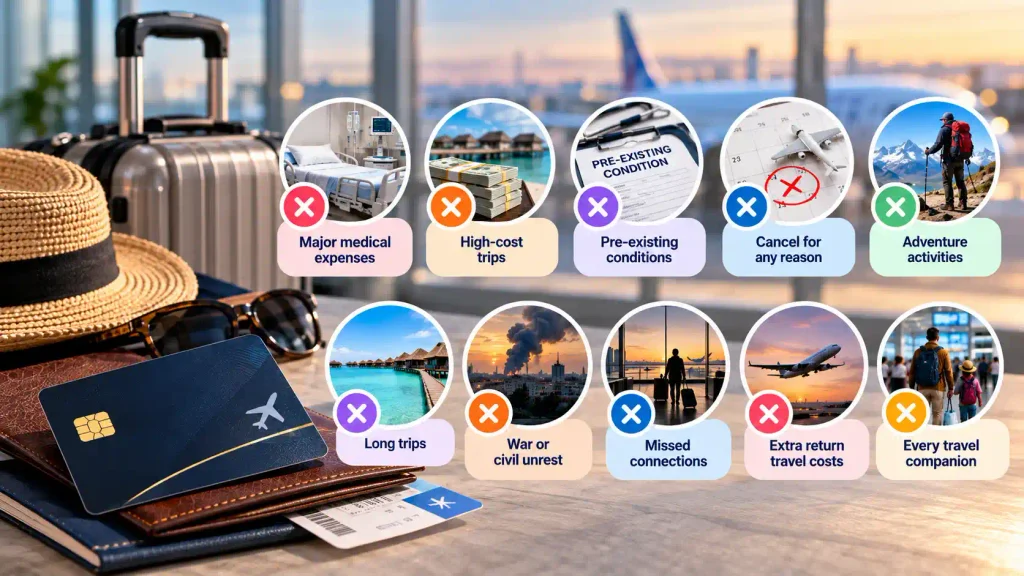
Credit card travel insurance can have significant limitations, especially for travelers who need broad medical protection or flexibility to cancel for reasons outside a policy’s list of covered events.
| Potential gap | Why it matters |
| Major medical expenses | Many cards provide no emergency medical coverage, while others have limited benefits |
| High-cost trips | Cancellation and interruption limits may be lower than the total amount prepaid |
| Pre-existing conditions | Some policies exclude related claims or impose specific eligibility conditions |
| Cancel For Any Reason | Most card benefits do not provide unrestricted cancellation protection |
| Adventure activities | Certain sports or hazardous activities may be excluded |
| Long trips | Benefits may apply only to trips within a defined duration |
| War or civil unrest | Specific exclusions may apply to losses associated with these events |
| Missed connections | A connection missed after a short delay may not meet the policy’s threshold |
| Extra return travel | New transportation costs after an interruption may be limited or excluded |
| Every travel companion | Eligibility may depend on the relationship to the cardholder and how the trip was paid for |
These are common limitations, not universal exclusions. The precise wording of the policy controls.
Is Medical Coverage the Biggest Gap?
For many international travelers, medical coverage deserves particular attention. A card may offer useful reimbursement for a delayed flight but no meaningful protection for an unexpected hospitalization.
For example, someone visiting a remote region may need emergency transportation to a hospital in another city or country. If the card lacks an evacuation benefit or has a low limit, the traveler could face substantial out-of-pocket costs.
Travelers should also confirm whether their existing health insurance covers treatment abroad, emergency transport, and repatriation. Do not assume that a domestic health plan automatically provides international coverage.
Does Credit Card Insurance Cover Pre-Existing Medical Conditions?
Coverage for pre-existing conditions varies by card and policy. Some benefits exclude losses related to certain existing medical conditions; others may offer limited exceptions or specific eligibility provisions.
A condition’s diagnosis date, treatment history, stability, and the policy’s lookback period may matter. Travelers with ongoing medical needs should read the actual policy language and consider a separate plan that expressly addresses their circumstances.
How Does Credit Card Travel Insurance Work?
Credit card travel insurance usually requires a qualifying purchase and a documented claim. Simply carrying a travel credit card doesn’t mean every trip or expense is insured.
Do You Have to Pay for the Entire Trip With the Card?
Many card benefits require the traveler to charge the full eligible fare or a specified portion of the trip to the card. Some allow qualifying reward-point redemptions or partial payments; others use stricter payment rules.
For instance, American Express’s U.S. trip cancellation and interruption terms specify eligible round-trip purchases made entirely with the qualifying card, subject to the applicable benefit guide. Other cards can have different requirements.
Before booking, check whether the requirement applies to airfare alone or also to other travel expenses. Paying for a flight with the card doesn’t automatically insure a separately booked hotel unless the benefit’s terms extend to that expense.
Who Is Covered?
The policy may cover the primary cardholder, an eligible spouse or domestic partner, dependent children, and sometimes other traveling companions. The definitions vary.
Check whether:
- A companion must travel with the cardholder.
- Family members are covered when traveling separately.
- Authorized users receive the same benefits.
- Every traveler must have part of the trip paid for with the eligible card.
- Age or residency requirements apply.
Do not assume that everyone on a group booking is automatically insured.
Is Credit Card Travel Insurance Primary or Secondary?
Primary coverage generally pays eligible claims before other applicable insurance. Secondary coverage typically applies after other coverage has been considered.
The answer can differ between benefits on the same card. A card might provide primary rental-car coverage but secondary trip cancellation or medical coverage. The policy’s coordination-of-benefits provisions explain how it handles claims.
How Do Travelers File a Claim?
The process usually begins with contacting the benefit administrator listed in the Guide to Benefits. Some issuers offer an online claims portal; others require an initial phone call or written notice.
Travelers may need to provide:
- The original itinerary and booking confirmation
- Credit card statements showing eligible payments
- Receipts for expenses being claimed
- Proof of cancellation, delay, or baggage loss
- Medical documentation when relevant
- Refunds or payments received from airlines, hotels, or other insurers
Claim notification deadlines can be short. Check the policy as soon as the disruption occurs rather than waiting until after the trip.
Read More Here: No-Annual-Fee Business Credit Cards: 6 Options for 2026
Credit Card Travel Insurance vs. Standalone Travel Insurance
A standalone travel insurance policy is purchased specifically for a trip or travel period. It may offer more comprehensive or customizable benefits, depending on the plan selected.
| Feature | Credit card travel insurance | Standalone travel insurance |
| Separate premium | Often included with eligible card membership | Usually requires a separate premium |
| Trip cancellation | Available on some cards, with defined covered reasons and limits | May offer broader options, depending on the plan |
| Trip delay | Available on some cards after a qualifying delay | Available on many plans, subject to terms |
| Baggage protection | May cover delay, loss, or damage | May offer similar benefits with different limits |
| Emergency medical | Often limited or absent | Medical-focused and comprehensive plans may offer higher limits |
| Medical evacuation | Available on some cards, but limits vary | Plans may offer higher or more tailored limits |
| Pre-existing conditions | Often restricted | Some policies offer a waiver if eligibility conditions and deadlines are met |
| Cancel For Any Reason | Generally not included | May be available as an optional benefit on eligible policies |
| Customization | Limited to the card’s benefits | Options may be available for trip cost, medical limits, and activities |
Standalone policies are not automatically superior in every category. Some card benefits can be valuable, while separately purchased policies may have exclusions or low limits. Compare the actual wording and limits rather than relying on product labels.
When Should Travelers Buy Additional Travel Insurance?
Consider a separate policy when the card’s benefits leave a financial gap the travelercan’tt comfortably absorb.
International Trips
Travelers going abroad should first review emergency medical and evacuation coverage. Medical costs, transport arrangements, and access to suitable treatment can differ considerably by destination.
A separate travel medical policy may be useful even when a card already covers trip delays and cancellation.
Expensive Vacations
If a trip includes costly flights, non-refundable hotels, a cruise, private tours, or prepaid experiences, compare the total eligible trip cost with the card’s cancellation and interruption limits.
For example, if two travelers have prepaid $14,000 for a holiday but the card’s maximum benefit is below the amount at risk, a covered cancellation could still leave a substantial loss.
Cruises and Remote Destinations
Cruise passengers and travelers visiting remote locations should check whether evacuation benefits cover transportation from a ship or isolated area. They should also review whether the policy pays for the specific type of evacuation needed.
Adventure Activities
Travelers planning skiing, scuba diving, mountaineering, or other higher-risk activities should verify exclusions before departure. Depending on the activity and insurer, you may need a separate policy or optional sports benefit.
Flexible Cancellation Needs
Travelers who want to cancel for a reason not covered by standard trip cancellation insurance can consider Cancel For Any Reason (CFAR) coverage. It is generally an optional benefit with eligibility conditions, purchase deadlines, and partial reimbursement limits. It does not mean that a traveler can cancel at any time and receive a full refund.
How to Decide Whether Your Card’s Coverage Is Enough
Use this checklist before relying on a credit card for an upcoming trip.
- Confirm the benefits: Download the current Guide to Benefits for the exact card.
- Check payment rules: Determine how much of the trip must be charged to the card.
- Calculate your financial exposure: Add non-refundable flights, accommodation, tours, and other prepaid costs.
- Review medical protection: Check emergency treatment and evacuation limits.
- Check who is insured: Confirm eligibility for family members and travel companions.
- Review exclusions: Look for pre-existing conditions, activity restrictions, and cancellation limitations.
- Confirm trip duration: Make sure the journey falls within the benefit’s maximum covered period.
- Understand the claims process: Record deadlines, administrator contact details, and required documents.
- Compare any separate policy: Purchase additional cover if important risks remain uninsured.
A useful approach is to treat card coverage as a starting point, then purchase only the additional protection needed to address meaningful gaps. Travelers should also check their existing health insurance and any protection provided by other eligible policies to avoid having the same expense reimbursed twice.
Conclusion
Credit card travel insurance can provide valuable protection against eligible cancellations, delays, baggage problems, and rental-car damage without requiring a separate policy for every trip. However, its limitations can become costly when a journey involves expensive prepaid arrangements or a medical emergency abroad.
Before departure, review the exact card benefits, payment requirements, covered travelers, exclusions, and claim deadlines. If medical treatment, evacuation, or non-refundable trip costs exceed the card’s limits, compare standalone policies and choose additional coverage that addresses those specific gaps.
Frequently Asked Questions
No. Travel insurance is more common on travel-focused and premium credit cards, but benefits vary by issuer and product. Some cards provide only limited protections, while others include several types of travel insurance. Check the card’s current Guide to Benefits.
It may cover eligible prepaid accommodation, including some vacation rentals, when the booking and loss meet the policy’s conditions. Coverage is not guaranteed merely because a property was booked through Airbnb. Confirm the eligible supplier definition, payment requirements, cancellation terms, and covered reasons.
Sometimes. Certain benefits include eligible family members even when they are not traveling, particularly when their illness or death triggers a covered cancellation or interruption. The definition of family member and the applicable conditions vary by policy.
Yes, travelers can hold both types of coverage. However, they must follow each policy’s claims rules and disclose other insurance or payments when required. The policies may coordinate benefits, and a traveler cannot assume both will reimburse every expense in full.
Card insurance may cover certain additional expenses caused by a qualifying delay or disruption, but it is not a substitute for the airline’s own refund and rebooking obligations. The card policy, applicable passenger-rights laws, and the reason for the cancellation all matter.
Not necessarily. A premium card may offer useful cancellation, delay, baggage, and rental-car benefits, but it may not provide adequate medical or evacuation coverage. Travelers should compare the card’s actual limits with the destination’s risks and costs.
Consider additional insurance for expensive trips, international travel, cruises, remote destinations, adventure activities, or situations with significant medical risks. It can also help when a traveler needs higher limits or coverage options the card doesn’t provide.