
The Best Flight Cancellation Insurance: What It Covers and When It’s Worth It
The best flight cancellation insurance reimburses eligible prepaid, nonrefundable travel costs when a covered event forces a traveler to cancel a trip; the right choice depends on the trip’s cost, the policy’s covered cancellation reasons, and whether existing credit-card or travel insurance already provides protection. No single plan works for every traveler, and standard cancellation coverage generally doesn’t reimburse you just because you change your mind.
Flight cancellation insurance can help protect money spent on airfare, hotels, tours, and other prepaid arrangements. However, policies differ significantly in covered reasons, reimbursement limits, exclusions, documentation requirements, and the deadline for purchasing coverage. Some plans also offer optional Cancel For Any Reason (CFAR) coverage, which can provide broader flexibility but usually reimburses only a percentage of eligible prepaid costs and comes with additional conditions.
This guide explains how flight cancellation insurance works, which providers and plan types to compare, what policies typically cover, and how to decide whether the added cost makes sense.
What Is Flight Cancellation Insurance?

Flight cancellation insurance is a form of travel insurance that can reimburse eligible nonrefundable expenses when a traveler cancels a trip for a reason listed in the policy. Depending on the plan, it may cover prepaid airfare and other insured trip expenses, such as hotel reservations, cruises, excursions, and organized tours.
Trip cancellation insurance differs from an airline’s cancellation policy. An airline may refund a ticket or offer a rebooking option under its fare rules or applicable passenger-protection laws. Travel insurance is separate: it may reimburse other qualifying losses that the airline does not refund, subject to the policy’s terms.
For example, a traveler might book a nonrefundable flight and hotel for a family holiday. If a covered medical emergency prevents the traveler from departing, a qualifying policy may reimburse the insured’s nonrefundable expenses after the claim is assessed. If the traveler simply decides to stay home because the weather forecast looks unpleasant, standard trip cancellation coverage may not apply.
See This Guide: 12 Best Websites for Booking Cheap Flights in 2026
What can cancellation insurance protect?
Depending on the plan, coverage may include:
- Nonrefundable airline tickets.
- Prepaid hotel or vacation-rental reservations.
- Unused prepaid tours, excursions, and activities.
- Other eligible travel expenses included in the insured trip cost.
Coverage is not automatic for every item. Travelers usually must insure eligible prepaid expenses, meet the plan’s purchase and claim requirements, and, when the policy requires it, subtract refunds or credits received from travel suppliers.
Is Flight Cancellation Insurance Worth It?
Flight cancellation insurance is most valuable when a traveler has a significant amount of prepaid, nonrefundable money at risk and could not comfortably absorb the loss. It may be less useful for an inexpensive ticket you can change or refund, or when a credit card already offers sufficient protection.
Consider these situations:
- An expensive international holiday: Flights, hotels, tours, and transfers can add up quickly. A covered cancellation could put several prepaid expenses at risk, not just the airfare.
- A family or group trip: One person’s illness or another covered event may disrupt multiple bookings. Travelers should check whether the policy covers the relevant family members and traveling companions.
- A cruise or tour with strict cancellation deadlines: The financial exposure can be greater when deposits or final payments become nonrefundable well before departure.
- A trip booked far in advance: More time between booking and departure creates more opportunity for circumstances to change, although insurance does not cover every future event.
- A flexible or refundable booking: If the airline and other suppliers already provide refunds or easy changes, extra insurance may offer less value.
A simple example
Suppose a traveler spends $3,000 on nonrefundable flights, accommodation,n and tours. A policy costs $180 and covers eligible cancellation losses up to the insured trip cost. If a covered event causes the traveler to cancel and the suppliers refund $500, the potential remaining eligible loss is $2,500 before applying policy limits, exclusions,s or other conditions.
That does not mean the insurer will automatically pay $2,500. The traveler must meet the policy requirements and provide supporting documents, and the insurer determines the covered amount. Still, the example shows why insurance can be worth considering when the financial exposure far outweighs the premium.
What Does Flight Cancellation Insurance Cover?
Standard trip cancellation benefits typically cover prepaid, nonrefundable trip expenses when you cancel for a reason listed in the policy. Common covered reasons may include the following, but the precise definitions and conditions vary by plan and location.
What expenses are reimbursed?
Eligible expenses may include:
- Nonrefundable airfare and airline-imposed cancellation penalties.
- Prepaid hotel or vacation-rental costs.
- Nonrefundable cruise, tour, and excursion payments.
- Other prepaid trip arrangements included in the insured trip cost.
Coverage normally applies to eligible losses rather than automatically paying the full amount of every reservation. Refunds, vouchers, credits, policy limits, and the type of booking can affect the final reimbursement.
What Flight Cancellation Insurance Usually Does Not Cover

One of the most common misunderstandings is assuming that insurance protects every reason for canceling. Standard trip cancellation coverage is based on named covered events, not unrestricted flexibility.
Common exclusions or limitations can include:
- Changing your mind: Canceling because you no longer feel like traveling is usually not covered under a standard policy.
- Fear of travel: General concern about crime, political unrest, illness, or bad weather may not qualify unless a specific policy provision applies.
- Known events: Circumstances already known or foreseeable when coverage is purchased may be excluded.
- Pre-existing medical conditions: These may be excluded unless the plan provides an applicable waiver and the traveler satisfies its requirements.
- Financial difficulties: A personal budget change or inability to afford a trip is not ordinarily a covered reason, unless a specific benefit says otherwise.
- Supplier refunds: Insurance is not meant to pay twice for the same loss. Refunds and credits may reduce the claim.
- Insufficient documentation: A claim can be delayed or denied if required evidence is missing or the cancellation does not meet the policy’s conditions.
Read the exclusions, definitions,s and claim requirements before buying. A summary of benefits is useful for comparison, but it is not a substitute for the full policy document.
What Is Cancel For Any Reason (CFAR) Insurance?
Cancel For Any Reason, commonly called CFAR, is an optional benefit that can reimburse part of eligible prepaid, nonrefundable trip costs when a traveler cancels for a reason that a standard policy would not cover. It is usually an add-on to a qualifying travel insurance plan rather than a standalone policy.
CFAR can be useful if a traveler wants the freedom to cancel because plans change, a personal concern arises, or the trip no longer feels worthwhile. However, the benefit is not unlimited: insurers commonly impose a purchase window, require the traveler to insure the full eligible trip cost, and require cancellation a specified amount of time before departure.
Check This Out: Travel Insurance Guide: Coverage & Common Exclusions
How much does CFAR reimburse?
Many CFAR benefits reimburse a percentage of eligible nonrefundable expenses rather than 100%. The percentage depends on the insurer and policy; market examples range from 50% to 75%, while certain separate products may have different terms.
For example, if a qualifying policy reimburses 75% of an eligible $2,000 loss, the potential reimbursement would be $1,500, assuming the claim meets all terms. The traveler would still be responsible for the remaining $ 500.
When should CFAR be considered?
CFAR may be worth the added premium when the trip is expensive, plans are uncertain, and the traveler wants more flexibility than standard covered reasons provide. It may be less attractive if most reservations are refundable or if the additional premium is high compared with the amount the policy could reimburse.
Do not wait until the trip is about to begin to investigate CFAR. Purchase windows and departure deadlines can be strict, and some plans require you to add the benefit shortly after the first trip deposit. Confirm the exact deadline in the plan documents.
The Best Flight Cancellation Insurance Plans to Compare
There is no universally best provider. A low-cost policy may suit a traveler who mainly wants cancellation protection. At the same time, a comprehensive plan may suit someone who also needs emergency medical coverage, evacuation benefits, baggage protection, and travel-delay coverage.
The following providers and plans are useful starting points for comparison. Availability, prices, and policy terms depend on the traveler’s residence, destination, age, trip cost, and purchase date.
| Provider or plan | Best for | What to examine |
| battleface Discovery | Travelers prioritizing basic trip cancellation coverage | Covered reasons, exclusions, optional CFAR and available add-ons |
| Tin Leg Economy | Travelers comparing cancellation with broader travel protection | Cancellation limits, medical benefits, delay and baggage coverage |
| Berkshire Hathaway Travel Protection ExactCare Value | Travelers looking for a package of travel benefits | Covered events, emergency medical protection and maximum benefits |
| WorldTrips Escape | Travelers comparing cancellation, interruption and delay benefits | Medical limits, missed-connection coverage and cancellation terms |
| Trawick International Safe Travels Protect | Travelers prioritizing medical and travel-disruption benefits | Medical coverage, evacuation, trip cancellation and baggage limits |
| Travel Guard travel protection plans | Travelers who want to compare standard cancellation with optional CFAR | Plan-specific covered reasons, reimbursement percentage and purchase deadlines |
| Allianz Travel Insurance trip protection plans | Travelers comparing cancellation coverage with optional flexibility benefits | Eligibility, cancellation terms, covered expenses and optional upgrades |
The first five options appear among the plans compared in the reference article. They are not ranked here as guaranteed winners: the most suitable choice depends on the quote, policy wording, and coverage required.
How to compare quotes fairly
Get quotes using the same trip details and compare the actual benefits, not just the headline premium. A cheaper plan may offer lower medical limits, fewer benefits, or a narrower list of covered cancellation reasons.
Compare at least these points:
- The maximum cancellation reimbursement and any per-person limits.
- Whether the entire nonrefundable trip cost must be insured.
- The exact covered reasons and exclusions.
- CFAR availability and reimbursement percentage.
- Emergency medical and evacuation benefits, if needed.
- Deductibles, excesses, waiting periods, and claim deadlines.
- The insurer’s requirements for supporting documents.
For U.S. travelers, the availability of specific plans and optional benefits can vary by state. Travelers living elsewhere should check insurers and policies licensed or available in their country of residence.
How Much Does Flight Cancellation Insurance Cost?
The cost depends on factors such as the trip price, traveler age, destination, duration, coverage limits, and optional benefits. CFAR and higher coverage limits can increase the premium. As a result, no single price applies to all travelers.
A practical way to compare costs is to obtain quotes for the same trip using different coverage levels:
- Cancellation-focused protection: Compare the least expensive suitable plans that cover the cancellation risks that matter most.
- Comprehensive travel insurance: Compare the added cost of medical, evacuation, baggage, and delay benefits.
- CFAR-enhanced protection: Check how much extra flexibility costs and calculate the maximum reimbursement under the benefit.
For example, a traveler booking a refundable domestic ticket and a low-cost hotel may have little nonrefundable money at risk. Someone booking an expensive international itinerary with prepaid accommodation and tours may have a much stronger reason to pay for coverage.
Do not choose a policy based on premium alone. The key question is whether the protection is worth the cost for the particular trip.
How to Buy Flight Cancellation Insurance
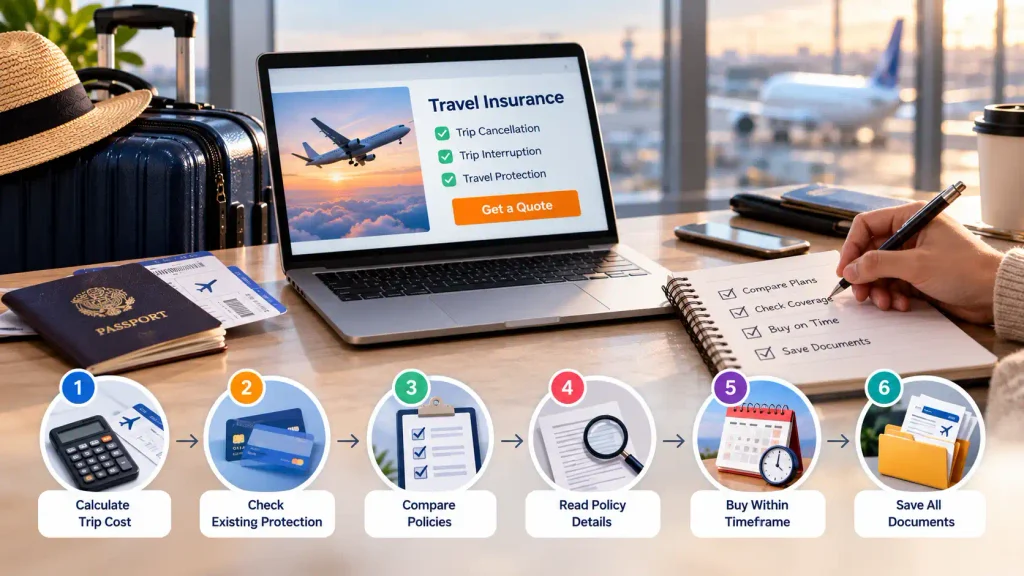
Buying coverage is usually straightforward, but the timing matters. You must buy a policy under the insurer’s rules, and optional benefits may have stricter deadlines than standard coverage.
- Calculate the nonrefundable trip cost. Include eligible airfare, accommodation,n and prepaid activities. Avoid insuring refundable expenses unnecessarily, and follow the insurer’s definition of trip cost.
- Check existing protection. Review any benefits provided by your credit card, airline booking, or existing annual travel insurance policy.
- Compare several policies. Get quotes from insurers and compare the benefits side by side.
- Read the full policy wording. Check covered reasons, exclusions, medical-condition provisions, reimbursement limits, and documentation rules.
- Purchase within the required timeframe. This is especially important if seeking CFAR or a waiver for a pre-existing medical condition.
- Save all documents. Keep the policy certificate, booking confirmations, receipts, and proof of payment together so you can access them if you need to file a claim.
Travel insurance generally covers unforeseen events, not losses that have already happened or circumstances the traveler already knows about. If an event has occurred, buying a policy afterward will not normally make that event eligible for reimbursement.
What to Do If You Need to Cancel a Flight
If a covered event forces a cancellation, contact the airline and other travel suppliers promptly. The insurer may require proof that the traveler attempted to cancel the reservations and identify the refunds, credits, or penalties applied.
Steps for filing a claim
- Contact the airline or travel supplier. Ask whether the booking can be refunded, changed, or credited.
- Notify the insurer. Follow its instructions and applicable claim deadlines.
- Gather evidence. This may include booking confirmations, payment receipts, cancellation confirmations, and documentation supporting the covered event.
- Submit the claim. Complete the required forms and provide the requested documents.
- Track the decision. Respond to requests for additional information and retain copies of all correspondence.
For medical cancellations, the insurer may require a medical certificate or other evidence establishing that the illness or injury meets the policy’s conditions. For an employment-related cancellation, it may request documents confirming the qualifying employment event. Requirements depend on the reason for cancellation and the policy.
Final Takeaway
The best flight cancellation insurance protects the most at-risk expenses without charging for benefits a traveler doesn’t need. Compare standard cancellation coverage with comprehensive travel insurance and CFAR, check existing credit-card benefits, and read the exclusions before buying. Most importantly, verify the purchase deadlines and covered reasons while the trip is still eligible for protection.
Frequently Asked Questions
Not necessarily. Missing a flight may fall under a separate missed-connection or travel-delay benefit, but simply arriving late at the airport may be excluded. Check the policy’s definition of a covered delay and the circumstances required for reimbursement.
The answer depends on the policy and the voucher’s terms. Insurers generally assess the actual eligible financial loss, so an airline refund or credit may reduce the amount claimed. Do not assume the insurer will reimburse the full ticket price in addition to a voucher.
Some policies may cover eligible award-ticket taxes, fees, or other qualifying nonrefundable expenses, but the treatment of redeemed points and miles varies. Check the plan wording before purchasing coverage, particularly if the airline’s cancellation rules return miles to the account but retain a fee.
No. Trip cancellation generally applies when a covered event forces a traveler to cancel before departure. Trip-delay coverage may reimburse specified additional expenses when a covered disruption delays travel. The benefits have different triggers, limits,s and documentation requirements.
Often, yes, but the policy’s purchase rules apply. Some benefits particularly CFAR and certain pre-existing medical condition waivers may require purchase within a limited period after the initial trip payment. Buying later may mean those benefits are unavailable.
Standard cancellation insurance generally does not cover a voluntary change of mind. CFAR may reimburse a portion of eligible nonrefundable costs for a cancellation that would otherwise be excluded, provided the traveler meets its conditions and deadlines.