
How to Choose a Credit Card for Rent Payments in 2026
The best credit card for paying rent is generally one that lets you earn rewards worth more than any transaction fee you have to pay. In 2026, Bilt is particularly relevant because its cardholders can make eligible rent payments through Bilt without the transaction fees that commonly make credit card rent payments expensive.
However, Bilt is not the only approach. A traditional rewards card can sometimes make sense when you’re trying to earn a valuable welcome bonus or when your landlord charges little or nothing for credit card payments.
The calculation is what matters. If your landlord charges a 3% card fee but your card effectively gives you only 1% back, paying rent by card means losing money unless another benefit makes up the difference.
Here is what renters should know before putting one of their largest monthly expenses on a credit card.
Best Credit Cards and Strategies for Paying Rent

The right option depends on whether your goal is earning rewards on rent every month, meeting a welcome-bonus spending requirement, earning travel rewards, or avoiding transaction fees.
| Option | Best For | Main Consideration |
| Bilt Blue Card | Renters wanting a no-annual-fee Bilt card | $0 annual fee and eligible housing rewards |
| Bilt Obsidian Card | Renters with significant dining or grocery spending | $95 annual fee |
| Bilt Palladium Card | Higher-spending travelers wanting premium benefits | $495 annual fee |
| General rewards card | Meeting a valuable welcome bonus | Rent-processing fee may outweigh normal rewards |
| Flat-rate cash-back card | Simple rewards when landlord fees are very low | Compare cash back with payment fee |
| Business rewards card | Eligible business-related rent expenses | Business and issuer rules apply |
The most important comparison is not simply how many points a card earns. You need to consider the net value after fees.
1. Bilt Blue Card — Good for Renters Avoiding an Annual Fee
The Bilt Blue Card is the entry-level option in Bilt’s current card lineup and carries a $0 annual fee.
Its appeal for renters is straightforward: cardholders can use Bilt’s housing-payment system without a transaction fee while potentially earning Bilt rewards.
Current Bilt terms allow cardholders choosing its housing-only rewards option to earn as much as 1.25x points on eligible rent and mortgage payments, with the actual multiplier depending on everyday card spending relative to the housing payment.
The current structure is:
| Everyday Spending Relative to Housing Payment | Housing Reward |
| Less than 25% | 250 points |
| 25% | 0.5x |
| 50% | 0.75x |
| 75% | 1x |
| 100% or more | 1.25x |
For example, if your rent is $2,000 and your qualifying everyday spending during the billing cycle reaches $1,500, that equals 75% of your housing payment. Under Bilt’s current published structure, that corresponds to 1x on the housing payment.
The card also currently earns rewards in categories such as Bilt partner restaurants, Lyft, and eligible travel booked through Bilt Travel.
Who Should Consider It?
The Blue Card can appeal to someone who:
- Pays rent every month
- Doesn’t want an annual fee
- Wants access to Bilt’s housing-payment system
- Can also use Bilt points for other rewards
- Wants travel-oriented points rather than straightforward cash back
The key is understanding the current housing-reward formula rather than assuming every rent payment automatically earns the maximum rate.
2. Bilt Obsidian Card — Useful for Dining or Grocery Spenders
The Bilt Obsidian Card has a $95 annual fee and is positioned toward cardholders who spend significantly on dining or groceries.
Current benefits include the choice of 3x points on dining or grocery spending, with the grocery category subject to an annual spending cap. The card also earns rewards on travel and offers a Bilt Travel hotel credit.
For housing payments, it participates in the same Bilt system that can provide up to 1.25x points on eligible rent and mortgage payments under the housing-only rewards structure.
This means the decision between Blue and Obsidian should not be based solely on rent.
Instead, consider whether your normal dining, grocery, and travel spending provides enough additional value to justify the annual fee.
3. Bilt Palladium Card — A Premium Option for Renters
The Bilt Palladium Card is Bilt’s premium credit card, carrying a $495 annual fee.
Its current benefits go substantially beyond housing payments. Bilt lists features including:
- 2x points on everyday purchases
- Up to 1.25x points on rent and mortgage under applicable housing rewards
- Bilt Cash
- Hotel credits
- Priority Pass membership
- Travel protections
- No foreign transaction fees
Bilt currently advertises a welcome offer of 50,000 Bilt Points plus Gold Status after $4,000 in eligible everyday purchases during the first 90 days, along with $300 in Bilt Cash upon approval, subject to the applicable terms.
Rent or mortgage spending is excluded from that stated $4,000 welcome-offer requirement, an important distinction for anyone considering the card primarily because of a large housing payment.
Who Should Consider It?
Palladium makes more sense for someone who can use its broader premium benefits and everyday earning structure.
Paying rent alone generally shouldn’t be the sole reason for accepting a $495 annual fee. Consider the complete package and how much value you realistically expect to receive.
Can You Pay Rent With a Credit Card?
Yes, but whether you can pay your landlord directly with a credit card depends on the landlord or payment platform.
Some landlords accept card payments through online portals. Others accept only ACH transfers, checks, or similar methods.
Third-party rent-payment platforms can sometimes bridge that gap, but they may charge fees.
Bilt approaches the problem differently for its cardholders. Its current system can facilitate housing payments through methods including payment portals, ACH-style account details, Venmo, or checks, while avoiding a transaction fee on eligible housing payments.
That distinction is important because payment fees are usually the biggest obstacle to earning worthwhile credit card rewards on rent.
How Much Does It Cost to Pay Rent With a Credit Card?
The cost depends entirely on your landlord or payment processor.
Suppose your monthly rent is $2,000 and your payment portal charges a 3% credit card fee.
Your cost becomes:
$2,000 × 3% = $60
Over 12 months:
$60 × 12 = $720
If your credit card earns only 1% back, you’d receive roughly $20 in rewards each month while paying a $60 fee.
That means you’re effectively losing about $40 per month, before considering other factors.
This is why a standard rewards card is often not worthwhile for recurring rent payments when a substantial processing fee applies.
When Does Paying Rent With a Credit Card Make Sense?

There are several situations where using a card may still be financially reasonable.
Your Landlord Doesn’t Charge a Card Fee
This is the simplest scenario.
If your landlord accepts credit cards without an additional charge, earning rewards on a bill you have to pay anyway can be beneficial.
Still, pay the card balance in full. Interest charges can quickly overwhelm the value of rewards.
You’re Using an Eligible Bilt Housing Payment
Bilt specifically promotes housing payments without a transaction fee for its cardholders.
That removes one of the major problems associated with using a credit card for rent.
You’re Earning a Valuable Welcome Bonus
Sometimes paying a transaction fee can make sense temporarily if the rent payment helps unlock a welcome bonus worth substantially more than the fee.
Imagine a new card requires $4,000 in qualifying purchases to receive a bonus.
If you’re struggling to reach that threshold through normal expenses, one rent payment might help.
But calculate the fee first.
A $2,000 rent payment with a 3% charge costs $60. If that payment is necessary to unlock a bonus worth several hundred dollars to you, the calculation may be different from using the same card for rent every month.
Always check whether rent payments qualify toward the specific card’s welcome-offer spending requirement.
When Should You Avoid Paying Rent With a Credit Card?
Avoid automatically putting rent on a card simply because you can earn points.
It may not make sense when:
- The processing fee exceeds your rewards
- You can’t pay the statement balance in full
- The payment would push your credit utilization unnecessarily high
- Your landlord offers a free bank-transfer alternative
- The transaction doesn’t qualify for the rewards or bonus you expected
- You’re paying a fee solely to earn low-value rewards
Credit card rewards are useful only when their value exceeds the additional cost you incur to earn them.
How to Calculate Whether Paying Rent by Card Is Worth It
Use a simple equation:
Reward value − transaction fee = net value
Suppose:
- Monthly rent: $2,500
- Card fee: 2.9%
- Rewards: 2%
- No other bonus
The fee is:
$2,500 × 2.9% = $72.50
The nominal rewards are:
$2,500 × 2% = $50
Your net result:
$50 − 72.50=-22.50
In this example, you’re paying $22.50 more than the rewards you’re receiving.
Now suppose the card fee is waived. The calculation changes completely because the $50 reward is no longer offset by a $72.50 processing charge.
What Should You Consider When Choosing a Card for Rent?
Transaction Fees
Start here.
A 2% to 3% processing fee can wipe out the normal rewards earned by many cards.
Reward Rate
Determine exactly how the card rewards rent.
Do not assume that a card’s highest advertised earning rate applies to housing payments.
Annual Fee
A premium credit card may offer excellent travel benefits but still be unnecessarily expensive if your only goal is earning rewards on rent.
Welcome Offer
A large rent payment can potentially help satisfy a new-card spending requirement, provided the transaction qualifies.
Reward Flexibility
Ask yourself how you will actually use the points.
Travel rewards can provide significant utility for frequent travelers, while others may prefer simple cash back.
Interest Rate
If you cannot pay your balance in full, the interest charged on a large rent payment can rapidly exceed your rewards.
How Does Bilt Pay Your Landlord Without a Card Fee?
Bilt’s current payment system is designed to let eligible cardholders make housing payments even when the landlord doesn’t normally accept a traditional credit card payment without fees.
Bilt states that cardholders can make housing payments through methods including payment portals, Venmo, or check. It can provide account and routing details for applicable payment portals, allowing the landlord to receive the payment without a standard direct credit card transaction.
Bilt also offers a mechanism under which the housing payment can be funded from a linked bank account, helping prevent the payment from occupying the cardholder’s credit line for an extended period.
Exact eligibility and payment procedures are subject to Bilt’s current terms.
Can You Earn Bilt Points on Rent Without a Bilt Credit Card?
Yes, although the earning structure differs from using a Bilt Card.
Bilt’s current terms state that members paying rent through Bilt without a Bilt Card can earn rewards according to the payment method.
For example, Bilt currently lists 250 points per monthly rent payment for qualifying ACH or debit-card rent payments. Certain eligible non-Bilt credit card rent payments can earn 1 point per $2 spent, but applicable payment fees and other conditions may apply.
This makes it important to distinguish between:
Being a Bilt Rewards member and holding a Bilt credit card.
They are related but not identical.
Can Paying Rent With a Credit Card Help Your Credit Score?
It can affect your credit profile indirectly, but using a credit card for rent does not automatically improve your credit score.
For example, placing a large rent payment on a card can temporarily increase your credit utilization if the balance is reported before you pay it off.
At the same time, consistently paying a credit card account on time can contribute positively to payment history over time.
Bilt separately advertises rent-reporting features for eligible payments, which is different from simply charging rent to a credit card.
Never take on interest-bearing debt merely for the purpose of earning rewards or attempting to improve credit.
Credit Card vs. ACH for Paying Rent
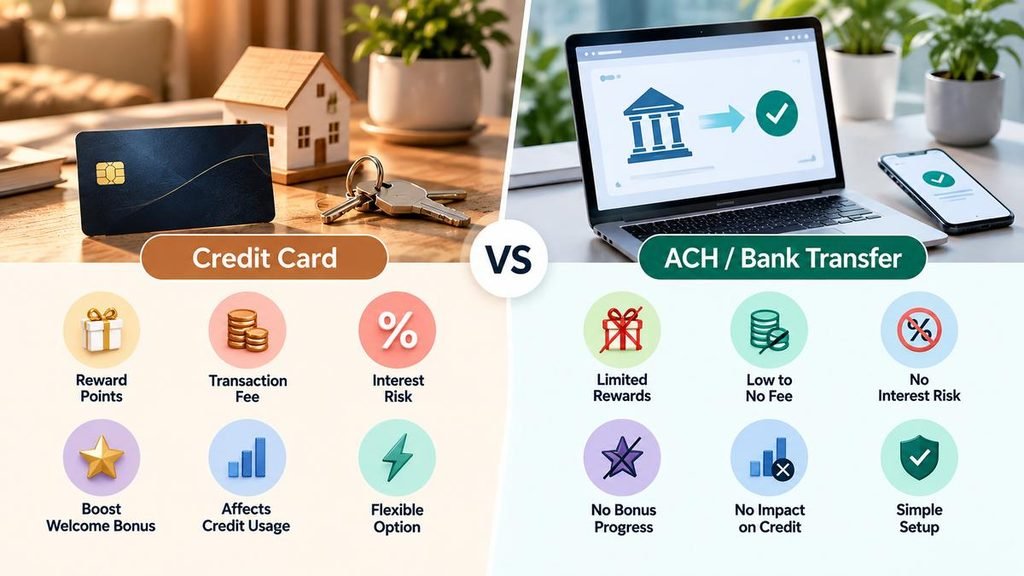
Whether credit card or ACH is preferable depends on the cost and benefits.
| Factor | Credit Card | ACH/Bank Transfer |
| Potential rewards | Yes | Usually limited |
| Processing fee | Often possible | Frequently free |
| Interest risk | Yes | No credit-card interest |
| Welcome-bonus progress | Potentially | No |
| Credit utilization impact | Possible | No |
| Convenience | Depends on landlord | Often straightforward |
If your landlord offers free ACH but charges 3% for cards, ACH may be financially preferable unless the card provides enough additional value to overcome that fee.
Tips for Paying Rent With a Credit Card
Calculate the fee before paying. Never focus only on the number of points advertised.
Pay the card in full. Carrying a balance can turn a rewards strategy into expensive debt.
Read welcome-offer terms. Confirm that the transaction counts toward the required spending.
Check your credit limit. A large rent charge can consume a substantial percentage of available credit.
Compare annual fees. Don’t pay hundreds of dollars for premium benefits you won’t use.
Understand point value. One point is not automatically worth one cent.
Review current card terms. Rewards programs, fees, earning rates, and card benefits can change.
Final Thoughts
Paying rent with a credit card can turn a large monthly expense into an opportunity to earn rewards, but only when the numbers make sense. Traditional rewards cards can become poor choices when a landlord adds a processing fee that exceeds the value of the points or cash back earned.
Bilt’s current card lineup takes a different approach by allowing eligible cardholders to make housing payments without a transaction fee and potentially earn up to 1.25x points under its housing rewards structure.
For other cards, calculate the fee, reward value, welcome-bonus benefit, annual fee, and your ability to pay the statement balance in full. The best rent-payment strategy is ultimately the one that leaves you with more value than additional cost.
Frequently Asked Questions
Bilt’s current credit cards are specifically designed to support eligible housing payments without a transaction fee. Its lineup includes the Blue, Obsidian, and Palladium cards.
No. Bilt currently lists a $0 annual fee for the Blue Card.
Under Bilt’s current housing-only rewards structure, eligible cardholders can earn up to 1.25x points on housing payments. The multiplier depends on qualifying everyday spending relative to the housing payment.
Usually not when the normal value of the rewards is less than the fee. However, circumstances such as earning a valuable welcome bonus can change the calculation.
Potentially. It depends on the card and whether the rent transaction is considered eligible spending under the offer’s terms. Always check the specific welcome-offer rules before paying a fee.
Yes, if your landlord or payment processor accepts it. However, a processing fee may apply and could outweigh the rewards you earn.
Yes. Bilt’s current terms provide points for certain rent payments made through Bilt without a Bilt Card, although earning rates and possible payment fees differ by payment method.
Generally, rewards should not be the reason to put a large rent payment on a credit card when you cannot pay the balance in full. Interest charges can substantially exceed the value of points or cash back.
The credit card account itself can affect your credit history through factors such as payment history and utilization. Simply categorizing a purchase as rent does not automatically build credit. Rent-reporting services are a separate mechanism.
Check the transaction fee and compare it with the realistic value of the rewards or other benefits you’re receiving.