
No-Annual-Fee Business Credit Cards: 6 Options for 2026
A no-annual-fee business credit card can help small-business owners earn cash back or travel rewards on everyday expenses without paying a yearly fee just to keep the account open. Several cards also provide welcome offers, introductory APR periods, employee cards, purchase protections, and category bonuses.
Current options range from straightforward 1.5% cash-back cards to products earning 2x transferable points or as much as 5% back in selected business categories.
The important part is matching the card to how your business actually spends. A company paying heavily for internet and office supplies may benefit from a different earning structure than a freelancer whose expenses are spread evenly across many categories.
Here are 6 no-annual-fee business credit cards to consider in 2026.
6 Business Credit Cards With No Annual Fee

| Credit Card | Annual Fee | Notable Rewards | Useful For |
| Amex Blue Business Plus | $0 | 2x points on the first $50,000 in eligible annual purchases, then 1x | Flexible travel rewards |
| Ink Business Unlimited | $0 | Unlimited 1.5% cash back | Simple everyday spending |
| Ink Business Cash | $0 | Up to 5% cash back in selected categories | Office and telecom expenses |
| Amex Blue Business Cash | $0 | 2% cash back on first $50,000 annually, then 1% | Straightforward cash back |
| Capital One VentureOne Business | $0 | 1.5x miles on general purchases; up to 5x through Capital One Business Travel | Travel rewards |
| Capital One Spark Cash Select | $0 | Unlimited 1.5% cash back; up to 5% through Capital One Business Travel | Flat-rate cash back |
The right card depends on whether you prefer cash back or travel rewards and whether your spending is concentrated in specific business categories.
1. The Blue Business Plus Credit Card From American Express
The Blue Business Plus Credit Card from American Express combines a $0 annual fee with Membership Rewards points.
Cardholders currently earn:
- 2x Membership Rewards points on eligible everyday business purchases on the first $50,000 spent per calendar year
- 1x points after reaching that $50,000 threshold
The card therefore works particularly well for a business with moderate annual expenses that wants a simple points-earning structure without managing multiple bonus categories.
Current Welcome Offer
The reference currently lists an offer of 15,000 Membership Rewards points after $3,000 in eligible purchases within the first 3 months of Card Membership.
Welcome offers can change, so applicants should verify the offer presented during application.
Other Features
The card also includes benefits such as:
- Expanded Buying Power
- Purchase protection
- Extended warranty protection
- Employee cards with no additional annual fee
- Introductory APR on eligible purchases
Expanded Buying Power can allow spending beyond the standard credit limit in certain circumstances. It does not provide unlimited spending power, and the amount available can vary according to factors considered by American Express.
Who Might Consider This Card?
It can be suitable for business owners who want:
- Membership Rewards points
- No annual fee
- A straightforward 2x earning structure
- Flexible rewards rather than pure cash back
- Less than or around $50,000 in annual card spending
The $50,000 threshold is important because spending above it earns only 1x points under the current structure.
2. Ink Business Unlimited Credit Card
The Ink Business Unlimited Credit Card is designed around simplicity.
Instead of requiring a business owner to track spending categories, the card currently earns unlimited 1.5% cash back on business purchases.
That can make it practical for businesses whose expenses are spread across numerous categories.
Current Welcome Offer
The reference currently lists:
$750 bonus cash back after spending $6,000 on purchases within the first 3 months after account opening.
The card also currently provides a 0% introductory APR on purchases for 12 months, followed by the applicable variable APR.
Why the Flat Rate Matters
Imagine your business spends:
- $7,000 on equipment
- $5,000 on advertising
- $3,000 on software
- $2,000 on professional services
- $3,000 on miscellaneous purchases
Instead of determining whether each transaction falls into a bonus category, eligible spending earns the same standard 1.5% rate.
That simplicity can be useful for businesses with unpredictable expenses.
Additional Benefits
Current features include:
- Employee cards at no additional cost
- Purchase protection
- Extended warranty protection
- Primary rental car coverage for eligible business rentals
- Fraud monitoring
- 5% total cash back on eligible Lyft rides through September 30, 2027
The card does, however, carry a foreign transaction fee, making it less attractive for businesses making substantial purchases abroad.
3. Ink Business Cash Credit Card
The Ink Business Cash Credit Card is more category-focused than the Ink Business Unlimited.
It currently earns:
5% cash back on the first $25,000 in combined purchases each account anniversary year at:
- Office supply stores
- Internet services
- Cable services
- Phone services
It also earns 2% cash back on the first $25,000 in combined annual purchases at:
- Gas stations
- Restaurants
Other purchases generally earn 1% cash back.
Current Welcome Offer
The reference currently lists a $750 bonus after spending $6,000 on purchases within the first 3 months after opening the account.
The card also currently offers a 0% introductory APR on purchases for 12 months, followed by the applicable variable rate.
When Can the 5% Categories Be Valuable?
Consider a business that spends $15,000 annually on qualifying internet, phone, and office-supply purchases.
At 5% back, that spending could generate:
$15,000 × 5% = $750
That is substantially different from earning 1% on the same purchases.
However, the bonus-category limits matter. Once the applicable $25,000 combined spending threshold is reached, subsequent purchases earn according to the card’s standard terms.
Who Might Consider This Card?
The earning structure can suit:
- Small offices
- Consulting businesses
- Agencies
- Companies with substantial phone and internet bills
- Businesses regularly purchasing office supplies
Businesses whose spending doesn’t match the bonus categories may find a flat-rate card easier to maximize.
4. American Express Blue Business Cash Card
Business owners who prefer cash back instead of points can consider the American Express Blue Business Cash Card.
The card currently earns:
- 2% cash back on eligible purchases on the first $50,000 spent each calendar year
- 1% thereafter
Cash back is automatically credited to the account statement, removing the need to manage a travel-rewards redemption strategy.
Current Welcome Offer
The reference lists a current offer of a $250 statement credit after making $3,000 in purchases during the first 3 months.
The card also currently includes a 0% introductory APR on purchases for 12 months from account opening, followed by the applicable variable APR.
Cash Back vs. Membership Rewards
The main difference between the Amex Blue Business Cash and Blue Business Plus cards is the type of reward earned.
Blue Business Cash: Cash back
Blue Business Plus: Membership Rewards points
Someone who wants simple savings may prefer cash back. A business owner who understands travel rewards and wants access to transferable Membership Rewards points may find the points card more appealing.
5. Capital One VentureOne Business Card
The Capital One VentureOne Business Card provides a travel-rewards alternative without an annual fee.
The reference currently lists:
- 5x miles on hotels, vacation rentals, and rental cars booked through Capital One Business Travel
- 1.5x miles on other purchases
Unlike a cash-back card, VentureOne Business earns Capital One miles.
Current Welcome Offer
The reference lists 50,000 miles after spending $4,500 on purchases within the first 3 months.
It also identifies benefits including:
- No annual fee
- No foreign transaction fees
- Rental car insurance
- Roadside assistance
- Hertz Gold Plus Rewards Five Star status
Why No Foreign Transaction Fee Matters
A no-foreign-transaction-fee card can be particularly useful for businesses whose employees travel internationally or regularly make eligible purchases outside the U.S.
Some competing no-annual-fee cards impose foreign transaction fees, which can reduce the value of rewards on overseas purchases.
6. Capital One Spark Cash Select
The Capital One Spark Cash Select focuses on straightforward cash-back rewards.
The reference currently lists:
- Unlimited 1.5% cash back on general business purchases
- 5% cash back on eligible hotels and rental cars booked through Capital One Business Travel
There are no rotating categories to activate and no spending cap on the standard 1.5% cash-back rate.
Current Welcome Offer
The reference lists a $750 bonus after spending $6,000 within the first 3 months after account opening.
Additional listed features include:
- $0 annual fee
- Employee cards at no additional annual fee
- Virtual card numbers
- Fraud protection
- Extended warranty
- Roadside assistance
The card can therefore appeal to businesses that want uncomplicated cash back rather than travel points.
How Do These No-Annual-Fee Business Cards Compare?
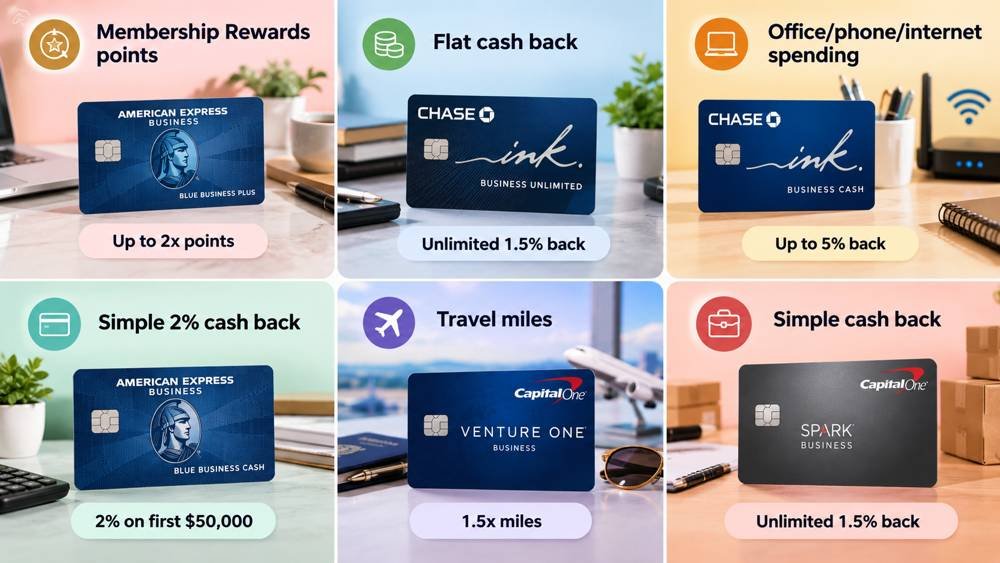
Different cards stand out for different spending patterns.
| Business Priority | Card to Examine | Reason |
| Membership Rewards points | Amex Blue Business Plus | Up to 2x points on eligible everyday spending |
| Flat cash back | Ink Business Unlimited | Unlimited 1.5% back |
| Office/phone/internet spending | Ink Business Cash | Up to 5% back in qualifying categories |
| Simple 2% cash back | Amex Blue Business Cash | 2% on first $50,000 annually |
| Travel miles | Capital One VentureOne Business | 1.5x general earning plus travel-booking bonuses |
| Simple Capital One cash back | Spark Cash Select | Unlimited 1.5% standard cash back |
Rather than choosing based solely on the welcome offer, calculate how much the card could earn from your normal annual business expenses.
What Does “No Annual Fee” Actually Mean?
A no-annual-fee card does not charge a recurring yearly membership fee simply for keeping the card.
That does not mean using the credit card is completely free.
Depending on the product and how it is used, other charges can include:
- Interest
- Late-payment fees
- Balance-transfer fees
- Cash-advance fees
- Foreign transaction fees
For example, a business card can have a $0 annual fee while still charging a foreign transaction fee.
Always review the complete pricing and terms before applying.
Are No-Annual-Fee Business Credit Cards Worth It?
They can be particularly useful when a business wants to earn rewards without having to generate enough value each year to offset an annual fee.
Suppose a premium business card costs $395 annually.
The business must obtain at least $395 of additional value from its rewards and benefits just to offset that fee.
A $0-annual-fee card eliminates that particular calculation.
No-fee cards can therefore appeal to:
- New businesses
- Freelancers
- Sole proprietors
- Businesses with relatively low expenses
- Occasional card users
- Owners building a long-term card strategy
However, a card with an annual fee can still provide greater net value when its enhanced rewards and benefits match a company’s spending and travel patterns.
Can a Freelancer Get a Business Credit Card?
Potentially, yes.
Business credit cards aren’t limited exclusively to large corporations. Sole proprietors, freelancers, and other self-employed individuals may also qualify for business cards.
The application requirements vary by issuer, and approval is never guaranteed.
Applicants may be asked for information concerning:
- Business type
- Business revenue
- Industry
- Time in business
- Personal income
- Personal credit history
- Tax identification information
New businesses may still be eligible even when revenue is limited, depending on the issuer and applicant’s overall financial profile.
Business Credit Card vs. Personal Credit Card
A business credit card is designed primarily for business-related expenses, while a personal card is intended for individual spending.
Using a dedicated business card can make expense tracking easier.
For example, keeping advertising, software, office supplies, business travel, and professional services on one business account can simplify bookkeeping compared with mixing those transactions with groceries and personal shopping.
Business cards may also provide:
- Employee cards
- Spending controls
- Business-oriented rewards
- Expense-management features
- Higher spending capacity in some circumstances
Terms and consumer protections can differ between business and personal cards, so applicants should understand the agreement before opening an account.
Cash Back or Points: Which Is Better for a Business?
Neither reward type is automatically better.
Cash Back
Cash-back cards are straightforward.
Rewards can effectively reduce business expenses through statement credits or other eligible redemption methods.
Cash back can suit businesses that:
- Want simplicity
- Don’t travel frequently
- Don’t want to learn airline and hotel transfer programs
- Prefer predictable reward value
Points and Miles
Points can offer more redemption flexibility, particularly for business owners who travel.
Cards such as the Amex Blue Business Plus and Capital One VentureOne Business provide access to points or miles rather than focusing exclusively on cash back.
The value obtained can vary substantially depending on how rewards are redeemed.
What Is a 0% Intro APR?
Some no-annual-fee business cards provide a temporary introductory period during which qualifying purchases accrue no interest.
Several cards in the reference currently offer 0% introductory APR on purchases for 12 months.
That can be useful when a business needs to make a major purchase and wants additional time to pay it off.
For example, suppose a company buys $6,000 of equipment.
A qualifying 12-month 0% intro APR could provide time to repay that purchase before the standard variable APR begins.
However, the balance still needs to be repaid. Any remaining balance after the introductory period can become subject to the regular APR according to the account terms.
Should You Choose a Card Based on the Welcome Bonus?
A welcome bonus can provide significant short-term value, but it shouldn’t be the only factor.
Consider:
- Required spending
- Time available to meet the requirement
- Long-term reward rate
- Bonus categories
- Foreign transaction fees
- Introductory APR
- Employee card policies
- Purchase protections
- How you’ll redeem the rewards
Most importantly, avoid making unnecessary purchases simply to reach a welcome-offer threshold.
Business expenses you would have paid anyway are generally a more sensible way to meet a spending requirement.
How to Choose a No-Annual-Fee Business Credit Card

Review Your Last 6 to 12 Months of Expenses
Look at where your business actually spends money.
Common categories include:
- Advertising
- Office supplies
- Phone bills
- Internet
- Software
- Fuel
- Restaurants
- Hotels
- Airfare
- Inventory
- Shipping
Then compare those expenses against each card’s earning structure.
Decide Between Cash Back and Travel Rewards
If you want simple savings, prioritize cash back.
If business or personal travel is important and you understand reward transfers and redemptions, flexible points may be more useful.
Look at Spending Caps
A high earning rate isn’t as attractive if your business quickly exceeds its spending cap.
For example, the Amex Blue Business Plus and Blue Business Cash cards have enhanced earning structures on the first $50,000 in applicable annual spending under their current terms.
Consider Foreign Transaction Fees
Businesses operating internationally should pay close attention to these fees.
A strong domestic rewards card may become less attractive when every overseas transaction incurs an additional charge.
Evaluate Employee Cards
If employees make business purchases, check whether additional cards are available without extra annual fees and whether you can control or monitor their spending.
Examine Protections
Depending on the card, benefits can include:
- Purchase protection
- Extended warranties
- Rental car coverage
- Fraud protection
- Roadside assistance
These benefits shouldn’t replace appropriate business insurance, but they can add value.
Final Thoughts
A $0 annual fee doesn’t mean sacrificing business rewards. Current cards provide options ranging from 2x Membership Rewards points and 2% cash back on eligible spending up to specified limits to 5% cash back in selected business categories.
The more important question is which earning structure matches your company’s expenses.
Businesses with substantial office-supply and telecommunications spending can examine category-focused cards such as Ink Business Cash. Those wanting consistent rewards across varied expenses can compare flat-rate cards such as Ink Business Unlimited and Capital One Spark Cash Select. Meanwhile, business owners interested in travel rewards can look more closely at Amex Blue Business Plus and Capital One VentureOne Business.
Before applying, verify the current welcome offer, APR, reward rates, spending caps, foreign transaction fees, and cardholder benefits directly with the issuer. Credit card terms can change, and the most valuable card is ultimately the one that complements expenses your business already needs to make.
Frequently Asked Questions
Not all of them. Several business cards charge no annual fee, including options from American Express, Chase, and Capital One.
Yes. No-annual-fee business cards can earn cash back, Membership Rewards points, Capital One miles, or other rewards depending on the product.
The Amex Blue Business Cash Card currently earns 2% cash back on eligible purchases on the first $50,000 spent each calendar year, followed by 1%.
The Amex Blue Business Plus earns Membership Rewards points, while Capital One VentureOne Business earns Capital One miles. Transfer options and terms depend on the respective rewards program.
The Ink Business Cash currently earns 5% cash back on up to $25,000 in combined eligible purchases each account anniversary year at office supply stores and on internet, cable, and phone services.
Yes, sole proprietors may be eligible for business credit cards. Approval depends on the issuer’s application criteria and the applicant’s financial profile.
Many do. The cards covered here currently advertise welcome offers, although the amounts and required spending vary and can change.
Some do. Several cards in this guide currently provide a 0% introductory APR on purchases for a limited period. Applicants should check the current terms and the APR that applies afterward.
Several no-annual-fee business cards provide employee cards without an additional annual fee, although policies vary by issuer.
They can be. Avoiding an annual fee reduces the fixed cost of keeping a card, which may be useful for a new business with limited or unpredictable spending.
Choose according to how you expect to redeem rewards. Cash back is generally simpler, while travel points and miles may provide more flexibility for businesses that travel regularly.