
Southwest Elite Status: A-List vs. A-List Preferred
Southwest Airlines offers two elite status levels through its Rapid Rewards loyalty program: A-List and A-List Preferred, which reward frequent flyers with benefits such as preferred seat selection, priority boarding, free checked bags, and bonus points. Travelers can qualify by completing a required number of eligible one-way flights or earning enough tier-qualifying points in a calendar year.
The two tiers share several benefits, but A-List Preferred offers more generous perks, including two free checked bags, a 100% points-earning bonus, complimentary seat selection (including available Extra Legroom seats at booking), and premium drinks on eligible flights. Whether elite status is worth pursuing depends on how often a traveler flies Southwest, how much they spend on eligible tickets, and which benefits they value most.
This guide explains the qualification requirements, compares both tiers, outlines ways to earn status faster, and helps travelers decide whether Southwest elite status fits their travel habits.
Related: Southwest International 15 Destinations: 2026 Guide
What Is Southwest Rapid Rewards Elite Status?
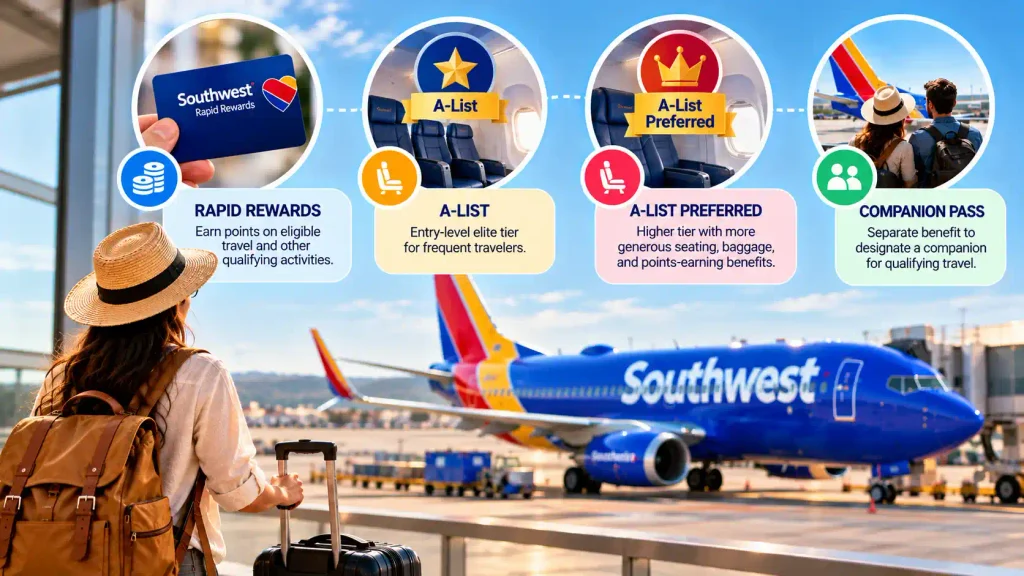
Southwest Rapid Rewards is the airline’s frequent flyer program. Members can earn points on eligible travel and other qualifying activities, then redeem those points for rewards such as flights. Elite status is a separate benefit level within the program that provides additional privileges to frequent customers.
Southwest has two published elite tiers:
- A-List: The entry-level elite tier for travelers who meet the lower annual qualification threshold.
- A-List Preferred: The higher tier, with more generous seating, baggage, and points-earning benefits.
Unlike redeemable Rapid Rewards points, tier qualifying points (TQPs) are used to determine elite status. A traveler may have a large redeemable points balance without having earned enough TQPs for A-List.
Southwest also offers the Companion Pass, a separate benefit that allows an eligible member to designate a companion for qualifying travel under the program’s rules. It is not the same as A-List or A-List Preferred status, and its qualification requirements are different.
How to Qualify for Southwest A-List and A-List Preferred
Southwest uses two primary qualification paths for its standard elite tiers: qualifying one-way flights or tier qualifying points earned during a calendar year. Travelers need to meet either threshold for the tier they want; they do not have to meet both.
| Qualification requirement | A-List | A-List Preferred |
| Qualifying one-way flights in a calendar year | 20 | 40 |
| Tier qualifying points in a calendar year | 35,000 | 70,000 |
| Status level | Entry elite tier | Higher elite tier |
What counts as a qualifying flight?
The flight-count route is based on qualifying one-way flights booked through Southwest. A one-way journey generally counts as one qualifying flight when it meets the program’s eligibility rules. A qualifying round trip can therefore contribute two one-way flights.
For example, a traveler who completes 10 qualifying round trips in a calendar year could reach the 20-flight A-List threshold, provided all segments meet Southwest’s qualifying-flight rules. A traveler aiming for A-List Preferred would need 20 qualifying round trips to reach 40 one-way flights.
Not every trip necessarily counts. Reward flights, Companion Pass travel, charter flights, and certain non-revenue or third-party bookings are excluded under Southwest’s program rules. Connecting itineraries also do not necessarily count as separate qualifying flights simply because they include multiple flight segments.
Travelers should check the current definition of a qualifying flight before relying on a particular itinerary to reach status.
What are tier qualifying points?
Tier qualifying points are credits that count toward elite status. They are different from the regular Rapid Rewards points members redeem for travel.
Southwest awards TQPs through eligible paid flights and certain qualifying credit card purchases and other designated activities. The number earned depends on the qualifying transaction and the applicable program rules.
A traveler who buys higher-priced eligible Southwest tickets may earn TQPs faster than someone who consistently buys lower-priced tickets. Eligible Southwest Rapid Rewards credit cards can also help members accumulate TQPs through spending, although the earning rate depends on the card.
Purchasing regular Rapid Rewards points does not automatically count toward elite qualification. Travelers should confirm that an earning activity specifically qualifies for TQPs before including it in their status plan.
When does Southwest elite status take effect?
Qualification is measured over a calendar year, from January 1 through December 31. Once a member meets the requirements, status benefits become available after the account recognizes the qualification.
Southwest’s standard program generally provides earned status through the remainder of the year in which it is achieved and the following calendar year. For example, a member who qualifies in 2026 should check the account’s displayed expiration date and applicable program terms for the precise period of validity.
Travelers who are close to a qualification threshold late in the year should verify that flights have been completed and eligible points have been posted before December 31. A reservation alone does not necessarily mean a flight has qualified.
Southwest A-List vs. A-List Preferred: Benefits Compared
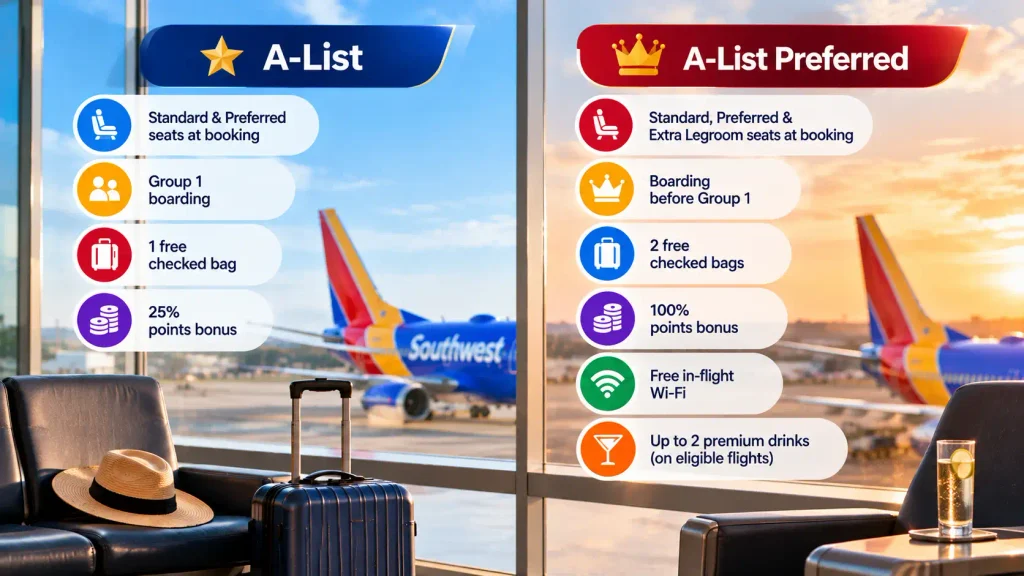
Both tiers offer priority services and extra travel benefits, but A-List Preferred is designed for travelers who want a more substantial improvement in their flying experience.
| Benefit | A-List | A-List Preferred |
| Complimentary seat selection | Available Standard or Preferred seats at booking; Extra Legroom seat selection within 48 hours of departure when available | Available Standard, Preferred, and Extra Legroom seats at booking |
| Boarding | Group 1 | Dedicated boarding before Group 1 |
| Free checked baggage | First checked bag free; second bag subject to the applicable fee | First and second checked bags free |
| Points-earning bonus | 25% on qualifying flights | 100% on qualifying flights |
| Same-day standby | Available under program rules; taxes or fees may apply | Available under program rules; taxes or fees may apply |
| Priority check-in and security lanes | Available where offered | Available where offered |
| Priority phone support | Yes | Yes |
| Complimentary premium drinks | Not a standard A-List benefit | Up to two on eligible flights over 250 miles |
| Complimentary in-flight Wi-Fi | Not included solely through A-List status | Included |
1. Seat selection and Extra Legroom seats
Southwest has moved away from its former open-seating model and now uses assigned seats. Elite status can therefore influence where a passenger sits and when they can choose an available seat.
A-List members can select available Standard or Preferred seats at booking. They can also select an available Extra Legroom seat within 48 hours before departure at no additional charge, subject to the program’s rules and seat availability.
A-List Preferred members receive a stronger seating benefit: they can select available Standard, Preferred, and Extra Legroom seats at booking without paying the usual seat-selection charge.
This distinction may matter to travelers who prefer additional legroom or want to secure a particular seat before arriving at the airport. However, complimentary access does not guarantee that every seat type will be available on every flight.
Southwest’s published rules also allow qualifying seat-selection benefits to extend to up to eight additional passengers on the same reservation, subject to eligibility requirements. Travelers should review the current terms if they are booking for a family or group.
2. Priority boarding
Both elite tiers receive priority boarding, but A-List Preferred has the stronger position. A-List members receive Group 1 boarding under Southwest’s current published tier benefits. A-List Preferred members receive dedicated boarding before Group 1.
Early boarding can make it easier to settle in, organize carry-on belongings, and get ready for departure. Since Southwest now assigns seats, the benefit is no longer about choosing any open seat after boarding. It still helps with the overall boarding experience, especially for travelers who want to board early.
Boarding arrangements can still depend on the itinerary and applicable operational rules. Members should check the boarding information shown on their reservation.
3. Free checked baggage
Checked-bag benefits are one of the most tangible differences between the tiers.
- A-List: One free checked bag; the second checked bag is subject to the applicable fee.
- A-List Preferred: Two free checked bags.
This can create meaningful savings for travelers who regularly check luggage. For example, a traveler who flies several times a year with two checked bags may find A-List Preferred more valuable than someone who travels with only a small carry-on.
Baggage allowances and fees can change, so travelers should confirm current weight, size, and excess-baggage rules before departure. The elite benefit does not automatically exempt a bag from restrictions on oversized, overweight, or otherwise restricted items.
4. Bonus Rapid Rewards points
Elite status increases the Rapid Rewards points earned on qualifying flights. A-List members receive a 25% earning bonus, while A-List Preferred members receive a 100% bonus. The higher tier can therefore help frequent travelers build their redeemable points balance more quickly.
Consider a qualifying flight that earns 1,000 base points under the applicable fare and earning rules. A 25% bonus would add 250 points for an A-List member, while a 100% bonus would add 1,000 points for an A-List Preferred member. The example illustrates the bonus calculation only; actual base earnings vary by ticket and program rules.
A larger points balance may help travelers work toward future reward flights. However, the value of this benefit depends on how frequently a member flies, how many points eligible tickets earn, and how effectively those points are redeemed.
5. Priority airport services and phone support
Both tiers offer priority phone support and access to Southwest’s Priority Lane and Express Lane services where available. These lanes can help eligible travelers move through designated check-in or airport security checkpoints more efficiently, depending on airport facilities and operating conditions.
Priority services do not guarantee a shorter wait at every airport. Some airports may not offer a particular lane, and security procedures remain subject to local requirements.
Priority phone support is particularly useful when a traveler needs assistance with a booking, itinerary change, or disruption. Members should contact Southwest using the appropriate channel linked to their Rapid Rewards account.
6. Same-day standby
Southwest elite members can access same-day standby under the program’s rules, including on eligible Basic fares. Standby lets a traveler request an eligible alternative flight without necessarily purchasing a new ticket, but availability and conditions apply.
Taxes or fees may apply in certain circumstances, and a seat on the requested flight is not guaranteed. Travelers should confirm eligibility, timing, and any charges before changing their plans.
This benefit may be useful when a meeting ends early, or a traveler wants to return home sooner. It should not be treated as a guaranteed free flight change.
7. Free Wi-Fi and premium drinks with A-List Preferred
A-List Preferred includes complimentary in-flight Wi-Fi and up to two complimentary premium drinks on eligible flights over 250 miles, subject to Southwest’s terms.
These benefits can appeal to travelers who use the internet during flights or regularly buy premium beverages. Their value depends on personal habits: a passenger who rarely connects to Wi-Fi or doesn’t drink alcohol may value seating, baggage, and points more.
Always check the current conditions for Wi-Fi access and beverage service, as onboard availability and operational restrictions can apply.
Can You Earn Southwest Elite Status Faster With a Credit Card?
Yes. Certain Southwest Rapid Rewards credit cards can help eligible cardholders earn tier qualifying points through qualifying purchases. This gives travelers another way to progress toward A-List or A-List Preferred beyond flying alone.
Southwest’s published tier information states that eligible Rapid Rewards credit cards can earn TQPs for every $5,000 spent. The number of points earned per spending increment varies by card, so members should check the current card terms rather than assuming every card earns at the same rate.
Before using card spending as a status strategy, consider the following:
- Annual fee: Compare the card’s fee with the value of benefits you will realistically use.
- Eligible spending: Confirm which purchases count toward TQPs and when points post.
- Spending discipline: Do not spend more than planned simply to reach elite status.
- Alternative rewards: Consider whether another card or a different travel-rewards strategy better suits your needs.
- Timing: Check the calendar-year qualification period and the date eligible spending is credited.
Credit card spending can complement flight activity, but it doesn’t mean you can simply buy elite status outright. The member must meet the published qualification criteria.
Is Southwest A-List Status Worth It?
A-List can be worthwhile for travelers who regularly fly Southwest and value practical benefits such as seat selection, earlier boarding, a free checked bag, priority services, and bonus points.
It is more likely to deliver value to travelers who would otherwise pay for preferred seating or checked baggage. Someone who takes frequent short trips with Southwest may appreciate the cumulative savings and convenience more than an occasional passenger.
A-List may be less compelling for someone who flies only once or twice a year, rarely checks a bag, and is satisfied with the seating options available without status. In that case, the cost of changing travel habits to reach the threshold could outweigh the benefits.
The key is to compare the status benefits with what you would actually spend without them. Don’t take an unnecessary flight or choose a more expensive fare solely to reach the threshold unless the numbers and your personal travel needs justify it.
Is A-List Preferred Worth the Higher Qualification Threshold?
A-List Preferred requires twice the qualifying flights or TQPs needed for A-List, but it also provides more generous benefits.
It may be especially valuable for travelers who:
- Frequently check two bags.
- Prefer Extra Legroom seats and want to select them at booking.
- Fly enough to earn 100% points on eligible flights.
- Use in-flight Wi-Fi regularly.
- Appreciate premium drinks on eligible flights.
- Want the highest level of Southwest’s standard elite status.
For a traveler who flies Southwest for work several times a month, these benefits can add up. Someone who takes only a few leisure trips annually may find A-List more attainable and sufficient.
A useful approach is to estimate the value of each benefit over the coming year. Include expected baggage charges, seat-selection costs, potential points earned, and the value of convenience. Compare that total with the extra flying or spending needed to qualify for the higher tier.
Can You Get Southwest Elite Status Through a Status Match?
Southwest periodically offers status-match promotions to eligible travelers who already hold elite status with another airline. A status match can provide temporary A-List or A-List Preferred benefits without requiring members to meet the full standard qualification threshold first.
To participate, travelers generally need to:
- Enroll in Rapid Rewards if they are not already members.
- Submit the required status information and proof of elite membership with an eligible airline.
- Wait for Southwest to verify the application and confirm the promotional status.
- Complete the required qualifying travel or earning activity within the promotional period if seeking an extension.
Under the published promotion, travelers who qualify to extend A-List status must complete three qualifying round trips or six qualifying one-way flights, or earn at least 11,500 TQPs from eligible activities during the 120 days. For A-List Preferred, the listed requirements are six qualifying round trips or 12 qualifying one-way flights, or at least 23,000 TQPs, subject to the promotion’s rules.
Status-match eligibility, qualifying airlines, timing, and extension requirements can change. Read the current terms carefully, and wait for confirmation before booking travel, assuming promotional benefits will apply.
How to Decide Which Southwest Status Tier Fits Your Travel
The right tier depends on how often you fly, the kinds of tickets you buy, and which benefits would make the biggest difference to your trips.
| Traveler profile | Potentially better fit | Why |
| Occasional Southwest flyer | No elite status may be sufficient | Benefits may not justify pursuing qualification |
| Frequent flyer who checks one bag | A-List | Includes one free checked bag and other priority benefits |
| Traveler who values preferred seating | A-List | Offers eligible Preferred seat selection at booking |
| Frequent traveler who wants Extra Legroom seats at booking | A-List Preferred | Offers eligible Extra Legroom selection at booking |
| Traveler who regularly checks two bags | A-List Preferred | Includes two free checked bags |
| High-frequency flyer focused on earning points | A-List Preferred | Offers a 100% points-earning bonus on qualifying flights |
| Traveler with elite status on another airline | Consider a status match | May provide temporary Southwest elite benefits if eligible |
These are general guidelines rather than guarantees of value. Travelers should compare their own annual flight plans and expenses with Southwest’s current benefits and qualification terms.
Final Thoughts
Southwest A-List and A-List Preferred can make frequent travel more convenient through priority services, seat-selection benefits, free checked bags, and bonus Rapid Rewards points. A-List is a good target for travelers who want meaningful benefits without meeting the higher threshold at the same time, A-List Preferred appeals to frequent flyers who want stronger seating, baggage, and earning advantages.
Before pursuing either tier, review Southwest’s current qualification rules, calculate how many eligible flights or TQPs you realistically expect to earn, and compare the benefits with your normal travel expenses. For travelers who already hold elite status with another airline, a current Southwest status-match promotion may offer an alternative route to temporary benefits.
FAQs About Southwest Elite Status
Standard A-List status is generally valid through the end of the calendar year in which it is earned and the following calendar year. Members should check their Rapid Rewards accounts for the exact expiration date and review current program rules.
Southwest’s standard qualification rules exclude reward flights from qualifying-flight and tier qualifying point calculations unless a specific promotion or program rule says otherwise. Check the current terms before assuming a points-booked trip will help earn status.
A-List members can select available Extra Legroom seats within 48 hours before departure at no additional charge, subject to availability and the program’s terms. A-List Preferred members can select available Extra Legroom seats at booking.
No. A-List and A-List Preferred are elite status tiers, while the Companion Pass is a separate benefit with its own qualification rules. Earning one does not automatically mean a traveler has earned the other.
Some seating and boarding benefits can extend to up to eight additional passengers on the same reservation, subject to the relevant tier rules. Other benefits may be member-specific or have different conditions, so travelers should check the applicable benefit details.
A-List Preferred offers more generous benefits, including two free checked bags, a 100% qualifying-flight points bonus, Extra Legroom seat selection at booking, complimentary in-flight Wi-Fi, and premium drinks on eligible flights. Whether it is better depends on how often a traveler flies and uses these benefits.