
Baby Bassinet Seats on 50+ Airlines: The Complete 2026 Guide
Many international airlines offer baby bassinet seats, allowing eligible infants to rest in a specially designed cot during permitted phases of a flight. However, the service isn’t available on every aircraft, and airlines set different rules for infant age, weight, length, seating arrangements, and advance reservations.
Airlines such as Emirates, Qatar Airways, Singapore Airlines, Lufthansa, British Airways, and Air Canada provide bassinets on selected flights. These bassinets are generally installed at designated bulkhead seats, usually in cabins equipped for long-distance travel.
For families flying with newborns or young infants, a bassinet can make a long journey more manageable. However, availability is limited, and a confirmed flight reservation doesn’t necessarily guarantee a bassinet.
This guide covers baby bassinet policies across more than 50 airlines, including eligibility requirements, booking procedures, seating options, potential charges, and essential safety considerations.
What Is a Baby Bassinet Seat on an Airplane?
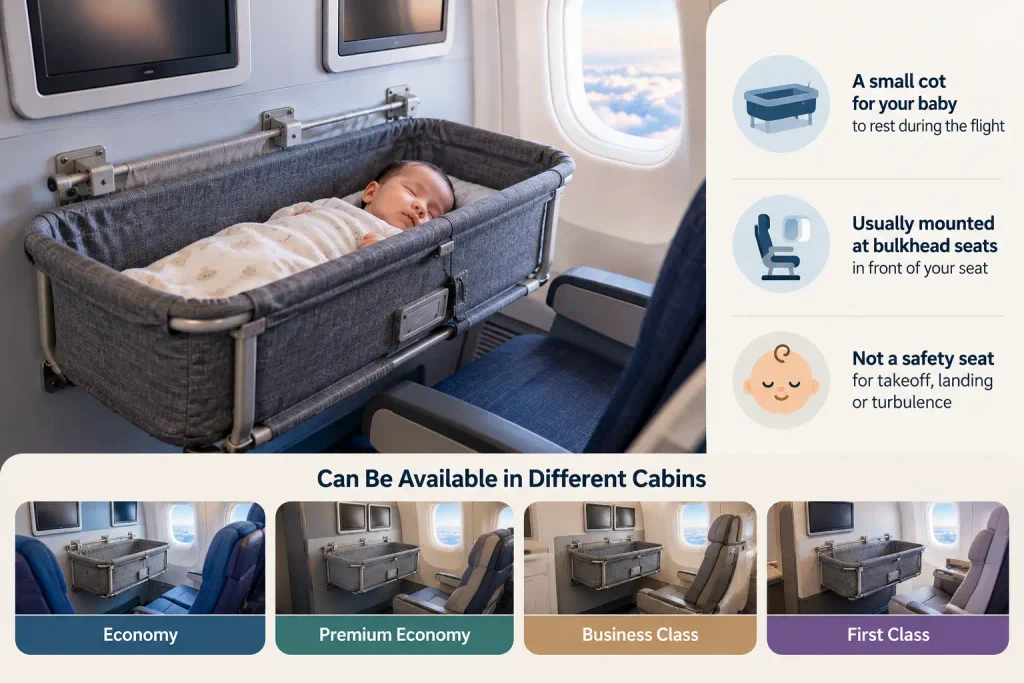
An airplane baby bassinet is a small, detachable cot that gives an infant a place to rest during a flight. It is usually attached to a designated bulkhead partition in front of the accompanying adult’s seat.
A bassinet seat refers to the passenger seat associated with this cot, rather than a separate seat purchased for the baby.
Airlines may also use terms such as skycot, carrycot, or baby cot.
Unlike a standard passenger seat, an aircraft bassinet is not an approved restraint for takeoff, landing, or turbulence. During these periods, the infant must be secured according to the airline’s safety instructions.
Where Are Bassinet Seats Located?
Baby bassinets are typically installed at bulkhead positions, where a fixed partition provides the necessary mounting points.
These locations may be found in Economy, Premium Economy, Business Class, or selected other cabins, depending on the aircraft.
Not every bulkhead seat supports a bassinet. A passenger selecting an ordinary bulkhead seat should not assume that a cot can be installed there.
Baby Bassinet Seats at a Glance
| Feature | General information |
| Purpose | Resting space for eligible infants |
| Location | Designated bulkhead seats |
| Common aircraft | Long-haul, wide-body aircraft |
| Infant age | Usually under 2 years, with stricter practical limits |
| Typical weight limits | Approximately 9–14 kg, depending on airline |
| Length limits | Vary by airline and bassinet model |
| Reservation | Advance request or designated seat selection |
| Cost | Often complimentary, although seat charges may apply |
| Availability | Limited and not always guaranteed |
| Takeoff and landing | Bassinet use prohibited |
| Turbulence | Infant must be removed when instructed |
The precise requirements depend on the operating airline and aircraft.
Baby Bassinet Policies on 50+ Airlines
The following directory covers 55 airlines. The categories indicate whether an airline publishes a bassinet service, whether availability depends on particular aircraft, or whether a bassinet should not be expected.
For carriers without a clearly established current policy, the table identifies the service as requiring confirmation rather than presenting availability as guaranteed.
International Airlines Offering or Potentially Offering Bassinets
| Airline | Bassinet availability | Reservation guidance |
| Aer Lingus | Selected long-haul aircraft | Contact reservations |
| Aeroflot | Selected equipped aircraft | Confirm route and aircraft |
| Aeromexico | Limited; aircraft-dependent | Contact airline |
| Air Canada | Selected wide-body aircraft | Request through reservations |
| Air France | Selected long-haul aircraft | Request in advance |
| Air India | Subject to availability | Request during booking or check-in |
| Air Mauritius | Selected equipped aircraft | Contact reservations |
| Air New Zealand | Selected equipped flights | Request designated bassinet seating |
| Air Seychelles | Requires confirmation | Check operating aircraft |
| Air Transat | Selected aircraft | Confirm before booking |
| ANA | Selected international flights | Request in advance |
| Asiana Airlines | Selected equipped flights | Contact reservations |
| Avianca | Requires confirmation | Check route and aircraft |
| Bangkok Airways | Selected A319/A320 flights over 2.5 hours | Request at least 24 hours before departure |
| British Airways | Selected long-haul aircraft | Request designated seating |
| Cathay Pacific | Selected equipped flights | Contact airline |
| China Airlines | Selected equipped aircraft | Request in advance |
| China Eastern | Aircraft-dependent | Confirm directly |
| China Southern | Selected equipped flights | Contact reservations |
| Condor | Selected long-haul flights | Request in advance |
| Delta Air Lines | Eligible wide-body flights | Request SkyCot through reservations |
| EL AL | Selected equipped aircraft | Contact reservations |
| Emirates | Selected equipped aircraft | Request during booking |
| Ethiopian Airlines | Selected equipped flights | Confirm availability |
| Etihad Airways | Selected aircraft | Request bassinet seat |
| EVA Air | Selected equipped aircraft | Contact reservations |
| Fiji Airways | Selected equipped flights | Confirm in advance |
| Finnair | Selected long-haul aircraft | Request bassinet-compatible seating |
| Garuda Indonesia | Selected equipped aircraft | Contact reservations |
| Gulf Air | Aircraft-dependent | Confirm directly |
| Hawaiian Airlines | Selected equipped flights | Request in advance |
| Iberia | Selected long-haul aircraft | Contact airline |
| Japan Airlines | Selected international flights | Request in advance |
| KLM | Selected intercontinental aircraft | Contact reservations |
| Korean Air | Selected international aircraft | Request in advance |
| LATAM Airlines | Selected wide-body flights | Confirm availability |
| Lufthansa | Selected long-haul aircraft | Request in advance |
| Malaysia Airlines | Selected equipped aircraft | Contact reservations |
| Oman Air | Selected equipped flights | Request in advance |
| Philippine Airlines | Selected equipped aircraft | Contact reservations |
| Qantas | Selected A330, A380 and 787 flights | Select an eligible bassinet seat |
| Qatar Airways | Selected equipped flights | Request bulkhead bassinet seating |
| Royal Brunei Airlines | Selected equipped aircraft | Contact reservations |
| Royal Jordanian | Selected equipped flights | Confirm in advance |
| Saudia | Selected equipped aircraft | Request through airline |
| Singapore Airlines | Selected equipped aircraft | Request bassinet seating |
| South African Airways | Aircraft-dependent | Confirm directly |
| SriLankan Airlines | Selected equipped flights | Contact reservations |
| SWISS | Selected long-haul aircraft | Request in advance |
| TAP Air Portugal | Selected long-haul aircraft | Contact airline |
| Thai Airways | Selected equipped flights | Request in advance |
| Turkish Airlines | Selected equipped aircraft | Request bassinet seating |
| Virgin Atlantic | Selected long-haul aircraft | Contact reservations |
| WestJet | Selected Boeing 787 flights | Request in advance |
Airlines Where Bassinets Are Generally Not Offered
| Airline | General availability |
| Alaska Airlines | Not generally provided on Alaska-operated flights |
| easyJet | No standard onboard bassinet service |
| Frontier Airlines | No standard onboard bassinet service |
| Icelandair | No standard onboard bassinet service |
| JetBlue | No standard onboard bassinet service |
| Porter Airlines | No standard onboard bassinet service |
| Ryanair | No standard onboard bassinet service |
| Southwest Airlines | No standard onboard bassinet service |
| Spirit Airlines | No standard onboard bassinet service |
Important: The tables are a planning directory, not a promise of availability. Airlines may change aircraft, cabin layouts, or infant policies without changing the route itself. For any entry without a cited airline-specific rule, the current service should be verified directly before booking.
Airline Bassinet Weight and Size Limits
Infant weight and length are among the most important eligibility requirements. Airlines may also prohibit use once a baby can sit upright independently, even when the baby remains below the published weight limit.
The following figures are supported by published airline policies.
| Airline | Maximum weight | Additional restrictions |
| Air Canada | Less than 12 kg (25 lb) | Infant must be unable to sit upright |
| Bangkok Airways | 11 kg (24.3 lb) | Maximum height 70 cm |
| Delta Air Lines | Less than 25 lb (11.3 kg) | Maximum length 26 inches (66 cm) |
| Etihad Airways | 11 kg (24 lb) | Maximum length 75 cm |
| Qantas | Less than 11 kg (24 lb) | Infant must fit and lie flat comfortably |
Air Canada lists eligible aircraft including the Boeing 787-8, 787-9, 777-200LR, 777-300ER, and Airbus A330. Its bassinets are allocated on a first-come, first-served basis and cannot be confirmed until departure.
Delta’s current SkyCot policy allows infants under 25 pounds and up to 26 inches long. SkyCots are limited to two per aircraft on qualifying flights, and final confirmation occurs at the departure gate.
Bangkok Airways publishes an 11 kg and 70 cm limit, with bassinets on eligible Airbus A319/A320 flights exceeding 2.5 hours.
Etihad publishes an 11 kg and 75 cm maximum.
Qantas lists a maximum weight below 11 kg and bassinet dimensions of approximately 71 × 31 × 26 cm.
Can a One-Year-Old Baby Use an Airline Bassinet?
Possibly, but age alone doesn’t determine eligibility.
A 12-month-old infant may exceed the airline’s weight or length restrictions or may already be able to sit upright independently.
For example, a baby weighing 10 kg may satisfy an airline’s 11 kg weight restriction but still be ineligible because the baby is too long for the cot.
Parents should check the baby’s expected measurements at the time of travel rather than relying only on age.
How to Book a Baby Bassinet Seat on an Airline
Booking a bassinet generally requires advance coordination with the airline. Some carriers allow bassinet-compatible seats to be selected online, while others process requests through customer service.
Step 1: Choose a Flight With Bassinet Facilities
Before purchasing tickets, travelers should check whether the selected flight uses an aircraft equipped with bassinets.
Long-haul flights operated by wide-body aircraft are often more likely to provide them.
However, aircraft type alone is insufficient. The particular cabin must also have suitable bassinet mounting positions.
Step 2: Add the Infant to the Reservation
The infant must be included in the booking, whether traveling on an adult’s lap or occupying a separately purchased seat.
International itineraries may require an infant ticket and applicable taxes or charges even when the baby does not occupy a separate passenger seat.
The infant’s date of birth and travel documents should match the booking information.
Step 3: Request the Bassinet
Once the booking is confirmed, the traveler should request a bassinet through the airline’s website, reservations department, or another approved channel.
Some airlines allow a bassinet-compatible seat to be selected directly through the booking management system.
Other airlines record a special service request but confirm the actual bassinet only at check-in or the departure gate.
Step 4: Check the Seat Assignment
A bassinet request and a bulkhead seat assignment are related but not identical.
The reservation should ideally show both the appropriate infant information and an eligible seating arrangement.
A regular bulkhead seat may not have a bassinet attachment.
Step 5: Reconfirm Before Departure
Because aircraft substitutions and operational changes can affect bassinet availability, families should verify the request before travel.
At the airport, check-in or gate staff can provide the latest information about the assigned seating and available equipment.
Even an accepted request may remain subject to final onboard safety checks.
Are Baby Bassinet Seats Free on Airlines?
Airline bassinets are frequently provided without a separate equipment charge. However, some airlines charge for reserving the associated bulkhead seat, particularly in Economy Class.
The cost depends on the airline, route, cabin, and ticket conditions.
Airline Bassinet Charges: Important Differences
| Airline | Published arrangement |
| Air India | Infant bassinets provided free of cost, subject to availability |
| Delta Air Lines | SkyCots available free of charge on qualifying flights |
| Bangkok Airways | Complimentary bassinets on eligible flights |
| Qantas | Bassinet seats may incur a charge in international Economy; complimentary in eligible premium cabins |
Air India confirms that bassinets are complimentary, subject to availability, and may be requested during booking, through customer support, or at airport check-in.
Qantas distinguishes between the bassinet facility and the seat reservation. Eligible international Economy passengers may pay to select a bassinet seat, while passengers in eligible First, Business, and Premium Economy cabins receive the seat selection without that charge.
A free bassinet therefore does not always mean a free seat assignment.
Are Baby Bassinets Available in Economy and Business Class?
Baby bassinets can be available in several cabin classes, but their installation depends on the aircraft layout.
Economy Class Bassinets
Economy-class bassinets are usually installed in designated bulkhead rows.
These positions may offer extra space in front of the passenger seat, although the armrests are sometimes fixed and cabin baggage may need to be stored overhead during takeoff and landing.
For families traveling on a budget, Economy bassinet seats can provide useful resting space without purchasing an additional premium-cabin ticket.
Premium Economy Bassinets
Some airlines offer bassinet-compatible seating in Premium Economy.
The combination of a wider seat, additional legroom, and a bassinet may make longer flights more comfortable for accompanying adults.
However, the smaller number of seats in Premium Economy can mean fewer available bassinet positions.
Business Class Bassinets
Business Class bassinets may be installed near bulkhead seats or within specially designed premium-cabin seating areas.
Not every lie-flat Business Class seat can accommodate a bassinet.
Travelers should confirm the exact seat configuration before selecting a premium-cabin ticket for this purpose.
First Class Bassinets
First Class bassinet availability is highly airline- and aircraft-specific.
Some premium cabin designs provide suitable arrangements, while others do not accommodate a detachable cot.
The presence of a First Class cabin should never be interpreted as a guarantee of infant bassinet facilities.
Can Babies Sleep in an Airplane Bassinet During the Entire Flight?
No. An airline bassinet can generally be used only when the aircraft is in an appropriate phase of flight and the cabin crew permits its use.
The baby must be removed during takeoff, landing, and periods when the crew requires passengers to secure themselves.
Turbulence is especially important because a bassinet does not provide the same protection as an approved child restraint system.
The American Academy of Pediatrics advises that an approved car seat or safety restraint is the safest arrangement for infant air travel. It also recommends a firm, flat bassinet surface without loose bedding, pillows, or soft toys.
Bassinet Safety Rules
- The infant must remain within the airline’s weight and size limits.
- Cabin crew must install or authorize use of the bassinet.
- The baby must be removed whenever instructed.
- Loose pillows, toys, and bedding should not be placed inside.
- The infant should not be left unattended.
- A bassinet must not be used as a storage compartment.
- Parents must follow the airline’s instructions during turbulence and other safety-related situations.
The specific rules of the operating airline take precedence over general guidance.
Baby Bassinet vs. Infant Car Seat: Which Is Better?
A bassinet and an approved child safety seat serve different purposes.
A bassinet provides a resting space during permitted phases of flight, while an approved child restraint system secures the infant in a separately purchased passenger seat.
| Feature | Airline bassinet | Approved infant car seat |
| Main purpose | Resting space | Passenger restraint |
| Separate infant seat required | Usually no | Yes |
| Can be used during takeoff | No | Yes, if approved and correctly installed |
| Can be used during landing | No | Yes, if approved and correctly installed |
| Suitable during turbulence | No | Yes, subject to proper installation |
| Availability | Depends on airline and aircraft | Depends on seat purchase and airline approval |
| Weight and size restrictions | Airline-specific | Manufacturer and airline restrictions |
For safety, the FAA recommends that children under 2 travel in an approved child restraint system rather than being held on an adult’s lap.
Families considering this option should confirm that the chosen car seat is approved for aircraft use and compatible with the airline’s seating rules.
What Happens if a Bassinet Is Unavailable?
A bassinet request may be declined or withdrawn because of aircraft changes, limited equipment, seating conflicts, or infant eligibility restrictions.
When this happens, the infant must travel using another arrangement permitted by the airline.
Possible alternatives include an adult’s lap under the applicable infant travel rules or a separately purchased seat with an approved child restraint.
If a bassinet-compatible seat was purchased for an additional fee but the facility was not provided, the passenger should review the airline’s seat-fee refund conditions.
The airline may refund an eligible seat selection charge in some circumstances, but the rules vary and should not be assumed to apply automatically.
Tips for Traveling With a Baby on a Long-Haul Flight
Careful preparation is useful even when a bassinet has been requested.
Choose flights carefully. Direct flights can reduce the number of takeoffs, landings, and airport transfers. When connections are necessary, sufficient transfer time is particularly important.
Confirm the operating airline. Codeshare flights may follow the operating carrier’s bassinet policy rather than the marketing airline’s policy.
Check the infant’s size. Weight and length should be evaluated close to departure, especially when the child is near the airline’s limit.
Keep essential items accessible. Diapers, wipes, feeding supplies, spare clothing, and necessary medications should be packed in accordance with carry-on and security rules.
Prepare for an unavailable bassinet. Families should not depend entirely on receiving a cot, even when the request has been recorded.
Follow cabin crew instructions. Bassinets must be used only when the crew confirms that conditions are safe.
Final Thoughts!
Airline baby bassinets can provide a useful resting space for infants during long flights, but availability is never universal. The most important considerations are the aircraft type, infant weight and length, bassinet-compatible seating, reservation procedures, and the airline’s safety restrictions.
Families should request bassinets as early as possible and reconfirm the arrangement before departure. A backup seating plan is also important because equipment availability may change.
For travelers comparing multiple carriers, the best choice is not necessarily the airline advertising the largest bassinet. The complete journey, connection times, cabin configuration, infant ticket rules, and availability of approved child restraints all deserve consideration.
Source note: This guide incorporates published information from official airline policies, including Air Canada, Air India, Bangkok Airways, Delta Air Lines, Etihad Airways, and Qantas. The wider airline directory is provided for comparison, but individual policies not independently verified should be confirmed with the operating carrier before booking.
Frequently Asked Questions!
Many international airlines provide bassinets on selected aircraft, including Emirates, Qatar Airways, Singapore Airlines, Lufthansa, British Airways, Air Canada, Air India, Qantas, and Delta Air Lines. Availability must be confirmed for the particular flight.
Yes, if the newborn meets the airline’s minimum age-to-fly requirements and bassinet eligibility rules. Minimum permitted flying ages vary, and medical advice may be appropriate for very young infants.
No. A bulkhead seat does not automatically guarantee a bassinet. The seat must be compatible with the equipment, and the airline must have an available cot.
The request should be made as soon as the flight is booked. Some airlines permit requests closer to departure, but availability may become more limited.
No. Airline bassinets are intended for one eligible infant at a time. Families traveling with twins should ask about multiple bassinet positions and the airline’s infant-to-adult seating rules.
Possibly. Eligibility depends on the airline’s age, weight, length, and developmental restrictions. Some one-year-old infants may no longer qualify.
A personal bassinet cannot generally be attached to an aircraft bulkhead unless specifically approved by the airline. Portable infant equipment may be accepted as baggage, but onboard use is governed by the airline’s rules.
Bassinet seats are usually at bulkheads and may offer additional space in front of the seat. However, this does not guarantee more usable legroom, and fixed armrests or nearby cabin facilities may affect comfort.
Some airlines provide them on selected shorter flights, but availability is much less common than on long-haul international services. Bangkok Airways, for example, publishes bassinet availability on certain Airbus A319/A320 flights longer than 2.5 hours.
The airline may need to change the seating arrangement or withdraw the bassinet request. Passengers should contact the operating airline to discuss available alternatives and any applicable seat-fee refund.