
Travel Points Valuation: What Are Miles Worth in 2026?
Travel points and airline miles are generally worth about 1 to 2 cents each. Still, their actual value can be substantially higher or lower depending on the loyalty program, redemption method, travel dates, award availability, and the type of flight or hotel stay booked.
That distinction matters because 100,000 points does not automatically equal $1,000, $2,000, or any other fixed amount. A rewards balance has a different practical value depending on how you use it. A transferable credit-card currency may be worth considerably more when moved to a useful airline partner, while the same points could produce a lower return through a basic statement-credit redemption.
This September 2026 guide explains current published valuations, how cents-per-point calculations work, why different experts arrive at different figures, and how travelers can judge whether a particular redemption represents good value.
What Does “Points and Miles Valuation” Mean?
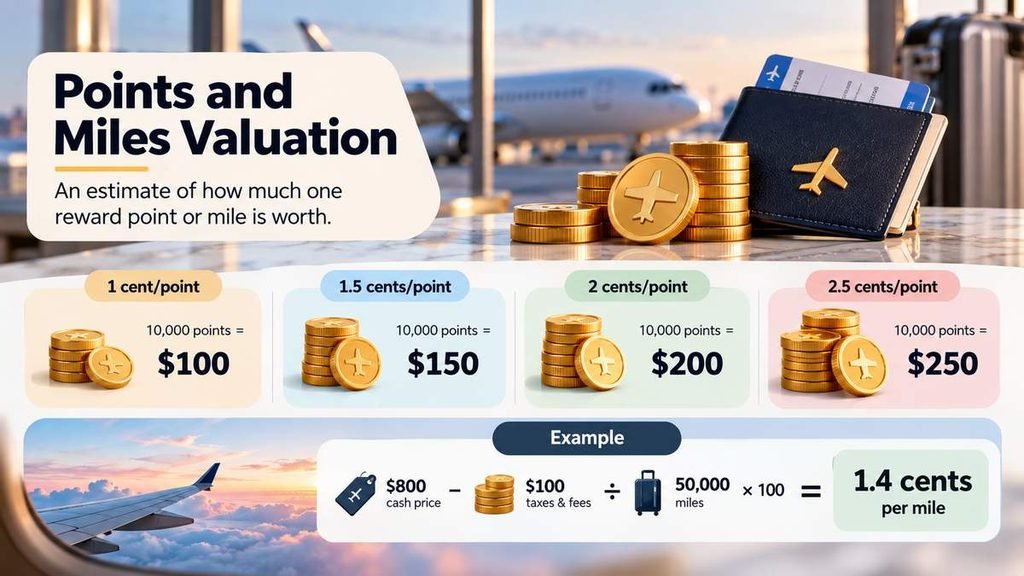
A points-and-miles valuation is an estimate of how much one reward point or mile is worth when redeemed. The figure is usually expressed in cents per point (cpp) or cents per mile (cpm).
For example:
- 1 cent per point means 10,000 points are valued at about $100.
- 1.5 cents per point means 10,000 points are valued at about $150.
- 2 cents per point means 10,000 points are valued at about $200.
- 2.5 cents per point means 10,000 points are valued at about $250.
The calculation is straightforward:
Value per point = (Cash price − taxes and fees that would still be paid) ÷ Points required × 100
Suppose a flight costs $800 in cash, while the same award costs 50,000 miles plus $100 in taxes and fees:
($800 − $100) ÷ 50,000 × 100 = 1.4 cents per mile
That 1.4-cent figure is the redemption’s effective value.
Valuations published by travel-rewards websites should therefore be treated as benchmarks rather than guaranteed exchange rates. Upgraded Points explicitly notes that airlines, hotels, and credit-card issuers generally do not publish an official universal valuation for their loyalty currencies.
September 2026 Points and Miles Valuations
The following figures are the September 2026 estimates published by Upgraded Points. They represent that publication’s valuation methodology and should not be interpreted as official prices set by the loyalty programs.
Flexible Credit-Card Points
| Rewards program | Sept. 2026 valuation | 50,000 points | 100,000 points |
| American Express Membership Rewards | 2.2¢ | $1,100 | $2,200 |
| Bilt Rewards | 2.0¢ | $1,000 | $2,000 |
| Chase Ultimate Rewards | 2.0¢ | $1,000 | $2,000 |
| Diners Club Rewards | 2.0¢ | $1,000 | $2,000 |
| Capital One miles | 1.8¢ | $900 | $1,800 |
| Citi ThankYou Rewards | 1.6¢ | $800 | $1,600 |
| Rove miles | 1.5¢ | $750 | $1,500 |
| Wells Fargo Rewards | 1.5¢ | $750 | $1,500 |
| Bank of America Rewards | 1.0¢ | $500 | $1,000 |
| Barclaycard Arrival miles | 1.0¢ | $500 | $1,000 |
| Brex Rewards | 1.0¢ | $500 | $1,000 |
Upgraded Points says these higher valuations for flexible currencies depend substantially on using transfer partners rather than simply taking the easiest redemption option.
Airline Loyalty Programs
| Airline program | Sept. 2026 valuation |
| Alaska Airlines Atmos Rewards | 1.6¢ |
| Asiana Club | 1.6¢ |
| Korean Air SKYPASS | 1.6¢ |
| Air Canada Aeroplan | 1.5¢ |
| ANA Mileage Club | 1.4¢ |
| Avianca LifeMiles | 1.4¢ |
| Etihad Guest | 1.4¢ |
| Virgin Atlantic Flying Club | 1.4¢ |
| Singapore Airlines KrisFlyer | 1.35¢ |
| Cathay Pacific Asia Miles | 1.3¢ |
| Delta SkyMiles | 1.2¢ |
| United MileagePlus | 1.2¢ |
| Emirates Skywards | 1.1¢ |
| Frontier Miles | 1.1¢ |
| Breeze Breezy Rewards | 1.0¢ |
The published Upgraded Points table also values Aer Lingus, British Airways, Iberia and Qatar Airways Avios at 1.25 cents each, while Lufthansa Miles & More is listed at 1.3 cents.
Hotel Loyalty Programs
| Hotel program | Sept. 2026 valuation |
| Leading Hotels of the World | 8.0¢ |
| Accor Live Limitless | 2.2¢ |
| World of Hyatt | 1.4¢ |
| Wyndham Rewards | 0.9¢ |
| Marriott Bonvoy | 0.7¢ |
| Best Western Rewards | 0.6¢ |
| Choice Privileges | 0.6¢ |
| Hilton Honors | 0.5¢ |
| IHG One Rewards | 0.5¢ |
| I Prefer | 0.5¢ |
| Radisson Rewards | 0.25¢ |
The unusually high Leading Hotels of the World figure illustrates why valuations should always be considered alongside redemption opportunities. A high theoretical value is less useful to a traveler who rarely stays at participating properties.
Why Do Points and Miles Have Different Values?
No universal value exists because loyalty currencies behave differently.
1. Redemption method
The same currency can produce different results depending on where you redeem it.
A traveler may use points for:
- Airline award tickets
- Business- or first-class flights
- Hotel nights
- Travel booked through a credit-card portal
- Gift cards
- Merchandise
- Statement credits
- Other program-specific rewards
A premium-cabin award can sometimes produce a substantially higher cents-per-point result than a low-cost economy ticket. Conversely, using flexible points for a low-value merchandise redemption can reduce their effective value.
2. Transfer partners
Transferable currencies are different from airline-specific miles because they provide access to multiple loyalty programs.
For example, American Express Membership Rewards can be transferred to participating airline and hotel programs. American Express states that transfers are final, and travelers should verify award availability before moving points.
Similarly, Chase Ultimate Rewards can be transferred to participating airline and hotel partners from eligible cards. Chase says most participating transfers are made at 1:1 ratios, although partner-specific rules can differ.
That flexibility can increase the practical value of points because travelers can compare several award programs before committing.
3. Award availability
A theoretical valuation is not useful if the desired award cannot be booked.
For example, a traveler might value 60,000 miles at $900 based on a 1.5-cent benchmark. But if the available flights require 90,000 miles for the dates that matter, the actual redemption decision may look very different.
Availability can depend on:
- Travel dates
- Route
- Cabin
- Number of passengers
- Partner inventory
- Advance booking period
- Program rules
Air Canada, for example, states that the number of Aeroplan points required for some rewards can vary according to factors including inventory availability and redemption timing.
Published Valuations Can Differ Significantly
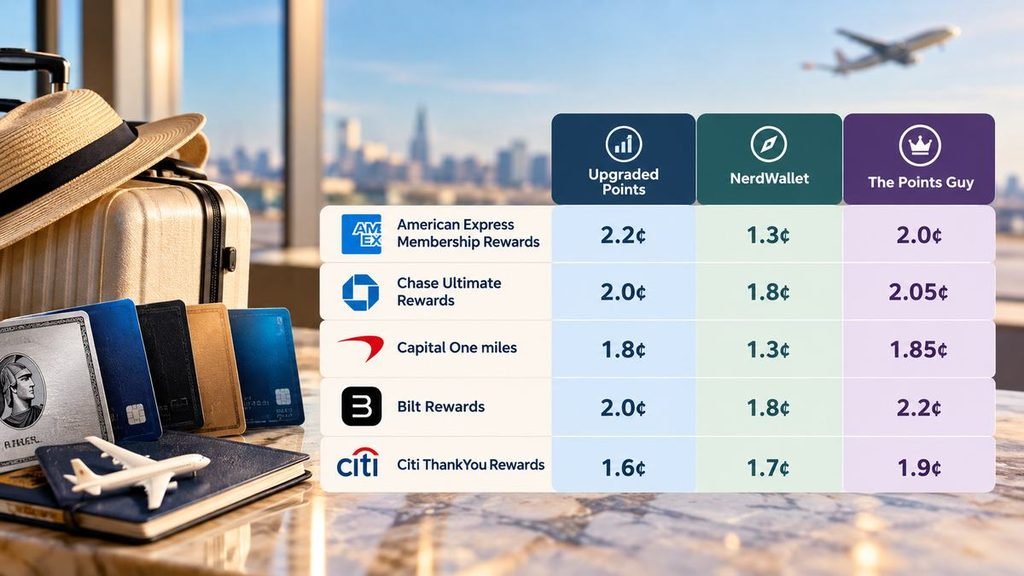
Travel-rewards valuations are methodologies, not official market prices, so different publications can reach different conclusions.
For September 2026, for example, NerdWallet estimates American Express Membership Rewards at 1.3 cents, while Upgraded Points places the currency at 2.2 cents. NerdWallet’s figures are based on its own analysis of cash and award bookings, while Upgraded Points incorporates factors including redemption values, flexibility, transfer partners, and award availability.
The Points Guy also publishes a separate September 2026 methodology, valuing American Express Membership Rewards at 2.0 cents, Chase Ultimate Rewards at 2.05 cents and Capital One at 1.85 cents.
This does not mean one source is necessarily “correct” and the others are wrong. The differences demonstrate that valuation depends partly on methodology and assumptions.
September 2026 comparison
| Currency | Upgraded Points | NerdWallet | The Points Guy |
| Amex Membership Rewards | 2.2¢ | 1.3¢ | 2.0¢ |
| Chase Ultimate Rewards | 2.0¢ | 1.8¢* | 2.05¢ |
| Capital One miles | 1.8¢ | 1.3¢ | 1.85¢ |
| Bilt Rewards | 2.0¢ | 1.8¢ | 2.2¢ |
| Citi ThankYou Rewards | 1.6¢ | 1.7¢ | 1.9¢ |
The practical lesson is that travelers should use published valuations as benchmarks, then calculate the value of the specific redemption they are considering.
Which Points Are Most Valuable in September 2026?
No universal “best” rewards currency exists because usefulness depends on travel patterns, but September 2026 valuations show major differences between programs.
Flexible points
Upgraded Points places American Express Membership Rewards at 2.2 cents per point, Chase Ultimate Rewards and Bilt Rewards at 2 cents, and Capital One miles at 1.8 cents.
Their flexibility is a major factor. A traveler can potentially move rewards to different airline or hotel programs instead of being tied to one carrier.
Airline miles
Airline valuations are generally lower than the highest flexible-point estimates, although premium-cabin awards and partner redemptions can sometimes produce considerably more value.
Upgraded Points lists Atmos Rewards at 1.6 cents, while Air Canada Aeroplan is 1.5 cents and several programs, including Avianca LifeMiles, Etihad Guest and Virgin Atlantic Flying Club, are listed at 1.4 cents.
Hotel points
Hotel valuations can vary even more dramatically.
Upgraded Points lists Leading Hotels of the World points at 8 cents each, Accor Live Limitless at 2.2 cents and World of Hyatt at 1.4 cents.
NerdWallet’s September 2026 analysis gives World of Hyatt a 1.8-cent median value, Marriott Bonvoy 0.7 cent, IHG One Rewards 0.6 cent and Hilton Honors 0.4 cent.
These differences reinforce the importance of looking at methodology rather than treating any single valuation as a guaranteed redemption rate.
How To Get More Value From Points and Miles
Compare cash and award prices before transferring
Never transfer flexible points simply because an award “looks cheap.”
First:
- Search for the desired flight or hotel.
- Confirm the cash price.
- Confirm the points or miles price.
- Add taxes, fees and surcharges.
- Calculate the cents-per-point value.
- Transfer only after confirming availability.
Transfers are generally irreversible. American Express explicitly warns that Membership Rewards transfers cannot be reversed, while Chase likewise states that partner transfers are final.
Look for transfer bonuses
A temporary transfer bonus can change the mathematics.
For example, if a program normally requires 50,000 transferable points but a 20% transfer bonus is available, the traveler may need only 41,667 source points to receive approximately 50,000 partner points.
However, the bonus is useful only when the underlying award is worthwhile. A transfer bonus does not automatically make a poor redemption valuable.
Consider premium-cabin travel
Business- and first-class awards can generate high cents-per-point figures because the comparable cash fares can be expensive.
But travelers should distinguish mathematical value from personal value. Someone who would happily pay $700 for economy but would never pay $4,000 for business class should not automatically treat the $4,000 fare as the amount saved.
Stay flexible with dates
A one-day change can sometimes make a major difference in award pricing.
Travelers who can shift a trip from a peak weekend to a nearby weekday may find:
- Lower award rates
- Better award availability
- Lower cash fares
- More hotel inventory
Flexibility is particularly important with programs that use dynamic or variable award pricing.
When Should Travelers Pay Cash Instead?
Using points is not automatically better than paying cash.
A traveler may reasonably choose cash when:
- The cash fare is unusually low.
- The award requires an unusually large number of points.
- The redemption produces substantially less value than the traveler’s benchmark.
- The traveler needs to preserve miles for a more valuable future trip.
- The cash booking earns valuable airline or hotel credit and status benefits.
- Taxes, fees, or surcharges make the award less attractive.
For example, if a $120 flight requires 15,000 miles plus $20 in fees, the redemption produces only:
($120 − $20) ÷ 15,000 × 100 = 0.67 cents per mile
A traveler may prefer to pay $120 and save the miles for a higher-value opportunity.
Points and Miles vs. Cash Back
Travel rewards are often more valuable to travelers who understand transfer partners and award programs.
Cash-back rewards are simpler because their value is normally explicit. If a card offers a 2% cash-back rate, $100 of eligible spending produces $2 in rewards.
Points are different because their value can depend on redemption.
This creates a trade-off:
Cash back: predictable and simple.
Travel points: potentially more valuable, but requiring research and flexibility.
For travelers who do not want to compare award programs, a fixed-value redemption can be perfectly reasonable even when a more complicated strategy might theoretically generate a higher valuation.
What Causes Points and Miles Values To Change?

Loyalty programs can change their economics without changing the name of their currency.
Common causes include:
- Award-price increases
- Changes to award charts
- Dynamic pricing
- New or removed transfer partners
- Changes in transfer ratios
- Higher taxes or carrier surcharges
- Reduced award availability
- New redemption categories
- Changes to hotel pricing
- Changes in credit-card transfer relationships
NerdWallet’s September 2026 research, for example, reported that Marriott Bonvoy’s estimated value fell from 0.8 cent in 2025 to 0.7 cent in 2026 following higher award pricing at a large share of properties. It also reported that World of Hyatt remained at 1.8 cents despite changes to its award structure.
These developments explain why monthly or annual valuation updates can be useful.
Common Mistakes When Valuing Points
Common mistakes include relying on headline valuations, ignoring redemption fees, and assuming every point has a fixed cash value. Travelers may also overlook their actual redemption habits. Comparing the cash price with the points required can provide a more realistic cents-per-point value before redeeming rewards.
Treating points as cash
A rewards balance is not necessarily equivalent to a bank balance. A 100,000-point balance may have different practical values depending on the redemption.
Ignoring taxes and fees
If an award costs 60,000 miles plus $250 in fees, the $250 should be considered when comparing it with a cash fare.
Using the highest possible valuation as the normal value
A spectacular redemption may produce 4 or 5 cents per point, but that does not mean every redemption will achieve it.
Transferring before finding an award
This is one of the costliest mistakes. Once points move from a flexible program to an airline or hotel program, they may not be transferable back.
Ignoring opportunity cost
Using 80,000 points today means you can’t use those points for another trip tomorrow. The best redemption is therefore not necessarily the one with the largest headline cents-per-point number.
The Practical Takeaway
Points and miles do not have a single official cash value. Their usefulness depends on the loyalty program, redemption, transfer options, availability, fees and the traveler’s own alternatives.
For September 2026, published valuations show that flexible currencies can carry substantial estimated value, while airline and hotel currencies span a much wider range. The figures from Upgraded Points, NerdWallet and The Points Guy also demonstrate that valuation is methodology-dependent rather than a fixed exchange rate.
The most reliable approach is to treat published valuations as benchmarks, then calculate the value of the actual booking. Before transferring points, travelers should confirm award availability, compare the cash price, account for taxes and fees, and consider whether they would realistically pay the cash fare.
That approach makes points and miles valuations useful for real travel decisions rather than simply turning a rewards balance into an impressive-looking dollar figure.
Frequently Asked Questions
There is no universal answer. Using September 2026 Upgraded Points estimates, 100,000 flexible points range from about $1,000 for several programs to $2,200 for American Express Membership Rewards. Airline and hotel currencies vary considerably more.
One cent per point is a useful baseline, but whether it is good depends on the currency and redemption. Flexible points can often be worth more when transferred to a suitable airline or hotel partner.
The answer depends on the airline. Under Upgraded Points’ September 2026 estimates, 50,000 miles are valued at about $550 with Emirates Skywards, $600 with Delta SkyMiles, and $800 with Alaska Mileage Plan.
No. Airline miles generally belong to a specific airline loyalty program, while transferable credit-card points can potentially move to multiple participating airline and hotel programs.
Yes. Some redemptions can produce substantially more than 2 cents per point, particularly unusual premium-cabin or luxury-hotel awards. However, a high-value redemption doesn’t necessarily represent the typical value of the entire rewards currency.
It depends on the specific redemption. Travelers should compare the cash price, points requirement, taxes and fees, and their realistic alternative use for the points rather than automatically favoring flights or hotels.
Different publishers use different data, assumptions, and methodologies. NerdWallet, The Points Guy, and Upgraded Points all publish September 2026 valuations, but their figures differ because they measure or model value differently.