
What ID Do You Need to Fly on a Plane? Essential Tips to Prevent Delays
Adults aged 18 and older flying within the United States need a REAL ID-compliant driver’s license, a valid passport, or another identification document accepted by the Transportation Security Administration (TSA). Travelers without acceptable identification may face additional verification, delays, fees, or denial of access to the security checkpoint.
Requirements differ for international flights, where passports and destination-specific entry documents are generally required. Children, foreign nationals, military personnel, and travelers who have lost their identification may also follow different procedures.
Understanding these distinctions before arriving at the airport can prevent last-minute complications. This guide explains acceptable IDs for domestic and international flights, REAL ID requirements, identification rules for minors, and practical steps to take when documents are missing or expired.
Explore this blog: TSA PreCheck Touchless ID: What Travelers Should Know
What Forms of ID Does TSA Accept for Domestic Flights?
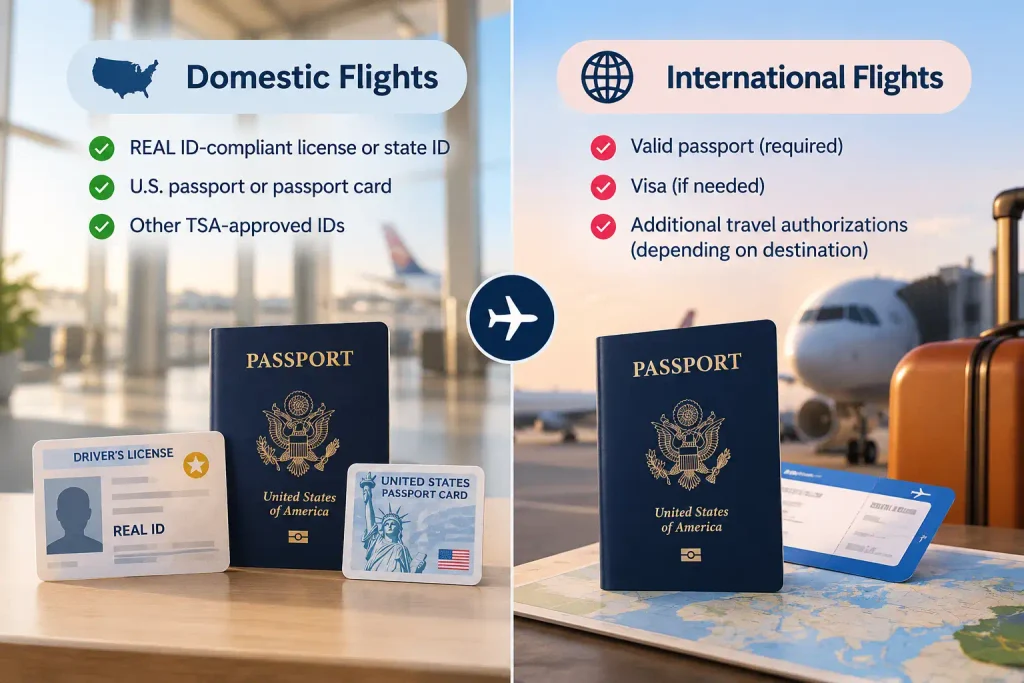
TSA accepts several government-issued identification documents for domestic flights, including REAL ID-compliant state licenses, U.S. passports, passport cards, and certain federal or military credentials.
A passport is not required for most U.S. domestic flights when the passenger has another acceptable form of identification.
Keep Reading: What Should You Do When Your Flight Is Canceled?
Which IDs Are Accepted at TSA Security Checkpoints?
The following table summarizes common forms of identification accepted by TSA.
| Identification document | Accepted for U.S. domestic flights? | Important details |
| REAL ID-compliant driver’s license | Yes | Must meet federal identification standards |
| REAL ID-compliant state identification card | Yes | Available to eligible non-drivers |
| U.S. passport book | Yes | Can be used instead of a REAL ID |
| U.S. passport card | Yes | Valid for domestic air travel |
| DHS Trusted Traveler card | Yes | Includes Global Entry, NEXUS, SENTRI, and FAST cards |
| U.S. Department of Defense ID | Yes | Includes qualifying military and dependent credentials |
| Permanent Resident Card | Yes | Also known as a Green Card |
| Foreign government-issued passport | Yes | Accepted as identification at TSA checkpoints |
| Federally recognized tribal photo ID | Yes | Subject to TSA’s accepted-document requirements |
| Transportation Worker Identification Credential | Yes | Commonly called TWIC |
| Employment Authorization Card | Yes | Form I-766 |
| Canadian provincial driver’s license | Yes | Listed among TSA’s accepted identification |
| Veteran Health Identification Card | Yes | Must meet TSA requirements |
TSA maintains an official list of acceptable identification documents, including certain additional federal credentials. Travelers should consult that list when using a less common ID.
Can Travelers Use a Passport Instead of a REAL ID?
Yes. A valid U.S. passport book or passport card is an acceptable alternative to a REAL ID-compliant driver’s license for domestic TSA screening.
For example, a passenger whose state license isn’t REAL ID-compliant can present a valid passport instead of getting a new driver’s license just for a domestic flight.
A passport card is suitable for domestic air travel but cannot replace a passport book for most international air travel.
What Is REAL ID, and Why Does It Matter for Flying in 2026?
REAL ID is a federal identification standard for state-issued driver’s licenses and identification cards used for certain official purposes, including domestic airport security screening.
Since May 7, 2025, adults using state-issued identification at TSA checkpoints have generally needed a REAL ID-compliant license or another TSA-accepted document.
A standard noncompliant driver’s license is no longer sufficient on its own.
How Can Travelers Tell Whether Their Driver’s License Is REAL ID-Compliant?
Most REAL ID-compliant licenses display a star near the upper portion of the card. Some enhanced driver’s licenses use different markings and are also acceptable.
Because card designs vary by state, travelers should check with their state Department of Motor Vehicles (DMV) if they are unsure.
A driver’s license without the usual star is not automatically unacceptable if it is a qualifying Enhanced Driver’s License.
Is a REAL ID Required if a Traveler Has a Passport?
No. A passport or another accepted federal identification document can be used instead of a REAL ID-compliant state license.
REAL ID is a standard for certain state-issued documents, not an additional document that every passenger must carry.
Can Travelers Fly With a Temporary Driver’s License?
A temporary paper driver’s license is not accepted as a standalone TSA identification document.
Passengers waiting for a replacement REAL ID should carry a valid passport or another accepted alternative. If no acceptable ID is available, the TSA ConfirmID process may be an option, but verification is not guaranteed.
What Happens if Someone Arrives at the Airport Without an Acceptable ID?
An adult without acceptable identification may use TSA ConfirmID, a paid alternative identity-verification process. However, payment does not guarantee passage through security.
The program began operating on February 1, 2026, and applies to adults who cannot present a REAL ID or another accepted identification document.
How Does TSA ConfirmID Work?
Travelers can complete the process using the official payment system before reaching the airport.
| TSA ConfirmID detail | Requirement |
| Fee | $45 per traveler |
| Eligibility | Travelers aged 18 or older without acceptable ID |
| Payment validity | 10 days from the selected travel start date |
| Payment website | Pay.gov |
| Verification result | Not guaranteed |
| Airport screening | Required if identity is successfully verified |
To use TSA ConfirmID, travelers should:
- Visit the official TSA ConfirmID page.
- Follow the payment link to Pay.gov.
- Enter the traveler’s legal name and travel start date.
- Pay the $45 fee.
- Save the electronic receipt or print a copy.
- Present the receipt at the airport checkpoint and follow TSA instructions.
Each adult who lacks acceptable identification must complete the process separately. The $45 payment is valid for the specified 10-day period, not indefinitely.
How Long Does TSA ConfirmID Verification Take?
TSA says identity verification averages about 10–15 minutes, but it may take 30 minutes or longer.
Travelers should allow additional time because processing can vary by airport, passenger circumstances, and checkpoint conditions.
Transportation Security Administration
A successful payment only provides access to the verification process. If TSA cannot establish the traveler’s identity, the passenger will not be permitted through security.
Can Someone Fly After Losing Their Wallet?
Possibly. A traveler who loses a wallet should first check whether they have another accepted ID, such as a passport or Global Entry card.
If no acceptable document is available, TSA ConfirmID may provide a way to attempt identity verification.
However, passengers should not assume that presenting credit cards, photographs, or personal information automatically guarantees access to the checkpoint.
Can Travelers Fly With an Expired ID?
TSA currently accepts certain expired identification documents for up to two years after their expiration date, provided they are otherwise among the accepted forms of ID.
This allowance applies to TSA checkpoint identification screening. It does not mean an expired passport is valid for international travel or that an expired license is valid for driving.
For example, a qualifying REAL ID-compliant license that expired several months ago may still be accepted by TSA for a domestic flight.
Travelers should confirm the latest TSA rules before departure, especially if the document is damaged, unusually old, or subject to separate restrictions.
What ID Do Children Need to Fly?
Children under 18 generally do not need to present identification to TSA when traveling on domestic flights within the United States.
However, airlines may request documentation to verify a child’s age, eligibility for an infant fare, or compliance with an unaccompanied-minor policy.
Do Infants and Toddlers Need Identification for Domestic Flights?
TSA does not require identification for children under 18 on domestic flights.
Nevertheless, an airline may request proof of age, especially when a child travels as a lap infant.
Parents should check the operating airline’s requirements rather than assuming that TSA’s screening rules cover every aspect of boarding.
Do Unaccompanied Minors Need ID?
TSA generally does not require domestic-flight identification for children under 18. However, an unaccompanied minor who wishes to use TSA PreCheck must present acceptable identification to receive expedited screening.
Airlines also maintain their own unaccompanied-minor procedures, which may require identification from the adults dropping off or collecting the child.
Do Children Need Passports for International Flights?
Yes, children traveling internationally by air generally need their own valid passports, subject to the rules applicable to their citizenship and itinerary.
A parent’s passport does not replace a child’s individual travel document.
Some countries also require parental consent letters, birth certificates, visas, or other documentation when a child travels with one parent or another adult.
What Identification Is Required for International Flights?
International air travel generally requires a valid passport book and any additional documents required by the destination or transit country.
For U.S. citizens, a REAL ID-compliant driver’s license or U.S. passport card does not replace a passport book for international flights.
The U.S. The Department of State confirms that passport cards are not valid for international air travel.
How Do Domestic and International Flight ID Requirements Compare?
U.S. domestic flight ID requirements generally allow adults to use REAL ID-compliant licenses or other TSA-approved identification. International flights typically require valid passports, along with visas or travel authorizations depending on the destination and nationality.
| Requirement | U.S. domestic flight | International flight |
| REAL ID driver’s license | Accepted | Not a substitute for a passport |
| U.S. passport book | Accepted | Generally required for U.S. citizens |
| U.S. passport card | Accepted | Not valid for international air travel |
| Child’s identification | Generally not required by TSA under age 18 | Passport generally required |
| Visa or electronic travel authorization | Not normally required for domestic travel | Depends on destination and nationality |
| Passport validity rules | Not applicable when using another accepted ID | Depends on destination |
| Parental consent documents | Airline-specific situations | May be required by destination or transit country |
Does a Passport Need Six Months of Validity to Fly Internationally?
Not always. Some destinations require a passport to remain valid for at least six months beyond the travel dates, while others have different validity requirements.
Travelers should check the destination country’s entry rules and any transit-country requirements before booking.
A passport that hasn’t expired yet may still be insufficient for a particular international trip.
Can Travelers Fly Internationally Without a Visa?
Sometimes. Visa requirements depend on citizenship, destination, length of stay, and purpose of travel.
Some countries allow visa-free visits, while others require an electronic travel authorization, an electronic visa, or a visa obtained before departure.
Travelers should check official government guidance rather than assuming that possessing a passport guarantees entry.
Can Travelers Use Digital Identification at the Airport?
Yes. TSA accepts certain approved digital identification credentials at participating checkpoints, but not every digital wallet or state-issued mobile driver’s license is supported.
Digital identification may include eligible mobile driver’s licenses and certain digital passport-based credentials offered through approved platforms.
However, travelers should still carry their physical identification. TSA advises passengers using digital ID to bring an acceptable physical document because participation and screening arrangements can vary.
Is a Photo of a Driver’s License Accepted by TSA?
Do not treat a photograph or screenshot of a driver’s license as an accepted identification document.
Approved digital IDs use specific identity-verification technology. A simple image stored in a phone’s photo gallery does not provide the same functionality.
If a traveler has only a photograph of an ID, TSA ConfirmID may be necessary.
Can Apple Wallet or Google Wallet Replace a Physical ID?
Certain approved credentials in supported digital wallets can be used at participating TSA checkpoints.
However, availability depends on the state, credential type, airport, and current TSA participation rules.
Travelers should verify that their digital ID is supported before departure and keep the physical document available as a backup.
What Happens if the Name on the Flight Ticket Does Not Match the ID?
A significant difference between the passenger’s identification and reservation details can cause problems at check-in or during security screening.
Airlines generally require the name on a ticket to match the traveler’s identification documents, though they may handle formatting conventions and minor variations differently.
Are Missing Middle Names or Suffixes a Problem?
Not necessarily. TSA accepts certain variations involving name suffixes, such as Jr. or Sr., between identification and boarding passes.
However, travelers should not assume that every spelling difference or missing name component is acceptable, especially on international itineraries.
For international travel, the booking name should follow the passport details and the operating airline’s requirements.
What if a Traveler’s Name Changed After Marriage?
A traveler whose legal name has changed should ensure the airline reservation and identification match before departure.
A marriage certificate or other legal name-change document may help explain the difference, but it does not guarantee acceptance by every airline or immigration authority.
For international travel, passengers should verify the applicable passport and airline rules before making changes.
The U.S. The Department of State provides procedures for updating a passport after a legal name change.
What Common ID Mistakes Can Delay Airport Security?
Identification-related delays often stem from issues you could have caught before you left home.
| Common mistake | Potential consequence | Recommended action |
| Bringing a non-REAL ID license | Additional verification or denied screening | Carry a passport or another accepted ID |
| Relying on a temporary paper license | ID may be rejected | Use another TSA-accepted document |
| Forgetting a passport for an international flight | Possible denial of boarding | Check passport requirements before departure |
| Assuming a passport card works internationally | Inability to board international air travel | Carry a passport book |
| Using an unsupported digital ID | Additional screening complications | Bring physical identification |
| Overlooking passport validity rules | Airline or immigration problems | Check destination requirements |
| Booking under an incorrect name | Check-in or boarding complications | Request correction from the airline |
| Arriving without ID or a verification plan | Long delays or missed flight | Review TSA ConfirmID before travel |
How Can Travelers Prevent Identification Problems Before Departure?
The most effective approach is to verify documents before the travel date rather than waiting until check-in.
Travelers should review their ID’s expiration date, confirm the booking name, and check whether they need additional documents.
For international journeys, review passport validity, visa eligibility, transit rules, and children’s documentation separately.
Read the blog: Is Paying More to Fly Into a Closer Airport Worth It?
Conclusive Remarks!
The most important preparation is confirming that your ID meets the requirements of both the flight and the destination.
For U.S. domestic flights, adults should carry a REAL ID-compliant license or another TSA-accepted document. International travelers should verify passport validity, visa requirements, and any additional documentation needed for transit or entry.
Passengers without acceptable identification should use TSA ConfirmID in advance rather than relying on airport verification.
Frequently Asked Questions!
Yes, if the license is REAL ID-compliant or is a qualifying Enhanced Driver’s License. A standard, noncompliant license isn’t sufficient on its own.
No. A birth certificate is not a standalone TSA-accepted identification document for adults. It may be useful for certain airline age-verification requirements involving children.
A standard school or university student ID is not an accepted substitute for TSA-required adult identification.
Yes. A valid Global Entry card is an accepted TSA identification document for domestic air travel.
Yes. TSA accepts qualifying U.S. Department of Defense identification, including certain dependent credentials.
Yes. TSA accepts foreign government-issued passports as identification for domestic screening. Visitors must also comply with applicable immigration requirements.
TSA currently accepts certain expired identification documents, including qualifying passports, for domestic screening up to two years after expiration. This does not authorize international travel with an expired passport.
TSA PreCheck does not eliminate identification requirements. Travelers still need an acceptable ID or must use an applicable alternative verification process.
No. The $45 payment allows TSA to attempt identity verification. A traveler whose identity cannot be established may be denied access to the security checkpoint.
No. A U.S. passport card is not valid for international air travel, including flights to Canada or Mexico. U.S. citizens generally need a passport book to fly internationally.
U.S. citizens traveling directly between Puerto Rico and the U.S. mainland generally follow domestic flight identification rules. Adults need TSA-accepted ID, but a passport isn’t required for that domestic itinerary alone.
Parents should carry each child’s passport and any required visa or travel authorization. Depending on the destination and family circumstances, parents may also need birth certificates, custody documents, or parental consent letters.