
What Should You Do When Your Flight Is Canceled?
If your flight is canceled, check the airline’s official notification, review your rebooking and refund options, and contact the airline before making alternative travel arrangements. Depending on the route and applicable passenger protection laws, travelers may be entitled to a replacement flight, a ticket refund, assistance with meals or accommodation, and, in certain circumstances, financial compensation.
A canceled flight can disrupt more than the journey itself. A missed connection, prepaid hotel, scheduled event, or time-sensitive appointment may suddenly require a new plan. However, the most convenient option is not always the one the airline offers first. Accepting a travel voucher, purchasing a replacement ticket, or canceling the reservation independently can affect the remedies available.
The right response depends on whether the airline canceled the service or the passenger wants to cancel, how soon departure was scheduled, and which country’s regulations cover the itinerary.
This guide explains what to do after a flight cancellation, how to request a refund or alternative flight, when airlines must provide assistance, and how to protect a claim for compensation.
What Should You Do Immediately After Your Flight Is Canceled?
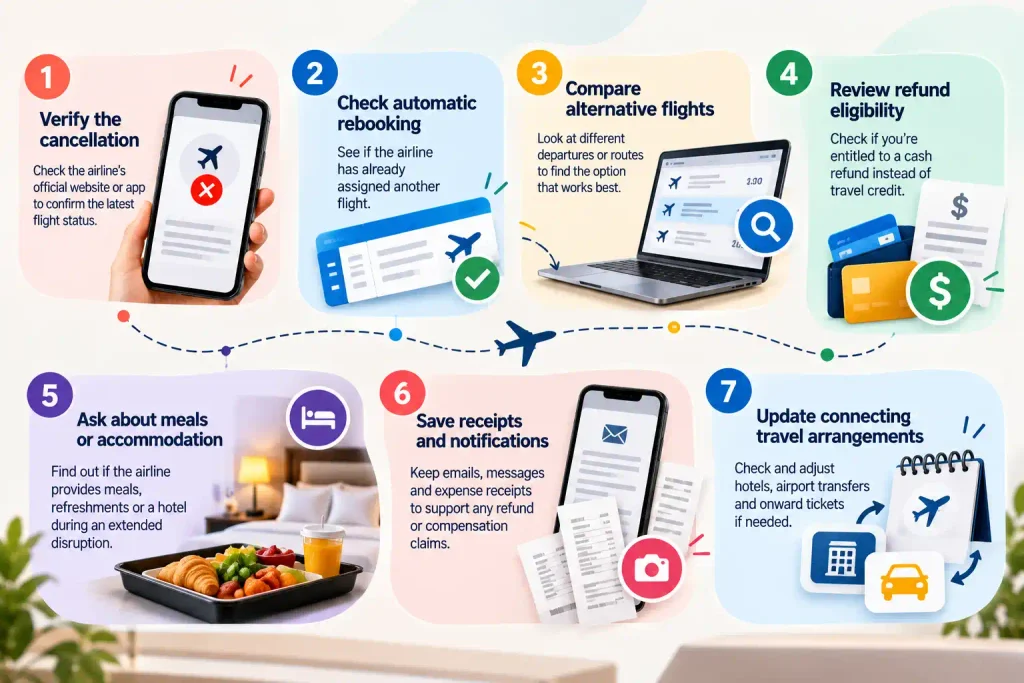
The first priority is to confirm the cancellation and identify the options the airline has made available. Travelers should act promptly, particularly when the next available flight has limited seats.
This checklist helps you organize your immediate response.
| Step | Recommended action | Why it matters |
| 1 | Verify the cancellation | Avoid relying on an outdated notification |
| 2 | Check automatic rebooking | The airline may already have assigned another flight |
| 3 | Compare alternative flights | A different departure may suit the original plans better |
| 4 | Review refund eligibility | A cash refund may be available instead of travel credit |
| 5 | Ask about meals or accommodation | Assistance may apply during an extended disruption |
| 6 | Save receipts and notifications | Evidence supports reimbursement and compensation claims |
| 7 | Update connecting travel arrangements | Hotels, transfers, and onward tickets may need changes |
How Can You Confirm That a Flight Has Actually Been Canceled?
Start with the operating airline’s website or mobile app. Enter the booking reference or flight number to check the latest status.
Airlines may send cancellation notices by email, text message, or app notification. However, a flight can undergo multiple schedule updates, and the information displayed by a third-party booking platform may not update immediately.
If the flight is operated by a different airline from the one shown on the ticket, check the operating carrier’s official flight status.
Read this guide: Can You Get a Full Refund Under the Emirates Cancellation Policy?
Should You Go to the Airport After Receiving a Cancellation Notice?
Not necessarily. If the airline confirms the cancellation before departure and provides a suitable rebooking option online, visiting the airport may be unnecessary.
However, passengers who are already at the airport should speak with the airline’s service desk, particularly when baggage has been checked or immediate assistance is required.
For example, a traveler whose flight is cancelled after baggage drop-off should confirm whether the luggage will be returned, transferred to a replacement flight, or held by the airline.
Should You Accept the First Replacement Flight?
Not automatically. A replacement may depart several hours later, arrive at a different airport, or introduce an inconvenient connection.
Before accepting, travelers should compare the new itinerary with the original booking and confirm whether the proposed alternative affects their refund rights.
Under applicable regulations, passengers may have a choice between reimbursement and rerouting rather than being required to accept the airline’s first offer.
Should You Choose Rebooking, Rerouting, or a Refund?
The best option depends on whether the original journey is still worth taking.
Rebooking usually means moving to another flight, rerouting means reaching the destination through a different itinerary, and a refund means recovering the eligible ticket payment instead of using the cancelled service.
| Option | What happens | Most useful when |
| Rebooking | Passenger moves to another departure | The trip is still necessary |
| Rerouting | Passenger travels through a different route or connection | The original route is unavailable |
| Refund | Eligible ticket amount is returned | The journey is no longer useful |
| Travel credit | Ticket value is retained for future travel | Passenger voluntarily prefers a later trip |
Can an Airline Rebook You Without Charging Extra?
Often, yes. When the airline cancels a flight, its disruption procedures or applicable law may require alternative transportation without an additional fare payment.
Under EU rules, eligible passengers can choose rerouting under comparable transport conditions at the earliest opportunity or at a later convenient date, subject to the applicable conditions.
Your Europe
For example, if a morning flight from Paris to Rome is cancelled, the airline may offer an afternoon departure. If that option is unsuitable, the traveler can ask whether another qualifying route is available.
Can You Request a Flight on Another Airline?
Sometimes. Whether the original airline must arrange transportation with another carrier depends on the jurisdiction and circumstances.
Passengers covered by UK cancellation rules may be entitled to suitable alternative transportation, including another airline where necessary. The airline should be given an opportunity to arrange this before the passenger buys a replacement ticket independently.
Can You Get a Refund for a Nonrefundable Ticket?
Yes. An airline-initiated cancellation can create refund rights even when the passenger purchased a restrictive fare.
For qualifying flights to, from, or within the United States, the Department of Transportation requires a refund when the airline cancels the flight and the passenger does not accept alternative transportation, a voucher, or other compensation.
A nonrefundable fare does not override that protection.
Is a Travel Voucher the Same as a Refund?
No. A voucher usually restricts the passenger to future travel under specified conditions, while a monetary refund returns the eligible payment.
Before accepting a voucher, travelers should examine its expiration date, transfer restrictions, eligible routes, and any conditions attached to future bookings.
What Happens to Connecting Flights After a Cancellation?
A cancellation can affect the entire itinerary, especially when the passenger must transfer between flights.
The most important detail is whether the connecting segments were purchased under one protected reservation or as separate tickets.
What If Both Flights Are on the Same Ticket?
When the flights form one protected itinerary, applicable rebooking obligations may extend to the ticketed final destination rather than only the cancelled segment.
Consider a passenger traveling from Amsterdam to Dubai through Istanbul on one reservation. If the first flight is cancelled, the airline or responsible booking carrier may need to arrange a suitable alternative to Dubai under the applicable conditions.
Passengers should ask for confirmation of every remaining segment, not merely the replacement for the first flight.
What If the Connecting Flights Were Booked Separately?
Separate tickets create additional risk.
For example, a traveler books Madrid–London with one airline and London–Toronto with another. If the first flight is cancelled, the second airline may not be required to protect the independently purchased onward ticket.
Travelers should contact both providers immediately. Depending on the fare, the second booking may be changeable, but any resulting costs are not automatically the first airline’s responsibility.
What If the Cancellation Makes the Entire Trip Pointless?
Under applicable EU rules, a passenger whose disrupted journey no longer serves its original purpose may qualify for reimbursement of relevant ticket portions and, where appropriate, a return flight to the initial departure point.
This can be important for short business trips, sporting events, or appointments that cannot be rescheduled.
What Assistance Should an Airline Provide During a Cancellation?
Depending on the governing rules, passengers waiting for alternative transportation may qualify for meals, refreshments, communication facilities, accommodation, and ground transportation.
These benefits are commonly described as the airline’s duty of care.
Can You Get Free Meals and Refreshments?
Under EU and UK passenger protection rules, eligible travelers awaiting rerouting are entitled to reasonable refreshments and meals appropriate to the waiting period.
Airlines may issue meal vouchers or provide assistance directly. If the required assistance is not offered, travelers may be able to recover reasonable expenses by submitting receipts.
Will the Airline Pay for a Hotel?
Where EU or UK duty-of-care rules apply, an airline must generally provide accommodation when rerouting requires an overnight stay, along with transportation between the accommodation and airport.
For example, a passenger whose replacement flight departs the following morning may qualify for a hotel rather than having to spend the night in the terminal.
The same entitlement should not be assumed for every route worldwide.
What If the Airline Refuses to Provide Assistance?
Ask for a written explanation and retain evidence of the request.
If immediate arrangements are necessary, keep spending reasonable and preserve itemized receipts. Reimbursement depends on the applicable legal obligations and whether the expenses were necessary.
Luxury accommodation, expensive meals, or unrelated purchases may not be recoverable.
Can You Claim Compensation When an Airline Cancels a Flight?
Possibly. Flight cancellation compensation depends on the governing passenger protection rules, the reason for cancellation, the amount of notice given, and the disruption experienced.
It is important to distinguish three types of financial remedies:
- Refund: Returns eligible money paid for transportation not used.
- Expense reimbursement: Covers qualifying additional costs, such as meals or accommodation.
- Compensation: A separate payment for qualifying inconvenience or disruption.
Receiving a refund does not necessarily eliminate eligibility for separate statutory compensation.
How Much Compensation Can You Claim Under EU Rules?
Under EU Regulation 261/2004, qualifying cancellations may result in compensation of €250, €400, or €600, depending on flight distance.
| Flight distance | Standard compensation |
| 1,500 km or less | €250 |
| More than 1,500 km within the EU, or other flights between 1,500 and 3,500 km | €400 |
| More than 3,500 km | €600 |
Compensation is not automatic. Eligibility depends on the cancellation notice, alternative flight timings, and whether extraordinary circumstances apply. Certain rerouting arrangements can also reduce the amount by 50%.
How Does Flight Cancellation Compensation Work in Canada?
Canada’s Air Passenger Protection Regulations distinguish disruptions within an airline’s control, those required for safety, and events outside its control.
For eligible cancellations fully within an airline’s control and not required for safety, compensation can depend on how late the passenger reaches the destination and whether the carrier is classified as large or small.
For example, qualifying passengers arriving three to six hours late may receive CAD $400 from a large airline or CAD $125 from a small airline. Other eligibility conditions and claim deadlines apply.
Can You Claim Compensation for a Canceled Flight in India?
India’s DGCA passenger protection requirements provide for alternative travel or refunds and, in specified cancellation circumstances, additional compensation.
The outcome depends on the notice given, flight circumstances, and applicable limits. Passengers should refer to Section 3, Series M, Part IV of the Civil Aviation Requirements rather than assuming every cancellation qualifies for a fixed payment.
Does the United States Require Cash Compensation for Every Cancelled Flight?
No. U.S. federal rules require refunds in qualifying cancellation situations, but they do not generally require a fixed inconvenience payment merely because an airline cancels a flight.
Airlines may voluntarily offer additional benefits or assistance. Their commitments can differ, so passengers should check the carrier’s applicable policies.
What If Your Flight Is Cancelled Because of Bad Weather?
Severe weather may prevent an aircraft from departing safely, disrupt air traffic control, or cause wider scheduling problems across multiple airports.
Passengers should still check their refund and rerouting rights, even if the cancellation is outside the airline’s control.
Does Bad Weather Eliminate the Right to a Refund?
No, not necessarily.
For qualifying U.S. flights, an airline cancellation can trigger a refund regardless of the reason when the passenger does not accept alternative transportation.
Under EU rules, extraordinary circumstances can remove the obligation to pay additional compensation, but the airline’s refund or rerouting obligations remain.
Are Technical Problems Considered Extraordinary Circumstances?
Not always.
Under EU passenger protection rules, technical defects arising during normal airline operations or routine maintenance generally do not qualify as extraordinary circumstances.
However, unusual events outside normal airline operations may be assessed differently.
The precise cause matters more than a broad explanation such as technical issue.
What Happens to Checked Baggage When a Flight Is Cancelled?
Baggage arrangements depend on when the cancellation occurs and whether the passenger accepts another flight.
A suitcase checked before cancellation may remain in the airline’s baggage system until it can be returned or transferred.
Can You Collect Your Checked Bag After Cancellation?
Often, yes, but collection procedures depend on the airport and airline.
Passengers should ask the baggage service desk where to collect the bag, how long retrieval may take, and whether it has already been assigned to another flight.
Will Checked Baggage Automatically Transfer to a Replacement Flight?
Not necessarily.
When an itinerary changes, the airline may need to retag baggage or update its handling instructions.
Travelers should verify the baggage destination shown on the replacement itinerary, especially when the new route includes a different connection.
What Should You Do About Hotels, Transfers, and Prepaid Activities?
A flight cancellation does not automatically cancel separately purchased travel arrangements.
Hotels, car rentals, transfers, tours, and event tickets usually remain subject to their own booking conditions.
Can You Get a Refund for a Nonrefundable Hotel?
Sometimes, but not simply because an airline cancelled the flight.
Contact the accommodation provider as soon as possible and request a date change, cancellation waiver, or credit.
For example, if an airline moves a Friday arrival to Sunday, a hotel may agree to modify the reservation even when its original terms restrict cancellation.
Does Travel Insurance Cover Flight Cancellation Expenses?
Travel insurance may reimburse qualifying additional expenses or unused prepaid costs when the disruption meets the policy’s covered-event conditions.
Coverage varies by policy, including exclusions, maximum benefits, waiting periods, and documentation requirements.
Travelers should first identify what the airline must provide, then review whether insurance covers any remaining eligible loss.
What If the Replacement Flight Affects Your Visa?
International passengers should confirm that their visa and travel documents remain valid for the revised itinerary.
A replacement flight may change the transit country, airport, or arrival date, creating additional entry or transit requirements.
This is particularly important for passengers with single-entry visas, restricted transit permissions, or time-limited travel authorization.
How Should You Request a Refund After a Flight Cancellation?
Passengers should use the airline’s official refund process or the appropriate ticketing provider.
For U.S.-covered cancellations, airlines and qualifying ticket agents have specific refund obligations when the passenger declines alternative transportation.
How Long Does a Flight Cancellation Refund Take?
Under U.S. rules, qualifying refunds must generally be issued within seven business days for credit card payments or 20 calendar days for other payment methods, measured according to the applicable refund-triggering circumstances.
EU-covered ticket reimbursement is generally due within seven days.
Other jurisdictions may impose different deadlines.
What If You Booked Through a Travel Agency?
Contact the agency that issued the ticket, while also checking the operating airline’s disruption options.
For U.S.-covered bookings, the merchant of record may be responsible for processing the applicable airfare refund.
Passengers should distinguish the airline’s refund obligations from any separate agency service fees permitted by the booking terms and law.
What Documents Should You Save?
Keep the original ticket, booking reference, cancellation notice, revised itinerary, receipts for additional expenses, and written correspondence with the airline.
If a refund or compensation claim is disputed, these records help establish the original schedule, what the airline offered, and the passenger’s actual costs.
How Can You File a Complaint If the Airline Does Not Resolve the Cancellation?
If the airline does not provide a satisfactory response, passengers can escalate the matter through the relevant regulator or approved dispute resolution process.
The appropriate authority depends on the route and governing passenger protection rules.
| Jurisdiction | Where to seek assistance |
| United States | U.S. Department of Transportation |
| European Union | Relevant national enforcement body |
| United Kingdom | Approved alternative dispute resolution provider or UK Civil Aviation Authority |
| Canada | Canadian Transportation Agency |
| India | AirSewa grievance platform and applicable DGCA procedures |
Passengers should usually begin with a written complaint to the airline and retain the complaint reference.
For Canada, the Canadian Transportation Agency advises passengers that they can submit a complaint if they are dissatisfied with the airline’s response or have not received one within 30 days.
See This Guide: The Best Flight Cancellation Insurance: What It Covers and When It’s Worth It
What Mistakes Should Travelers Avoid After a Flight Cancellation?
A few decisions can create unnecessary expenses or complicate an otherwise valid claim.
- Buying a replacement ticket immediately: First ask whether the airline must provide alternative transportation.
- Accepting a voucher without reviewing refund rights: A monetary refund may be available.
- Ignoring connecting flights: Confirm that every remaining segment is still valid.
- Leaving checked baggage unaccounted for: Obtain clear collection or transfer instructions.
- Spending excessively on accommodation: Only reasonable, eligible expenses may be reimbursed.
- Discarding cancellation evidence: Save the original and revised flight information.
- Assuming compensation is guaranteed: Eligibility depends on the route, law, cause, and notice period.
Conclusion: What Is the Best Way to Handle a Cancelled Flight?
A flight cancellation requires two decisions: how to reach the destination, and what to do about the original ticket. Travelers who still need to complete their journey should compare the airline’s replacement options before purchasing another flight. Those whose plans are no longer practical should review their entitlement to a monetary refund rather than immediately accepting travel credit.
The next priority is protecting the rest of the itinerary. Confirm connecting flights, checked baggage, accommodation, and any visa requirements affected by the revised schedule. If the cancellation creates an overnight wait, ask what assistance the airline must provide and retain receipts for necessary expenses.
Finally, refund rights and compensation are separate matters. Checking the rules applicable to the flight, documenting the disruption, and submitting any claims within the required deadlines gives passengers a stronger basis for resolving the cancellation without unnecessary financial loss.
Related FAQs!
Yes, under many passenger protection systems. The right to a refund generally depends on the cancellation and the passenger’s decision not to accept alternative travel, rather than solely on how close the cancellation occurs to departure.
Yes, in qualifying circumstances. A refund returns eligible ticket costs, while statutory compensation addresses certain disruptions. The requirements differ by jurisdiction.
Some airlines automatically assign a replacement flight, while others ask passengers to select an alternative. Always check the revised itinerary and confirm acceptance before any stated deadline.
Possibly. If both flights are part of the same booking, applicable refund rules may cover more than the cancelled segment. Separate return tickets generally have their own conditions.
Yes, passengers can ask whether an earlier suitable departure is available. The airline’s obligation to provide it depends on the applicable rules and available alternatives.
The airline’s responsibility for consequential losses is not automatically established. Travelers should check the ticket conditions, applicable law, cruise provider’s policies, and travel insurance coverage.
Under EU rules, passengers informed at least 14 days before cancellation generally do not qualify for the fixed cancellation compensation, although applicable refund and rerouting rights remain.
Potentially, yes. The cancellation may trigger refund or rerouting rights. Additional compensation depends on whether the strike qualifies as an extraordinary circumstance under the applicable law.
Not automatically. Reimbursement depends on the airline’s obligations, whether it failed to provide suitable alternatives, and whether the replacement purchase was reasonable. Contacting the original airline first is generally advisable.
Eligible unused optional services may be refundable when the associated flight is cancelled. The exact treatment depends on the applicable regulations and whether the service was provided.