
Spirit Airlines Go Big vs. Go Comfy: Key Differences
Spirit Airlines’ former Go Big fare offered a larger Big Front Seat and a broader package of premium perks. At the same time, Go Comfy focused on added personal space, baggage, and select onboard benefits at a lower comfort level. These bundles were introduced in 2024 as part of Spirit’s effort to make its fare options easier to compare. However, Spirit Airlines began winding down operations on May 2, 2026, canceling all flights, so neither fare is currently available to book. This guide compares how the two options worked, what each included, and what their differences meant for travelers when the airline was operating.
Related: Alaska Airlines Seat Selection: A Complete Guide
What Were Spirit Airlines’ Go Big and Go Comfy Fares?
Go Big and Go Comfy were bundled fare options that combined seats, baggage, and selected onboard services into one ticket price. Instead of buying each extra separately, passengers could choose a bundle based on how much space and convenience they wanted.
The two products addressed different priorities:
- Go Big: Designed for travelers who wanted a wider seat, more legroom, included snacks and drinks, Wi-Fi access, and priority airport services.
- Go Comfy: Designed for travelers who wanted additional space around their seat, included baggage, priority boarding, and a simpler set of refreshments.
Both were part of Spirit’s 2024 fare transformation, which also introduced Go and Go Savvy. The bundles aimed to give passengers more choice between a low base fare and a more inclusive ticket. Spirit’s announcement described Go Big as its most premium option and Go Comfy as a new way to improve comfort without choosing the largest seat.
The names didn’t stay in place indefinitely. In 2025, Spirit revised its fare structure, replacing the Go-branded bundles with three broader categories: Value, Premium Economy, and Spirit First. Spirit First took the place of the former Go Big product, while the Go Comfy concept evolved as the airline introduced extra-legroom seating. The airline ceased operations in May 2026, so these historical features are not current booking options.
Go Big vs. Go, CareKey at a Glance
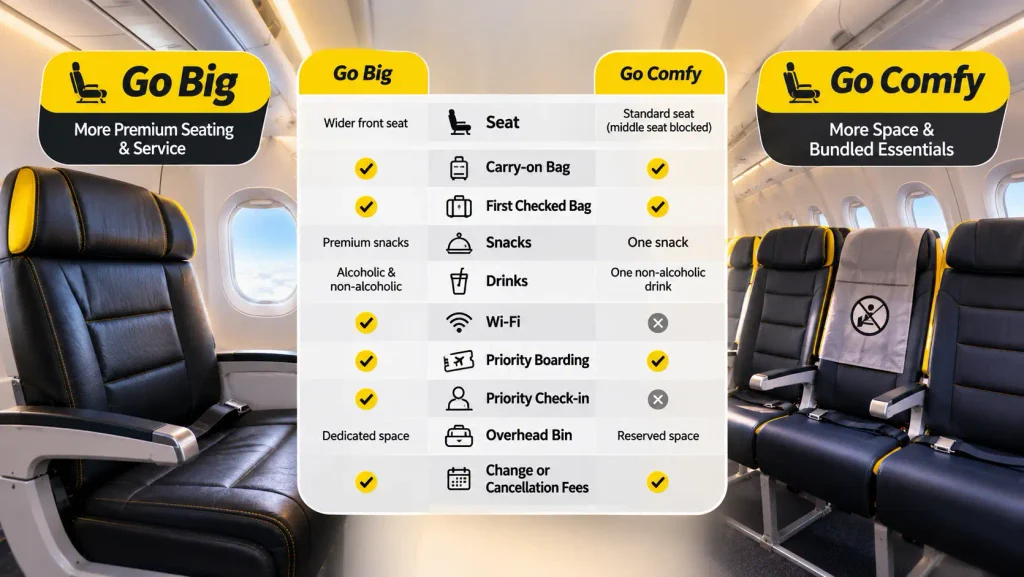
The biggest distinction was the seat itself. Go Big included Spirit’s wider Big Front Seat, while Go Comfy originally offered a standard-style seat with the middle seat beside the passenger block. Their included amenities also differed.
| Feature | Go Big | Go Comfy |
| Main purpose | More premium seating and service | More space and bundled essentials |
| Seat | Wider Big Front Seat | Standard-style seat with blocked middle seat in its original configuration |
| Seating layout | Two seats on each side of the aisle in the front section | Standard cabin seating with the middle seat blocked in the original version |
| Carry-on bag | Included | Included |
| First checked bag | Included, subject to applicable limits | Included, subject to applicable limits |
| Snacks | Included premium snacks | One snack |
| Drinks | Included drinks, including alcoholic beverages | One non-alcoholic beverage |
| Wi-Fi | Streaming Wi-Fi access, subject to availability | Not included |
| Priority boarding | Included | Included |
| Priority check-in | Available at participating airports | Not a standard Go Comfy benefit |
| Overhead-bin benefits | Dedicated/reserved space associated with the premium bundle | Reserved overhead-bin space associated with the bundle |
| Change or cancellation fees | No change or cancellation fees under the bundled fare rules then in effect | No change or cancellation fees under the bundled fare rules then in effect |
1. Seat Comfort: Go Big Offered the More Substantial Upgrade
For passengers comparing Go Big and Go Comfy, the seat was the most important difference. Go Big offered a genuinely larger seat, whereas the original Go Comfy arrangement aimed to create more usable space without replacing the standard seat with a wider one.
Go Big: The Big Front Seat
Spirit’s Big Front Seat was located at the front of the aircraft and arranged in a 2-2 configuration rather than the more typical 3-3 arrangement on many single-aisle aircraft. That meant passengers had to share their row with a middle seat.
The larger seat often offers more width, added cushioning, and greater legroom than Spirit’s standard economy seating. Published descriptions of the product cited seat pitch of up to approximately 36 inches and width of around 18.5 inches, although dimensions can vary by aircraft and measurement method.
The practical advantages included:
- More room across the seat.
- More space for legs and knees.
- No middle seat in the Big Front Seat configuration.
- A position near the aircraft’s front, which could make exiting quicker after landing.
These features made Go Big attractive for passengers on longer domestic journeys, travelers who preferred a wider seat, and anyone who found standard economy seating restrictive.
It was important, however, not to confuse the Big Front Seat with a full international business-class product; it offered additional room but not the full range of services associated with international business class, such as a lie-flat bed or a dedicated premium-cabin dining experience.
Go Comfy: Extra Personal Space Without the Larger Seat
In its original form, Go Comfy included a standard-style seat with the middle seat blocked. The idea was straightforward: travelers could enjoy more elbow room and avoid having another passenger seated immediately beside them.
This arrangement could help a solo traveler who wanted more space but didn’t want a wider seat. It could also work for two people traveling together who wanted to sit in the same row while keeping the middle seat empty, depending on the seat assignment and aircraft configuration.
Spirit later changed the Go Comfy concept. In 2025, the airline began introducing extra-legroom seats with approximately 32 inches of pitch, while moving away from the guaranteed blocked-middle-seat approach. That change meant passengers needed to distinguish the original Go Comfy bundle from its later seating evolution.
Seat takeaway: Go Big was the stronger choice for passengers who valued a larger seat and more substantial personal space. Original Go Comfy was more about having room around a standard seat; the upgrade focused on one seat.
2. Baggage Allowance options included more than More Than the Basic Fare
Baggage was another major difference between Spirit’s bundled fares and its most basic ticket options. Spirit’s ultra-low-cost model historically let passengers choose extras individually, meaning the lowest-priced fares didn’t automatically include everything. Both Go Big and Go Comfy didn’t include a carry-on bag or a first checked bag under the bundle terms then in effect. This helps passengers avoid adding these separately during checkout.
What Did the Included Bags Mean?
The carry-on allowance was useful for travelers who wanted to bring a cabin-size suitcase or a larger personal item. The checked bag, instead, was for larger items, clothing for a longer trip, or belongings that wouldn’t fit in the cabin.
Spirit’s published fare information specified a checked-bag weight allowance of up to 50 pounds for the relevant bundles. Standard size, weight, and prohibited-item rules still applied, and excess or additional baggage could involve charges under the airline’s applicable policies.
For example, a traveler taking a weeklong trip might prefer a bundle that includes a carry-on and a checked bag, rather than paying for each separately. Someone traveling with only a small backpack, however, might have received less practical value from the included baggage.
The best way to evaluate a bundled fare was to compare the total price with the cost of purchasing the needed services individually. An included bag wasn’t necessarily a saving if the traveler wouldn’t have paid for one in the first place.
Did Go Big Include More Baggage Than Go Comfy?
The core baggage allowance was broadly similar: both bundles included one carry-on and one checked bag under their published terms. The distinction was not primarily the number of bags but the broader package of seat and onboard benefits.
Passengers also needed to account for baggage rules on connecting itineraries, especially when more than one airline was involved. Allowances and charges on another carrier could differ from those that had applied to a Spirit segment.
3. Snacks and Drinks: Go Big Had the More Extensive Package
The two bundles also differed in their included refreshments.
Go Big Included Snacks and Drinks
Go Big included snacks and drinks, including alcoholic beverages, under the bundle’s published terms. This was a more extensive package than the basic refreshments included with the Comfy package.
The advantage was convenience. Travelers didn’t need to budget separately for every eligible snack or drink during the flight, though the exact selection depended on onboard service availability.
The exact selection of alcoholic beverages was a distinguishing benefit, but alcohol was not always available. Onboard stock, service portions, and applicable rules could affect what passengers received.
Go Comfy Included a Snack and a Non-Alcoholic Drink
Go Comfy offered a smaller refreshment package: one snack and one non-alcoholic beverage. That covered a basic onboard need without matching the broader selection associated with Go Big.
For a short flight, a snack and drink might have been enough. For someone expecting several refreshments, wanting an alcoholic beverage, or valuing a more inclusive onboard package, Go Big offered more.
Neither bundle should be confused with a traditional full-service premium-cabin meal service. The benefits were designed around Spirit’s own bundled model, not a promise of restaurant-style dining or a multi-course meal.
4. Wi-Fi: An Important Advantage of Go Big
Wi-Fi access was another benefit that separated Go Big from Go Comfy. Go Big included access to Spirit’s streaming Wi-Fi service, subject to availability. This could be useful for travelers who wanted to stay connected, work during a flight, or use compatible services while onboard.
Go Comfy did not include Wi-Fi as part of its standard bundle. Passengers who wanted connectivity would have needed to check whether a separate option was available and what it cost under the applicable terms.
There were two important qualifications:
- Availability mattered. Wi-Fi service could depend on the aircraft, route, and operational conditions.
- Access was not a guarantee of every online activity. Streaming Wi-Fi and other onboard connectivity services can have technical limitations.
For a short flight where passengers planned to read, rest, or listen to offline music, Wi-Fi might not have influenced the decision. For someone who needed to work or wanted internet access during the journey, its inclusion made Go Big more attractive.
5. Airport Convenience: Priority Boarding and Check-In
Both Go Big and Go Comfy included priority boarding under their fare terms. This benefit lets passengers board earlier than travelers in the standard boarding group, making it easier to settle in and manage their belongings.
Go Big also included priority check-in at participating airports. This could reduce the need to use the regular check-in line, although availability depended on the airport and the service operating there.
Why Priority Boarding Could Matter
Priority boarding was especially useful for travelers carrying a full-size cabin bag. Boarding earlier could improve the chance of finding space in the designated overhead bin area, although the exact process and bin allocation depended on the airport, aircraft, and applicable boarding rules.
For a traveler who checked a bag and carried only a small personal item, early boarding might have been less valuable. For someone with a cabin suitcase, it could make the airport experience more convenient.
Why Priority Check-In Was Different
Priority check-in and priority boarding were separate benefits. The former related to airport check-in services at participating locations; the latter related to the boarding sequence at the gate.
Go Big’s broader package included both, while Go Comfy primarily provided priority boarding. Travelers comparing the historical products needed to assess whether priority check-in would actually save time at their departure airport.
6. Price and Value: Which Bundle Made More Sense?
There was no single price difference that applied to every Go Big and Go Comfy itinerary. Fare prices varied with route, travel date, demand, and availability, so one bundle could represent better value on one flight than on another.
The most useful comparison was the total trip cost, not just the difference between the two ticket prices.
A traveler could estimate value by adding the services they would otherwise have bought separately:
- The preferred seat or seating upgrade.
- A carry-on bag.
- A checked bag.
- Snacks and drinks.
- Wi-Fi access.
- Any relevant airport-service benefits.
If the price difference between Go Big and Go Comfy was smaller than the value of the extra benefits the passenger expected to use, Go Big might have been the better deal. If the larger seat, alcoholic beverages, and Wi-Fi were not important, Go Comfy could have offered a more economical package at the time.
Watch for the Difference Between Price and Perceived Value
An inclusive fare can make the checkout process simpler, but not every passenger benefits equally from every included extra. A bundle may look attractive because it lists more amenities, yet a traveler who uses only one or two of them could pay for benefits that add little value to the trip.
The strongest comparison therefore considered the seat, bags, refreshments, and connectivity together.
7. Go Big vs. Go Comfy: Advantages and Limitations
The following summary captures the main trade-offs between the original bundles.
Go Big: Advantages
- A wider Big Front Seat with additional cushioning and legroom.
- No middle seat in the Big Front Seat configuration.
- Carry-on and first checked bag included under the published bundle terms.
- Snacks and drinks, including alcoholic beverages.
- Streaming Wi-Fi access, subject to availability.
- Priority boarding and priority check-in at participating airports.
Go Big: Limitations
- It was the more premium option, so the ticket price could be higher.
- The seat was not equivalent to an international lie-flat business-class product.
- Wi-Fi and airport services were subject to availability and applicable conditions.
- Passengers who did not need the extra seat space or bundled amenities might not have received enough value from the additional cost.
Go Comfy: Advantages
- The original version provided a blocked middle seat for additional personal space.
- A carry-on and first checked bag were included under the published bundle terms.
- Priority boarding was included.
- A snack and non-alcoholic beverage were part of the package.
- It offered an alternative for travelers who wanted more comfort without choosing the Big Front Seat.
Go Comfy: Limitations
- Its original seat was not as wide as the Big Front Seat.
- The original blocked-middle-seat arrangement later changed as Spirit introduced extra-legroom seating.
- Wi-Fi and alcoholic beverages were not included in the original bundle’s standard benefits.
- The value depended on the fare difference and whether the passenger used the included extras.
8. How Go Big and Go Comfy Fit Into Spirit’s Fare Changes
The distinction between Go Big and Go Comfy makes more sense when viewed as part of Spirit’s broader pricing strategy.
In 2024, Spirit introduced four bundles: Go, Go Savvy, Go Comfy, and Go Big. The aim was to offer passengers different levels of inclusions, from a lower-cost option with separately purchased extras to a more comprehensive premium bundle.
In 2025, the airline revised its fare names and structure. Go Big was replaced by Spirit First, which retained the Big Front Seat and a package of premium benefits. Go Comfy also evolved as the airline began adding extra-legroom seats and moving away from its original blocked-middle-seat design.
That history matters because online articles and archived fare comparisons may describe different versions of the products. A page discussing the original Go Comfy middle-seat block may not accurately describe the later extra-legroom seating arrangement.
The final change was more consequential: Spirit announced on May 2, 2026, that it was beginning an orderly wind-down, effective immediately, and that all flights had been cancelled. Its official restructuring website states that customer service is no longer available through the airline’s former call center or email channels.
Consequently, travelers researching these fare names should treat them as historical products rather than current options.
Explore this Blog: How to Get Paid for Airline Delays: A Traveler’s Guide
Final Takeaway
When Spirit Airlines offered both products, Go Big was the stronger option for passengers who wanted a wider seat and a more comprehensive set of onboard perks. Go Comfy was designed for travelers who prioritized extra personal space and included essentials without choosing the Big Front Seat.
The distinction was not simply about which fare included more features. It was about whether the additional seat comfort, baggage, refreshments, Wi-Fi, and airport services justified the price difference for a particular trip.
Today, the comparison is useful as a record of Spirit’s former fare structure, not as a guide to current bookings. Because the airline ceased operations in May 2026, travelers should verify the status of any historical ticket, voucher, or claim through the official wind-down and claims resources rather than relying on old fare descriptions.
Frequently Asked Questions
Go Big provided the more substantial seat upgrade, with the wider Big Front Seat, plus included refreshments, Wi-Fi access, baggage, and priority services. Go Comfy focused on additional space and essential bundled benefits. Which offered better value depended on the passenger’s needs and the fare difference at the time.
Yes. Under the published Go Big bundle terms, one carry-on bag and one checked bag were included, subject to applicable size and weight restrictions. The original Go Comfy bundle also included these bags.
Not in its original configuration. It offered a standard-style seat with a blocked middle seat to create additional personal space. Spirit later changed the product concept as it introduced extra-legroom seating, so the details depended on when the ticket was purchased and the aircraft configuration.
Go Big included access to Spirit’s streaming Wi-Fi service, subject to availability. Go Comfy did not include Wi-Fi in its standard original bundle.
Alcoholic drinks were part of the Go Big refreshments package, while the original Go Comfy bundle included a snack and a non-alcoholic beverage. Onboard selections and service conditions could affect availability.
No. Spirit Airlines began winding down operations on May 2, 2026, cancelling all flights. The two bundles are historical fare products, not currently bookable Spirit options.
Spirit revised its fare structure in 2025, using Value, Premium Economy, and Spirit First as its newer fare categories. Spirit First replaced the former Go Big fare, while the Go Comfy concept evolved with changes to seating. Spirit subsequently ceased operations in May 2026, so those later fare names are also historical rather than current booking choices.