
Best Southwest Airlines Credit Cards of October 2026
Southwest Airlines credit cards can be valuable for travelers who fly with the airline regularly, especially those who can use the cards’ anniversary points, checked-bag benefits, seat-selection perks, and other travel-related savings. The best choice depends on whether you want a low annual fee, more rewards on Southwest purchases, premium flight benefits, or flexible points you can transfer to multiple travel partners.
The main options include the Southwest Rapid Rewards Plus, Premier, and Priority consumer cards, as well as the Premier Business and Performance Business cards. Travelers who prefer a broader rewards program should also compare the Chase Sapphire Preferred® Card, which earns transferable Chase Ultimate Rewards® points rather than Southwest Rapid Rewards points directly.
Card offers and benefits can change. The welcome bonuses below are examples of offers advertised by Chase during the October 2026 research period, not guaranteed offers for every applicant. Applicants should confirm current eligibility, fees, earning rates, and terms on the issuer’s website before applying.
Related: Southwest Summer 2027: 20 New & Returning Routes
Best Southwest Airlines Credit Cards at a Glance
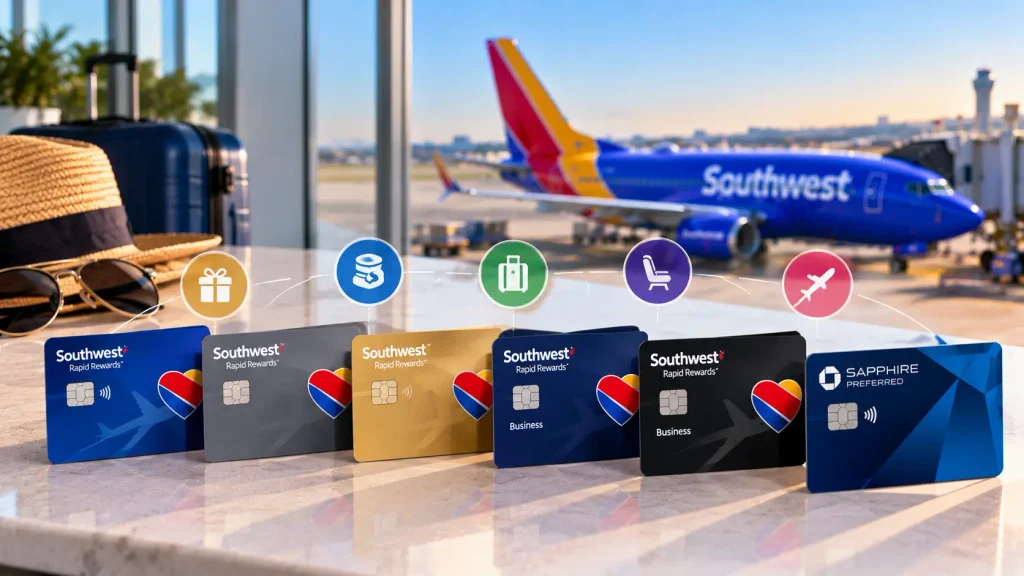
The best Southwest Airlines credit cards offer Rapid Rewards points, anniversary bonuses, and travel perks such as a free first checked bag and seat-selection benefits. Chase options vary in annual fees, earning rates, and benefits to suit different travel habits.
| Credit card | Best for | Annual fee | Notable features |
| Southwest Rapid Rewards® Plus | Travelers seeking the lowest annual fee among the main consumer options | $99 | Anniversary points, Southwest rewards, checked-bag and boarding benefits |
| Southwest Rapid Rewards® Premier | Travelers seeking a middle-ground option | $149 | Anniversary points, annual Companion Pass qualifying-point boost, flight benefits |
| Southwest Rapid Rewards® Priority | Frequent Southwest flyers | $229 | Higher anniversary-point award, seat benefits, flight discount |
| Southwest Rapid Rewards® Premier Business | Small-business owners seeking Southwest perks | $149 | Anniversary points, business spending rewards, flight benefits |
| Southwest Rapid Rewards® Performance Business | Business travelers who want richer benefits | $299 | Higher Southwest earning rate, more anniversary points, seat-selection benefits |
| Chase Sapphire Preferred® | Travelers who want flexible travel rewards | $95 | Chase Ultimate Rewards points, transfer partners, travel and dining rewards |
1. Southwest Rapid Rewards® Plus Credit Card: Best for a Lower Annual Fee
The Southwest Rapid Rewards Plus Credit Card is a sensible starting point for travelers who want airline-specific rewards without paying for the higher-tier consumer cards. Its $99 annual fee is lower than those of the Premier and Priority cards, making it worth considering for occasional Southwest flyers who can still make use of the card’s rewards and travel benefits.
What makes the Plus card useful?
The Plus card earns Rapid Rewards points on eligible purchases, including Southwest purchases and select everyday spending categories. It also provides anniversary points, giving cardholders an annual rewards deposit as long as the account meets the issuer’s requirements.
Other benefits may include:
- A free first checked bag under the card’s applicable terms.
- A boarding benefit for eligible cardholders and companions on the same reservation.
- A yearly boost of Companion Pass qualifying points.
- Rewards that can be redeemed for eligible Southwest flights and other options in the Rapid Rewards program.
Check the precise benefits, earning categories, and conditions in the current card agreement. In particular, cardholders should verify how the checked-bag and boarding benefits apply to their itinerary and reservation.
Who should choose it?
This card is a good fit for travelers who fly Southwest a few times a year and prefer a lower annual fee over premium benefits. It may also suit people who want to earn Rapid Rewards points on everyday spending but don’t expect to use enough of the higher-tier card’s benefits to justify the higher annual cost.
For example, a traveler who takes two or three Southwest round trips annually might find the Plus card useful if the points earned and applicable checked-bag savings outweigh the fee. Someone who rarely flies Southwest, however, may get better value from a general-purpose no-annual-fee rewards card.
2. Southwest Rapid Rewards Premier Credit Card: Best Middle-Ground Option
The Southwest Rapid Rewards Premier Credit Card sits between the Plus and Priority cards. At a $149 annual fee, it costs more than the Plus card but less than the Priority card, making it a good option for travelers who want extra Southwest benefits without choosing the most expensive consumer card.
Key benefits
The Premier card earns Rapid Rewards points on eligible Southwest purchases and select everyday spending. Chase also advertises anniversary points and a yearly boost of Companion Pass qualifying points for eligible cardholders.
Travel benefits can include a free first checked bag, a boarding benefit, and seat-related perks, subject to availability and card terms. The current product page also lists a yearly flight-discount benefit for eligible cardholders; exclusions and redemption conditions apply.
A notable advantage is the card’s potential to help a traveler build toward Southwest’s Companion Pass. Cardholders receive a Companion Pass qualifying-point boost, and eligible points earned through card spending may also count toward qualification. The annual boost does not automatically grant Companion Pass status.
Who should choose it?
The Premier card may suit travelers who fly Southwest regularly enough to use its benefits but don’t need every perk of the Priority card. It is also worth comparing for people who value anniversary points and want to accumulate qualifying points toward Companion Pass.
Before choosing it over Plus, compare the additional annual fee with the incremental benefits. A traveler who does not use the added features may be better off keeping the lower-cost card.
3. Southwest Rapid Rewards® Priority Credit Card: Best for Frequent Southwest Flyers
The Southwest Rapid Rewards Priority Credit Card is designed for travelers who regularly use Southwest-specific benefits. Its $229 annual fee is higher than the Plus and Premier cards, but the extra cost may be justified if the cardholder flies the airline often and uses the available perks.
Benefits to consider
The Priority card offers a higher annual anniversary-point award than the lower-tier consumer cards. It also earns Rapid Rewards points on eligible purchases, with an elevated rate for eligible Southwest spending and additional rewards in select everyday categories.
Current Chase product information highlights benefits such as:
- Anniversary points: A yearly points deposit, subject to the card’s terms.
- Seat benefits: Eligible cardholders can select a Preferred or Standard seat at booking when available, and may receive Extra Legroom seat upgrades within 48 hours of departure when available.
- Checked-bag benefit: A free first checked bag under the applicable terms.
- Boarding benefit: Eligible cardholders and passengers on the same reservation receive a boarding benefit.
- Companion Pass progress: A yearly boost of Companion Pass qualifying points.
- Flight discount: A yearly promotional flight discount, subject to the card’s terms and exclusions.
- Inflight savings: A statement benefit for eligible inflight purchases may apply under current terms.
These benefits are subject to availability, qualifying reservations, and the issuer’s conditions. Seat selection is not a guaranteed upgrade to a particular seat, and travelers should check the current benefit details before booking.
Is the Priority card worth its annual fee?
The card is most compelling for frequent Southwest flyers who can use several benefits throughout the year. For instance, a traveler who regularly checks luggage, values seat-selection benefits, and redeems anniversary points may get more practical value than someone who flies only once or twice a year.
The right comparison is not simply whether the card offers more perks than Plus. It depends on whether the extra benefits justify the difference in annual fees for that traveler. If the cardholder wouldn’t pay separately for the added services, the advertised value may not translate into real savings.
4. Southwest Rapid Rewards® Premier Business Credit Card: Best for Small-Business Owners
The Premier Business card is designed for eligible business owners who want to earn Southwest rewards through business expenses. It has a $149 annual fee and can be useful for people whose business spending naturally includes travel, dining, gas, or other eligible purchases.
Main features
Chase advertises anniversary points, a yearly Companion Pass qualifying-point boost, a free first checked bag, and a boarding benefit. Eligible cardholders can also select a Preferred or Standard seat within 48 hours before departure when available, subject to the card’s conditions.
The card earns elevated rewards on eligible Southwest purchases, with additional earning opportunities in selected categories such as gas stations and restaurants. The exact category limits and rates should be checked in the current rewards agreement.
Who benefits most?
This card can be a practical option for freelancers, consultants, and small-business owners who pay eligible operating expenses by credit card and travel with Southwest. Separating business purchases from personal spending can also make expense tracking easier, although cardholders should follow their accounting and tax requirements.
A business card is not automatically the best choice simply because the applicant owns a business. Applicants should consider their eligibility, business spending pattern, annual fee, and the value of the benefits they will actually use.
5. Southwest Rapid Rewards® Performance Business Credit Card: Best for Business Travelers
The Performance Business card is the premium option among the main Southwest business cards. Its $299 annual fee is higher than the Premier Business card’s fee, but it offers more earning opportunities and travel benefits.
Notable benefits
The card earns elevated rewards on eligible Southwest purchases, with additional points available in qualifying everyday categories such as gas stations, restaurants, local transit and commuting, and hotel accommodations booked directly with the hotel. It also earns points on other eligible purchases.
Chase lists several features that may appeal to frequent business travelers:
- Anniversary points: A yearly award of points, subject to the account terms.
- Seat benefits: Preferred or Standard seat selection at booking when available, plus Extra Legroom seat upgrades within 48 hours of departure when available.
- Checked baggage: A free first checked bag under the applicable conditions.
- Boarding benefit: A boarding benefit for eligible passengers on the same reservation.
- Security-screening credit: Up to $120 toward an eligible Global Entry, TSA PreCheck®, or NEXUS application fee, subject to the card’s terms.
- Companion Pass progress: A yearly boost of Companion Pass qualifying points.
- Tier-qualifying points: Eligible card spending can contribute toward Southwest A-List status.
- Inflight savings: A benefit for eligible inflight purchases may apply under current terms.
- No foreign transaction fees: Subject to the current pricing and benefits terms.
The card also advertises a higher annual anniversary-point award than the Premier Business card. Exact earning categories, annual spending limits, and benefit conditions can change, so review the latest official product details before applying.
Is the Performance Business card worth it?
This card is most relevant to business owners who fly Southwest frequently and can use several of its benefits. A business with recurring Southwest purchases, regular hotel stays, local transportation expenses, and employees or colleagues traveling on the same reservations may have more opportunities to use the card than a business that rarely travels.
The higher annual fee makes it less attractive for low-spending businesses or owners who take only occasional Southwest flights. Compare the Performance Business card with the Premier Business version using actual annual expenses rather than the maximum possible value of every advertised perk.
6. Chase Sapphire Preferred® Card: Best for Flexible Travel Rewards
The Chase Sapphire Preferred is not a Southwest-branded credit card, but it’s worth considering because you can transfer its points to Southwest Rapid Rewards and other eligible travel partners. This flexibility may help travelers who fly multiple airlines or want more than one way to redeem their rewards.
The card has a $95 annual fee. Chase advertises bonus earning in categories such as travel booked through Chase Travel, dining, and other eligible purchases, alongside a base rate on other eligible spending. Its current offer and category terms should be confirmed directly with Chase.
Why choose a flexible points card?
A Southwest-branded card primarily rewards spending toward the Rapid Rewards program and includes benefits tied to Southwest travel. A flexible travel card, by contrast, lets a cardholder transfer eligible points to Southwest when that redemption makes sense, or use other travel partners when another option offers better value.
For example, someone who flies Southwest domestically but uses other airlines internationally may prefer a card that supports multiple loyalty programs. The trade-off is that the Sapphire Preferred doesn’t offer Southwest-branded benefits like the same checked-bag or seat-selection perks.
Who should choose it?
The Sapphire Preferred may be a better fit for travelers who value flexible redemptions, dine out frequently, book travel through eligible channels, and do not want their rewards tied primarily to a single airline.
Travelers who almost always fly Southwest and want airline-specific benefits may prefer a Southwest card. People who rarely fly Southwest may find the flexible points structure more useful.
Read this blog: Southwest Boarding Process and Groups Explained: How It Works Now
How to Choose the Right Southwest Credit Card
The best card matches a traveler’s real spending and flying habits, not necessarily the one with the largest welcome bonus or most benefits.
Compare the annual fee with benefits you will use
Start by estimating the value of benefits you are likely to use in a typical year. Consider anniversary points, checked-bag savings, seat benefits, eligible inflight discounts, and any relevant security-screening or flight-discount benefits.
Do not assign full value to a benefit simply because it appears on the card’s marketing page. A benefit saves money only when it replaces a purchase or expense the traveler would otherwise make.
Review the welcome offer carefully.
Welcome offers can provide a substantial initial points balance, but they usually require a minimum amount of eligible spending within a specified period. The offer shown to one applicant may differ from the offer shown to another, and the issuer’s eligibility restrictions apply.
Before applying, check:
- The number of points offered.
- The required spending amount.
- The time allowed to meet the spending requirement.
- Whether annual fees and other charges count toward the spending threshold.
- Restrictions on receiving a bonus if the applicant has held or received a bonus on a similar card.
Avoid spending more than planned simply to earn a bonus. Interest charges can quickly erase the value of travel rewards.
Consider how often you fly Southwest.
A frequent Southwest flyer may be able to use more of the card’s annual benefits than someone who travels only occasionally. Travelers who regularly check baggage or value seat-related perks should compare the applicable benefits across the Plus, Premier, and Priority cards.
If Southwest is only one of several airlines used throughout the year, a flexible rewards card may offer more useful redemption options.
Think about Companion Pass goals.
Southwest’s Companion Pass lets an eligible member designate a companion to travel with them on qualifying flights without paying the fare, though taxes and fees still apply. Qualification generally requires 100 qualifying one-way flights or 135,000 qualifying points in a calendar year, and the pass is valid for the remainder of the qualifying year and the following full calendar year. Program rules and qualifying-point exclusions apply.
Eligible Rapid Rewards credit card activity can help a traveler accumulate Companion Pass qualifying points, and cardmembers receive an annual qualifying-point boost under current program terms. However, opening a card does not guarantee Companion Pass status. Travelers should calculate how many qualifying points they can realistically earn and confirm which points count.
Decide whether a business card is appropriate.
Business cards can offer rewards on categories relevant to business spending, but applicants should consider eligibility requirements and their ability to manage the account responsibly. Choose a business card that fits legitimate business expenses and travel needs, not just a larger advertised bonus.
Final Verdict: Which Southwest Credit Card Is Best?
The Southwest Rapid Rewards Plus Credit Card is the straightforward choice for travelers who want a lower annual fee and Southwest-specific rewards. The Premier card offers a middle ground, while the Priority card is more compelling for frequent Southwest flyers who can use its extra benefits. Business owners can compare the Premier Business and Performance Business cards according to their spending patterns and travel frequency.
For people who want to transfer points across multiple travel programs, the Chase Sapphire Preferred may offer more flexibility, though it doesn’t replace Southwest-branded card perks. Before applying, compare the current welcome offer, annual fee, eligible spending categories, and benefit restrictions against the travel expenses that are genuinely likely to occur over the next year.
Frequently Asked Questions
Among the main consumer cards compared here, the Southwest Rapid Rewards Plus Credit Card has the lowest annual fee at $99. It is worth considering for travelers who want Southwest-specific rewards without paying the higher fees associated with Premier or Priority.
The Southwest Rapid Rewards Priority Credit Card is a strong option for frequent Southwest flyers who can use its anniversary points and travel-related benefits. The best choice still depends on how often the cardholder flies and whether the benefits justify the annual fee.
A Southwest business card may be worth considering for eligible business owners who regularly charge business expenses and fly Southwest. The Premier Business card has a lower annual fee than the Performance Business card, while Performance offers richer earning and travel benefits. Compare both against actual spending and travel needs.
Yes. Eligible points earned through Southwest Rapid Rewards credit cards can count toward Companion Pass qualification, and eligible cardmembers receive a yearly qualifying-point boost under current program terms. Not every type of Rapid Rewards point qualifies, so applicants should check Southwest’s official rules.
The Sapphire Preferred earns Chase Ultimate Rewards points, not Southwest Rapid Rewards points directly. Eligible points can be transferred to Southwest and other participating travel partners, subject to the current transfer rules.
Southwest does not operate a broad network of its own airport lounges, and the cards discussed here should not be chosen on the assumption that they include Southwest lounge access. Travelers who prioritize lounges should compare cards from other issuers and verify the specific access rules.
Potentially. The value of a welcome bonus depends on how many points you earn, the fare and itinerary you choose, and how many points it takes to redeem. Check available award prices before applying, and do not assume a fixed cash value for every point.
Not necessarily. A traveler who flies Southwest only once a year may find it difficult to justify an annual fee unless the rewards and benefits provide enough value. A general-purpose card—or a card with no annual fee—may be a better match for infrequent travel.