
Alaska Airlines Seat Selection: A Complete Guide
Seat selection on Alaska Airlines depends on the fare you purchase, the seat category you select, and your Mileage Plan status or other eligible benefits. Some travelers can select seats during booking, while others may need to pay for a preferred location or accept an assignment later. Understanding these rules before purchasing a ticket helps passengers avoid unexpected charges and choose the right balance of comfort, flexibility, and price.
Alaska Airlines offers several seating options, from standard Main Cabin seats to Premium Class seats with extra legroom and, on eligible aircraft, First Class. Its Saver fare has more restrictions than a standard Main Cabin ticket, so the cheapest advertised fare may not provide the same seat-selection flexibility.
This guide explains how Alaska Airlines seat selection works, when fees may apply, how to choose seats for families and groups, and what travelers should know before checking in.
Read this Blog: How to Upgrade to First Class on Alaska Airlines
How Does Alaska Airlines Seat Selection Work?
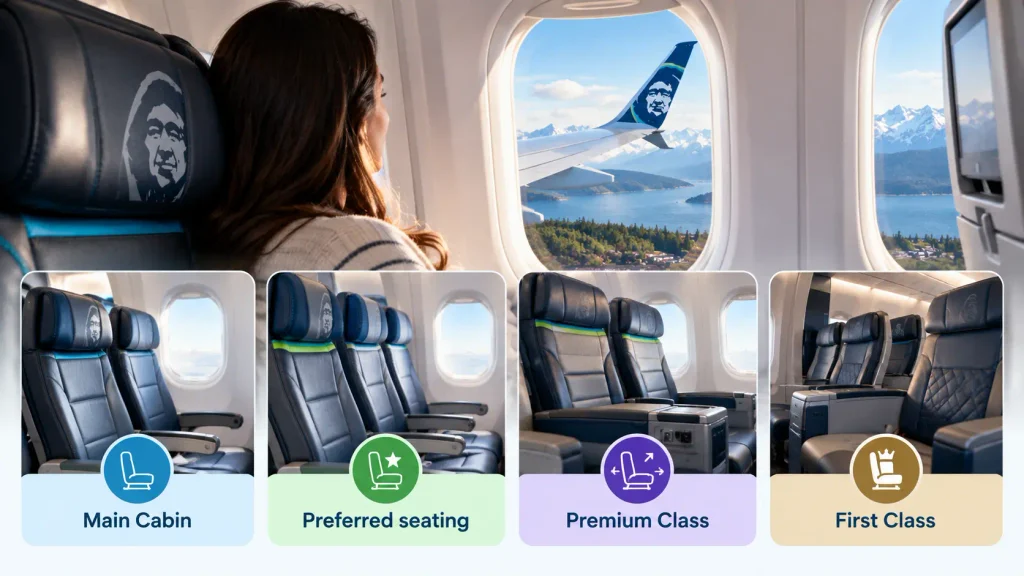
Alaska Airlines lets passengers select available seats based on their fare rules, eligibility, and the aircraft’s seating configuration. Depending on the ticket, travelers may choose a seat during booking, manage their selection later, or receive an assignment when the airline assigns seats.
The main seating categories are:
- Main Cabin: Standard economy seating.
- Preferred seating: Selected Main Cabin seats in more desirable locations, where offered.
- Premium Class: Seats with additional legroom and other benefits.
- First Class: A separate premium cabin on aircraft configured to offer it.
Seat availability varies by flight, aircraft, route, and booking conditions. Not every flight offers every category, and a seat that appears available when booking may no longer be available later.
Passengers can generally manage eligible reservations through Alaska Airlines’ website or app. Travelers who booked through a travel agency or another airline may need to use the original booking channel or contact the relevant provider if seat selection cannot be completed directly.
Related: Alaska Adds 5 Korean Air Codeshare Routes in 2026
Alaska Airlines Seat Types Explained
Understanding the differences between seat categories makes it easier to decide whether an upgrade is worth it.
1. Main Cabin Seats
Main Cabin is Alaska Airlines’ standard economy cabin. These seats suit travelers who want a standard economy experience without paying for a premium seating category.
Seat-selection eligibility and charges depend on the fare and reservation. Some tickets include standard seat selection, while Saver fares have tighter restrictions. Even when a passenger can select a seat, the choice is limited to the seats available at the time.
The Main Cabin is often a sensible option for travelers who do not need extra legroom and are comfortable with a standard economy seat.
2. Preferred Seats
Preferred seats are generally located in more desirable parts of the Main Cabin, such as toward the front of the economy cabin. Their main advantage is location, not a substantially different seat design.
These seats may help passengers deplane sooner after landing, which can help travelers with onward plans. Availability, eligibility, and any additional charge depend on the flight and fare.
A preferred seat does not automatically provide the extra legroom associated with Premium Class. Travelers should review the seat map carefully before paying for a particular location.
3. Premium Class
Premium Class offers more legroom than standard Main Cabin seating. It may also include benefits such as complimentary alcoholic beverages for eligible adult passengers on qualifying flights, subject to Alaska Airlines’ current service rules and applicable restrictions.
Premium Class can be especially appealing on longer domestic flights or for travelers who prefer more room to stretch their legs. However, it is not the same as First Class: passengers remain in the economy cabin and should not expect the same services or space as in the premium cabin.
Premium Class availability varies by aircraft and route. The price of selecting a Premium Class seat may also vary depending on the itinerary, demand, and booking conditions.
4. First Class
First Class is Alaska Airlines’ premium cabin on aircraft that offer it. It generally offers more spacious seating and additional onboard services than Main Cabin.
For travelers considering an upgrade, the important question is whether the extra comfort and services justify the fare difference. A short flight may not require a premium cabin, while a longer journey could make the additional space more valuable.
First Class availability and configuration depend on the aircraft. Passengers should check the seat map and fare details for their exact flight rather than assume every route offers the same layout.
Alaska Airlines Seat Selection Rules by Fare Type
The fare type is one of the most important factors in determining when and how a passenger can choose a seat.
| Fare or cabin | Seat-selection considerations |
| Saver | More restrictive seating rules; seat choices and timing may be limited |
| Main Cabin | Standard seating options, with eligibility and any charges determined by the ticket |
| Premium Class | Additional-legroom seating, subject to availability and applicable pricing or upgrade rules |
| First Class | Premium-cabin seat selection for eligible First Class bookings |
| Award ticket | Rules depend on the award fare, cabin, and applicable program conditions |
What should travelers know about Saver fares?
Saver is Alaska Airlines’ restricted, lower-priced economy fare. It may appeal to passengers who prioritize the lowest initial ticket price, but it offers less flexibility than a standard Main Cabin fare.
Saver passengers may have limited seat-selection options before check-in and may be assigned seats later in the process. Travelers should not assume that choosing a Saver fare guarantees a particular seat or that members of a group will automatically sit together.
For example, a solo traveler on a short flight who is comfortable with an assigned seat may find Saver suitable. A family that needs to sit together or a passenger who wants extra legroom may prefer to compare the total cost of a Main Cabin or another available option.
Before buying Saver, review the current restrictions on seat assignments, changes, cancellations, and other fare conditions. A lower initial price is useful only if the restrictions work for the trip.
How Much Does Alaska Airlines Seat Selection Cost?
Alaska Airlines does not have one fixed price for every seat upgrade. The amount depends on the route, aircraft, seat location, fare, demand, and any benefits attached to the reservation.
Standard Main Cabin seats
For eligible Main Cabin fares, standard seat selection is generally included. Passengers can usually choose an available seat during booking or return to their reservation later to select one.
A free seat choice does not mean every seat is available without a charge. Preferred locations, Premium Class, and First Class may carry additional costs when the passenger is not eligible for complimentary access or an upgrade.
Preferred and Premium Class seats.
Preferred and Premium Class seats may be available for an additional fee. Alaska displays the applicable price during booking or when the traveler manages the reservation.
First Class upgrades
Travelers may be offered a paid First Class upgrade when booking, after purchase, or during check-in, depending on availability and eligibility. Prices are not fixed across routes or flights.
Before paying, compare the upgrade cost with the price of purchasing First Class from the beginning. The original fare plus a later upgrade can sometimes be less attractive than a different fare offered at the start of booking.
Can travelers select seats for free?
Often, yes. Eligible Main Cabin passengers can generally choose standard seats without an extra charge, while Saver passengers face more restrictions. Access to Preferred or Premium Class seats for free depends on elite status, fare conditions, and upgrade availability.
The best way to confirm a fee is to open the seat map for the actual reservation. Third-party examples of seat prices should not be treated as current prices for another flight.
How to Select a Seat on Alaska Airlines
Passengers can generally choose or change seats on Alaska Airlines’ website or mobile app. Selecting a seat during booking usually provides the widest choice because other passengers may claim seats as the flight fills.
- Search for flights on Alaska Airlines’ website or app.
- Choose the flight and fare that suit the trip.
- Enter the required passenger information.
- Open the seat map when prompted.
- Review the available seats and any displayed charges.
- Select the desired seat and confirm the choice, including any applicable payment.
The seat map may use different labels or colors for standard seats, Preferred seating, Premium Class, unavailable seats, and paid upgrades. Read the on-screen information before selecting a seat.
Choosing or changing a seat after booking
If you’ve already purchased the ticket, you can usually manage the reservation online.
- Open Alaska Airlines’ website or app.
- Find the trip using the reservation details or by signing in.
- Open the seat-selection section.
- Review the available seats and any additional costs.
- Select the preferred seat and save the change.
If the reservation was made through a travel agency or another airline, the traveler may need to return to that booking provider or contact Alaska Airlines for help. Some reservations or itinerary combinations may limit which changes can be made online.
What if no seats are available?
A seat map that shows few or no available seats does not necessarily mean the flight is sold out. Some seats may be held for operational reasons, passengers with particular needs, or later assignment. Availability can also change as other passengers modify their reservations.
Travelers who do not have a seat assignment should check their booking and follow the instructions provided during check-in. If a particular seat is essential, contact the airline before departure rather than assuming one will become available.
Alaska Airlines Seat Selection for Families and Groups
Families often need more than a convenient seat: they need to know whether children can sit beside an accompanying adult. Alaska Airlines has a family seating policy that lets eligible children aged 13 or younger sit with an accompanying adult without an additional seat-selection charge, when the policy’s conditions are met.
However, passengers should not assume that every family member will automatically be seated together under every fare and circumstance. Availability, aircraft layout, and reservation rules can affect the options.
Should families book Saver fares?
Saver fares are less suitable for families who need to select adjacent seats in advance. Alaska states that Saver seats are assigned at check-in and that it cannot guarantee that parties of two or more will sit together. It advises groups that want advance seat selection to consider upgrading to an eligible seat category.
For example, two adults traveling with a young child may prefer a fare that lets them select seats before check-in. Paying more upfront can be worth it if it removes uncertainty about where the family will sit.
What about groups traveling together?
Friends or relatives on the same booking should select seats early, if their fare allows. Being on one reservation does not guarantee they will all sit together, especially on a Saver fare or a nearly full flight.
For larger groups, it may be more practical to prioritize pairs of seats or ensure each child sits with a responsible adult rather than expect the entire group to occupy one row.
How Atmos Rewards Status Affects Seat Selection
Alaska Airlines’ loyalty program is now called Atmos Rewards. Eligible status members can receive seating benefits that may make it easier to access Preferred seating or qualify for complimentary upgrades.
The benefits depend on the member’s status level, the fare purchased, available seats, and the rules for the particular flight.
Preferred seating for elite members
Eligible Atmos Rewards members and qualifying oneworld status holders may receive access to certain Main Cabin seats without an additional selection fee on eligible non-Saver fares. The exact benefits depend on status and seat availability.
Saver fares have important exceptions: Alaska states that status members do not receive Preferred seating benefits on Saver tickets, although some upgrade and boarding benefits may still apply.
Complimentary Premium Class and First Class upgrades
Eligible members may be considered for complimentary upgrades when seats are available. An upgrade is not guaranteed simply because a passenger has elite status.
Upgrade timing and priority can depend on the member’s status level, fare, itinerary, and other eligibility rules. Passengers who need a confirmed premium seat should compare the cost of purchasing one with the chance of receiving an upgrade.
Can a companion receive the same benefits?
Some loyalty benefits may extend to eligible companions traveling on the same reservation, but the conditions vary. Travelers should review the current Atmos Rewards terms rather than assume every companion receives the same seat or upgrade privileges.
Read this blog: Inside the Alaska Lounge at SEA Concourse N: Access & Amenities
How to Choose the Best Seat on Alaska Airlines
The best seat depends on the passenger’s priorities, including legroom, cabin location, convenience, and budget.
Window, aisle, or middle seat?
- Window: Useful for passengers who want to look outside, rest against the cabin wall, or avoid being disturbed by people moving through the aisle.
- Aisle: Convenient for travelers who want easier access to the restroom or prefer to stand and stretch when permitted.
- Middle: Often less desirable for solo travelers, but a practical choice when traveling with family or friends.
- Seats near the front: Can make it easier to leave the aircraft sooner after landing, depending on the cabin layout.
- Exit-row seats: May provide extra legroom, but eligibility requirements apply, and some seats may have limited recline or other restrictions.
No seat type is best for everyone. A window seat may suit someone planning to sleep, while an aisle seat can be more convenient for a passenger who expects to get up frequently.
Is Premium Class worth the extra cost?
Premium Class may be worth it for passengers who value extra legroom and earlier boarding. Alaska advertises four extra inches of legroom compared with standard Main Cabin seats, plus complimentary alcoholic beverages on most flights over 350 miles for eligible adult passengers.
For a short journey, the upgrade may offer limited practical value. On longer flights, a passenger who finds standard economy seats restrictive may appreciate the extra space.
A useful approach is to compare the Premium Class price with the flight length and the traveler’s comfort needs. Don’t pay for an upgrade just because it is offered; decide whether the added benefits justify the cost.
What seats should passengers with mobility needs consider?
Passengers with disabilities or mobility needs should review Alaska Airlines’ accessibility information and contact the airline in advance if they need assistance or a particular seating arrangement. Exit-row seats have specific safety eligibility requirements and may not suit every passenger.
Travelers who need an aisle seat, boarding assistance, or accommodation for a service animal should communicate their requirements to the airline before departure. Seat maps alone may not show every accessibility consideration.
Common Alaska Airlines Seat Selection Mistakes to Avoid
A few simple checks can prevent confusion and unexpected expenses.
- Choosing Saver without checking the restrictions: The fare may not allow advance selection of a standard seat, and groups are not guaranteed to sit together.
- Assuming every seat is free: Main Cabin seat selection may be included, but Preferred and Premium Class seats can cost extra.
- Waiting too long to choose: Popular seats may be taken as the flight fills.
- Assuming an upgrade is guaranteed: Loyalty status can provide upgrade eligibility, but availability and priority rules apply.
- Overlooking the aircraft type: Seat dimensions, layouts, and available categories can differ between aircraft.
- Ignoring family seating conditions: Alaska’s family seating guarantee has specific requirements, including being on the same reservation and the availability of adjacent seats in the relevant cabin.
- Forgetting to save the selection: Confirm that the chosen seat appears in the booking details after making a change.
- Assuming a seat will remain unchanged: Aircraft substitutions and operational changes can result in reassigned seats. Check the reservation again before departure.
Final Takeaway: Plan Seat Selection Before You Fly
Alaska Airlines seat selection is generally straightforward once passengers understand the difference between Saver, Main Cabin, Preferred, Premium Class, and First Class. For travelers who want a standard seat and more flexibility, Main Cabin is often the simpler choice; Saver suits passengers willing to accept a later assignment.
Before booking, compare the full fare with any seat-upgrade cost, check the aircraft’s seat map, and review the latest rules on family seating and loyalty benefits. These steps help travelers choose a seat that fits their comfort needs without paying for upgrades they don’t need.
Frequently Asked Questions
Eligible Main Cabin passengers can generally choose available standard seats without an additional charge. Saver fares are different: seats are assigned at check-in unless a passenger purchases an eligible upgrade. Preferred and Premium Class seats may also require payment.
Alaska states that Saver seats are assigned at check-in. If a passenger still has no seat assignment after checking in, the airline says it will assign one at the gate. A particular seat or adjacent seats for a group are not guaranteed.
Alaska commits to seating children aged 13 or younger next to at least one accompanying adult without an additional charge, subject to conditions. These include having the child and adult on the same reservation, adjacent seats being available in the applicable cabin, and other requirements outlined in the airline’s policy and the U.S. Department of Transportation’s family seating guidance.
Yes. Alaska allows eligible Saver passengers to purchase upgrades to Premium Class or First Class when available. However, buying an upgraded seat does not remove the other restrictions attached to a Saver fare.
Eligible passengers can usually change their seat through the Alaska Airlines website or app by opening the reservation and viewing the seat map. The new selection may cost extra, and available choices can be more limited closer to departure.
Premium Class may require an additional payment unless the passenger qualifies for an applicable complimentary upgrade or benefit. The price varies by flight and availability, so the seat map is the best place to check the current offer.
Eligible members may receive complimentary access to certain Preferred seats or qualify for upgrades, depending on status, fare, and availability. Saver fares have separate restrictions, so passengers should check the benefits that apply to their specific ticket.
An aircraft substitution can change the seat map and may affect a passenger’s assigned seat. Travelers should check their reservation again before departure and contact Alaska Airlines if the new assignment creates a significant problem.