
How to Get Paid for Airline Delays: A Traveler’s Guide
Depending on the circumstances, a delayed flight may qualify a traveler for cash compensation, a ticket refund, meals, hotel accommodations, reimbursement for reasonable expenses, or travel insurance benefits. The key distinction is that these are different types of claims, and a delay does not automatically entitle every passenger to cash.
In the United States, airlines generally have no blanket federal requirement to pay passengers cash simply because a flight arrives late. However, European Union and United Kingdom rules can provide fixed compensation for qualifying delays. Travelers may also have rights under an airline’s customer service commitments, the terms of a travel insurance policy, or the benefits attached to an eligible credit card.
The best approach is to establish why the flight was delayed, check the rules for the route, save evidence of the disruption, and submit a claim through the appropriate channel.
What Counts as Flight Delay Compensation?
Flight delay compensation is money or another benefit a traveler may be entitled to receive after a disrupted flight. The form of payment depends on the applicable law, airline policy, or insurance agreement.
Travelers should distinguish between four common forms of assistance:
- Fixed cash compensation: A payment required by certain passenger-rights laws when specific conditions are met.
- Ticket refund: A return of the ticket price when a flight is canceled or significantly changed, and the traveler chooses not to take the alternative offered.
- Expense reimbursement or assistance: Help with reasonable meals, accommodation, or transport costs when applicable.
- Insurance or credit card benefits: Coverage for eligible additional expenses caused by a covered travel delay.
These benefits are not interchangeable. An airline might owe a traveler a refund without owing fixed delay compensation. Another passenger might qualify for statutory compensation and reimbursement for reasonable expenses, subject to the applicable rules.
Can You Get Paid for a Delayed Flight in the United States?
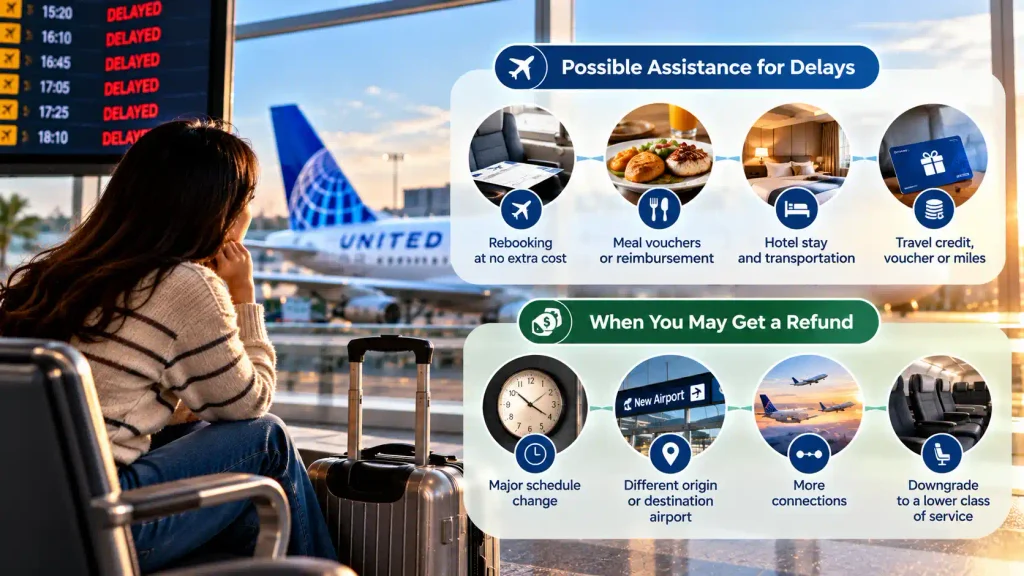
In the United States, passengers should not assume that a delay of three hours or more guarantees cash compensation. Federal rules focus on refunds when flights are canceled or significantly changed, and passengers decline the alternative, while additional delay assistance depends largely on airline commitments and other applicable protections. The U.S. The Department of Transportation (DOT) publishes an Airline Cancellation and Delay Dashboard showing what major airlines have committed to provide for disruptions within their control.
When a U.S. airline may provide compensation
First, identify the cause of the disruption. Airline-controlled problems may include maintenance issues, crew scheduling problems, fuel or baggage-loading delays, and cabin-cleaning issues. Weather, air traffic control restrictions, and certain safety or security events are generally outside the airline’s control.
Airline policies differ, so passengers should check the carrier’s current commitments rather than assume that every airline offers the same benefits.
Possible assistance includes:
- Rebooking on another flight at no additional cost.
- Meal vouchers or meal reimbursement under the airline’s policy.
- Hotel accommodation and ground transportation for a qualifying overnight disruption.
- A travel credit, voucher, or miles when the airline’s policy provides one.
- Reimbursement for eligible expenses under the airline’s stated rules.
A commitment to provide a hotel or meal is not the same as a legal entitlement to cash for lost time. The DOT dashboard helps passengers compare airline commitments and see which benefits apply to controllable delays.
Read this blog: U.S. Airlines Unaccompanied Minor Travel Rules 2026
When can you get a refund instead?
Under the U.S. DOT’s refund rules, a passenger generally qualifies for a refund when an airline cancels a flight or makes a qualifying significant change, and the passenger chooses not to travel or accept the alternative offered. This protection applies even to many nonrefundable tickets.
For covered itineraries, significant changes include:
- A departure or arrival time more than three hours earlier or later for domestic travel.
- A departure or arrival time more than six hours earlier or later for international travel.
- A change to a different origin or destination airport.
- An increase in the number of connections.
- A downgrade to a lower class of service.
The rules also cover certain changes affecting accessibility for passengers with disabilities. The U.S. Department of Transportation explains the exact criteria and refund process.
A refund is generally issued to the original payment method, not replaced with a voucher, unless the passenger agrees to that alternative. DOT guidance specifies processing deadlines of seven business days for credit card purchases and 20 calendar days for other forms of payment in covered cases. A traveler who accepts and takes the alternative flight generally cannot claim a refund under these rules solely because the original flight was significantly delayed.
How Much Flight Delay Compensation Can You Get in Europe?
Passengers on qualifying flights covered by EU Regulation 261/2004 may be entitled to fixed compensation if they reach their final destination at least three hours late, unless the airline proves that extraordinary circumstances caused the delay and could not have been avoided even with reasonable measures.
The regulation generally covers flights departing from an EU airport and flights arriving in the EU from outside the EU when operated by an EU airline. Other details can depend on the itinerary and operating carrier.
| Flight distance | Typical compensation for a qualifying delay |
| 1,500 km or less | €250 per passenger |
| More than 1,500 km within the EU, and other flights between 1,500 km and 3,500 km | €400 per passenger |
| Other flights over 3,500 km | Up to €600 per passenger |
For long-haul journeys over 3,500 km, a delay of three to less than four hours can result in a reduced amount of €300 in qualifying cases; a delay of four hours or more can qualify for €600. The amount depends on the specific route and circumstances.
The delay is measured at the final destination, not simply by how late the aircraft leaves the departure airport. On a single booking with a connection, a late arrival on the first leg can matter if it causes the traveler to reach the final destination late enough.
What are extraordinary circumstances?
Airlines may refuse fixed compensation if they can demonstrate that an extraordinary circumstance caused the delay and could not have been avoided despite reasonable measures. Severe weather, certain air traffic management restrictions, security risks, and some external strikes may qualify, depending on the facts.
An airline cannot avoid compensation with a vague explanation such as “operational reasons.” If a claim is denied, the traveler can ask for a specific explanation and supporting information. Ordinary technical problems are not automatically extraordinary circumstances.
Right to meals, accommodation, and a refund
EU passenger-rights rules can also require assistance while a passenger waits. Depending on flight distance and the expected delay, that may include meals and refreshments, communication facilities, and hotel accommodation with transport when an overnight stay becomes necessary.
If the departure delay reaches five hours, a passenger can generally choose not to travel and request a refund for the unused journey, with return transport to the original departure point where the rules require it. The right to care and the right to fixed compensation are separate: one may apply even when the other does not.
What Are the Rules for Flight Delay Compensation in the United Kingdom?
UK passenger-rights rules, commonly called UK261, are similar in important respects to EU rules. A traveler may be entitled to compensation if the flight arrives at its destination more than three hours late and qualifying extraordinary circumstances did not cause the delay.
Under current UK Civil Aviation Authority guidance, compensation for a qualifying delay is generally based on flight distance and, for longer routes, the length of the arrival delay.
| Flight distance | Typical UK compensation |
| Under 1,500 km | £220 |
| 1,500–3,500 km | £350 |
| Over 3,500 km, arriving 3–4 hours late | £260 |
| Over 3,500 km, arriving more than 4 hours late | £520 |
The UK rules also provide a right to care after certain departure-delay thresholds, with the threshold depending on flight distance. If the airline does not arrange reasonable care, passengers may be able to claim back appropriate expenses. Keep itemized receipts and avoid unusually expensive purchases that may be considered unreasonable.
For claims involving a UK departure or arrival, confirm that UK261 applies to the specific itinerary before relying on these figures. The operating airline and the route matter.
Can Travel Insurance Pay for a Flight Delay?
Yes. Travel insurance may reimburse certain expenses caused by a covered delay, and some policies include a fixed benefit after a specified waiting period. Coverage is governed by the policy rather than a universal compensation schedule.
Depending on the plan, eligible benefits might include:
- Meals and accommodation during a qualifying delay.
- Necessary transport expenses.
- Additional costs incurred to continue the trip.
- A fixed delay benefit once the policy’s minimum delay period is reached.
Not every policy includes all these benefits. Some require the delay to last a minimum number of consecutive hours; others cover only specified causes or impose per-person and per-trip limits. Pre-existing circumstances, documentation requirements, and exclusions may also affect a claim.
How to make a travel insurance claim
- Read the policy wording. Check the definition of a covered delay, the waiting period, exclusions, and maximum payout.
- Obtain proof of the delay. Save the airline’s notification, boarding pass, itinerary, and any statement explaining the cause.
- Keep itemized receipts. Document meals, lodging, ground transport, and other expenses for which reimbursement is sought.
- Submit the claim through the insurer. Include the required forms and evidence, and keep a copy of everything submitted.
- Check for overlapping benefits. An insurer may ask whether the airline has already refunded or reimbursed any of the claimed expenses.
Insurance generally helps with losses specified in the policy; it does not necessarily compensate a traveler for inconvenience or lost vacation time. Travelers should also check whether they must first seek reimbursement from the airline.
Can a Credit Card Cover Airline Delays?
Some travel credit cards include trip-delay insurance or related travel protections. These benefits can help cover eligible additional expenses when a qualifying delay disrupts a trip, but the exact coverage depends on the card’s benefit guide.
Common conditions include paying for the trip, or a specified portion of it, with the eligible card or its rewards. The delay may also have to last a set number of hours or require an overnight stay.
Before filing, check:
- Which purchases must be charged to the card.
- The minimum delay duration and covered reasons.
- The maximum benefit per traveler or trip.
- Which expenses qualify and which are excluded.
- The deadline for notifying the benefits administrator.
- Which documents are required?
A card benefit is not the same as statutory airline compensation. It may reimburse expenses such as meals or lodging without paying a separate amount for lost time. If both airline assistance and card coverage may apply, review the terms and avoid submitting the same expense twice for reimbursement.
Step-by-Step: How to Claim Money for an Airline Delay
The process is easier when the traveler keeps a clear record from the moment the disruption occurs.
1. Save the booking and flight details
Keep the booking confirmation, ticket number, boarding pass, flight number, scheduled departure and arrival times, and the airline’s updated itinerary. If the trip involves a connection, retain the details for every flight on the same booking.
2. Ask the airline why the flight was delayed
Ask an airline representative or customer-support team for the reason and, if possible, written confirmation. Save app alerts, emails, text messages, and airport display screenshots.
The cause matters because maintenance or crew issues may be treated differently from severe weather or air traffic control restrictions. Do not assume the cause based solely on a general airport announcement.
3. Check the rules that apply to the route
Establish whether the flight is covered by U.S. refund rules, EU261, UK261, an airline’s customer service commitments, or a combination of these protections. Check both the operating carrier and the company that sold the ticket.
If the airline has published a commitment to provide meals, accommodation, or rebooking for the relevant type of delay, keep a copy of that policy. For U.S. flights, the DOT dashboard is a practical starting point.
4. Ask for assistance at the airport
For a lengthy or overnight delay, ask whether the airline can provide a meal voucher, hotel, transport, or a replacement flight. Request clear instructions before paying for alternatives yourself.
If the airline cannot arrange care and the applicable rules allow reimbursement, choose reasonable options and retain receipts. Do not assume every expense will be repaid automatically.
5. Submit the correct claim
Use the airline’s official customer-service or passenger-rights claim process. State what you are requesting: statutory compensation, reimbursement for expenses, a refund for an unused ticket, or another benefit.
Include the flight details, the actual arrival time, the reason provided for the delay, and the evidence supporting the claim. If the airline uses separate forms for compensation and expenses, submit each through the appropriate channel.
6. Keep the claim reference and follow up
Save the confirmation number and a copy of your submission. If the airline rejects the claim, ask for the specific reason and the rule or policy it relied on. You can then decide whether to escalate the complaint to the relevant aviation regulator, an approved dispute-resolution body, or another appropriate authority.
7. Check insurance and card benefits separately
If the airline does not cover all eligible expenses, review your travel insurance and credit card protections. Each provider may have its own filing deadline and documentation requirements. Submit the relevant evidence promptly.
Explore this blog: How to Find Great Travel Deals on Travelzoo In 2026
What Documents Do You Need to Claim Flight Delay Compensation?
Having the right evidence can make a claim easier to assess. Requirements differ by airline, regulator, insurer, and card issuer, but travelers should generally keep:
- Booking confirmation and ticket number.
- Boarding pass or proof of travel.
- Flight number, date, route, and operating airline.
- Original scheduled and actual arrival times.
- Airline messages stating the delay, cancellation, or reason.
- Itemized receipts for meals, hotel stays, and transport.
- Correspondence with the airline and any claim reference number.
- Insurance documents or the applicable credit card benefit guide, if relevant.
For example, if a traveler pays for a modest hotel after an airline-controlled overnight delay, the receipt alone may not be enough. The traveler may also need proof that the flight was disrupted, evidence of the airline’s response, and documentation showing that the hotel expense was reasonable.
What to Do If an Airline Rejects Your Claim
A denial does not always mean the claim is invalid. First, read the airline’s explanation carefully and check whether it addresses the specific rules that apply to the journey.
If the airline says extraordinary circumstances caused the delay, ask for a clearer explanation. If the claim concerns expenses, verify whether the airline considers the items eligible and whether it has requested missing receipts. If the dispute is about a U.S. refund, compare the decision with the DOT’s published refund requirements.
Possible next steps include:
- United States: File a complaint or seek assistance through the U.S. Department of Transportation’s aviation consumer resources.
- European Union: Contact the relevant national enforcement body if the airline does not resolve a covered passenger-rights claim.
- United Kingdom: Follow the UK Civil Aviation Authority’s claim guidance and check whether the airline participates in an approved alternative dispute-resolution scheme.
- Insurance or credit card claims: Use the appeal process described in the policy or card benefit guide.
Deadlines for legal claims vary by jurisdiction, so do not assume that a single worldwide time limit applies. Keep copies of every communication and make a note of the dates on which the disruption and claim occurred.
The Practical Takeaway
Getting paid for an airline delay starts with identifying the benefit that actually applies. Check passenger-rights rules for the route, confirm the airline’s reason for the disruption, and separate fixed compensation from refunds and expense reimbursement. Keep the booking documents, delay notifications, and itemized receipts, then file through the airline’s official channel and review any relevant insurance or card coverage. If the claim is denied, ask for a clear explanation and consider escalating through the appropriate regulator or dispute-resolution process.
Frequently Asked Questions
There is no universal threshold. Under qualifying EU and UK rules, passengers may be eligible for fixed compensation if they arrive at the final destination more than three hours late, subject to exceptions. U.S. passengers should check refund eligibility and the airline’s specific commitments.
Usually, weather delays do not qualify for fixed compensation under EU or UK rules when the weather meets the applicable extraordinary-circumstances test. U.S. airlines also generally do not promise the same assistance for weather disruptions as for controllable delays. Assess refund rights, insurance coverage, and other obligations separately.
Potentially, yes. Accepting a replacement flight does not automatically eliminate fixed compensation rights under qualifying EU or UK rules. However, under U.S. DOT refund rules, a passenger who accepts and takes the alternative generally cannot receive a ticket refund solely because the original flight was significantly changed.
Yes, in some circumstances. If connecting flights are on a single booking, the delay may be assessed by reference to the final destination under applicable EU or UK rules. Separate self-transfer bookings are treated differently, and the missed connection may not be covered in the same way.
A passenger can often submit a claim directly to the airline without paying a third-party service. A claim company may help with paperwork or disputes, but it can charge a fee or take a share of any recovery. Compare its terms with the airline’s official claim process before signing an agreement.
There is no single processing time for all claims. The timeline depends on the airline, the claim type, the evidence provided, and whether the airline disputes eligibility. U.S. ticket-refund deadlines under DOT rules are distinct from the timeline for a compensation or expense claim.
Possibly. The payment method does not automatically determine whether a passenger qualifies for statutory delay compensation. However, refunding an award booking may require returning miles and taxes under the applicable rules, while travel insurance or credit card benefits may have separate payment requirements.