
Southwest Boarding Process and Groups Explained: How It Works Now
Southwest has eight numbered boarding groups, plus separate boarding arrangements for eligible passengers who board before the numbered groups. The group printed on the boarding pass determines when a passenger should line up at the gate.
| Boarding category | Who generally qualifies |
| A-List Preferred | Rapid Rewards A-List Preferred members board before Group 1 |
| Group 1 | A-List members and passengers with a Choice Extra fare |
| Group 2 | Passengers with eligible Extra Legroom seats |
| Groups 3–4 | Choice Preferred passengers seated in Standard or Preferred seats |
| Group 5 | Eligible primary Southwest Rapid Rewards credit-cardmembers who do not qualify for an earlier group |
| Groups 3–7 | Choice passengers seated in Standard or Preferred seats, depending on their assigned group |
| Group 8 | Basic fare passengers |
| Priority Boarding | Purchased option that boards passengers ahead of Group 1, when available |
| Preboarding | Eligible passengers with disabilities who need assistance or additional time, and unaccompanied minors under Southwest’s stated process |
| Active-duty U.S. military | Eligible military passengers with valid identification receive special boarding consideration. |
This is a general guide rather than a guarantee of a specific group for every traveler. Southwest assigns groups based on several factors, and an earlier benefit based on status, fare, or seat type can override a later one. The boarding pass is the final reference for an individual flight.
Related: Southwest International 15 Destinations: 2026 Guide
What Changed in Southwest’s Boarding Process?
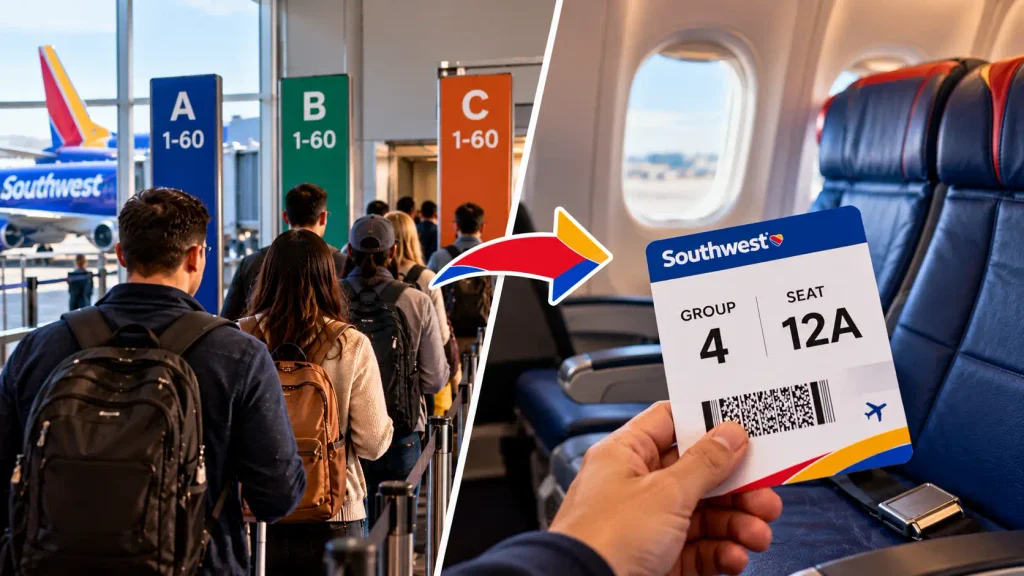
Before January 27, 2026, Southwest used an open-seating model. Passengers received a boarding group—A, B, or C—and a position from 1 to 60. The earlier the position, the more choice a passenger generally had when selecting a seat after boarding.
Assigned seating has replaced that system. Under the new system, passengers are assigned a seat, and the boarding pass displays both the seat and the boarding group. Seat selection no longer depends on how early someone enters the aircraft.
| Feature | Former Southwest process | Current process |
| Seating | Open seating; passengers choose an available seat onboard | Assigned seats |
| Boarding designation | A, B, or C group plus a position number | Numbered Groups 1–8, with separate priority arrangements |
| Seat choice | Depends on available seats when boarding | Usually selected when booking, depending on fare and eligibility |
| Basic fare | Open seating under the former system | Standard seat assigned at check-in, subject to applicable exceptions |
| Main reason to board early | Improve the choice of available seats | Board earlier, access overhead-bin space sooner, and settle in earlier |
The new system is more familiar to travelers who have flown airlines with assigned seating. It also changes how passengers should think about upgrades: paying for a seat type can affect both comfort and boarding order, but you no longer need an early boarding group just to choose a seat.
How Southwest’s Boarding Process Works at the Airport
The process is straightforward once passengers know where to find their boarding group and when to approach the gate.
1. Check the boarding pass
After checking in, open the Southwest mobile boarding pass or review the printed version. Confirm the flight number, boarding group, and assigned seat. If the group or seat assignment appears different from what was expected based on the fare or status, check the reservation or ask a Southwest agent for clarification.
2. Arrive at the gate with enough time
Reach the departure gate before boarding begins. Gate locations, boarding times, and airport procedures vary, so follow the Southwest app and airport displays. Do not rely on the boarding group alone to estimate when to arrive at the airport.
3. Listen for the boarding announcement
Southwest calls passengers according to the current boarding order. Eligible preboarders and other passengers with crucial priority board according to the airline’s procedures, followed by A-List Preferred and the numbered groups.
When your group is called, approach the designated boarding area and follow the gate agent’s instructions. Southwest has moved away from the old A/B/C numbered-position setup, so passengers should follow the current gate signage and announcements rather than looking for the former boarding columns.
4. Scan the boarding pass and board
Once your turn comes, scan your boarding pass and enter the aircraft. Find the seat printed on your pass and place carry-on items in the overhead bin or under the seat in front of you, following crew instructions and the aircraft’s storage limits.
5. Sit in the assigned seat
Passengers should use their assigned seats rather than looking for an open row. If a seat assignment appears incorrect or a seating issue arises, ask a flight attendant for help instead of moving to another seat without permission.
How Southwest Assigns Groups 1 Through 8
The fare you purchase is one of the most important factors, but not the only one. Seat type and location, Rapid Rewards status, and eligible credit-card benefits can change a passenger’s boarding priority.
A-List Preferred: Before Group 1
A-List Preferred members receive a dedicated boarding benefit that places them ahead of Group 1. They also have enhanced seat-selection benefits, including access to available Extra Legroom seats at booking, subject to Southwest’s terms.
For frequent Southwest travelers, this status can reduce the need to buy a separate boarding upgrade. It is a benefit of elite status, however, not something every passenger receives automatically.
Group 1: Choice Extra and A-List
Group 1 generally includes passengers who buy a Choice Extra fare and Rapid Rewards A-List members. Choice Extra includes an Extra Legroom seat when available, along with other fare benefits such as two checked bags and ticket refundability under the applicable rules.
A-List members receive Group 1 boarding even when they do not have a Choice Extra fare. They can select eligible Standard or Preferred seats and may upgrade to an available Extra Legroom seat within 48 hours of departure under Southwest’s published benefit terms.
Group 2: Extra Legroom seats
Passengers with eligible Extra Legroom seats in Choice or Choice Preferred fares generally board in Group 2 unless another benefit gives them earlier priority.
Extra Legroom seats are located at the front of the cabin and near exit rows. Southwest says these seats offer up to five additional inches of legroom compared with Standard and Preferred seats, although the actual difference depends on the aircraft. They may also include extra snacks and complimentary premium beverages when available.
Groups 3 and 4: Choice Preferred
Choice Preferred passengers seated in Standard or Preferred seats generally board in Groups 3–4. This fare can attract travelers who want a Preferred seat near the front of the cabin without purchasing the top-level Choice Extra fare.
Preferred seats have standard legroom; their main distinction is location. Passengers should not assume that a Preferred seat offers the extra space provided by an Extra Legroom seat.
Group 5: Eligible Southwest credit-cardmembers
Eligible primary Southwest Rapid Rewards credit-cardmembers can receive Group 5 boarding if a better boarding group does not apply. The benefit may extend to up to eight passengers on the same reservation, provided the primary cardmember remains on that reservation, and the terms are satisfied.
This benefit is not necessarily available to every person who holds a card as an authorized user. Southwest’s published terms distinguish primary cardmembers from authorized users and employee cards. The benefit applies to eligible Southwest-operated flights, and the account must be in good standing. After a new card approval, Southwest advises allowing time for the card status to update in the Rapid Rewards account.
Groups 3–7: Choice fares
Choice passengers seated in Standard or Preferred seats are assigned a general boarding group within Groups 3–7. The precise group depends on the passenger’s eligibility and other boarding factors.
This means Choice does not guarantee one fixed group for every booking. A passenger with a qualifying card benefit, for example, may board earlier than another passenger traveling on the same fare type.
Group 8: Basic fares
Basic fares generally board last, in Group 8. Under the current system, the Standard seat is normally assigned at check-in rather than selected at the time of booking. However, eligible Rapid Rewards credit-cardmembers and tier members may have seating benefits under the applicable terms.
Basic can suit travelers who prioritize the lowest available fare and are comfortable with fewer choices. Those who want to choose a specific seat or board earlier should compare the full cost of upgrading to another fare or purchasing an eligible add-on.
Read This Guide: Southwest Unveils Its Largest Summer Schedule for 2027
Can You Pay to Board Earlier on Southwest?
Yes. Southwest offers Priority Boarding for purchase when available. The airline says you can purchase it starting 24 hours before the original scheduled departure, and the purchase window may remain open until 30 minutes before departure. The option is priced per passenger, per flight segment, and availability is not guaranteed.
Priority Boarding places eligible purchasers ahead of Group 1. It differs from purchasing an Extra Legroom seat: one is a boarding upgrade, while the other is a seat product that can also offer a better boarding group.
When is Priority Boarding worth paying for?
It may be useful if a traveler wants to board earlier to settle in, organize a carry-on, or improve the chance of finding suitable overhead-bin space. However, it does not provide a better seat assignment by itself. For example, if a passenger already has an assigned aisle seat, paying for Priority Boarding does not change it to a window seat.
Before paying, check the price for the specific flight segment and compare it with any benefits already included in the ticket or loyalty status. A connecting itinerary may require a separate purchase for each segment, which can make the total cost higher than expected.
Does Buying an Extra Legroom Seat Improve Boarding Priority?
Generally, yes. Eligible Extra Legroom seats are associated with Group 2 boarding, unless a passenger’s fare or status qualifies them for an earlier boarding category. Choice Extra fares generally include an Extra Legroom seat and Group 1 boarding.
The difference is worth understanding:
- Choice Extra fare: Includes an Extra Legroom seat and Group 1 boarding.
- Choice or Choice Preferred with an Extra Legroom seat: Generally boards in Group 2.
- Priority Boarding: A separate paid option that boards ahead of Group 1, when available.
- Elite status: Can provide earlier boarding and seat-selection benefits without buying a separate upgrade, subject to the status terms.
The best option depends on the seat’s value. A passenger who wants more legroom on a longer flight may find the seat upgrade worthwhile. Someone who only wants to board earlier may prefer to compare Priority Boarding with the fare’s included benefits.
What Are Southwest’s Preboarding Rules?
Preboarding is intended for passengers who need additional time or assistance to board, stow accessibility equipment, or be seated. Southwest’s official boarding information also lists unaccompanied minors in its preboarding arrangements. Eligibility and procedures depend on the circumstances and the airline’s policy.
Passengers with disabilities
Passengers who need preboarding because of a disability-related need should speak with a Southwest employee before boarding begins. For example, a passenger who needs additional time to reach a seat or stow an assistive device can ask an agent about the process.
Preboarding is not simply a way to get a better seat. With assigned seating, passengers already have a seat assignment; the purpose is to provide appropriate time and assistance.
Active-duty U.S. military
Southwest gives active-duty U.S. military personnel with valid identification special boarding consideration. Passengers should have the required military identification available and listen for instructions from the gate agent.
Unaccompanied minors
Southwest includes unaccompanied minors in its boarding information. Families arranging travel for a child who is flying alone should review the airline’s current unaccompanied-minor requirements rather than assuming the boarding process is the only requirement.
How Does Family Boarding Work Now?
Southwest’s former family-boarding process was designed around open seating and helped eligible families sit together after boarding. Under the assigned-seat system, passengers on the same reservation are generally assigned the same boarding group, except for group-travel reservations. Families using fares that permit seat selection can choose seats during booking.
For parents traveling with children, the most important task is to confirm the actual seat assignments before departure. If a family books a fare that includes seat selection, it can choose seats together when available. If the family books Basic, the seat-selection options may be more limited, so parents should review the rules and reservation details before purchase.
For example, two adults and a child on one reservation should check that all three seat assignments are appropriate for the family. A shared boarding group does not by itself guarantee adjacent seats if the booking’s seat-selection rules or availability do not provide them.
If a passenger needs disability-related boarding assistance, that is a separate consideration from family seating. Speak to Southwest before boarding if additional time or assistance is needed.
Do All Passengers on One Reservation Board Together?
Generally, yes. Southwest says passengers on the same reservation receive the same boarding group, except for group-travel reservations. A-List, A-List Preferred, and eligible primary credit-cardmember boarding benefits can extend to up to eight passengers on the same reservation, subject to the applicable rules.
There are a few details to keep in mind:
- The relevant cardmember or tier member must remain on the reservation for the applicable benefit to continue.
- Passengers on a group-travel reservation may be assigned boarding groups based on seat assignment.
- A Companion Pass does not automatically grant every passenger the same elite boarding priority; Southwest applies the highest relevant benefit according to the member’s tier status and the Companion Pass terms.
If people traveling together booked separate reservations, they should not assume they will receive the same boarding group. Check each boarding pass and ask Southwest about available options before boarding begins.
Common Southwest Boarding Mistakes to Avoid
The new system is simple once passengers know their group, but a few assumptions can still confuse.
Expecting the old A, B, and C groups. Those groups belonged to the former open-seating process. Use the numbered group printed on the current boarding pass.
Assuming early boarding means choosing a seat. The seat is assigned before boarding under the current system. Priority changes when a passenger boards, not which seat appears on the pass.
Confusing Priority Boarding with Extra Legroom. Priority Boarding is a separate boarding purchase. Extra Legroom is a seat type that generally comes with Group 2 boarding, while Choice Extra includes both an Extra Legroom seat and Group 1 boarding.
Assuming every credit-cardholder gets the same benefit. The Group 5 benefit applies to eligible primary cardmembers and has conditions. Authorized users and employee cards are not automatically eligible for the same benefit.
Arriving at the gate just as boarding starts. Even with an early group, passengers should arrive at the gate in time to hear announcements and follow the airline’s instructions.
Ignoring the assigned seat. Once onboard, sit in the seat printed on the boarding pass. If there is a problem, ask the crew rather than changing seats without permission.
Check Out This Blog: Southwest Elite Status: A-List vs. A-List Preferred
Final Thoughts
Southwest’s current boarding process revolves around assigned seats and numbered boarding groups. Before traveling, check the group on the boarding pass, confirm the seat assignment, and review any fare, status, or card benefits that may provide earlier boarding. If paying for an upgrade, compare the benefit you actually need—more legroom, an earlier boarding position, or a more flexible fare—rather than assuming all upgrades do the same thing.
Frequently Asked Questions
No. Southwest replaced the former A/B/C groups and numbered positions with a system using Groups 1–8 for flights operating under the new process, which began January 27, 2026.
Group 1 is the earliest of the numbered groups, but it is not the very first boarding category. A-List Preferred members board before Group 1, and eligible Priority Boarding purchasers board ahead of Group 1. Separate preboarding arrangements also apply.
No. A Companion Pass does not automatically confer a specific priority boarding group. The applicable boarding benefit depends on the Rapid Rewards member’s tier status and the current Companion Pass rules.
Southwest now uses assigned seating. Passengers should take the seat shown on their boarding pass and ask a flight attendant if there’s an issue. They should not assume they can choose any open seat as they could under the old open-seating system.
Southwest says Priority Boarding is available for purchase starting 24 hours before the original scheduled departure and, when available, up to 30 minutes before departure. It is priced per passenger, per flight segment.
Eligible primary Rapid Rewards credit-cardmembers can receive Group 5 boarding if they do not qualify for an earlier group. The benefit can extend to eligible passengers on the same reservation, subject to Southwest’s terms and account requirements.