
Azores: Top Places to Visit and Things to Do for All
The best things to see and do in the Azores include visiting the crater lakes of Sete Cidades, soaking in São Miguel’s geothermal pools, whale watching, hiking around volcanic landscapes, climbing Mount Pico, seeing Pico’s UNESCO-listed vineyards, discovering Terceira’s historic Angra do Heroísmo, and exploring the waterfalls and lakes of Flores.
But planning an Azores trip requires one important decision: which islands should you visit?
The Portuguese archipelago contains 9 inhabited volcanic islands spread across the North Atlantic. Although they share volcanic origins, each offers something different. São Miguel has famous crater lakes and geothermal landscapes, Pico has Portugal’s highest mountain and black-lava vineyards, São Jorge is known for its fajãs, Terceira combines volcanic scenery with historic architecture, and Flores is dominated by lakes, cliffs, waterfalls, and greenery.
Trying to visit all 9 on a short vacation usually means spending too much time in transit. For a first trip, choosing 1 to 3 complementary islands generally creates a better experience.
The Azores at a Glance
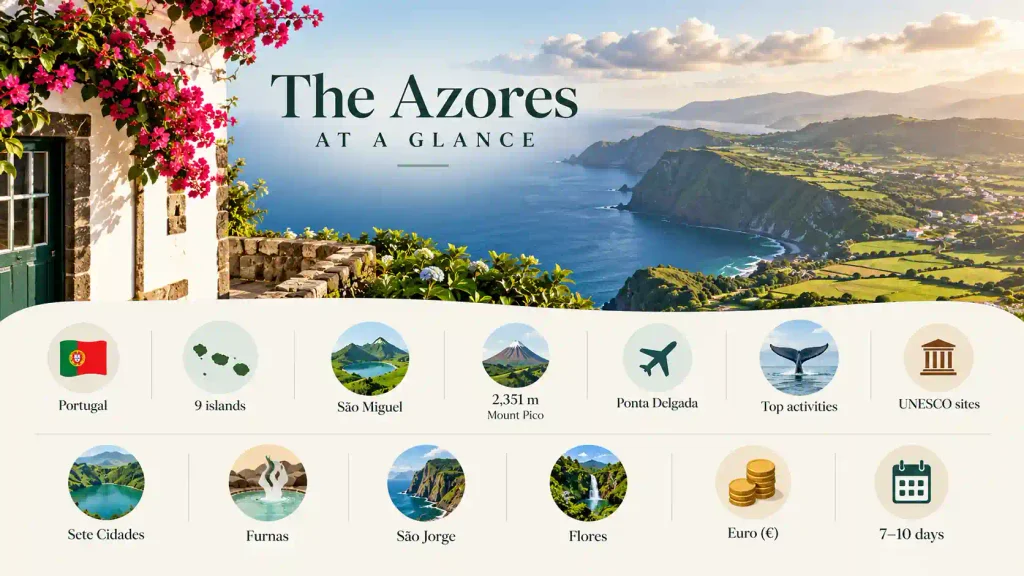
The islands are traditionally divided into eastern, central, and western groups, which matters when planning an island-hopping itinerary.
| Travel Detail | Information |
| Country | Portugal |
| Number of main islands | 9 |
| Largest island | São Miguel |
| Highest point | Mount Pico, 2,351 m |
| Main gateway | Ponta Delgada, São Miguel |
| Famous activities | Hiking, whale watching, thermal bathing, diving |
| UNESCO highlights | Angra do Heroísmo and Pico vineyard landscape |
| Best-known crater lake | Sete Cidades |
| Geothermal destination | Furnas |
| Famous for fajãs | São Jorge |
| Particularly scenic island | Flores |
| Currency | Euro (€) |
| Good first trip | Around 7–10 days |
Which Azores Islands Should You Visit?
There is no single “best” Azores island because the right choice depends on what you want to do.
| Island | Best Known For |
| São Miguel | Crater lakes, Furnas, hot springs, first visits |
| Santa Maria | Beaches, warmer feel, quieter landscapes |
| Terceira | Angra do Heroísmo, caves, culture |
| Graciosa | Quiet atmosphere, volcanic features |
| São Jorge | Fajãs, hiking, dramatic coastline |
| Pico | Mount Pico, vineyards, whale watching |
| Faial | Horta, Caldeira, maritime heritage |
| Flores | Waterfalls, lakes, dramatic scenery |
| Corvo | Caldeirão and remote atmosphere |
For a first visit, São Miguel is usually the easiest starting point because it combines many of the features associated with the Azores in one island.
Travelers with more time can add islands from the central group, particularly Pico, Faial, São Jorge, or Terceira.
1. See the Crater Lakes of Sete Cidades
Sete Cidades is one of the Azores’ signature landscapes, with volcanic crater scenery and lakes surrounded by steep green slopes on western São Miguel.
The famous Lagoa Azul and Lagoa Verde sit within the enormous volcanic caldera.
Visit viewpoints around the area before descending toward the village.
Weather makes an enormous difference.
Low cloud can completely obscure the crater even when conditions elsewhere on São Miguel are sunny.
The official Azores tourism service provides webcams for locations including Sete Cidades, Lagoa do Fogo, Furnas, Nordeste, and Ponta Delgada, making them useful for checking conditions before driving across the island.
Don’t Build a Fixed Schedule Around Viewpoints
This is one of the most useful lessons for an Azores trip.
If Sete Cidades is clear when you wake up, consider visiting even if you originally planned it for another day.
The same applies to other high-elevation viewpoints.
Azorean weather rewards flexibility.
2. Visit Lagoa do Fogo
Lagoa do Fogo is another spectacular volcanic lake on São Miguel, surrounded by comparatively undeveloped mountain scenery.
Its name translates as “Lake of Fire,” a reminder of the volcanic forces that shaped the island.
The high viewpoint provides sweeping views across the crater when clouds cooperate.
Walking opportunities are available in the surrounding landscape, although trail access and road-management measures can change.
The Azores’ official trail network provides current routes by island, difficulty, distance, and trail type.
Check current road access, trail conditions, and any seasonal transport arrangements before visiting rather than relying on an older itinerary.
3. Experience the Geothermal Landscape of Furnas
Furnas is one of the best places to experience the volcanic character of São Miguel because geothermal activity appears throughout the valley.
Steam rises from the ground, mineral-rich waters feed thermal pools, and fumaroles remind visitors that the Azores sit in an active geological region.
A Furnas day can include:
- Geothermal areas
- Furnas Lake
- Thermal bathing
- Gardens
- Walking
- Local food
Furnas is also associated with cozido das Furnas, a traditional stew whose cooking process uses geothermal heat in the volcanic ground.
Trying it gives the geothermal landscape a culinary dimension rather than making the visit solely about sightseeing.
4. Soak in the Azores’ Thermal Waters
São Miguel is particularly well suited to travelers interested in geothermal bathing.
Popular experiences include naturally heated pools and mineral-rich waters around Furnas and elsewhere on the island.
Depending on the facility, water can contain minerals that stain light-colored swimwear.
Bring:
- Dark swimwear
- Towel
- Sandals
- Change of clothes
Opening hours, admission charges, reservations, maintenance closures, and bathing conditions can change, so verify the specific thermal facility before traveling.
5. Go Whale Watching
Whale and dolphin watching is one of the Azores’ defining marine experiences, with excursions available from several islands.
The archipelago’s position in the North Atlantic makes its waters important for numerous cetacean species.
Whale-watching operators are available on islands including São Miguel, Pico, and Faial, while official Azores tourism resources list cetacean watching among the archipelago’s principal activities.
Sightings are never guaranteed.
Species and frequency vary according to:
- Season
- Ocean conditions
- Migration
- Location
- Weather
Choose a responsible operator that follows applicable wildlife-viewing regulations rather than promising unrealistically close encounters.
6. Hike Through Volcanic Landscapes
Hiking is one of the best ways to experience the Azores because trails cross crater rims, forests, coastal cliffs, lava landscapes, lakes, and fajãs.
Official trails exist across all 9 islands.
Difficulty varies substantially.
The official trail network includes everything from short easy routes to demanding day hikes. For example, listed routes range from easy walks of only a few kilometers to hard routes exceeding 20 km.
Before setting out, check:
- Trail status
- Distance
- Elevation
- Difficulty
- Weather
- Daylight
- Transportation
- Temporary closures
Rain can make volcanic paths slippery.
Waterproof layers and shoes with reliable grip are useful even when the morning begins under blue skies.
7. Climb Mount Pico
Mount Pico rises 2,351 m above sea level, making it the highest mountain in Portugal and the dominant landmark of Pico Island.
Climbing it is one of the archipelago’s most challenging outdoor experiences.
The ascent should not be treated as an ordinary sightseeing walk.
Weather, steep volcanic terrain, physical fitness, visibility, and mountain regulations all matter.
Travelers planning the climb should check current official requirements before arrival, including:
- Registration
- Visitor limits
- Fees
- Equipment recommendations
- Weather conditions
- Guide options
Not everyone needs to reach the summit to appreciate Pico.
The mountain dominates views from across the island and can also be seen from neighboring Faial and São Jorge when skies are clear.
8. Walk Through Pico’s UNESCO-Listed Vineyards
Pico’s other great landscape is almost the opposite of its towering mountain.
Close to the coast, vines grow among black volcanic rock.
The Landscape of the Pico Island Vineyard Culture became a UNESCO World Heritage Site in 2004.
Generations of growers constructed grids of dry-stone walls around small plots known as currais.
These walls protect vines from Atlantic winds and salt spray while absorbing and radiating heat.
The result is an extraordinary geometric landscape of:
- Black lava
- Green vines
- Stone walls
- Blue ocean
Lajido da Criação Velha and Lajido de Santa Luzia are highlighted as particularly important examples of this vineyard tradition.
Wine tasting adds another dimension to the experience, but the cultural landscape itself is worthwhile even for visitors who do not drink alcohol.
9. Discover Angra do Heroísmo on Terceira
Angra do Heroísmo provides one of the strongest contrasts to the Azores’ natural attractions because its historic center is a UNESCO World Heritage Site.
The city developed into an important Atlantic port linking Europe with other continents.
Portugal’s official tourism information notes that Angra was an obligatory port of call on major maritime routes from the 15th century until the rise of steamships in the 19th century.
Spend time walking rather than simply driving through.
Look for:
- Historic streets
- Churches
- Colorful façades
- Fortifications
- Public squares
- Harbor views
Terceira is a particularly good choice for travelers who want cultural history alongside volcanic scenery.
10. Go Underground at Algar do Carvão
Terceira’s volcanic story continues beneath the surface.
Algar do Carvão is a volcanic cavity that allows visitors to experience the interior of an extinct volcanic system rather than simply viewing a crater from above.
Official Azores trail information describes the cavity as approximately 100 m deep and places it within Terceira’s volcanic landscape.
Access conditions and operating schedules can change.
Check current opening information before building a day around it.
Nearby volcanic landscapes can make this part of Terceira a strong contrast to the streets of Angra do Heroísmo.
11. Discover São Jorge’s Fajãs
São Jorge is particularly famous for its fajãs—small areas of relatively flat land formed beneath the island’s steep coastal cliffs.
Some formed through lava flows, while others developed from landslides and coastal processes.
The result is a dramatic landscape where villages, farmland, lagoons, and walking trails occupy narrow pieces of land between cliffs and ocean.
Fajã da Caldeira de Santo Cristo is among the best-known.
The official Great Route of São Jorge passes through several fajãs and includes views toward Pico and Faial.
This makes São Jorge especially appealing to hikers.
12. See Faial’s Caldeira
Faial’s central caldera is one of the island’s defining natural features and provides an excellent hiking landscape when conditions are suitable.
The official Azores trail network lists a 6.8 km circular Caldeira route, categorized as easy and estimated at around 2.5 hours.
Weather can change rapidly at higher elevations.
Fog can transform a clear crater view into a wall of cloud surprisingly quickly.
If the caldera is clear, consider taking advantage of the conditions rather than assuming visibility will improve later.
13. Walk Around Horta
Horta gives Faial a strong maritime personality.
The city has long been associated with sailors crossing the Atlantic, and its marina remains an important part of local life.
Spend time around:
- Horta Marina
- Waterfront
- Historic center
- Cafés
- Harbor viewpoints
Faial also works particularly well in combination with Pico because the islands are close together.
Official Portuguese tourism information places Pico just 6 km from Faial, helping explain why the central islands work so naturally as a multi-island trip.
14. Experience the Volcanic Landscape of Capelinhos
Faial provides another striking reminder that the Azores’ geology is not simply ancient history.
The Capelinhos area was dramatically transformed by volcanic activity in the late 1950s.
Today, its dark volcanic landscape feels very different from the lush greenery associated with much of the archipelago.
A visit helps illustrate how volcanic activity continues to shape the islands.
Pair Capelinhos with Horta and the central caldera for a broader understanding of Faial.
15. Chase Waterfalls on Flores
Flores is one of the best Azores islands for travelers prioritizing dramatic natural scenery, with crater lakes, waterfalls, steep green cliffs, hydrangeas, and a rugged Atlantic coastline.
Official Azores tourism describes the island as known for its scenery and extensive blue and white hydrangeas.
Flores feels more remote than São Miguel.
That remoteness is part of the appeal.
Rather than filling every hour with attractions, allow time for:
- Viewpoints
- Waterfalls
- Lakes
- Coastal drives
- Short walks
- Longer hikes
- Weather delays
This is an island where landscape is the attraction.
16. Visit Corvo’s Caldeirão
Corvo is the smallest and most remote of the 9 islands.
Its signature landscape is the Caldeirão, a large volcanic caldera occupying much of the island’s interior.
Official Azores tourism calls Corvo’s caldera one of the archipelago’s most remarkable landscapes.
Corvo is often paired with Flores because both belong to the western group.
However, weather and sea conditions can affect transport.
Do not build an inflexible itinerary around a short connection.
17. Relax on Santa Maria
Travelers who picture the Azores exclusively as dark cliffs and crater lakes may be surprised by Santa Maria.
Official tourism material nicknames it the “Sun Island.”
Its atmosphere and landscapes differ from the larger volcanic islands.
Santa Maria can suit travelers looking for:
- Quieter surroundings
- Beaches
- Coastal scenery
- Walking
- A slower pace
It is a useful reminder that the 9 islands should not be treated as interchangeable.
18. Slow Down on Graciosa
Graciosa offers another quieter alternative.
Official Azores tourism particularly associates the island with peaceful surroundings and bathing experiences.
Its lower-key atmosphere can appeal to travelers who have already visited São Miguel or who deliberately want to avoid packing their itinerary with famous sights.
Rather than chasing a long checklist, Graciosa rewards slower travel.
19. Go Diving
The Azores also offer extensive underwater experiences.
Official tourism resources list diving locations across all 9 islands, with volcanic underwater formations and Atlantic marine life contributing to the appeal.
Conditions and suitable dive sites depend on:
- Island
- Season
- Certification level
- Ocean conditions
- Visibility
- Experience
Use a reputable licensed dive operator and choose sites appropriate for your certification and experience.
20. Try Azorean Food
Food in the Azores reflects the islands’ agricultural and maritime setting.
Look for regional specialties such as:
- Fresh fish
- Limpets
- Octopus
- Local beef
- Cheese
- Pineapple
- Tea
- Cozido
- Regional wines
São Jorge is particularly associated with cheese, while Pico is strongly linked with volcanic-soil viticulture.
São Miguel also has an unusual distinction within Europe: tea cultivation.
Rather than treating meals as something between sightseeing stops, leave room to try local restaurants and products.
When Is the Best Time to Visit the Azores?
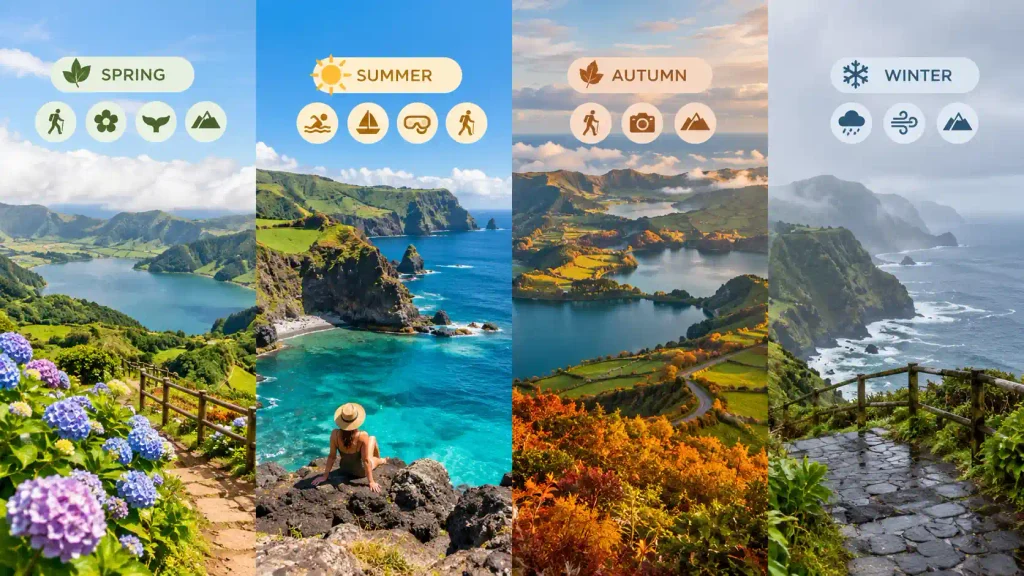
The Azores can be visited year-round, but late spring through early autumn generally provides the broadest range of outdoor opportunities, while individual activities and wildlife experiences have their own seasonal patterns.
Weather in the archipelago is famously changeable.
Sun, cloud, wind, fog, and rain can all appear within a relatively short period.
Spring
Good for:
- Hiking
- Green landscapes
- Flowers
- Whale watching
Conditions can still be variable.
Summer
Summer generally offers warmer conditions and is particularly popular for:
- Hiking
- Island-hopping
- Swimming
- Boat trips
- Diving
It is also a busier period.
Autumn
Early autumn can still provide excellent outdoor opportunities, but conditions become progressively less predictable.
Winter
Winter can work for travelers comfortable with rain, wind, and itinerary flexibility.
Some tourism services operate differently outside the peak season.
How Many Days Do You Need in the Azores?
Allow at least 5 to 7 days for one island, around 7 to 10 days for 2 islands, and roughly 2 weeks if you want to experience several islands without rushing.
A common planning mistake is assuming the islands are small enough to see quickly.
Distances may look short on a map, but volcanic roads, hiking, viewpoints, weather, flights, and ferries all consume time.
5 Days
Choose one island.
São Miguel is the obvious first-trip option.
7 to 10 Days
Choose 2 islands or combine several closely connected central islands.
2 Weeks
A multi-island itinerary becomes more practical.
You might combine:
São Miguel + Terceira + Pico/Faial
or concentrate entirely on the central island group.
Trying to visit all 9 islands in 2 weeks would create a transport-heavy trip.
Sample 7-Day São Miguel Itinerary
Day 1: Ponta Delgada
Settle in and walk around the city.
Use the first day gently, particularly after a long journey.
Day 2: Sete Cidades
Visit the crater viewpoints while weather conditions are favorable.
Continue through western São Miguel.
Day 3: Lagoa do Fogo and Ribeira Grande
Prioritize Lagoa do Fogo when visibility is clear.
Spend additional time around the island’s north coast.
Day 4: Furnas
Make this your geothermal day.
See Furnas Lake, volcanic areas, gardens, and thermal waters, and consider trying cozido.
Day 5: Nordeste
Drive through eastern São Miguel for coastal viewpoints, greenery, waterfalls, and quieter landscapes.
Day 6: Whale Watching
Book a responsible whale-watching trip.
Keep part of the day flexible in case ocean conditions affect departures.
Day 7: Flexible Weather Day
Use the final day for:
- A missed viewpoint
- Hiking
- Thermal bathing
- Ponta Delgada
- Beach time
- Food experiences
A weather-flex day is particularly valuable in the Azores.
Sample 10-Day Azores Island-Hopping Trip
A first multi-island itinerary could look like:
Days 1–5: São Miguel
Sete Cidades, Furnas, Lagoa do Fogo, Ponta Delgada, whale watching.
Days 6–8: Pico
Mount Pico, vineyard landscape, whale watching, coastal villages.
Days 9–10: Faial
Horta, Caldeira, Capelinhos.
This itinerary provides volcanic lakes, geothermal activity, mountains, wine culture, marine experiences, and historic towns without trying to cover the entire archipelago.
How Do You Travel Between the Azores Islands?
Inter-island travel depends heavily on geography.
The central islands are relatively well suited to combining sea connections, particularly places such as Faial and Pico, which sit close together.
For islands farther apart, flying can be more practical.
Schedules can vary seasonally.
When island-hopping:
- Allow buffer time.
- Avoid critical international connections immediately after a weather-sensitive transfer.
- Check current ferry schedules.
- Check inter-island flight schedules.
- Do not assume every island pair has a convenient direct connection.
The archipelago stretches across a substantial area of the Atlantic despite looking compact on many maps.
Do You Need a Rental Car in the Azores?

A rental car is highly useful on several Azores islands, particularly São Miguel, because many viewpoints, trailheads, lakes, and geothermal attractions are spread across rural areas.
It is not the only option.
Travelers can also use:
- Taxis
- Tours
- Private transfers
- Local buses
- Walking in towns
Rental cars provide the most flexibility for responding to weather.
If clouds cover western São Miguel, for example, a car makes it easier to change plans and head toward clearer conditions elsewhere.
Reserve early during busy travel periods.
What Should You Pack for the Azores?
Prepare for changeable Atlantic weather rather than packing only for the season shown on the calendar.
Useful items include:
- Waterproof jacket
- Comfortable walking shoes
- Hiking shoes when needed
- Layers
- Sun protection
- Swimwear
- Small daypack
- Reusable water bottle
- Quick-drying clothing
- Waterproof protection for electronics
For thermal pools, consider bringing older or dark-colored swimwear because mineral-rich water may discolor fabric.
Practical Tips for Visiting the Azores
A few habits make an Azores trip considerably easier:
- Check webcams before driving to mountain viewpoints.
- Keep at least one flexible day.
- Do not overbook island transfers.
- Check official trail conditions before hiking.
- Reserve rental cars early during busy periods.
- Carry waterproof clothing even on promising mornings.
- Choose responsible wildlife operators.
- Allow weather buffers before your flight home.
- Do not assume all 9 islands offer the same experience.
- Spend enough time on each island to enjoy it rather than simply collecting destinations.
The Azores are particularly rewarding when the itinerary leaves room to change.
Final Thoughts
The best Azores trip is not necessarily the one that covers the most islands. Choose islands according to the experiences you care about, then leave enough time for weather, hiking, viewpoints, and unplanned stops.
For a first visit, São Miguel offers the broadest introduction through Sete Cidades, Lagoa do Fogo, Furnas, thermal waters, whale watching, and Ponta Delgada. With additional time, Pico and Faial make an excellent central-island combination, while Terceira adds history, São Jorge provides outstanding fajã landscapes, and Flores rewards travelers willing to venture farther west.
Above all, keep the itinerary flexible. In an archipelago where clouds can hide a crater in the morning and reveal it a few hours later, changing your plans can sometimes produce the best day of the trip.
Frequently Asked Questions
The Azores are particularly known for volcanic landscapes, crater lakes, geothermal activity, whale watching, hiking, Mount Pico, waterfalls, dramatic coastlines, and green scenery.
São Miguel is a strong first choice because it combines Sete Cidades, Lagoa do Fogo, Furnas, geothermal bathing, hiking, whale watching, beaches, and Ponta Delgada on one island.
The archipelago consists of 9 main islands: São Miguel, Santa Maria, Terceira, Graciosa, São Jorge, Pico, Faial, Flores, and Corvo.
Beauty is subjective. São Miguel offers particularly varied scenery, Flores is famous for waterfalls and lush landscapes, Pico is dominated by its mountain and volcanic vineyards, and São Jorge is distinguished by steep cliffs and fajãs.
Yes. Whale and dolphin watching is one of the archipelago’s established tourism activities, with operators available on several islands. Sightings and species vary by season and conditions.
Yes, but climbing Portugal’s highest mountain is a demanding activity rather than an ordinary sightseeing walk. Check current mountain access, registration requirements, weather, equipment recommendations, and visitor regulations before attempting the ascent.
Costs depend heavily on season, island, accommodation, rental-car availability, and activities. Island-hopping can add considerably to the budget because of additional flights or ferry travel.
Yes. Crater viewpoints, scenic drives, geothermal pools, towns, whale watching, gardens, food, vineyards, and coastal attractions provide plenty to do without long hikes.
A car is not mandatory, but it is very useful for reaching dispersed attractions and adjusting plans when weather changes. Tours and transfers are alternatives.
Yes. The Azores are an autonomous region of Portugal located in the North Atlantic Ocean.
Yes. Families can enjoy viewpoints, short walks, geothermal attractions, whale watching, swimming, towns, and nature experiences. Choose hikes and marine activities according to children’s ages and abilities.
Yes, but concentrate on one island or a carefully chosen combination. One week on São Miguel provides a much more relaxed experience than attempting to visit several distant islands.