
Australia and New Zealand Trip: Questions to Ask First
You can combine Australia and New Zealand in one trip, but the best itinerary depends on how much time you have, when you travel, and which experiences matter most to you. Both countries offer far more than a single holiday can cover. Adding too many stops may leave you spending more time in airports and on roads than at the places you came to see.
A useful way to plan is to choose your priorities first, then build a route around them. Do you want Australian cities and beaches followed by New Zealand’s mountains? Are wildlife and hiking more important than seeing several famous landmarks? The eight questions below will help you decide where to go, how to divide your time, and whether visiting both countries on this trip is the right choice.
1. How Much Time Do You Have?
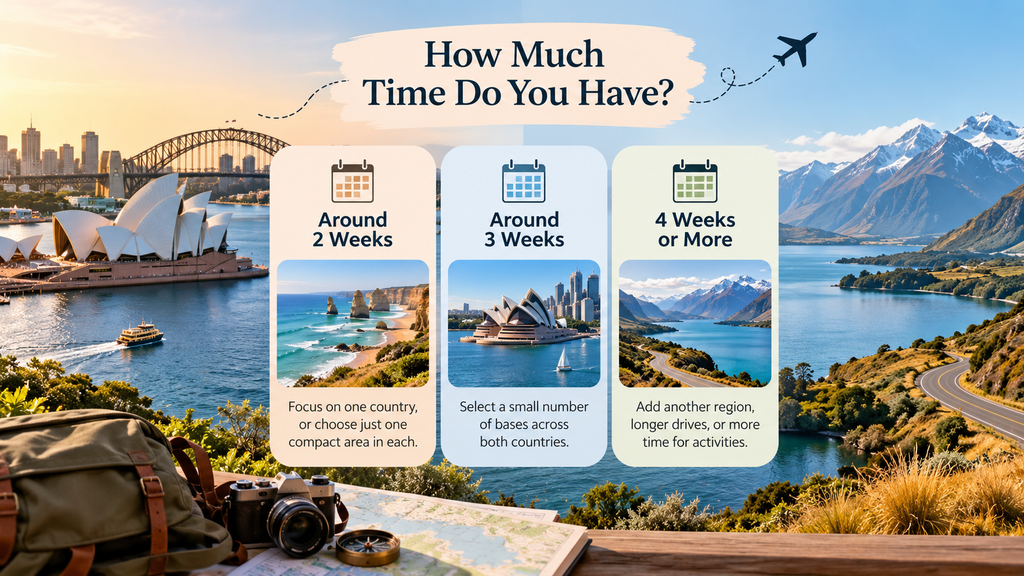
Three weeks is a useful starting point for a trip that includes a few carefully chosen places in each country. With less time, consider focusing on one country or limiting the combined itinerary to one region in each. The original planning guide also recommends allowing at least three weeks; the practical reason is the number of long flights and transfers involved.
For example, a three-week trip could pair Sydney and one other Australian region with Auckland and part of New Zealand’s North Island. If a South Island road trip is your main goal, give it enough days to enjoy stops along the way instead of treating every town as an overnight transit point.
| Time available | A practical approach |
| Around two weeks | Focus on one country, or choose just one compact area in each |
| Around three weeks | Select a small number of bases across both countries |
| Four weeks or more | Add another region, longer drives, or more time for activities |
These are planning guides, not fixed rules. The time you need depends on your pace and the places you choose.
2. What Time of Year Will You Travel?
Your dates should shape your route. New Zealand’s summer runs from December to February, making it popular for outdoor travel. During the same period, Australia’s tropical north is in its wet season, with heavier rain and the possibility of tropical storms. Australia’s official tropical cyclone season runs from November through April. Conditions vary considerably by region and year, so a summer visit to Sydney is a different proposition from a summer visit to tropical northern Australia.
Ask what you want to do in each country. If a warm-weather New Zealand road trip is the priority, plan around its summer and choose your Australian stops accordingly. If you want to visit Australia’s tropical north in its drier months, remember that June through August is winter in New Zealand—a good fit for snow sports, but a different experience from a summer hiking holiday.
3. Which Experiences Matter Most?
Write down your top three experiences in each country before looking at flights. This keeps the itinerary focused on what you want to do, rather than on how many destinations you can fit into it. Your list might include:
- Australia: Sydney’s harbor, reef activities, wildlife encounters, the Outback, or a coastal drive.
- New Zealand: geothermal areas, Māori cultural experiences, alpine scenery, hiking, or a South Island road trip.
Then look for variety. If you are already planning several coastal days in Australia, you might use your New Zealand time for mountains and geothermal landscapes. If your main interest is wildlife, choose stops and guided experiences that serve that interest in both countries. The aim is to give each destination enough time to be memorable.
4. How Many Flights and Long Drives Are You Comfortable With?
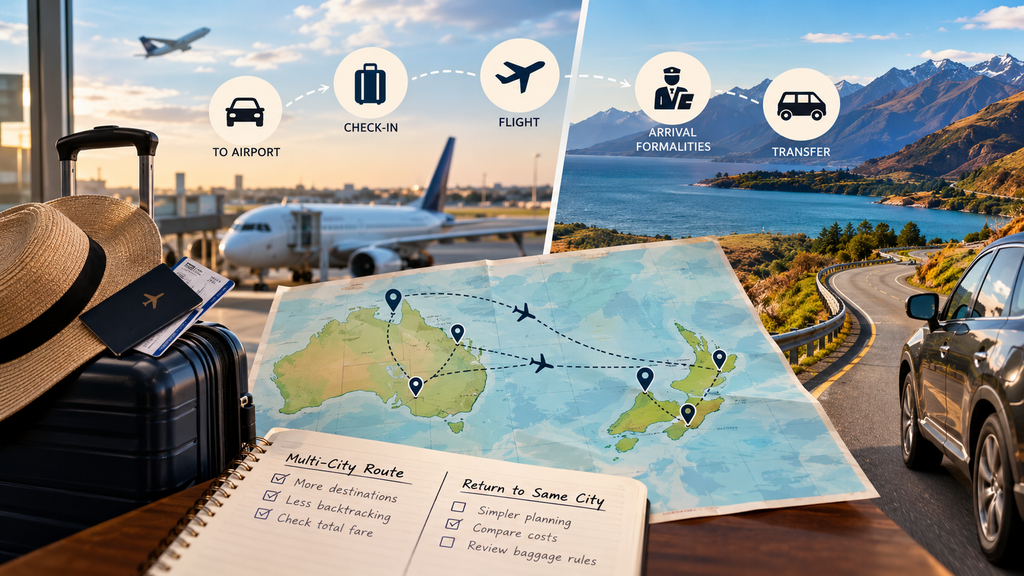
A route can look simple on a map and still involve a demanding travel day. For every proposed stop, count the journey to the airport, check-in, the flight, arrival formalities where applicable, and the transfer to your accommodation. A domestic flight or border crossing can use much more of a day than its scheduled flying time suggests.
There are several air links between the countries. For example, Air New Zealand lists nonstop services between Sydney and Auckland, Wellington, Christchurch, and Queenstown, though availability and frequency depend on the route and date. That gives you options beyond automatically pairing Sydney with Auckland.
Compare a multi-city itinerary with a return flight to the same city. Arriving in one place and departing from another can reduce backtracking, but check the total fare, baggage terms, and connection times before deciding. If you plan to drive, allow time for stops and changing weather rather than calculating each day solely from the map’s minimum driving estimate.
5. How Will You Split Your Time Between the Countries?
You do not need to divide the trip equally. Give more days to the country containing your most important experiences.
A traveler who wants a substantial New Zealand road trip may spend one week in Australia and two in New Zealand. Someone planning several Australian regions might reverse that split and choose one focused New Zealand stop. Either can work. What matters is whether the days remaining after travel are enough for the activities on your list.
Try writing the itinerary with every flight and transfer shown as its own entry. If you discover that you have only one full day in several destinations, remove a stop and use those days where they will make a difference.
6. What Is Your Total Budget?
Budget for the whole route, not just the international flights and hotels. Visiting both countries can add a flight between them, separate domestic flights, airport transfers, vehicle rentals, and activity costs.
The route itself affects spending. A short stay in several cities often means more transport costs, while a slower trip through fewer regions may give you more choice over accommodation and day-to-day activities. Compare two complete versions of your itinerary before booking: one with every destination on your wish list, and one with a stop removed. The simpler version may free up money for an experience you care about more.
7. Have You Checked Entry and Biosecurity Requirements for Both Countries?
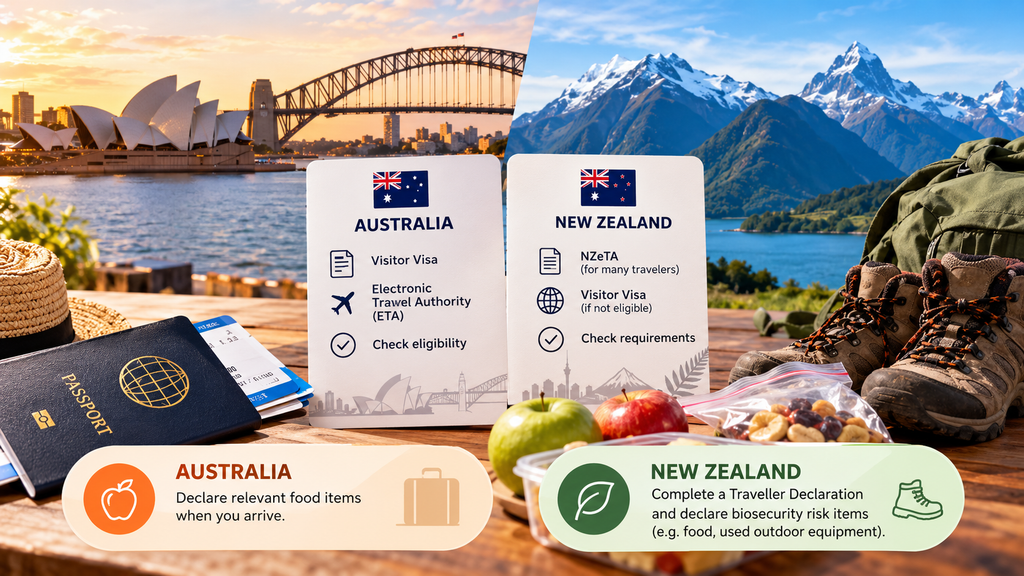
Check each country separately. Permission to visit Australia does not give you permission to enter New Zealand, and the correct visa or travel authority depends on your passport and circumstances. Australia offers different visitor options, including an Electronic Travel Authority for eligible passport holders. New Zealand requires many travelers from visa-waiver countries to obtain an NZeTA before travel; travelers who are not eligible may need a visitor visa. Verify the rules on both governments’ official sites before paying for nonrefundable arrangements.
Both countries also have strict rules for items brought across the border. Australia requires arriving air passengers to declare relevant food items. New Zealand requires a Traveller Declaration and the declaration of biosecurity risk items, which can include food and used outdoor equipment. Clean hiking shoes and check what you must declare before flying from one country to the other.
8. Would You Enjoy a Slower Trip More?
Before booking, read your itinerary as a sequence of actual days. How often will you pack? How many mornings begin with an early checkout? Do you have enough time in the places you most want to see?
If the schedule feels crowded, choose depth over another stop. Three nights in a region can give you a full day for its main attraction, time for a second interest, and some flexibility if weather changes. This is especially valuable when the trip includes outdoor activities. You can still experience the contrast between Australia and New Zealand without attempting to cover every landscape in either country.
An Example of a Focused Three-Week Route
One possible structure is:
- Australia, days 1–8: Spend several days in Sydney, then visit one additional Australian region that suits the season and your interests.
- Travel day: Fly to New Zealand and settle into your next base.
- New Zealand, days 10–20: Choose either a North Island route or a focused South Island trip, with several nights in key places.
- Departure day: Leave enough time for the journey home without relying on a tight final connection.
Treat this as a framework rather than a fixed route. Your dates, entry requirements, available flights, and preferred pace should determine the final order.
Conclusion
The strongest combined trip begins with a short list of priorities. Decide how many days you can travel, choose regions that suit the season, and count every flight and transfer before adding another stop. Once you have a workable route, confirm current flight schedules and the entry rules for both countries. You will have a better trip if your itinerary leaves enough time to enjoy the places that made you want to go.
Frequently Asked Questions
Sometimes, but compare the total trip cost before booking. A separately booked flight may have a lower fare, while a multi-city itinerary may offer better connections or baggage arrangements. Check baggage charges, airport transfers, and what happens if an earlier flight is delayed.
Only if you have enough time to enjoy them. If your combined holiday gives New Zealand about a week, focusing on one island usually makes more sense. With two weeks or more in New Zealand, you have more room to include both the North and South Islands without changing accommodation every night.
No. You must travel between the countries by air or sea. You can rent a vehicle within either country, but check the rental terms and plan a separate booking after crossing the border.
Allow a generous connection, especially when you must collect bags, pass through immigration and customs, and check in again. Separate tickets generally leave you responsible for making the next flight if the first one is delayed. The time needed depends on the airports, terminals, and entry requirements.
Pack for the specific regions and activities on your itinerary. A trip combining tropical Australia with New Zealand’s South Island may call for light clothing, rain protection, and warm layers. If you bring hiking shoes or outdoor gear into New Zealand, clean them thoroughly and declare any items required by its biosecurity rules.