
Azores Airlines Economy Class Review: Seats, Wi-Fi & Service
Azores Airlines offers economy-class service connecting Portugal’s Azores Islands with mainland Portugal, Madeira, other European destinations, Cabo Verde, and North American cities. Its economy product provides a straightforward short- and medium-haul experience, with comfort and amenities varying by aircraft.
The airline’s economy cabins generally feature 3-3 seating, personal-device entertainment, power outlets, and food and drinks available for purchase. However, there are no seatback entertainment screens, and Wi-Fi is available only on select aircraft. The aircraft itself can make a noticeable difference, with newer A321neo cabins offering a more modern environment than older A320 aircraft.
Azores Airlines at a Glance
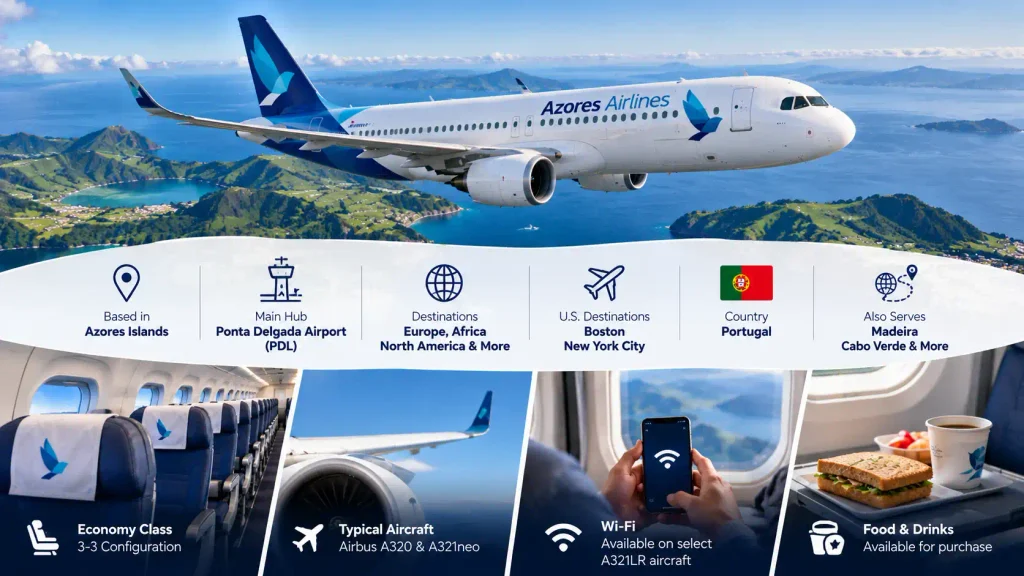
Azores Airlines is a Portuguese airline based in the Azores Islands. Its principal hub is John Paul II Ponta Delgada Airport (PDL) on São Miguel Island. From this hub, the carrier connects the Azores with other islands in the archipelago, mainland Portugal, and international destinations.
The airline serves Madeira, Cabo Verde, Spain, France, Germany, and destinations in the United States and Canada. In the U.S., the source identifies Boston and New York City as destinations for Azores Airlines.
| Feature | Details |
| Airline | Azores Airlines |
| Country | Portugal |
| Base | Azores Islands |
| Main hub | John Paul II Ponta Delgada Airport |
| Main hub code | PDL |
| U.S. destinations | Boston and New York City |
| Cabin reviewed | Economy |
| Typical aircraft reviewed | Airbus A320 and A321neo |
| Seat configuration | 3-3 |
| Seatback screens | Not available |
| Wi-Fi | Available on select A321LR aircraft |
| Inflight food | Available for purchase |
| Inflight drinks | Available for purchase |
Explore This Blog: Azores: Top Places to Visit and Things to Do for All
Where Does Azores Airlines Fly?
Azores Airlines’ network is centered on the Azores but extends well beyond the Portuguese archipelago. From its Ponta Delgada hub, the airline flies to other Azorean islands and mainland Portugal.
Its broader international network includes Madeira, Cabo Verde, Spain, France, and Germany. The airline also provides transatlantic connectivity to the United States and Canada.
The source specifically identifies Boston (BOS) and New York City (JFK) as the airline’s U.S. destinations. This gives Azores Airlines a useful role for travelers connecting the Azores and Portugal with the northeastern United States.
The airline’s geographic position also makes it relevant for travel between Portugal and Atlantic island destinations. Routes linking Ponta Delgada with Madeira and mainland Portugal complement its longer international services.
For travelers evaluating Azores Airlines, the route network is therefore one of its most important considerations. The airline offers nonstop flights between destinations that would otherwise require connections through larger European hubs.
Also Worth Reading: Priceline in 2026: The Complete Guide to Booking Flights, Hotels, Cars & More
Azores Airlines Economy Class
Azores Airlines’ economy cabin is a straightforward standard economy product. The source highlights several consistent characteristics across the reviewed aircraft: 3-3 seating, personal-device entertainment, power outlets, no seatback screens, and food and beverages available for purchase.
The cabin experience varies according to aircraft age and configuration. The Airbus A320 used on the Lisbon-Ponta Delgada route featured an older-looking interior with dark blue leather seats showing visible wear. By comparison, the Airbus A321neo operating between Ponta Delgada and Funchal had a noticeably newer cabin, with modern-looking dark blue fabric seats.
This distinction matters because Azores Airlines does not provide a fully uniform cabin experience across its fleet.
Economy seating on both aircraft measured about 18 inches wide. Pitch was approximately 30 inches on the A320 and 30.5 inches on the A321neo.
The half-inch difference between the two aircraft is minimal, meaning the newer A321neo’s advantage comes more from cabin condition and construction than from a substantial increase in legroom.
Azores Airlines A320 Economy Seats
The source describes the Airbus A320 configuration as having 168 economy seats in a 3-3 layout. This aircraft configuration has no business-class cabin.
The seats use dark blue leather upholstery. The source describes the seats as dated, with faded material and visible wear.
Seat width is about 18 inches, and pitch is about 30 inches. The pitch offers a standard narrow-body economy configuration, though taller travelers may find the space limited.
Each seat includes a latch-operated tray table. The tray table is sturdy enough for a personal laptop and provides a practical surface for work or using a personal device.
Overall, the A320 offers a conventional economy cabin without premium features. Its main limitation is its older appearance and modest seat pitch, not a lack of basic functionality.
Azores Airlines A321neo Economy Seats
The Airbus A321neo provides a more modern economy cabin than the A320. The configuration contains 170 economy seats and 16 business-class seats, with economy arranged in a 3-3 layout. The cabin uses dark blue fabric seats with a newer construction and less visible wear.
Economy seats are approximately 18 inches wide and provide 30.5 inches of pitch.
Although the A321neo offers slightly more pitch than the A320, the difference is only half an inch and doesn’t add much personal space. The newer aircraft nevertheless offers a more contemporary cabin environment.
Tray tables are also available and are sturdy enough to accommodate a 14-inch laptop.
For travelers choosing between aircraft, the A321neo may offer a more appealing cabin experience mainly because of its newer interior rather than a significant difference in seat dimensions.
Azores Airlines Seat Comfort
Seat comfort on Azores Airlines depends substantially on aircraft type.
Both the A320 and A321neo economy seats measure about 18 inches wide, a standard width for a narrow-body economy seat. Pitch is approximately 30 inches on the A320 and 30.5 inches on the A321neo.
The modest legroom suits travelers who want straightforward transportation rather than a particularly spacious cabin.
The A320’s older leather seats can also affect the overall perception of comfort. The A321neo’s newer fabric seats provide a fresher cabin environment.
Tray tables are one of the stronger practical features highlighted in the source. They are sturdy and large enough to support a personal laptop, making them useful for passengers who want to work or use a larger personal device during the flight.
Inflight Entertainment
Azores Airlines does not provide seatback entertainment screens on its aircraft.
Instead, passengers can use their own phones, tablets, or laptops to access entertainment through the aircraft’s entertainment network when available.
The system lets passengers stream movies and TV programs to their personal devices after connecting to the onboard entertainment network.
This approach eliminates the need for built-in screens while still providing access to entertainment content. Passengers should therefore bring a charged personal device if they want to use the available entertainment system.
Without seatback screens, the entertainment experience depends partly on the passenger’s own device.
Power Outlets
Power outlets are available at the seats, letting passengers keep personal electronics charged during the flight.
This is particularly useful because the airline relies on personal devices for entertainment rather than seatback screens.
Passengers can therefore use their own smartphones, tablets, or laptops for entertainment while using the available power connection to extend battery life.
The combination of power outlets and personal-device entertainment gives the economy cabin some practical functionality despite its relatively simple entertainment setup.
Wi-Fi Availability
Wi-Fi was not available on the flights described in the source. However, the airline does offer Wi-Fi on select Airbus A321LR aircraft.
This means you cannot assume onboard connectivity on every Azores Airlines flight.
Passengers who need internet access should check aircraft and service availability before departure rather than expecting Wi-Fi as a standard feature across the fleet.
The distinction between the airline’s entertainment network and internet connectivity is also important. The aircraft’s entertainment system can offer personal-device streaming even when internet access is unavailable.
Food and Drinks
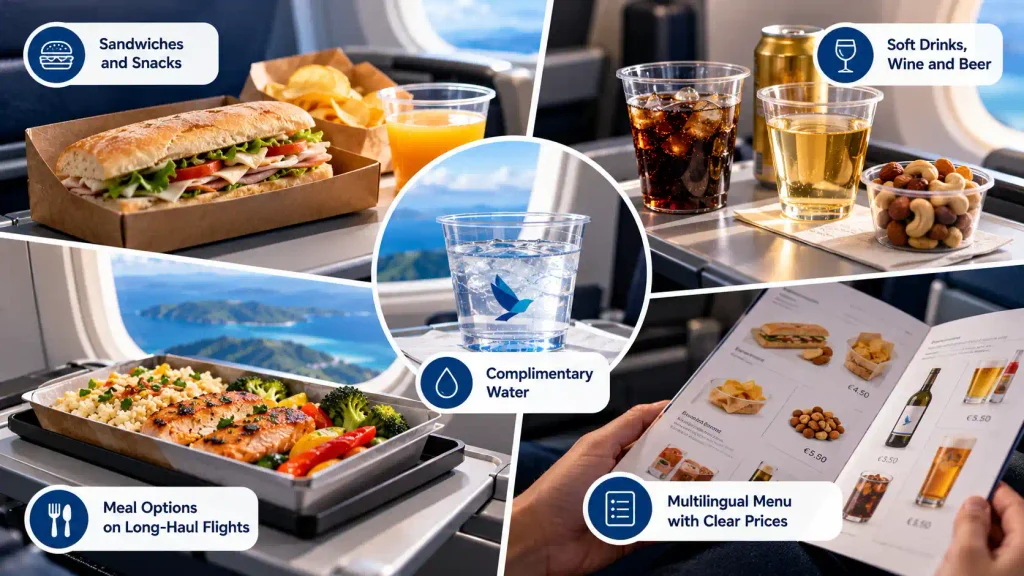
Azores Airlines operates a buy-on-board model for food and beverages in economy on the flights described in the source.
The menu provides several choices, including soft drinks, wine, beer, chips, nuts, sandwiches, and other snacks. The menu clearly displays prices.
The airline also lists more substantial meal options for its long-haul services to the United States and Canada.
A multilingual menu makes it easier for international passengers to review the available selections.
The airline provides complimentary water during flights, while other food and drink items are available for purchase.
Passengers planning to eat on shorter flights should therefore be prepared to purchase food onboard rather than expecting a complimentary snack or meal.
Read This Blog: Air France Lounge at LAX: Location, Access, Food and Amenities
Lavatories
The source described the aircraft lavatories as clean and well stocked during the flights covered.
Flight attendants also inspected the lavatories during the flights to help maintain their condition.
This attention to cabin facilities contributes to the overall onboard experience, particularly on flights where passengers may need to use the facilities during the journey.
Although the source does not provide detailed information on lavatory dimensions or specific amenities, it notes cleanliness and regular inspection as notable aspects of the service.
Check-In Experience
Azores Airlines offers several check-in options, including airport check-in and online check-in.
The source indicates that check-in times can vary by airport. At Lisbon, airport check-in opens approximately 2 hours before departure, while the Ponta Delgada-Funchal service opens approximately 3 hours before departure.
Ponta Delgada Airport also provides self-service kiosks, giving passengers another airport check-in option.
The airline offers online check-in through its website or mobile app starting 48 hours before departure. However, passengers traveling to or from the United States must still visit the airport counter to present travel documents to an employee.
At the airports described in the source, priority lines were available for passengers with disabilities and pregnant travelers.
Ponta Delgada uses destination-specific check-in lines, with airport displays identifying the appropriate queue. A dedicated line is also available for passengers traveling between islands.
Boarding Process
Boarding procedures can differ by airport. At Lisbon, the boarding area may have limited seating and a zig-zag queue. This can make the process feel less organized.
At Ponta Delgada, boarding is handled differently. Passengers may walk across the tarmac to the aircraft and use either the front or rear stairs depending on their assigned row.
The source describes Ponta Delgada’s boarding process as more organized, particularly in the way boarding groups are called and enforced.
This difference shows how the airport environment can shape the ground experience, regardless of the airline.
Airport Ground Service
Azores Airlines’ airport service is centered on efficient processing, with customer interaction varying by employee and stage of the journey.
Check-in staff provide flight information and explain airport procedures. At Ponta Delgada, separate destination-based queues help organize passengers, particularly at the airline’s main hub.
Gate agents focus primarily on boarding, with customary greetings and thanks as part of the interaction.
Passengers should therefore expect a functional ground-service experience rather than an extensively personalized one.
Flight Attendant Service
Flight attendants are a stronger element of the onboard service described in the source.
Cabin crew greet passengers during boarding, remain available throughout the flight, and assist with routine requests. They also inspect the lavatories during flights and thank passengers as they leave the aircraft.
The source describes the cabin crew as friendly and helpful, making them one of the more positive elements of the economy experience.
This contrasts somewhat with the more process-focused nature of the airport ground staff.
Overall, the service model appears practical and professional, with the strongest emphasis on cabin-crew interaction once passengers are onboard.
Azores Airlines Economy: Main Advantages
Azores Airlines’ economy product has several practical advantages for travelers using its network.
Convenient Atlantic Connectivity
The airline provides nonstop connections between the Azores, Portugal, Madeira, and selected destinations in Europe and North America.
Personal-Device Entertainment
Although there are no seatback screens, passengers can stream available entertainment content to their own devices through the aircraft’s entertainment network.
Power at the Seat
Seat power outlets allow passengers to keep personal electronics charged during the flight.
Practical Tray Tables
The tray tables are sturdy and can accommodate a personal laptop, making them useful for passengers who need to work or use larger devices.
Friendly Cabin Crew
The source highlights flight attendants as a strong part of the overall service, with helpful interactions and attention to cabin cleanliness.
Clear Onboard Pricing
Food and beverage prices are clearly displayed on the multilingual menu, so passengers can understand the cost of available purchases before ordering.
Things to Consider Before Flying Azores Airlines
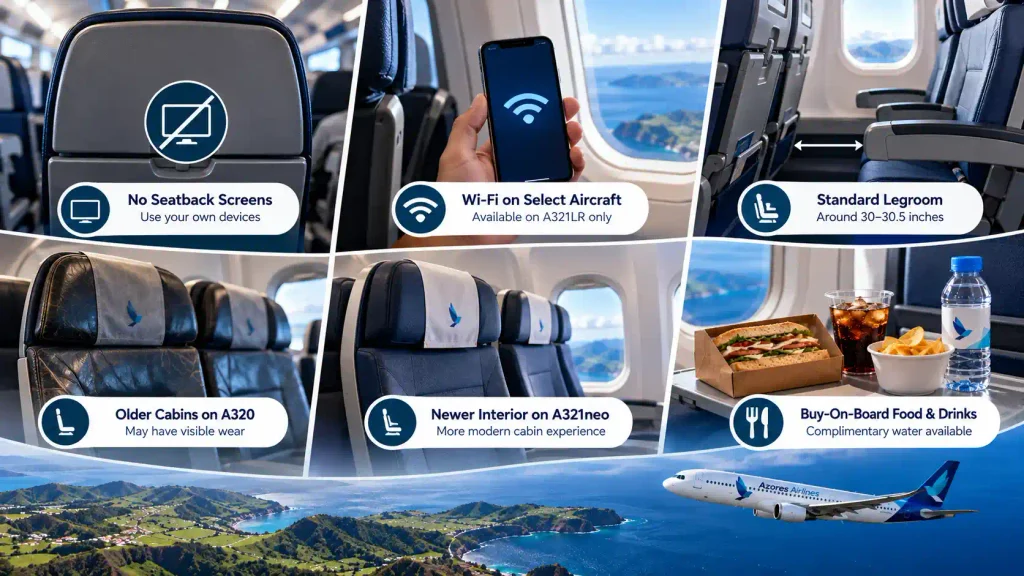
The economy product has several limitations that travelers should consider before booking.
First, it lacks seatback entertainment screens. Passengers who prefer built-in entertainment will need to rely on their own devices.
Wi-Fi is also not universally available. It is limited to select A321LR aircraft, so travelers shouldn’t assume an Azores Airlines flight will offer internet access.
Seat pitch is another consideration. The A320 offers about 30 inches of pitch, while the A321neo offers about 30.5 inches. The difference is small, and neither configuration is designed around generous legroom.
The aircraft’s age can also influence the cabin experience. The A320 reviewed in the source had visibly worn leather seats, while the A321neo offered a considerably newer interior.
Finally, economy passengers should expect to purchase most food and beverages onboard. Complimentary water is available, but snacks, drinks, and meals are generally sold separately.
Azores Airlines Economy: Who Is It Best For?
Azores Airlines can be a practical choice for travelers who value nonstop connections involving the Azores, mainland Portugal, Madeira, and the airline’s North American destinations.
It’s especially suited to passengers whose itinerary fits the airline’s direct network and who prioritize convenient routing over a premium onboard experience.
The economy product is relatively simple, making it suitable for travelers comfortable bringing their own entertainment devices and buying food and beverages as needed.
Passengers who require generous legroom, built-in entertainment, or guaranteed internet connectivity may find the product less suitable.
Aircraft selection can also matter. Travelers with a choice of flights should consider the aircraft type, as the newer A321neo offers a more modern cabin than the older A320.
Overall Azores Airlines Economy Review
Azores Airlines provides a straightforward economy-class experience focused primarily on transportation and network connectivity rather than extensive onboard amenities.
Its biggest advantage is its route network. From its Ponta Delgada hub, the airline connects the Azores with mainland Portugal, Madeira, several European destinations, Cabo Verde, and North America. Boston and New York City are its two identified U.S. destinations.
The economy cabin itself is functional but relatively basic. Seats are arranged in a 3-3 configuration, with approximately 18 inches of width and around 30 to 30.5 inches of pitch on the A320 and A321neo aircraft described in the source.
The newer A321neo provides a more modern cabin environment, while the A320 has an older interior and visibly worn leather seats.
Entertainment is based on passengers’ personal devices rather than seatback screens. Power outlets are available, and an onboard entertainment network lets you stream selected content. Wi-Fi, however, is limited to select A321LR aircraft.
You can buy food and beverages, from snacks and sandwiches to soft drinks, wine, and beer. Complimentary water is also provided.
Ground operations are generally functional, with online check-in, digital boarding passes, airport counters, and self-service kiosks at Ponta Delgada. Boarding procedures vary by airport, and the cabin crew provides friendly, helpful service.
Overall, Azores Airlines offers a practical economy product for travelers who value nonstop Atlantic connectivity and are comfortable with a relatively simple onboard experience. The main factors to consider are aircraft age, limited seat pitch, no seatback screens, limited Wi-Fi availability, and the buy-on-board food model.
You May Also Like: Best Things to Do in Cape Town for an Unforgettable Trip
Final Verdict
Azores Airlines delivers a functional economy product built around direct connectivity between the Azores, Portugal, Europe, and North America. Its cabins are relatively simple, with no seatback screens, limited Wi-Fi availability, modest seat pitch, and food and drinks generally sold separately.
The newer A321neo offers a more modern cabin than the older A320, while both aircraft provide power outlets and personal-device entertainment. Flight attendants are a notable strength, with the source highlighting friendly, helpful cabin service.
For travelers who prioritize convenient nonstop access to the Azores and surrounding destinations, Azores Airlines can be a practical choice. Those seeking a more amenity-rich economy experience should factor in limited connectivity, no seatback screens, and buy-on-board catering before choosing the airline.
Frequently Asked Questions
Azores Airlines is a Portuguese carrier connecting the Azores archipelago with mainland Portugal, Madeira, Europe, Cabo Verde, and destinations in North America.
The source identifies Boston (BOS) and New York City (JFK) as Azores Airlines’ U.S. destinations.
No. The airline does not offer seatback entertainment screens. Passengers can instead use personal devices to stream content through the aircraft’s entertainment network.
Wi-Fi is available on select A321LR aircraft. It is not available throughout the entire fleet.
Economy passengers generally need to purchase food and drinks. Available options include snacks, sandwiches, soft drinks, wine, and beer. Complimentary water is provided.
Economy seats generally use a 3-3 configuration. The A320 has approximately 30 inches of pitch and 18-inch-wide seats, while the A321neo has approximately 30.5 inches of pitch and 18-inch-wide seats.
The A321neo configuration described in the source has 16 business-class seats, while the A320 configuration described has no business-class cabin.
Yes. Passengers can check in online through the airline’s website or mobile app starting 48 hours before departure. For U.S.-related flights, passengers must present travel documents at the airport counter.
Yes. The seats described in the source have power outlets for passengers’ personal electronic devices.
Azores Airlines can be a practical option for travelers seeking nonstop connections involving the Azores, particularly when the airline’s direct network matches the itinerary. The economy product is relatively simple, so travelers should consider the aircraft, seat space, entertainment, Wi-Fi, and food options before booking.