
Which Airlines Have Starlink Wi-Fi? Complete 2026 Guide
Airlines currently offering Starlink Wi-Fi include airBaltic, Air France, Alaska Airlines, British Airways, Copa Airlines, Emirates, Hawaiian Airlines, Iberia, JSX, Qatar Airways, SAS, Southwest Airlines, United Airlines, Virgin Atlantic, WestJet, and ZIPAIR. Availability varies by aircraft because several airlines are still installing the system across their fleets.
Starlink has rapidly expanded as airlines look for faster and more reliable in-flight connectivity. Unlike traditional satellite systems, Starlink uses a network of satellites in low Earth orbit, allowing connected aircraft to provide internet access over remote regions and oceans.
Most participating airlines currently offer Starlink at no additional charge, although some require membership in a loyalty program. Copa Airlines uses a different model, providing complimentary access to eligible passengers while charging others.
Airlines Offering Starlink Wi-Fi in 2026
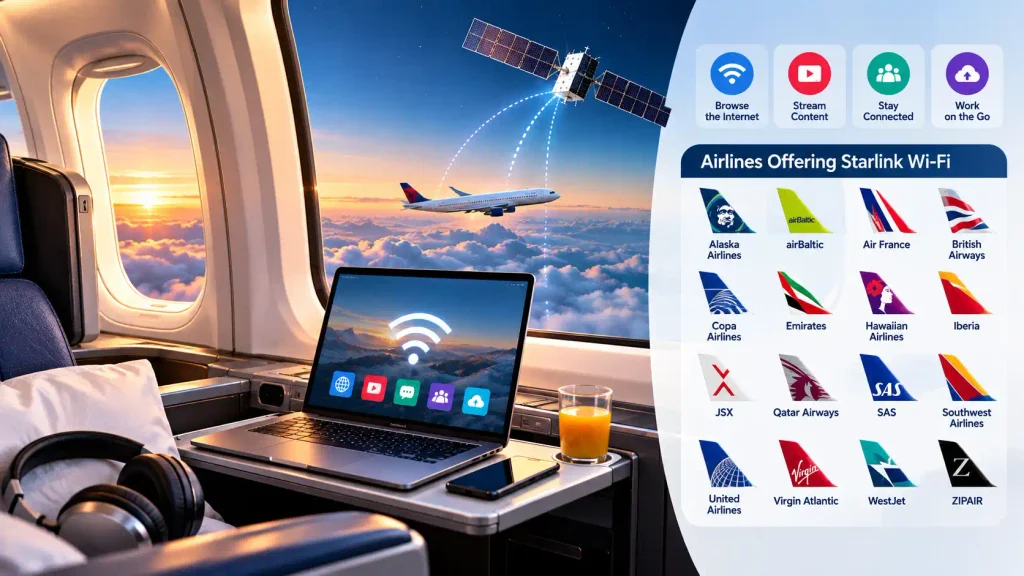
| Airline | Starlink Status | Access |
| airBaltic | Available | Free |
| Air France | Available | Flying Blue membership |
| Alaska Airlines | Rolling out | Atmos Rewards membership |
| British Airways | Rolling out | Free |
| Copa Airlines | Rolling out | Free for eligible passengers; paid for others |
| Emirates | Rolling out | Free |
| Hawaiian Airlines | Available on eligible fleet | Free |
| Iberia | Rolling out | Free |
| JSX | Available | Free |
| Qatar Airways | Available/rolling out | Free |
| SAS | Rolling out | EuroBonus membership |
| Southwest Airlines | Rolling out | Rapid Rewards membership |
| United Airlines | Rolling out | MileagePlus membership |
| Virgin Atlantic | Rolling out | Free |
| WestJet | Rolling out | WestJet Rewards membership |
| ZIPAIR | Available | Free |
Several other carriers have announced future installations, including airlines within Lufthansa Group, Singapore Airlines, Korean Air and related Hanjin Group carriers, Frontier Airlines, LEVEL, and Vueling.
What Is Starlink Wi-Fi?
Starlink is a satellite internet network operated by SpaceX that provides high-speed connectivity to homes, businesses, ships, aircraft, and other users.
For aviation, aircraft communicate with Starlink’s constellation of low-Earth-orbit satellites through specialized onboard equipment.
The low altitude of these satellites can help reduce latency compared with traditional satellite systems positioned much farther from Earth.
Starlink also uses optical space lasers across its satellite constellation, which can help provide connectivity over oceans, polar areas, and locations far from conventional ground stations.
Starlink states that its aviation technology has already provided connectivity on more than 200,000 flights worldwide.
Why Are Airlines Installing Starlink?
Reliable inflight internet has historically been difficult to provide consistently.
Conventional aircraft Wi-Fi can suffer from:
- Slow download speeds
- High latency
- Coverage gaps
- Limited bandwidth
- Difficulty streaming video
- Poor connectivity over oceans
Starlink’s low-Earth-orbit network is designed to address many of these limitations.
The technology can support internet-intensive activities such as:
- Video streaming
- Messaging
- Web browsing
- Cloud-based work
- Social media
- Video calls where airline policies permit them
- Online gaming
Actual performance can still vary according to the aircraft, location, network demand, and airline restrictions.
Is Starlink Wi-Fi Free on Airlines?
Starlink Wi-Fi is complimentary on many participating airlines, but the access rules are not identical.
Some carriers make the connection free to everyone.
Others require passengers to sign into a free loyalty-program account.
A smaller number use paid or mixed-access models.
Airlines Offering Free Starlink Without Membership
The September 2026 reference identifies carriers offering complimentary access without requiring loyalty membership, including:
- airBaltic
- British Airways
- Emirates
- Hawaiian Airlines
- Iberia
- JSX
- Qatar Airways
- Virgin Atlantic
- ZIPAIR
Availability remains dependent on whether the scheduled aircraft has been equipped with Starlink.
Airlines Requiring Loyalty Membership
Several airlines provide complimentary Starlink after passengers sign in to their loyalty accounts.
Current examples include:
| Airline | Membership Required |
| Air France | Flying Blue |
| Alaska Airlines | Atmos Rewards |
| SAS | EuroBonus |
| Southwest Airlines | Rapid Rewards |
| United Airlines | MileagePlus |
| WestJet | WestJet Rewards |
These loyalty programs can generally be joined without a standard membership fee, but individual terms apply.
1. AirBaltic Starlink Wi-Fi
airBaltic provides complimentary Starlink Wi-Fi without requiring loyalty-program membership.
The Latvian carrier became the first European airline to equip its entire fleet with Starlink.
Its fleet consists of Airbus A220 aircraft, meaning Starlink availability is significantly more predictable than on airlines that are still completing installations.
This fleetwide deployment removes much of the uncertainty associated with checking whether a particular aircraft has the new connectivity system.
2. Air France Starlink Wi-Fi
Air France has been progressively installing Starlink across its fleet.
Passengers receive complimentary high-speed connectivity after signing into a Flying Blue account.
Starlink has appeared on aircraft including:
- Embraer regional aircraft
- Airbus A220
- Airbus A350
Aircraft that have not yet received Starlink can continue to use Air France’s previous inflight connectivity systems.
Therefore, the aircraft assigned to the flight remains important.
3. Alaska Airlines Starlink Wi-Fi
Alaska Airlines is rolling out Starlink across its fleet, with complimentary access linked to Atmos Rewards membership.
Starlink-equipped Boeing 737 MAX aircraft have already entered service.
Alaska plans to extend Starlink to additional aircraft, including Boeing 787 Dreamliners supporting its growing international network.
The reference lists the end of 2027 as the target for completing the rollout.
Because installation remains underway, not every Alaska Airlines flight currently has Starlink.
Explore This Guide: Alaska and Hawaiian Unveil New Premium Cabins and Lounges
4. British Airways Starlink Wi-Fi
British Airways began operating passenger flights with Starlink in March 2026.
Its Boeing 787-8 Dreamliner subfleet was the first to receive the technology.
Starlink access is complimentary and does not currently require a loyalty membership.
British Airways intends to expand the system substantially across its fleet, with the reference listing the end of 2028 as the target for completing the rollout across more than 300 aircraft.
BA CityFlyer aircraft are not included in the current rollout plan.
5. Copa Airlines Starlink Wi-Fi
Copa Airlines launched Starlink-equipped passenger flights in July 2026, becoming the first Latin American airline identified by the reference as operating the technology.
Its access model differs from most Starlink airlines.
Complimentary connectivity is currently available to eligible:
- Business class passengers
- ConnectMiles Gold members
- ConnectMiles Platinum members
- ConnectMiles Presidential members
- Eligible Starlink Residential and Roam subscribers
Other passengers can purchase access.
Copa therefore represents an important exception to the widespread free-Starlink model.
Its rollout is expected to be completed in early 2027.
Related to this: Copa Airlines Economy Review: Comfort & Onboard Service
6. Emirates Starlink Wi-Fi
Emirates is progressively installing complimentary Starlink Wi-Fi across its fleet.
By the time of the reference update, Starlink-equipped Boeing 777 aircraft were already operating, and the airline’s first Starlink-equipped Airbus A380 had entered service in April 2026.
Emirates intends to continue installations through mid-2027.
Its newer Airbus A350 aircraft initially use Viasat connectivity, although Emirates also plans to introduce Starlink to that fleet.
As a result, connectivity technology can still differ by Emirates aircraft.
Related to this: Emirates A350 U.S. Debut: What Travelers Should Know
7. Hawaiian Airlines Starlink Wi-Fi
Hawaiian Airlines was an early adopter of Starlink among scheduled North American carriers.
Its Airbus A321neo and Airbus A330 aircraft are equipped with complimentary Starlink connectivity.
The service is particularly useful on longer flights between Hawaii and the continental U.S. or international destinations because satellite connectivity can operate across oceanic regions.
However, Hawaiian does not plan to provide Starlink on its interisland fleet under the current rollout structure.
8. Iberia Starlink Wi-Fi
Iberia operated its first Starlink-equipped passenger flight on June 23, 2026, flying from Madrid to São Paulo.
The initial aircraft was an Airbus A330-300.
Iberia provides Starlink connectivity free of charge without requiring a loyalty-program membership.
The airline expects approximately 35% of its fleet to have Starlink by the end of 2026, according to the reference.
Therefore, availability remains aircraft-dependent during the rollout.
9. JSX Starlink Wi-Fi
JSX was the first carrier identified by the reference to operate passenger aircraft equipped with Starlink.
Its Embraer 135 and Embraer 145 aircraft use Starlink, and the carrier has also installed the technology on its ATR fleet.
Access is complimentary without requiring a membership.
JSX demonstrates that Starlink aviation technology is not limited to large commercial wide-body aircraft.
10. Qatar Airways Starlink Wi-Fi
Qatar Airways became an early major international adopter of Starlink.
The airline provides the service free of charge on equipped aircraft without requiring loyalty-program membership.
Its rollout has focused primarily on aircraft including:
- Boeing 777
- Airbus A350
The reference notes that Qatar Airways has identified routes receiving Starlink-equipped aircraft, including its U.S. services.
Because installations have occurred progressively, aircraft assignment remains relevant when checking availability.
Also Worth Reading: Qatar Airways Avios Booking Rules Get More Flexible
11. SAS Starlink Wi-Fi
Scandinavian Airlines began operating Starlink-equipped Airbus A320 aircraft after testing the technology in early 2026.
Complimentary access requires SAS EuroBonus membership.
The carrier had not announced a firm date in the reference for installing Starlink across its wide-body aircraft.
Consequently, the service is more likely to appear on applicable narrow-body routes during the current phase of deployment.
12. Southwest Airlines Starlink Wi-Fi
Southwest Airlines began operating Starlink-equipped passenger flights in June 2026.
Complimentary access requires Rapid Rewards membership.
Southwest plans to equip more than 300 aircraft with Starlink by the end of 2026.
However, its fleet contains roughly 800 aircraft according to the reference, meaning Starlink is not yet expected on every Southwest flight.
Availability should become increasingly common as installations continue.
You May Also Like: Southwest Airlines International Routes & 15 Destinations
13. United Airlines Starlink Wi-Fi
United Airlines is undertaking one of the largest Starlink deployments among U.S. carriers.
Starlink is currently available on selected domestic flights, with complimentary access requiring MileagePlus membership.
United provides information through its app when an upcoming flight is scheduled to have Starlink.
This can make it easier to identify an equipped aircraft before boarding.
The airline has also expanded complimentary connectivity on some aircraft that do not yet have Starlink, so free Wi-Fi should not automatically be interpreted as Starlink service.
14. Virgin Atlantic Starlink Wi-Fi
Virgin Atlantic’s first Starlink-equipped Airbus A350 flew from London Heathrow to New York JFK on May 18, 2026.
The airline is providing complimentary Starlink without requiring loyalty membership.
Its rollout sequence includes:
- Airbus A350-1000
- Boeing 787-9
- Airbus A330neo
Virgin Atlantic expects fleetwide installation to be completed by the end of 2027.
15. WestJet Starlink Wi-Fi
WestJet became the first Canadian airline to begin Starlink installation in February 2025.
By the reference’s September 2026 update, more than 100 Boeing 737 aircraft had Starlink connectivity.
Complimentary access requires WestJet Rewards membership.
Starlink can therefore commonly appear on WestJet’s narrow-body routes, including flights between Canada and the U.S.
The Boeing 787 Dreamliner fleet is expected to complete installation by the end of 2026.
16. ZIPAIR Starlink Wi-Fi
ZIPAIR became the first Asian airline identified by the reference to operate a commercial Starlink-equipped flight, beginning service on February 25, 2026.
The Japanese low-cost carrier provides the connection free of charge.
ZIPAIR is a subsidiary of Japan Airlines and operates medium- and long-haul international flights.
Its adoption is notable because high-speed satellite connectivity is increasingly appearing on low-cost airlines rather than remaining exclusive to full-service premium carriers.
Airlines Adding Starlink Wi-Fi
Several carriers have announced Starlink plans but are at different stages of deployment.
| Airline/Group | Expected Starlink Development |
| Frontier Airlines | Expected in early 2027 |
| Korean Air | Planned rollout |
| Asiana Airlines | Planned rollout |
| Jin Air | Planned rollout |
| Air Busan | Planned rollout |
| Air Seoul | Planned rollout |
| LEVEL | Installation planned |
| Lufthansa Group | Fleetwide program underway/planned |
| Singapore Airlines | First service expected in 2027 |
| Vueling | Initial aircraft expected in rollout |
Because these schedules can change, an announced partnership should not be interpreted as confirmation that every flight already has Starlink.
Lufthansa Group Starlink Wi-Fi
Lufthansa Group announced a large-scale Starlink program covering multiple airlines.
The reference identifies participating carriers including:
- Lufthansa
- SWISS
- Austrian Airlines
- Brussels Airlines
- Eurowings
- ITA Airways
- Air Dolomiti
- Edelweiss
The rollout covers an extensive combined fleet and is scheduled to continue through 2029.
This represents one of Europe’s largest announced Starlink deployments.
Singapore Airlines Starlink Wi-Fi
Singapore Airlines has announced plans to introduce Starlink on selected long-haul aircraft.
The reference identifies:
- Long-range Airbus A350 aircraft
- Ultra-long-range Airbus A350 aircraft
- Airbus A380 aircraft
The first Starlink-equipped Singapore Airlines flight is expected in early 2027, with completion targeted before the end of 2029.
Under the announced access structure, Business Class, First Class, and eligible PPS Club members receive complimentary access, while Premium Economy and Economy passengers require KrisFlyer membership.
Therefore, Singapore Airlines should currently be classified as an announced future Starlink operator, rather than an airline already offering the service.
Korean Air and Hanjin Group Starlink
Korean Air and other Hanjin Group airlines have also announced Starlink deployment.
The reference includes:
- Korean Air
- Asiana Airlines
- Jin Air
- Air Busan
- Air Seoul
Initial installation is expected to prioritize long-haul aircraft such as the Airbus A350-900 and Boeing 777-300.
Jin Air’s Boeing 737-8 aircraft are expected to be among the first narrow-body aircraft within the group to receive Starlink.
Frontier Airlines Starlink Wi-Fi
Frontier Airlines plans to introduce Starlink beginning in early 2027, according to the reference.
The airline had not confirmed the passenger pricing structure in the September 2026 source.
Therefore, whether Frontier’s Starlink will be:
- Completely free
- Loyalty-based
- Fare-dependent
- Paid
remains unconfirmed by the reference.
How Fast Is Starlink Wi-Fi on a Plane?
Starlink is designed to provide broadband-like connectivity from aircraft, but a single universal passenger speed should not be assumed.
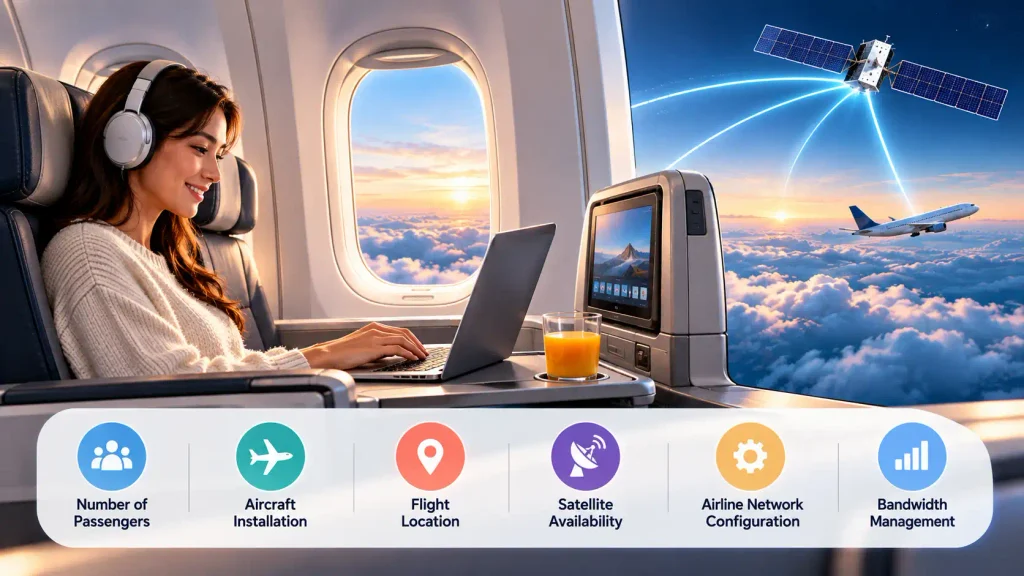
Actual performance can depend on:
- Number of connected passengers
- Aircraft installation
- Flight location
- Satellite availability
- Airline network configuration
- Bandwidth management
Starlink states that its aviation system is designed around high-speed, reliable connectivity with global coverage.
The reference reports very high real-world download speeds in some airline testing, but those results should not be interpreted as a guaranteed minimum for every passenger or flight.
Does Starlink Work Over the Ocean?
Yes. Starlink Aviation is designed to provide connectivity over oceanic areas.
Starlink’s optical laser mesh allows satellites to transmit data through the constellation, helping provide service in areas located far from terrestrial ground stations, including open oceans and polar regions.
This capability makes Starlink particularly relevant to airlines operating:
- Transatlantic flights
- Transpacific flights
- Remote international routes
- Polar routes
- Long overwater sectors
Coverage remains subject to regulatory and operational conditions.
Can Starlink Be Used From Takeoff to Landing?
Starlink markets its aviation product around connectivity from takeoff to landing, with worldwide flight coverage.
The exact point at which passengers may connect can still depend on the airline’s policies, aircraft configuration, and local regulatory requirements.
Passengers should therefore follow onboard instructions even when the aircraft has Starlink installed.
Does Starlink Support Streaming?
Starlink’s high-bandwidth architecture can support streaming services, making video streaming one of the most noticeable improvements over many older inflight internet systems.
However, an airline can impose its own restrictions.
Individual carriers may regulate:
- Streaming
- Voice calls
- Video calls
- Content
- Device use
- Audio playback
For example, the reference notes that United requires headphones when passengers consume audio content through its Starlink service.
Does Every Aircraft on a Starlink Airline Have It?
No.
This is one of the most important distinctions in the current rollout.
Some carriers, such as airBaltic and JSX, have broad or fleetwide installations on the applicable fleets described by the reference. Others are still equipping aircraft gradually.
An airline advertising Starlink therefore does not automatically mean every flight offers it.
The aircraft type and individual aircraft installation status can determine availability.
How to Check Whether a Flight Has Starlink
Several methods can help identify Starlink availability:
- Check the airline’s booking page.
- Review the aircraft details.
- Open the airline’s mobile app before departure.
- Check the Wi-Fi information during online check-in.
- Look for Starlink branding at boarding or onboard.
- Review the airline’s current fleet rollout information.
United, for example, advises passengers through its app when an upcoming flight is scheduled to feature Starlink.
Aircraft substitutions can still occur, so advance availability may not be guaranteed.
Starlink vs. Traditional Inflight Wi-Fi
| Feature | Starlink | Traditional Satellite Wi-Fi |
| Satellite orbit | Low Earth orbit | Often geostationary |
| Latency potential | Lower | Generally higher |
| Streaming capability | Strong | Varies |
| Ocean coverage | Supported | Depends on provider |
| Installation | Aircraft-specific | Aircraft-specific |
| Passenger cost | Often free | Free or paid |
| Availability | Rapidly expanding | Widely established |
The comparison is general because traditional inflight systems differ substantially among providers and generations.
Why Low-Earth-Orbit Satellites Matter
Traditional geostationary communications satellites operate much farther from Earth.
Starlink’s satellites orbit substantially closer.
The shorter distance can reduce the time required for data to travel between:
- Aircraft
- Satellite network
- Internet infrastructure
- Passenger device
This can improve responsiveness for web browsing, messaging, streaming, and cloud-based applications.
Which U.S. Airlines Currently Have Starlink?
The reference identifies several U.S. carriers currently operating Starlink-equipped aircraft:
- Alaska Airlines
- Hawaiian Airlines
- JSX
- Southwest Airlines
- United Airlines
Availability varies significantly among them because fleetwide rollout stages differ.
Frontier Airlines has announced future Starlink service, with the reference placing its introduction in early 2027.
Which European Airlines Have Starlink?
Current European operators identified by the reference include:
- airBaltic
- Air France
- British Airways
- Iberia
- SAS
- Virgin Atlantic
Additional European airlines are expected to join as Lufthansa Group, LEVEL, Vueling, and other announced programs progress.
Which Middle Eastern Airlines Have Starlink?
Qatar Airways and Emirates are major Middle Eastern carriers currently deploying Starlink.
Qatar Airways began with aircraft including the Boeing 777 and Airbus A350, while Emirates is progressively adding the system to Boeing 777 and Airbus A380 aircraft, with further fleet expansion planned.
Which Asian Airlines Have Starlink?
ZIPAIR became an early Asian commercial operator of Starlink.
Singapore Airlines and the Korean Air/Hanjin Group carriers have also announced significant future deployments.
This means Starlink availability in Asia is expected to expand substantially as announced installations progress.
Advantages of Starlink Wi-Fi for Airline Passengers
Starlink can improve inflight connectivity in several ways:
- Faster internet performance
- Lower latency
- Better streaming capability
- Oceanic coverage
- Connectivity on remote routes
- Support for work applications
- Easier messaging
- More consistent broadband-style use
- Often complimentary access
Starlink also reports that its aviation network has already been used on more than 200,000 flights, demonstrating the increasing scale of its aviation deployment.
Limitations to Keep in Mind
Starlink does not eliminate every inflight internet limitation.
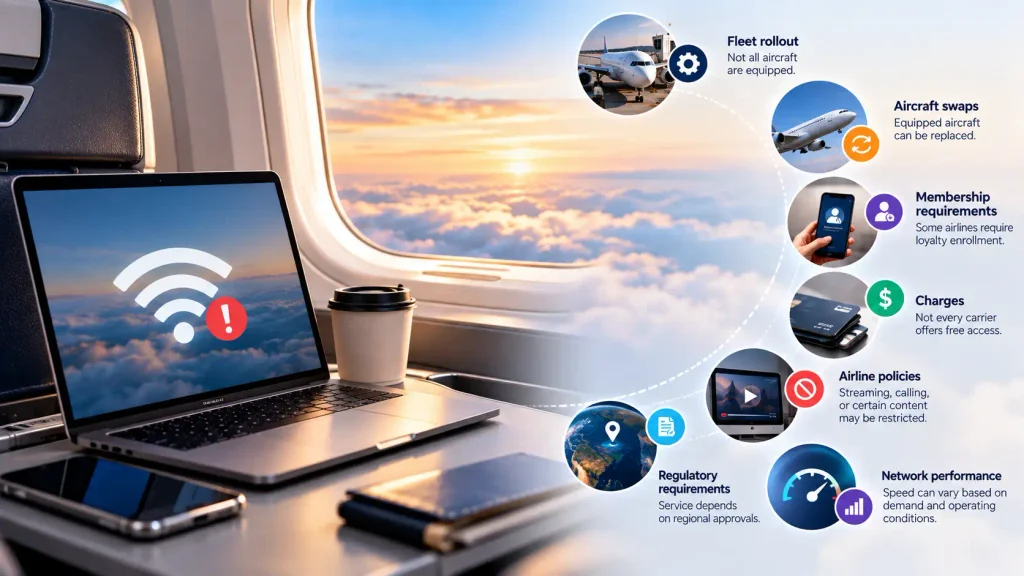
Several factors remain relevant:
Fleet rollout: Many airlines have only partially equipped their aircraft.
Aircraft swaps: A Starlink-equipped aircraft can be replaced before departure.
Membership requirements: Some airlines require loyalty enrollment.
Charges: Not every carrier provides unrestricted free access.
Airline policies: Streaming, calling, or certain content may be restricted.
Regulatory requirements: Service can depend on regional approvals.
Network performance: Speed can vary according to demand and operating conditions.
Is Starlink Changing Airline Wi-Fi?
Starlink is accelerating the shift toward broadband-style inflight connectivity.
Its growing airline adoption means passengers are increasingly encountering internet services capable of supporting activities that were difficult on older systems.
The scale of deployment is also expanding rapidly. Starlink says its aviation system has already provided connectivity on more than 200,000 flights, while its aviation platform is designed for global operation, including oceanic and polar regions.
The reference’s September 2026 airline list also demonstrates how the technology has expanded beyond early adopters to large international, regional, full-service, and low-cost carriers.
Final Thoughts
Starlink Wi-Fi is now available on aircraft operated by a growing group of airlines, including airBaltic, Air France, Alaska Airlines, British Airways, Copa Airlines, Emirates, Hawaiian Airlines, Iberia, JSX, Qatar Airways, SAS, Southwest Airlines, United Airlines, Virgin Atlantic, WestJet, and ZIPAIR.
Most airlines provide the service free of charge, either to every passenger or after enrollment in a loyalty program. Copa Airlines currently stands out for using a mixed free-and-paid access model.
Availability nevertheless remains highly aircraft-dependent. British Airways, Emirates, Iberia, Alaska Airlines, Southwest, United, Virgin Atlantic, and several others are still progressing through fleet installations.
The list is also set to grow. Singapore Airlines, Frontier Airlines, Lufthansa Group carriers, Korean Air and related Hanjin Group airlines, LEVEL, and Vueling are among carriers with announced Starlink plans.
For passengers, checking the exact aircraft and the airline’s app shortly before departure remains the most practical way to determine whether Starlink will be available on a particular flight.
Frequently Asked Questions
Current operators include airBaltic, Air France, Alaska Airlines, British Airways, Copa Airlines, Emirates, Hawaiian Airlines, Iberia, JSX, Qatar Airways, SAS, Southwest Airlines, United Airlines, Virgin Atlantic, WestJet, and ZIPAIR. Availability varies by aircraft.
It is complimentary on many airlines. Some require free loyalty-program membership, while Copa Airlines currently uses a mixed complimentary and paid model.
Yes. United operates Starlink-equipped aircraft on selected flights, and complimentary access requires MileagePlus membership.
Yes. Emirates is progressively installing complimentary Starlink on its fleet, including Boeing 777 and Airbus A380 aircraft.
Yes. Qatar Airways provides complimentary Starlink on equipped aircraft, with its rollout focusing on aircraft including the Boeing 777 and Airbus A350.
Yes. British Airways began operating Starlink-equipped passenger flights in March 2026, initially using Boeing 787-8 aircraft.
Yes. Southwest began operating Starlink flights in June 2026 and plans to equip more than 300 aircraft by the end of 2026. Rapid Rewards membership is required for complimentary access.
Singapore Airlines has announced Starlink, but the reference places its first Starlink-equipped passenger flight in early 2027. Selected A350 and A380 aircraft are planned to receive the technology.
Yes. Starlink uses an optical laser mesh across its satellite constellation that helps provide connectivity in areas far from terrestrial ground stations, including open oceans.
Starlink’s high-bandwidth system can support streaming, although individual airlines can impose restrictions or bandwidth-management policies.
No. Several airlines are still installing the equipment, so availability depends on the individual aircraft assigned to a flight.
Airline apps, booking details, online check-in information, aircraft details, and onboard Wi-Fi notices can indicate availability. United, for example, informs passengers through its app when an upcoming flight is scheduled to offer Starlink.