
LATAM Airlines Review: Seats, Baggage, Wi-Fi, Fees & LATAM Pass
LATAM Airlines is one of South America’s most important carriers, combining an extensive regional network with long-haul services to North America, Europe, Oceania, and select destinations in Africa. Its modern fleet, competitive fares, long-haul business-class cabins, and LATAM Pass loyalty program make it a significant option for travelers flying within or through South America.
The airline also has a relatively unbundled fare structure. Lower-priced economy fares can exclude checked baggage and other services, while fees for seat selection, changes, and additional services can increase the total cost. Understanding what each fare includes is therefore an important part of evaluating LATAM.
LATAM Airlines at a Glance
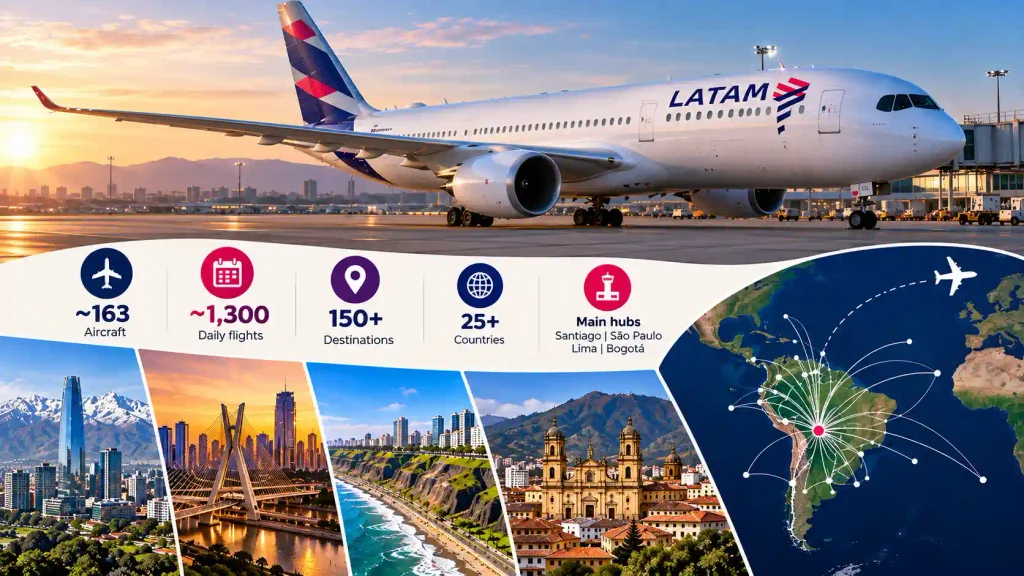
LATAM Airlines is a legacy international carrier formed through the merger of LAN Airlines and TAM Airlines. It is the largest airline group in South America and operates approximately 1,300 flights per day worldwide, with seasonal variations.
The airline operates a fleet of about 163 aircraft and serves major hubs in Santiago, São Paulo–Guarulhos, Lima, and Bogotá. Its network reaches more than 150 destinations across over 25 countries.
| Feature | Details |
| Airline | LATAM Airlines |
| Alliance | None |
| Frequent-flyer program | LATAM Pass |
| Category | Legacy international airline |
| Fleet | Approximately 163 aircraft |
| Daily flights | Approximately 1,300 |
| Destinations | 150+ |
| Countries served | 25+ |
| Main hubs | Santiago, São Paulo, Lima, Bogotá |
| Tagline | “Together, further” |
Unlike many major international airlines, LATAM is not part of a global airline alliance. It left Oneworld in 2020 after Delta invested in the airline. Instead, LATAM maintains individual partnerships with carriers including Delta and several airlines in Europe and Asia.
LATAM Route Network and Connectivity
LATAM’s strongest feature is its South American network. The airline serves a wide range of destinations across the continent and connects South America with major markets in North America and Europe.
Its international network also extends beyond those regions, with services to South African, Australia, and New Zealand. This gives LATAM an important role for travelers who need to connect between South America and other parts of the world.
The airline’s principal hubs in Santiago, São Paulo, Lima, and Bogotá support connections across its extensive network. Travelers using LATAM for regional travel can therefore access a broad selection of destinations without relying entirely on global alliance connections.
Partnerships with other airlines add further connectivity. Delta is one of the airline’s most important partners, while additional partnerships extend LATAM’s reach into European and Asian markets.
LATAM Pass Frequent-Flyer Program
LATAM Pass is LATAM’s loyalty program and a key part of the airline’s overall offering. Members can earn and redeem points on LATAM flights, partner airlines, and various non-air travel partners.
Members can use points for flights, cabin upgrades, seat selection, baggage, and other travel-related extras. The program also offers elite status tiers, including Gold, Gold Plus, Platinum, Black, and Black Signature.
Higher-level members receive benefits such as bonus point earning, preferred seating, additional baggage allowances, priority services, and lounge access. Elite status becomes more valuable at higher tiers, while entry-level status offers fewer benefits than elite programs tied to major global airline alliances.
One of LATAM Pass’s main limitations is dynamic award pricing. Redemption rates can change substantially based on demand. Attractive award opportunities can be available, particularly for travel within South America, but premium long-haul redemptions can become expensive outside promotional periods.
For travelers in the U.S., transfer options into LATAM Pass are more limited than those available through many alliance-based programs. The source identifies Marriott Bonvoy and Choice Privileges as U.S. transfer options.
LATAM Pass can therefore be particularly useful for frequent LATAM travelers, especially those who regularly fly within South America and can benefit from higher-tier status.
LATAM Economy Class
LATAM’s economy product varies according to the fare selected and the route. A standard economy ticket generally includes a regular economy seat and a personal item and carry-on allowance. On most international flights, the combined carry-on allowance can reach 12 kilograms (26 pounds).
Most flights include complimentary nonalcoholic beverages. Long-haul international services generally include complimentary meals, while short-haul flights within South America can offer food and beverages for purchase.
Checked baggage is one of the most important differences between fare types. LATAM’s Light economy fares do not include a checked bag, while higher economy fares can include baggage.
This structure means that the lowest advertised fare may not represent the final cost for travelers who need to check luggage or select a preferred seat.
LATAM Premium Economy
LATAM currently markets front-of-cabin seating as premium economy on short-haul flights. However, the source notes that a true premium economy product is scheduled to be introduced on wide-body aircraft in 2027.
The existing premium economy product provides a wider seat and additional legroom compared with standard economy. It also includes priority boarding, one checked bag, improved meal service, and complimentary alcoholic and nonalcoholic beverages.
On short-haul aircraft, premium economy can provide a blocked middle seat in addition to the extra space.
This makes the product a notable step above standard economy, especially for travelers who want extra room and priority services without purchasing long-haul business class.
LATAM Business Class
LATAM business class provides a substantially more premium experience on long-haul routes. The cabin includes lie-flat seats, lounge access, priority check-in, priority boarding, priority baggage handling, multiple checked bags, and premium dining and beverage service.
The exact seat depends on the aircraft. LATAM operates both 2-2-2 and 1-2-1 business-class layouts on long-haul aircraft.
The airline has also introduced business-class suites with closing privacy doors, becoming the first airline in South America to offer this type of product. These suites operate on select routes to the U.S.
On short-haul routes, business class can be considerably simpler. Instead of a dedicated premium seat, the product may involve a blocked middle seat and additional service benefits.
Travelers comparing LATAM business-class fares should therefore verify the aircraft and configuration before booking.
LATAM Seats and Aircraft
LATAM operates several Airbus and Boeing aircraft, and seat dimensions vary considerably by aircraft type and cabin.
On the Boeing 767-300ER, business class has 20 seats with approximately 45 inches of pitch and 19.5-inch seat width. Economy has 213 seats with about 31 inches of pitch, though rows 12 through 16 offer around 35 inches. Economy seats are approximately 17.8 inches wide.
The Boeing 777-300ER has 38 business-class seats with approximately 44 inches of pitch and a 23-inch width. Its economy cabin has 372 seats, with about 31 inches of pitch and a 17.1-inch width. Rows 12 through 16 offer around 35 inches of pitch.
The Boeing 787 fleet provides some of LATAM’s strongest long-haul premium seating. Depending on configuration, business-class beds range from approximately 75 to 79 inches, with seat widths between 21 and 23 inches. Economy generally offers 31 inches of pitch, with selected rows providing 35 inches.
On the Airbus A319, A320, A320neo, A321, and A321neo, premium economy seats generally provide about 33 to 34 inches of pitch, approximately 17.7 inches of width, and a blocked middle seat. Economy pitch varies by aircraft and configuration, generally ranging from approximately 28 to 33 inches.
| Aircraft | Cabin | Pitch/Bed | Width |
| Boeing 767-300ER | Business | 45 inches | 19.5 inches |
| Boeing 767-300ER | Economy | 31–35 inches | 17.8 inches |
| Boeing 777-300ER | Business | 44 inches | 23 inches |
| Boeing 777-300ER | Economy | 31–35 inches | 17.1 inches |
| Boeing 787-8 | Business | 75–76 inches | 21–23 inches |
| Boeing 787-8 | Economy | 31–35 inches | 17.1–17.3 inches |
| Boeing 787-9 | Business | 79 inches | 23 inches |
| Boeing 787-9 | Economy | 31–35 inches | 17.1–17.3 inches |
| Airbus A320 family | Premium Economy | 33–34 inches | 17.7 inches |
| Airbus A320 family | Economy | 28–33 inches | 17.7 inches |
The variation between aircraft reinforces the importance of checking the aircraft type when seat comfort is a priority.
Read This Blog: Delta One Seats Compared: Which Aircraft Has the Best Seat?
LATAM Baggage Allowance
LATAM’s baggage rules depend on fare type and route. The most restrictive economy fares generally require passengers to purchase checked baggage separately, while higher fares include at least one checked bag.
For flights between the U.S. and South America, Economy Light fares do not include a checked bag. The first checked bag costs about $50 to $65, depending on the route.
Economy Standard fares on the same markets include one checked bag weighing up to 23 kilograms (50 pounds).
Within South America, Economy Light fares also exclude checked baggage, with first-bag charges of approximately $25 to $40 depending on the route.
Business-class passengers receive two checked bags, with each bag allowed to weigh up to 32 kilograms, or 70 pounds.
Excess baggage charges can apply when bags exceed the applicable weight allowance. Since baggage can materially change the final ticket cost, travelers should compare fares based on the complete package rather than the base price alone.
LATAM Change and Cancellation Fees
LATAM’s change and cancellation rules vary by fare type. International Economy Light fares can carry a change fee of about $150, plus any applicable fare difference. Economy Standard international fares have change fees ranging from approximately $75 to $125.
Refundable fares can have refund fees ranging from $0 to $75 depending on the route.
For U.S. bookings made at least seven days before departure, a 24-hour free-cancellation policy applies according to the source.
Travelers who expect their plans to change may therefore find higher or refundable fares more suitable than the cheapest economy options.
LATAM Reservation Fees
LATAM does not charge a reservation service fee for online bookings through LATAM.com.
Phone bookings through the LATAM call center can carry a $25 fee per ticket. Bookings made at a ticket office can cost approximately $25 to $40, depending on the country.
For travelers comfortable booking online, booking directly through the website avoids these additional service charges.
Preferred and Extra-Legroom Seats
LATAM offers several paid seat-selection options. Standard preferred seats generally cost approximately $15 to $40 per segment. Extra-legroom seats can cost about $30 to $90 per segment, depending on the route length.
Elite LATAM Pass members may receive discounted or complimentary access to certain preferred seats depending on their status level.
These charges are another reason to compare the total cost of a fare rather than simply selecting the lowest base price.
LATAM Wi-Fi
LATAM offers Wi-Fi on most Airbus A320 family aircraft and selected wide-body aircraft. Availability therefore varies depending on the aircraft operating a particular flight.
Messaging is free on supported aircraft. Full internet access generally costs approximately $8 to $12 on shorter flights and $15 to $20 on longer flights.
Certain elite members may receive complimentary access on selected routes. The airline continues to expand onboard connectivity, with upgrades focused on improving speed and reliability rather than providing free full internet access to every passenger.
See This Wi-Fi Guide: Which Airlines Have Starlink Wi-Fi? Complete 2026 Guide
Food and Drinks
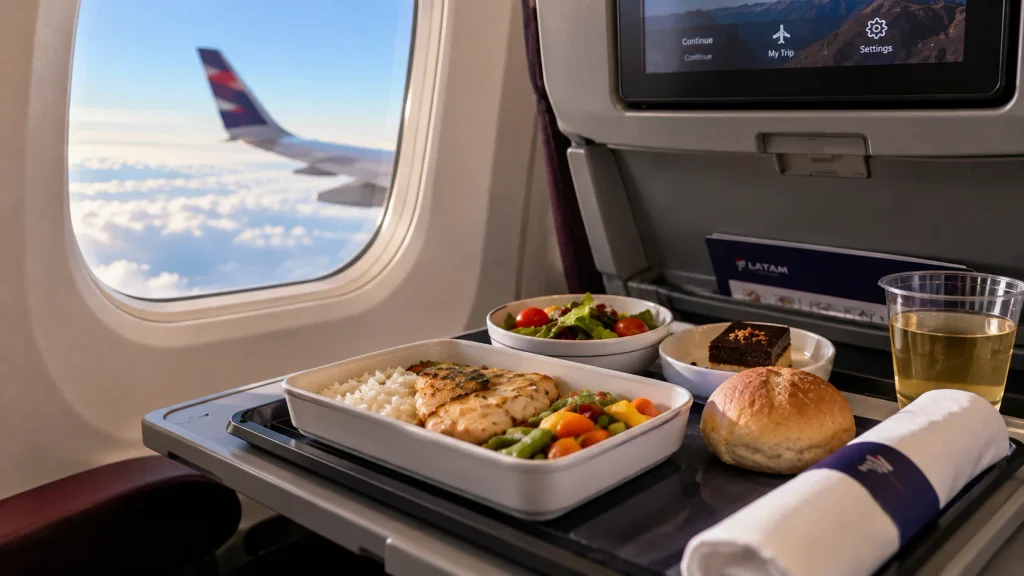
Food and beverage service depends on flight length and cabin. Short-haul economy passengers can purchase snacks and drinks onboard. Long-haul economy passengers receive complimentary meals and drinks.
Premium economy and business-class passengers receive complimentary meals and alcoholic beverages.
The distinction between short- and long-haul service means the onboard experience can differ substantially by itinerary. Travelers expecting a full meal should consider flight duration and cabin when selecting a ticket.
LATAM Airport Lounges
LATAM operates lounges throughout South America and in selected international locations. Eligible business-class passengers, qualifying elite members, and certain credit card holders can access them.
Major lounge locations include:
- Bogotá
- Buenos Aires
- Lima
- Miami
- Santiago
- São Paulo–Guarulhos
The Santiago lounge is divided into three sections and is described as the largest airport lounge in South America.
Typical lounge amenities include hot food, showers, Wi-Fi, and workspaces. For eligible travelers, these facilities can add substantial value to premium-cabin and elite-status travel.
Check Out This Blog: US Lounges & Restaurants: Priority Pass Complete Guide
Unaccompanied Minor Services
LATAM provides an unaccompanied-minor service for eligible children. On domestic South American routes, the service costs approximately $50 per one-way segment. International service costs approximately $150 per one-way segment.
The service is mandatory for children ages 5 to 11 and optional for passengers ages 12 to 17.
Families using the service should review the applicable conditions and requirements before travel, as eligibility and documentation can affect the booking process.
Pet Transportation
LATAM permits eligible pets to travel in the cabin or hold, subject to weight and route restrictions.
In-cabin pets can weigh up to 7 kilograms (15 pounds), including the carrier. The listed fee ranges from approximately $200 to $250 depending on the route.
Pets traveling in the aircraft hold can weigh up to 23 kilograms, or 50 pounds, and the listed charge ranges from approximately $300 to $350.
Pets exceeding the applicable weight limits must travel as cargo at higher rates. Because pet transportation is subject to specific restrictions, passengers should verify the applicable requirements before adding an animal to an itinerary.
LATAM Customer Satisfaction
LATAM receives generally positive comments about its onboard comfort and modern aircraft, but customer-service consistency remains a common concern.
Frequently reported issues include slow customer-service responses, strict fare rules, delays, and lengthy refund processing. Irregular operations can make these issues more noticeable, as passengers may need help with changes or refunds.
The source lists LATAM’s Skytrax rating at 3 stars out of 5. Tripadvisor gives the airline 3.5 out of 5 based on 42,343 reviews, while Kayak lists a 7.5 out of 10 rating based on 1,894 verified reviews.
These ratings reflect a mixed but generally functional passenger experience, with the airline’s network and onboard product standing out as strengths. At the same time, customer support and fare flexibility remain areas to consider.
LATAM Safety and Operational Performance
LATAM maintains a strong overall safety record and operates one of the youngest fleets in South America.
The source notes that the airline has experienced several incidents involving injured passengers during the past decade, but no passenger deaths were reported in that period. LATAM has also invested significantly in fleet modernization and operational reliability following its restructuring during the pandemic.
The airline’s relatively young fleet contributes to its modern onboard product, particularly on long-haul routes where newer Boeing 787 aircraft provide lie-flat business-class seating.
LATAM Awards
LATAM received several major honors at the 2025 Skytrax World Airline Awards. The airline was named Best Airline in South America, reinforcing its position as a leading carrier in the region.
Additional awards included:
- Best Business Class in South America
- Best Business Class Onboard Catering in South America
- Best Economy Class in South America
- Best Economy Class Onboard Catering in South America
- Best Airline Staff in South America
- Best Cabin Crew in South America
- Cleanest Airline in South America
LATAM’s Santiago lounge was also named the Best Business Class Lounge in South America.
These awards complement the airline’s strong regional network and highlight the quality of its premium and economy onboard offerings.
How to Reduce LATAM’s Extra Costs
LATAM passengers can reduce extra costs by choosing a fare that includes the services they need.
For example, travelers who need checked baggage and preferred seating may find a higher economy fare cheaper overall than buying the lowest fare and adding each service separately.
LATAM Pass elite status can also provide useful benefits, including preferred seating, additional baggage, priority services, and lounge access depending on the tier.
For U.S.-based frequent LATAM travelers, the airline’s co-branded credit cards can provide additional opportunities to earn LATAM Pass miles and Qualifying Points. The premium World Elite Mastercard offers higher earning rates, upgrade coupons, and annual lounge passes, while the no-annual-fee LATAM Airlines Mastercard offers lower earning rates and Qualifying Points.
Travelers not specifically loyal to LATAM may instead use general travel rewards cards to offset eligible travel expenses such as baggage, seat selection, or other charges.
LATAM Airlines: Main Advantages
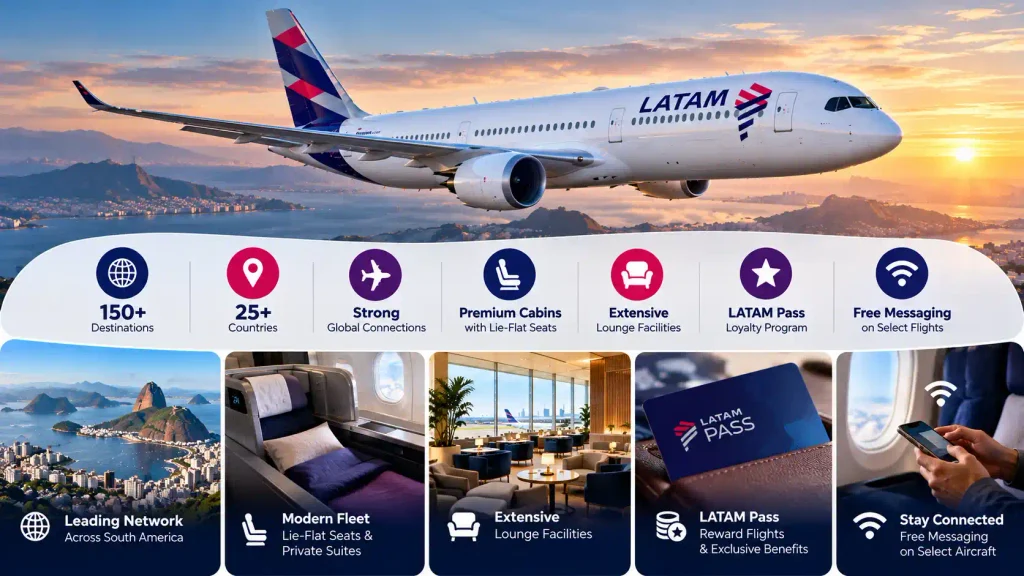
LATAM’s key strengths are its network, fleet, premium cabins, and regional relevance.
The airline offers:
- One of the most comprehensive networks in South America
- More than 150 destinations across 25+ countries
- Strong connections to North America and Europe
- Additional services to Africa, Australia, and New Zealand
- A modern fleet
- Lie-flat business-class seats on long-haul routes
- New business-class suites with privacy doors on select routes
- Extensive lounge facilities
- A dedicated LATAM Pass loyalty program
- Strong premium and economy award recognition
- Competitive pricing on many routes
- Free messaging on supported Wi-Fi-equipped aircraft
Things to Consider Before Flying LATAM
LATAM’s fare structure deserves close attention before booking. The cheapest Economy Light fares may exclude checked baggage, while seat selection and other extras can increase the final price.
Customer-service responsiveness is another consideration. The source identifies delays, refund processing, strict fare rules, and support responsiveness as common complaints.
The lack of global alliance membership can also matter to travelers who prefer a traditional alliance network. LATAM instead relies on individual airline partnerships.
Finally, aircraft configuration can significantly influence the onboard experience. Long-haul Boeing 787 aircraft offer a substantially more premium business-class product than the simpler business-class configurations found on many short-haul routes.
Overall LATAM Airlines Review
LATAM Airlines is a strong option for travelers who need extensive coverage of South America or connections between the continent and major international markets. Its network, modern fleet, long-haul business-class cabins, lounges, and LATAM Pass program are among its most notable strengths.
The airline’s economy product varies because fare conditions determine what’s included. The cheapest fares can exclude checked baggage and require separate payment for preferred seating, while higher fares provide a more comprehensive package.
Premium travelers have access to lie-flat business-class seating on long-haul aircraft, lounge access, priority services, and premium dining. LATAM’s newer business-class suites with closing doors add an especially competitive product on selected U.S. routes.
LATAM Pass can be valuable for frequent travelers, particularly those who regularly fly within South America. However, dynamic award pricing and limited U.S. transfer options can reduce its appeal for some travelers.
Overall, LATAM combines an extensive regional network with a modern fleet and competitive premium products. Its value is strongest when passengers understand the fare structure, select the right aircraft, and account for baggage, seat, and change fees before booking.
Frequently Asked Questions
LATAM is generally a solid airline with an extensive South American network, modern aircraft, and competitive pricing. However, customer-service experiences can vary, and travelers should pay close attention to fare restrictions and additional fees.
Checked baggage is included on higher economy fares, premium economy, and business class. The cheapest Economy Light fares generally do not include checked baggage.
No. LATAM is not currently part of a global airline alliance. Instead, it maintains partnerships with several major international airlines.
Yes. Wi-Fi is available on most Airbus A320 family aircraft and selected wide-body aircraft. Messaging is free on supported aircraft, while full internet access generally costs extra.
Yes. Long-haul business class includes lie-flat seating, lounge access, priority services, multiple checked bags, and premium dining. Short-haul business class can have a simpler configuration.
LATAM markets front-of-cabin seating as premium economy on short-haul flights. The product includes additional legroom, a wider seat, priority boarding, one checked bag, and enhanced meal service. A true wide-body premium economy product is scheduled for 2027.
LATAM Pass is LATAM’s frequent-flyer program. Members can earn and redeem points for flights, upgrades, seat selection, baggage, and other travel extras.
Yes. LATAM Pass lets members earn and redeem points with LATAM and partner airlines, though redemption prices can vary significantly because the program uses dynamic pricing.
Yes. LATAM operates services connecting South America with the U.S., including select routes featuring its newer business-class suites.
Long-haul economy flights generally include complimentary meals and drinks. Premium economy and business class include complimentary meals and alcoholic beverages, while short-haul economy flights can offer food and drinks for purchase.
LATAM’s primary hubs are Santiago in Chile, São Paulo–Guarulhos in Brazil, Lima in Peru, and Bogotá in Colombia.
The source describes LATAM as maintaining a strong overall safety record and operating one of the youngest fleets in South America. The airline has also invested in fleet modernization and operational reliability.