
Alaska Airlines: 5 New Korean Air Codeshare Routes
Alaska Airlines added its code to five Korean Air routes via Seoul Incheon—Bangkok, Busan, Hanoi, Ho Chi Minh City, and Singapore—on August 13, 2026, expanding the destinations available on Alaska-marketed itineraries. Still, award availability on these new connections is the main catch.
The expansion is significant because Alaska Airlines has been building a broader international network through Seattle and its airline partnerships. Instead of stopping at Seoul, eligible Alaska bookings can now continue on Korean Air into several major Asian destinations.
However, travelers using Atmos Rewards points should approach the new routes differently than a straightforward cash booking. At the time of the August launch, searches showed the new itineraries when paying cash but disappeared when an award search was selected. Alaska’s current Korean Air partner page confirms that Korean Air award travel can be booked through Alaska or Hawaiian, but that doesn’t mean every codeshare itinerary or date will have award availability.
Here is what the expansion means, where the five routes lead, and what travelers should know before booking.
What Are the 5 New Korean Air Codeshare Routes?

Beginning August 13, 2026, Alaska Airlines will market five Korean Air-operated routes from Seoul Incheon International Airport (ICN). The new routes are:
| Korean Air route | Destination | Country |
| Seoul Incheon – Bangkok | Bangkok (BKK) | Thailand |
| Seoul Incheon – Busan | Busan (PUS) | South Korea |
| Seoul Incheon – Hanoi | Hanoi (HAN) | Vietnam |
| Seoul Incheon – Ho Chi Minh City | Ho Chi Minh City (SGN) | Vietnam |
| Seoul Incheon – Singapore | Singapore (SIN) | Singapore |
The expansion was reported in schedule filings and gives Alaska Airlines a marketing presence beyond its Seoul gateway. Travelers can therefore encounter Alaska flight numbers on Korean Air-operated segments while the aircraft and onboard service remain Korean Air’s responsibility.
The distinction between a marketing carrier and an operating carrier matters. Alaska Airlines may sell the itinerary under its flight number, while Korean Air operates the aircraft. Seat selection and certain service requests can consequently be handled through Korean Air rather than Alaska. Alaska specifically directs customers to KoreanAir.com for seat selection on Korean Air flights.
Why the Codeshare Expansion Matters
The biggest change is not that Korean Air suddenly began flying to these destinations. Korean Air already operates extensive services from Seoul to Southeast Asia and elsewhere.
Instead, the change gives Alaska Airlines customers another way to connect beyond Seoul.
For example, an itinerary from Seattle to Singapore could combine an Alaska or Alaska-group flight to Seoul with a Korean Air-operated connection to Singapore under an Alaska-marketed itinerary. That is different from independently purchasing one ticket to Seoul and a second ticket from Seoul to Singapore.
Alaska has been positioning Seattle as an increasingly important international gateway. The airline launched nonstop Seattle–Seoul service in 2025 through Hawaiian Airlines,
while its wider Seattle strategy includes additional international destinations.
The Korean Air relationship therefore gives Alaska access to destinations that would be difficult to serve directly with its own aircraft.
The five destinations serve different types of travelers
The new routes also broaden the usefulness of Seoul as a connecting point:
- Bangkok: A major Southeast Asian leisure and business destination.
- Busan: A useful domestic connection for travelers continuing within South Korea.
- Hanoi: A gateway to northern Vietnam and a major cultural and business center.
- Ho Chi Minh City: A major southern Vietnamese destination with strong leisure and business demand.
- Singapore: One of Southeast Asia’s most important business, financial, and aviation hubs.
Korean Air’s existing schedules show substantial service to several of these cities, including Bangkok, Hanoi, Ho Chi Minh City, and Singapore. Schedules can change by season, aircraft, and date, so travelers should verify the operating flight when booking.
The Catch: Cash Availability Does Not Automatically Mean Award Availability
This matters most to points travelers.
When the new codeshare was examined around its August launch, the five destinations appeared in Alaska’s booking system when searching for paid fares. However, the same itineraries reportedly disappeared after switching the search to award travel. That created a major difference between buying the itinerary with cash and redeeming Atmos Rewards points.
That distinction is important because a codeshare relationship and a loyalty-program redemption relationship are not necessarily identical.
A traveler could see:
Seattle → Seoul → Singapore
as an Alaska-marketed cash itinerary but not necessarily find the same combination when searching for an award ticket.
Has the situation changed?
Alaska’s current partner information provides an important update.
As of September 2026, Alaska lists Korean Air among its earn-and-redeem partners and states that members can book Korean Air award travel online through Alaska Airlines or Hawaiian Airlines.
That means it would be inaccurate to say that Atmos Rewards members simply cannot redeem points on Korean Air.
The more useful takeaway is narrower: Korean Air award availability is not guaranteed for every codeshare itinerary, even though Korean Air is an eligible redemption partner.
Availability can depend on the particular route, travel date, cabin, and inventory released to the loyalty program.
Therefore, travelers should search the exact itinerary before transferring or purchasing points.
What About Earning Atmos Rewards Points?
The earning side of the relationship has also changed.
Alaska’s current Korean Air partner page says that Korean Air tickets purchased through Alaska or Hawaiian can earn Atmos Rewards points. It also publishes earning rates based on Korean Air booking class.
For example, the current published table shows:
| Korean Air cabin | Example fare classes | Total Atmos Rewards points |
| First Class | P | 400% |
| First Class | F | 365% |
| Prestige Class | J | 235% |
| Prestige Class | C, D, I, R | 225% |
| Economy | Y, B, M, W, S, H, E | 100% |
| Economy | K | 75% |
| Economy | L, U | 50% |
| Economy | Q, N, T | 25% |
These percentages are based on the distance flown and the published fare-class rules, not the ticket’s cash price. Alaska also notes that travelers should sign into Atmos Rewards when purchasing eligible Korean Air flights through Alaska or Hawaiian.
This creates an important distinction:
A paid Korean Air itinerary purchased through an eligible Alaska channel can earn points even when an equivalent award itinerary is unavailable.
Travelers should therefore check the ticket’s marketing carrier, operating carrier, booking channel, and fare class rather than assuming every Korean Air ticket earns identically.
Why the Korean Air Partnership Has Become More Complicated

The codeshare expansion comes after broader changes to the Alaska–Korean Air loyalty relationship.
Korean Air’s SKYPASS program stopped mileage accrual on Alaska Airlines and Hawaiian Airlines flights for travel beginning January 1, 2026. Korean Air says SKYPASS mileage accrual on Alaska and Hawaiian flights is unavailable from that date based on boarding date, subject to the rules for earlier travel and retroactive claims.
At the same time, Alaska continues to list Korean Air as an Atmos Rewards earn-and-redeem partner.
The result is a partnership that is stronger in some commercial areas but different in loyalty-program mechanics than before.
That is why travelers shouldn’t assume an old Alaska–Korean Air mileage rule still applies in 2026.
What Is a Codeshare Flight?
A codeshare is an arrangement in which one airline markets a flight operated by another airline.
For example, a traveler might see an Alaska Airlines flight number on a Seoul–Singapore itinerary even though Korean Air operates the aircraft.
The practical advantages can include:
- A more straightforward booking process.
- A single itinerary for connecting flights when offered as such.
- Easier itinerary management than independently booking separate tickets.
- Access to destinations outside Alaska’s own nonstop network.
- Potential loyalty-program earning or redemption opportunities, depending on the fare and ticket.
But codeshares don’t mean the marketing airline provides every part of the travel experience.
Korean Air remains responsible for operating its own aircraft on these flights. Alaska’s partner information also directs customers to Korean Air for seat selection on Korean Air-operated services.
What Should Travelers Check Before Booking?
The new routes can be useful, but travelers should verify several details before committing to a ticket.
1. Check whether the itinerary is cash or award eligible
Don’t assume that seeing a route in Alaska’s normal flight search means it will appear for Atmos Rewards redemption.
Search the exact origin, destination, dates, and cabin using the award-search function.
2. Confirm the operating airline
Look for wording such as “operated by Korean Air.”
This tells travelers who will actually fly the aircraft and which airline’s onboard product and operational procedures apply.
3. Check seat-selection rules
Alaska states that Korean Air seat selection should generally be handled through KoreanAir.com, although some economy seats may not be eligible for advance selection.
This is particularly relevant for travelers who are accustomed to managing every part of an itinerary through Alaska’s website.
4. Review the fare conditions
A cheap cash fare and a flexible fare can have very different cancellation, change, seat, and earning conditions.
The same route may also have different fare classes, which can affect Atmos Rewards earnings.
5. Check the connection ainSeoul
A connection through Incheon is not the same as a nonstop flight.
Travelers should review the scheduled connection time and airport requirements, particularly if the itinerary involves separate tickets or a change in booking structure.
For a single-ticket itinerary, the airline’s published connection arrangement generally provides more protection than two unrelated tickets, but travelers should still understand the itinerary before departure.
How the New Routes Fit Alaska’s International Strategy
The five codeshare additions are part of a much broader shift for Alaska Airlines.
Historically, Alaska’s network was heavily concentrated in the western United States, with Seattle as its largest hub. The airline has increasingly added long-haul international service and expanded its partnerships.
Alaska says it is developing its Seattle hub as a global gateway, with international service to Seoul and Tokyo and additional European routes.
The airline’s 2026 annual-report materials also show Korean Air among its partner airlines, although the relationship’s precise earning, redemption, and codeshare components differ from partner to partner.
For Alaska customers, partnerships can therefore be as important as Alaska-operated aircraft when determining how far an Alaska-marketed itinerary can go.
Could These Routes Be Useful for West Coast Travelers?
Yes, particularly for travelers starting in cities where Alaska has strong service into Seattle.
A traveler based in the Pacific Northwest, for example, could potentially build an itinerary that begins with an Alaska-operated domestic flight, connects in Seattle, continues to Seoul, and then takes a Korean Air-operated flight onward to one of the five destinations.
The advantage is network reach rather than a new Alaska-operated nonstop.
This distinction matters most when comparing itineraries. A traveler should look at:
- Total travel time.
- Number of connections.
- Connection length.
- Operating airlines.
- Cabin and aircraft.
- Cash price.
- Atmos Rewards earning.
- Atmos Rewards award availability.
- Baggage conditions.
- Change and cancellation rules.
A route that looks attractive on a map may not be the most convenient option once the complete itinerary is displayed.
What the Expansion Means for Atmos Rewards Members
Atmos Rewards members should view the expansion as a network opportunity rather than an automatic points opportunity.
Alaska currently advertises more than 1,000 destinations through its airline partners, and Korean Air remains among the carriers where members can earn and redeem points.
But loyalty-program inventory can be more restrictive than regular paid inventory.
For example, if a cash search shows:
Seattle → Seoul → Bangkok
That does not necessarily mean the same itinerary will be available for the required number of Atmos Rewards points.
The most important habit is therefore to verify award space first if points are the reason for choosing the itinerary.
Travelers who need a specific date should be particularly careful about transferring flexible credit-card points into a loyalty program before confirming that the desired award seat exists.
Is It Better to Book the Whole Trip Through Alaska?
There is no universal answer because the better booking method depends on price, award availability, flexibility, and itinerary requirements.
A single Alaska-marketed itinerary can appeal to travelers who want a simpler reservation structure. However, a separate booking could sometimes offer different pricing or award options.
The key issue is that separate tickets can create additional connection risk. If one independently booked flight is delayed, and the traveler misses a separately ticketed onward flight, the second airline’s obligations may differ from those associated with a single itinerary.
For long-haul Asia travel, that distinction can be meaningful.
Travelers should therefore compare the complete itinerary, rather than looking only at the first flight segment.
Alaska Airlines and Korean Air: What Has Changed?
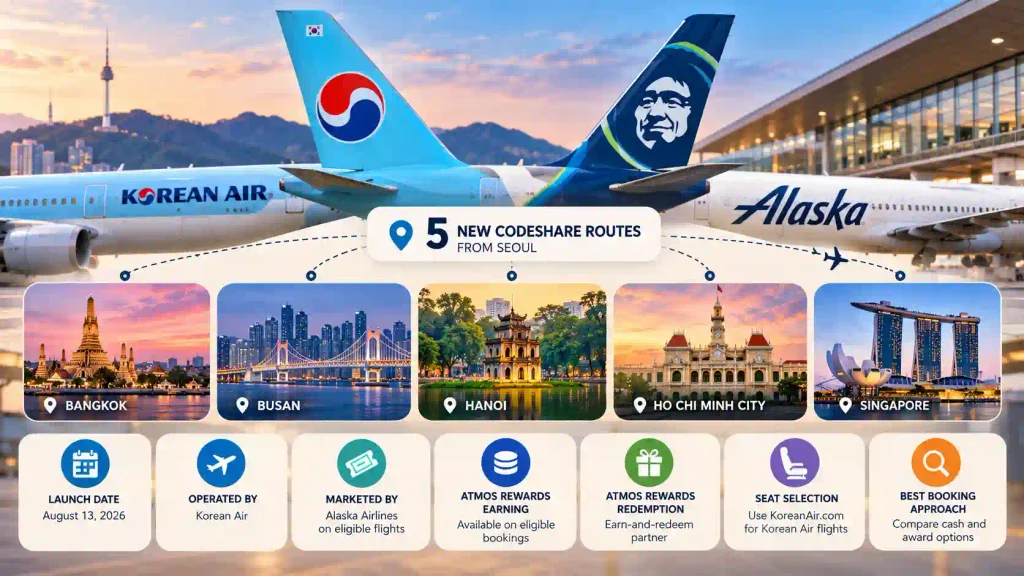
| Area | Current situation |
| New codeshare routes | 5 additional Korean Air routes from Seoul |
| Launch date | August 13, 2026 |
| Destinations | Bangkok, Busan, Hanoi, Ho Chi Minh City, Singapore |
| Operating carrier | Korean Air |
| Marketing carrier | Alaska Airlines on eligible codeshare flights |
| Atmos Rewards earning | Available on eligible Korean Air bookings, with rules based on booking channel/fare |
| Atmos Rewards redemption | Korean Air is an earn-and-redeem partner |
| Award availability | Not guaranteed on every codeshare itinerary |
| Seat selection | Korean Air directs travelers to KoreanAir.com for its flights |
| Best booking approach | Compare cash and award options for the exact itinerary |
Final Takeaway
Alaska Airlines’ expansion to five additional Korean Air routes gives travelers more ways to connect through Seoul to Bangkok, Busan, Hanoi, Ho Chi Minh City, and Singapore without limiting the Alaska-marketed network to Seoul itself. The most important caveat is that a cash codeshare itinerary does not guarantee matching Atmos Rewards award availability.
Alaska’s current rules confirm that Korean Air remains an Atmos Rewards earn-and-redeem partner, so the situation is more nuanced than simply saying points cannot be used. Travelers should search the exact flight before transferring points, confirm which airline operates each segment, review the fare and seat-selection conditions, and compare the complete itinerary before booking.
FAQs About Alaska Airlines’ Korean Air Codeshare
The additional codeshare routes began August 13, 2026. They connect Seoul Incheon with Bangkok, Busan, Hanoi, Ho Chi Minh City, and Singapore.
Yes. Alaska currently lists Korean Air as an earn-and-redeem partner and says members can book Korean Air award travel through Alaska Airlines or Hawaiian Airlines. However, availability varies by flight and date.
When the routes launched, reported searches showed the new itineraries as cash options, not award options. The issue was therefore not the codeshare’s existence but the availability of award inventory.
No. The five added segments are operated by Korean Air. Alaska places its marketing code on eligible flights, allowing them to appear as Alaska-marketed itineraries.
Eligible Korean Air flights can earn Atmos Rewards points when purchased through Alaska or Hawaiian, subject to the applicable fare-class and booking rules. Alaska publishes specific earning rates for Korean Air.
Not necessarily. A codeshare identifies the marketing relationship; the operating carrier provides the aircraft and operates the flight. On these five routes, Korean Air operates the relevant services.