
Checked Luggage Dimensions & Weight Limits of Popular Airlines
Packing a checked suitcase seems simple enough until you start comparing airline baggage rules. One carrier may allow a 62-inch suitcase weighing up to 50 pounds, while another may use a completely different size limit or calculate your allowance by total weight rather than by the number of bags.
And then there are the finer details. Your checked baggage allowance can change depending on your airline, fare, cabin class, route, frequent-flyer status, and even the carrier operating a connecting flight.
So, is there a standard checked luggage size?
There is a common benchmark: 62 linear inches (158 cm) and 50 pounds (23 kg). Several major airlines use limits around this size and weight. But it is not a universal aviation rule.
For example, Frontier Airlines currently limits standard checked bags to 62 linear inches but uses a 40-pound weight limit, while British Airways permits checked bags up to 90 × 75 × 43 cm and generally allows 23 kg in Economy. Emirates uses a weight-based system on many routes and permits individual bags up to 32 kg, with total dimensions of up to 300 cm under that system.
That is why the safest way to pack is not to assume that your suitcase works everywhere. Check the baggage allowance attached to your ticket before you leave for the airport.
What Is the Standard Checked Luggage Size?
A common checked-bag limit is 62 linear inches (158 cm).
Unlike a suitcase’s individual length, width, or height, linear dimensions are calculated by adding all three:
Length + Width + Height = Linear Dimensions
For example, a suitcase measuring:
- 28 inches long
- 20 inches wide
- 14 inches high
would have:
28 + 20 + 14 = 62 linear inches
That is why two suitcases can have completely different shapes and still fall within the same 62-inch limit.
However, airlines may measure the outside dimensions differently or use a different maximum altogether. Wheels and handles can also count, so measure the suitcase from its outermost points rather than relying only on the manufacturer’s advertised body dimensions.
What Is the Standard Checked-Bag Weight?
50 pounds (23 kg) is a common checked-bag weight limit, particularly for Economy passengers on many major airlines.
But again, there is no worldwide standard.
Some airlines use 23 kg as the standard Economy limit. Others allow 32 kg in premium cabins, while some low-cost carriers use a lower standard.
Frontier, for example, currently sets its standard checked-bag weight at 40 pounds, while Emirates can provide a total weight allowance of 20 kg to 35 kg in Economy depending on the fare.
So if you have a suitcase weighing 48 pounds, it may be acceptable on one airline but considered overweight on another.
Checked Luggage Size and Weight by Airline
The following table gives a quick reference for 30 major airlines. These figures describe commonly published maximum size and weight parameters for standard checked baggage; they do not mean that the stated weight or number of bags is automatically included in every fare.
| Airline | Common maximum size | Common weight limit | Baggage system / note |
| Delta Air Lines | 62 linear in / 157 cm | 50 lb / 23 kg | Standard U.S. checked-bag model |
| Southwest Airlines | 62 linear in | 50 lb / 23 kg | Standard size/weight limit |
| JetBlue Airways | 62 linear in / 158 cm | 50 lb / 23 kg | Allowance varies by fare and route |
| Alaska Airlines | 62 linear in | 50 lb / 23 kg | Standard checked-bag model |
| Hawaiian Airlines | 62 linear in | 50 lb / 23 kg | Allowance varies by itinerary |
| Frontier Airlines | 62 linear in | 40 lb / 18 kg | Overweight thresholds begin above 40 lb |
| Allegiant Air | 80 linear in | 50 lb / 23 kg | Larger dimensional limit than many U.S. carriers |
| Air Canada | 62 linear in / 158 cm | 50 lb / 23 kg | Route and fare affect allowance |
| Virgin Atlantic | 90 × 75 × 43 cm | 23 kg Economy | Upper Class bags can weigh up to 32 kg |
| Virgin Australia | Route/fare dependent | Commonly 23 kg | Allowance varies by fare and itinerary |
| British Airways | 90 × 75 × 43 cm | 23 kg Economy | Business/First allowances can be higher |
| Lufthansa | 158 cm total | 23 kg Economy | Premium cabinsAi can receive higher limits |
| Air France | 158 cm / 62.2 in | 23 kg Economy | Cabin and fare affect allowance |
| KLM | 158 cm total | 23 kg Economy | Standard/Flex Economy allowance varies |
| Iberia | 158 cm total | 23 kg | Fare and cabin affect allowance |
| Turkish Airlines | 158 cm total | 23 kg Economy | Piece/weight concept depends on route |
| Ryanair | 80 × 120 × 120 cm | 20 kg option | Checked bags are purchased separately |
| easyJet | Under 275 cm total | Up to 32 kg | 15 kg/23 kg options; weight can be added |
| Wizz Air | Route/fare dependent | Up to 32 kg | Multiple paid checked-bag options |
| SWISS | 158 cm total | 23 kg Economy | Cabin and fare determine allowance |
| Emirates | Up to 300 cm total* | Up to 32 kg per bag | Weight concept on many routes |
| Qatar Airways | 158 cm | Up to 32 kg per piece | Weight/piece concept depends on route |
| Etihad Airways | 158 cm | Up to 32 kg | Allowance varies by route and fare |
| Saudia | 158 cm standard | 23 kg Economy | Some routes/cabins allow more |
| Singapore Airlines | 158 cm | 23 kg Economy | Piece concept applies to U.S./Canada routes |
| Cathay Pacific | Route dependent | Up to 32 kg | Allowance varies by cabin and fare |
| Japan Airlines | Route dependent | Up to 32 kg | Piece and weight rules vary |
| ANA | 158 cm | 23 kg Economy | Number of pieces varies by fare |
| Qantas | Route/fare dependent | Up to 32 kg per piece | Allowance varies by itinerary |
| Air India | 158 cm standard | 23 kg Economy | Some fares permit multiple pieces |
Emirates uses a weight concept on many routes; individual bags can weigh no more than 32 kg, and total dimensions of an individual bag should not exceed 300 cm under that concept.
The table is a starting point, not a substitute for your ticket’s baggage allowance. KLM, for example, states that checked baggage depends on ticket type and destination, while ANA similarly notes that the free allowance varies according to fare rules.
Delta Air Lines Checked Luggage Size
Delta Air Lines uses a standard checked-bag maximum of 62 linear inches (157 cm), calculated by adding length, width, and height. Its standard checked-bag weight limit is 50 pounds (23 kg).
That does not mean every Delta passenger receives a free 50-pound checked bag. The number of bags included and applicable fees depend on the itinerary, fare, status, and other eligibility factors.
Southwest Airlines Checked Luggage Size
Southwest Airlines uses 62 total inches as its standard checked-bag size limit and 50 pounds as the standard weight limit. If you’re measuring a suitcase at home, remember that the airline’s dimensional calculation is based on the total outside dimensions rather than simply the suitcase’s body size.
JetBlue Airways Checked Luggage Size
JetBlue Airways generally uses the familiar 62-linear-inch and 50-pound standard for checked baggage.
The more important question for a JetBlue passenger is often how many checked bags are included in the specific fare. A bag can meet the airline’s size requirements while still carrying a separate baggage fee.
Alaska Airlines Checked Luggage Size
Alaska Airlines uses the common 62-linear-inch standard for checked baggage, with a typical 50-pound weight limit.
Passengers should still check the baggage allowance associated with their particular fare because bag size and free baggage entitlement are two different things.
Hawaiian Airlines Checked Luggage Size
Hawaiian Airlines also follows the familiar 62-linear-inch and 50-pound benchmark for standard checked baggage.
This is particularly useful to remember when packing for a trip to Hawaii because a suitcase that meets the physical size requirement may still incur a fee depending on the ticket and itinerary.
Frontier Airlines Checked Luggage Size
Frontier Airlines takes a slightly different approach from many major U.S. carriers.
Its checked bags can measure up to 62 linear inches, but the standard weight limit is 40 pounds, not 50. Frontier also publishes additional charges for bags weighing 41–50 pounds and higher weight brackets. Bags above 99.99 pounds are not accepted.
This is a good example of why assuming “62 inches means 50 pounds” can lead to a surprise at the airport.
Allegiant Air Checked Luggage Size
Allegiant Air allows a larger standard checked-bag dimensional limit than the common 62-inch benchmark, although the baggage allowance and fees depend on the booking.
If you’re flying a low-cost carrier, check the actual bag option purchased with the ticket rather than assuming that a standard checked bag is included.
Air Canada Checked Luggage Size
Air Canada generally uses 158 cm (62 linear inches) and 23 kg (50 pounds) as important standard checked-baggage limits. The airline also notes that oversize and overweight charges can apply when baggage exceeds those thresholds.
Virgin Atlantic Checked Luggage Size
Virgin Atlantic uses a different dimensional format from the familiar 62-inch rule.
Its standard checked bag can measure up to 90 × 75 × 43 cm. Economy Classic and Delight generally include one 23 kg checked bag, Premium includes two 23 kg bags, and Upper Class includes two bags weighing up to 32 kg each. Economy Light does not include a free checked bag.
Virgin Australia Checked Luggage Size
Virgin Australia baggage allowances can vary significantly according to fare, route, and ticket conditions.
If you’re traveling domestically within Australia, check the baggage entitlement shown on the booking rather than relying on an international airline’s standard 23 kg assumption.
British Airways Checked Luggage Size
British Airways uses a maximum checked-bag size of 90 × 75 × 43 cm.
Economy and Premium Economy bags can generally weigh up to 23 kg, while Business and First Class allowances can permit bags weighing up to 32 kg. The number of bags depends on cabin, fare, route, and status.
Lufthansa Checked Luggage Size
Lufthansa Airlines uses 158 cm (62 inches) as the standard maximum combined dimension for checked baggage.
Economy baggage is commonly limited to 23 kg per piece, while premium cabins can receive higher allowances depending on the ticket.
For example, an Economy passenger and a Business Class passenger on the same Lufthansa flight can have very different baggage entitlements even though their suitcases meet exactly the same 158 cm size limit.
Air France Checked Luggage Size
Air France uses a 158 cm combined-dimension benchmark for standard checked baggage.
The permitted weight depends on cabin and fare. Economy and Premium passengers commonly use a 23 kg limit, while Business and La Première can have higher allowances.
KLM Checked Luggage Size
KLM states that checked baggage can measure up to 158 cm, including handles and wheels, and a standard Economy Standard or Flex ticket can include one bag weighing up to 23 kg. Basic and Light tickets may not include checked baggage.
That makes KLM a good example of why fare type matters just as much as airline policy.
Iberia Checked Luggage Size
Iberia generally uses the 158 cm combined-dimension standard for checked baggage, with baggage weight and number of pieces determined by the fare, cabin, and route.
Check the baggage allowance displayed in your reservation before packing, particularly when traveling on a codeshare itinerary.
Turkish Airlines Checked Luggage Size
Turkish Airlines commonly uses 158 cm as the maximum combined dimension for standard checked baggage.
Its baggage system can vary between a piece concept and a weight concept depending on the itinerary, so two Turkish Airlines passengers traveling on different routes may not receive the same baggage allowance.
Ryanair Checked Luggage Size
Ryanair operates differently from the traditional full-service airline model.
Its paid 20 kg checked bag can measure up to 80 × 120 × 120 cm, according to Ryanair’s current baggage guidance.
The important point is that Ryanair does not simply give every passenger a free standard checked suitcase. Checked baggage is generally an additional purchase tied to the fare and booking.
EasyJet Checked Luggage Size
easyJet allows passengers to purchase hold luggage in different weight options, including 15 kg and 23 kg.
The maximum total size is 275 cm, calculated by adding length, width, and height, and no individual bag can exceed 32 kg. Passengers can also add weight online in increments.
So an easyJet passenger may have more flexibility in distributing weight than someone whose airline uses a fixed 23 kg-per-bag allowance.
Wizz Air Checked Luggage Size
Wizz Air offers several paid checked-baggage options, with weight limits reaching 32 kg.
The applicable bag allowance depends on what the passenger purchases, so Wizz Air travelers should check the baggage option attached to their booking rather than treating 23 kg as an automatic allowance.
SWISS Checked Luggage Size
SWISS generally uses the familiar 158 cm combined-dimension limit for checked baggage.
Economy baggage commonly uses a 23 kg weight limit, although the number of included bags depends on the fare and cabin.
Emirates Checked Luggage Size
Emirates is an excellent example of why baggage systems cannot be reduced to one universal number.
On many routes, Emirates uses a weight concept, meaning your allowance is based on the total weight of all your checked bags. Depending on the Economy fare, that can range from 20 kg to 35 kg. Premium Economy receives 35 kg, Business 40 kg, and First 50 kg under the weight concept.
Each individual bag must not exceed 32 kg, and the combined dimensions of an individual bag should not exceed 300 cm under this system.
Qatar Airways Checked Luggage Size
Qatar Airways uses both weight and piece concepts depending on the route.
A single checked bag cannot exceed 32 kg or 158 cm in combined dimensions. Additional baggage can be purchased by weight on many routes, while Africa and Americas itineraries use a piece-based approach.
Etihad Airways Checked Luggage Size
Etihad Airways commonly uses 158 cm as the combined-dimension limit for a standard checked piece.
The permitted weight can vary by route and cabin. Some premium-cabin allowances can reach 32 kg per piece, while Economy allowances are often lower.
Saudia Checked Luggage Size
Saudia uses 158 cm (62 inches) as the standard dimension for many checked-baggage situations.
Its published baggage rules also state that individual excess pieces for Guest Class should not exceed 23 kg and 158 cm, while certain routes and premium cabins can allow up to 32 kg. Bags exceeding certain absolute thresholds may need to be transported as cargo.
Singapore Airlines Checked Luggage Size
Singapore Airlines uses the piece concept for flights to and from the United States and Canada.
For Economy Class on those routes, each checked bag can weigh up to 23 kg, with maximum combined dimensions of 158 cm. Premium cabins have higher weight limits.
The airline’s baggage system can differ on other routes, which is another reason to check the allowance attached to the specific ticket.
Cathay Pacific Checked Luggage Size
Cathay Pacific uses baggage allowances that vary by fare, cabin, and route.
Economy passengers commonly receive a 23 kg-per-piece allowance on piece-based itineraries, while premium cabins can receive higher weight limits. Check the booking confirmation for the exact number of pieces included.
Japan Airlines Checked Luggage Size
Japan Airlines uses baggage rules that vary by route and cabin.
Premium cabins can permit bags weighing up to 32 kg, while Economy allowances can use a lower per-piece limit. Travelers should check whether their itinerary is governed by a piece or weight concept.
ANA Checked Luggage Size
ANA uses 158 cm (62 inches) as the standard combined-dimension limit for international checked baggage.
Economy and Premium Economy generally use a 23 kg per-piece limit, while Business and First Class can permit up to 32 kg per piece. The number of free bags varies by fare.
For example, ANA currently states that Economy passengers can receive between zero and two pieces depending on fare rules, so the phrase “ANA allows two checked bags” would be incomplete without mentioning the fare.
Qantas Checked Luggage Size
Qantas baggage allowances vary according to route, fare, and cabin.
The airline’s published rules set 32 kg as the maximum weight for an individual checked bag.
The number of bags included can differ considerably between domestic and international itineraries, so check your ticket before packing.
Air India Checked Luggage Size
Air India uses both piece and weight concepts depending on the itinerary.
Its current baggage information lists a 158 cm / 62-inch maximum for First and Business pieces, with Economy and Premium Economy allowances calculated differently when two pieces are included. Economy/Premium Economy pieces are limited to 23 kg each, while First and Business pieces can reach 32 kg.
What Are Linear Inches for Checked Luggage?
Linear inches are simply the combined measurement of your suitcase’s length, width, and height.
For example:
30 + 18 + 14 = 62 linear inches
The suitcase does not have to be 30 inches long specifically. It could be 28 × 20 × 14 inches or 26 × 20 × 16 inches and still total 62 inches.
The important thing is to check how your airline defines the measurement. Some airlines specifically include wheels and handles.
KLM, for example, states that its 158 cm calculation includes handles and wheels.
How Do You Measure Checked Luggage?
To measure your suitcase:
- Place the suitcase on a flat surface.
- Measure the longest point from end to end.
- Measure its width at the widest point.
- Measure its height from the floor to the highest external point.
- Include wheels and handles if the airline requires them.
- Add the three measurements together if the airline uses linear dimensions.
Example
Suppose your suitcase measures:
27 × 19 × 16 inches
Its linear dimension is:
27 + 19 + 16 = 62 inches
That meets a 62-linear-inch limit.
But don’t stop there. If your airline has a 50-pound weight limit and your suitcase weighs 56 pounds, the bag can still be oversized in another way: the dimensions are acceptable, but the weight is not.
How Many Checked Bags Can You Take?
The number of checked bags you can take depends on your fare, cabin, route, airline, loyalty status, and sometimes the operating carrier.
Your ticket may show baggage information using terms such as:
- 0PC — no checked bag included
- 1PC — one checked bag
- 2PC — two checked bags
- A weight allowance such as 23K or 30K
The exact notation can vary between airlines and booking systems.
For example, an Economy passenger may receive one 23 kg bag on one itinerary but two 23 kg bags on another itinerary with the same airline.
That’s why saying “Airline X allows two checked bags” without specifying the route and fare can be misleading.
What Happens If Your Checked Bag Is Too Large?
If your suitcase exceeds the airline’s standard dimensions, it may be classified as oversized baggage.
Depending on the airline, you may:
- Pay an oversized-baggage fee
- Be subject to additional handling requirements
- Need to transport the item as special baggage
- Be refused if it exceeds the airline’s absolute maximum
For example, Frontier allows oversized bags above its standard 62 linear inches up to a published maximum, while bags above 110 linear inches are not accepted.
So paying an oversized-bag fee does not necessarily mean any size suitcase will be accepted.
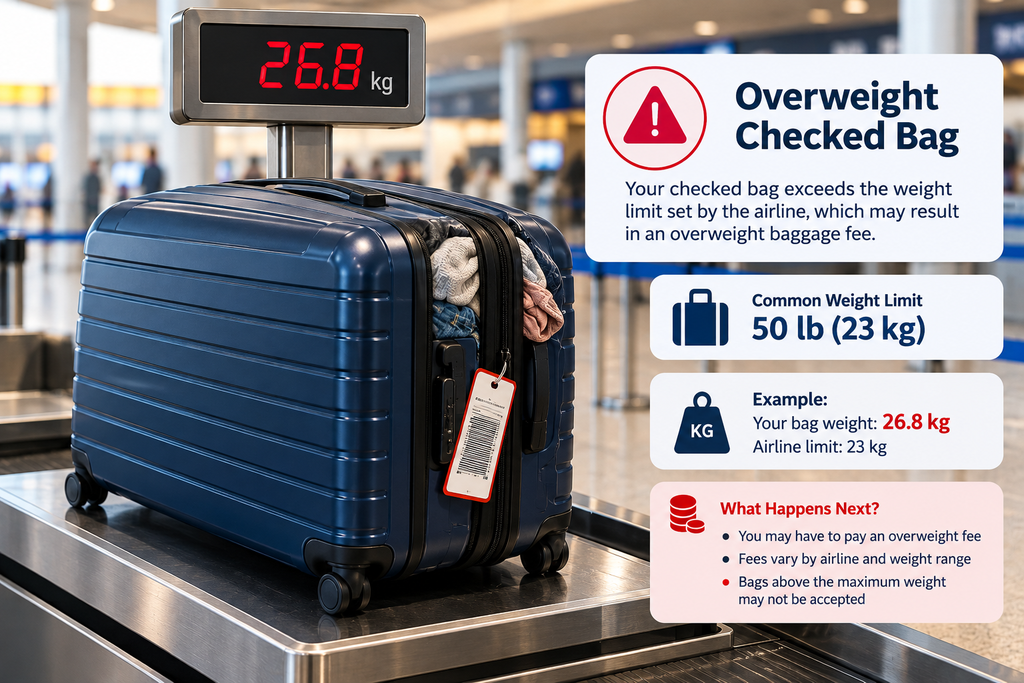
What Happens If Your Checked Bag Is Overweight?
An overweight bag exceeds the weight allowance attached to your ticket.
Suppose your allowance is:
1 checked bag × 23 kg
Your suitcase weighs:
27 kg
The suitcase might be perfectly acceptable in terms of size, but it is still overweight.
Depending on the airline, you may be able to pay an overweight fee, purchase additional weight, or move some belongings into another permitted bag.
However, airlines can impose an absolute maximum. British Airways, for example, permits up to 32 kg per checked bag in applicable cabins, while Frontier’s standard limit is much lower before additional charges apply.
Can You Have an Oversized and Overweight Bag?
Yes.
A suitcase can exceed both its permitted dimensions and its permitted weight.
For example, imagine a bag measuring 65 linear inches and weighing 58 pounds when your allowance is 62 inches and 50 pounds.
You have two separate issues:
- Oversized: 65 inches instead of 62
- Overweight: 58 pounds instead of 50
The airline may charge separately for the two conditions, subject to its baggage rules.
This is why simply paying an overweight fee at the airport does not automatically solve an oversized-bag problem.
Does the Airline Matter More Than the Suitcase?
When it comes to baggage rules, the airline matters enormously.
The same suitcase can be accepted without additional charges on one carrier and incur a fee on another.
Take Frontier and Delta as an example. Both use a 62-linear-inch dimensional limit, but Frontier’s standard checked-bag weight limit is 40 pounds, while Delta’s standard limit is 50 pounds.
So a 45-pound suitcase could meet both airlines’ size requirements but be treated differently because of the weight.
What Happens When Two Airlines Are on the Same Itinerary?
This is one of the easiest baggage details to overlook.
If your journey includes two or more airlines, you should not automatically assume that the first carrier’s baggage rules apply throughout the trip.
The applicable baggage rules can depend on the itinerary, ticket, marketing carrier, operating carrier, and applicable baggage provisions.
ANA, for example, specifically warns that another airline’s baggage rules may apply when an itinerary includes a flight operated by another carrier.
Example
Imagine you’re flying:
Delhi → Frankfurt → New York
with the first segment operated by one airline and the second by another.
Even if the whole journey appears under one booking reference, you should check the baggage allowance printed on the ticket and confirm which airline’s baggage rules apply.
This becomes especially important when the airlines use different baggage systems.
How to Avoid Checked Baggage Fees
You don’t necessarily need to travel with a tiny suitcase to avoid baggage charges. You simply need to know what your ticket actually includes.
Check Your Ticket Before Packing
Your booking confirmation is more useful than a generic baggage chart because it reflects the allowance associated with your itinerary.
Weigh Your Suitcase at Home
A basic luggage scale can save you from discovering an overweight bag at the check-in counter.
Measure the Outside of the Bag
Don’t measure only the suitcase body. Wheels and handles may count toward the airline’s dimensions.
Check Your Fare Type
A Standard Economy fare and a Basic Economy fare can have completely different baggage allowances on the same airline.
Check the Operating Carrier
This is particularly important for codeshare and connecting itineraries.
Consider Prepaying
Some airlines offer baggage purchases online before departure, sometimes at a lower price than paying at the airport.
Frontier, for example, explicitly encourages passengers to purchase bags in advance, while easyJet allows hold luggage to be added through Manage Bookings.
Can You Prepay for Checked Bags?
Many airlines allow you to purchase checked baggage before arriving at the airport.
The process and price vary.
For example, easyJet lets passengers add hold luggage through Manage Bookings, while Frontier allows passengers to purchase baggage during booking or before the flight.
If your airline offers different prices depending on when you purchase the bag, checking the online baggage option before heading to the airport can be worthwhile.
Checked Luggage vs. Carry-On: What’s the Difference?
The two are completely different baggage categories.
Checked luggage is handed over at the airline counter or bag drop and travels in the aircraft’s hold. You collect it after landing.
Carry-on luggage remains with you in the cabin and must meet the airline’s cabin-bag requirements.
A suitcase that is perfectly acceptable as checked baggage can be far too large to take onboard.
For example, a 28-inch suitcase may fit comfortably within a checked-baggage size limit but still exceed the airline’s carry-on dimensions by a considerable margin.
What Is the Maximum Weight for One Checked Bag?
There is no single maximum that applies to every airline.
32 kg (70 lb) is an important upper threshold used by many international carriers, particularly for premium cabins. But a 32 kg bag does not mean every passenger is entitled to check a 32 kg suitcase.
British Airways, for example, allows up to 32 kg per checked bag in Business and First, while Economy generally uses 23 kg.
Emirates similarly caps an individual bag at 32 kg under its weight concept even when the passenger’s overall allowance is higher.
If your bag exceeds an airline’s absolute maximum, you may need to redistribute the contents or use cargo services rather than simply paying an overweight fee.
Final Takeaway
There is no single checked-luggage rule that works across every airline.
62 linear inches and 50 pounds are useful benchmarks, but they are only benchmarks. Frontier uses a 40-pound standard, British Airways uses 90 × 75 × 43 cm, Virgin Atlantic uses the same dimensional format with cabin-specific weights, Emirates can use a total-weight system, and Ryanair sells checked baggage in specific weight options.
The safest routine is simple:
Check your ticket → check the airline → measure your suitcase → weigh it → check your route.
Do that before leaving home, and you’re far less likely to discover at the airport that your perfectly innocent-looking suitcase has become an oversized, overweight, and unexpectedly expensive piece of luggage
Frequently Asked Questions
A common standard is 62 linear inches (158 cm), calculated by adding length, width, and height. However, several airlines use different dimensional limits, so always check your carrier’s policy.
No. 62 linear inches is an airline baggage limit, not a physical suitcase size.
For example, a 28 × 20 × 14-inch suitcase totals 62 linear inches.
50 pounds (23 kg) is common among many airlines, but it is not universal. Frontier, for example, uses a 40-pound standard checked-bag limit.
They can. KLM, for example, explicitly includes handles and wheels in its 158 cm measurement. Check your airline’s specific measurement instructions.
Sometimes, but only when the airline and your fare permit it. A 70-pound bag is not automatically acceptable just because it is below a carrier’s absolute maximum.
Yes. Business and First Class passengers frequently receive higher baggage allowances than Economy passengers.
Not always. Many low-cost carriers sell checked baggage separately or include it only in certain fare bundles.
Many major airlines use 62 linear inches (158 cm), including Delta, Southwest, JetBlue, Alaska Airlines, Air Canada, Lufthansa, ANA, and others. However, the exact weight and number of bags included can differ.
Almost. 23 kg is approximately 50.7 pounds, although airlines commonly describe the allowance as 23 kg or 50 lb depending on their published rules.
Check the airline’s rules for each condition separately. You may need to pay both an overweight and oversized charge, repack the suitcase, or use another baggage option.
The applicable rules depend on your itinerary and ticket. Check your booking confirmation and the baggage conditions for the relevant carriers before traveling.