
9 Most Kid-Friendly Airports in the U.S. according to Studies
Traveling with children becomes considerably easier when an airport offers more than boarding gates and waiting areas. Dedicated play spaces, accessible restrooms, nursing rooms, family-friendly dining, and activities that occupy children during delays can make a meaningful difference.
The 2019 Upgraded Points study evaluated 50 major U.S. airports on amenities such as children’s play areas, entertainment, Wi-Fi, and lounges. Boston Logan International Airport ranked first, followed by Portland International Airport. The original study used passenger boarding data from 2018, so its findings represent a historical snapshot rather than a permanent ranking.
For families planning a trip now, the most useful question isn’t which airport scored highest in 2019, but which facilities remain available in the terminal they will actually use.
What Were the 9 Most Kid-Friendly Airports in the Current Study?
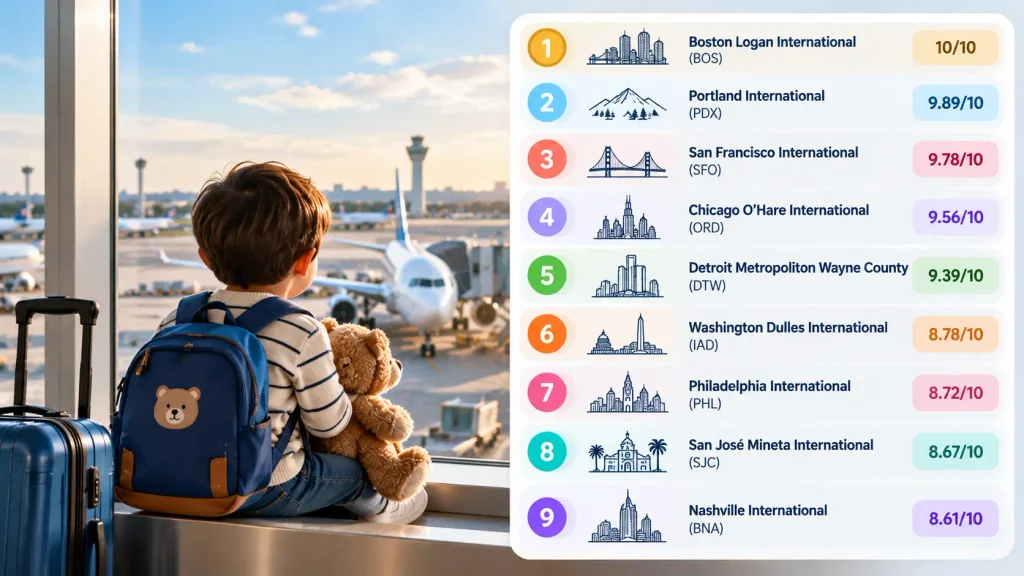
The 2019 study identified nine of the most kid-friendly airports and ranked them by family-focused amenities and services. Boston Logan International Airport topped the list, while Portland and San Francisco followed closely, reflecting their commitment to family-friendly travel experiences.
| Rank | Airport | Score |
| 1 | Boston Logan International (BOS) | 10/10 |
| 2 | Portland International (PDX) | 9.89/10 |
| 3 | San Francisco International (SFO) | 9.78/10 |
| 4 | Chicago O’Hare International (ORD) | 9.56/10 |
| 5 | Detroit Metropolitan Wayne County (DTW) | 9.39/10 |
| 6 | Washington Dulles International (IAD) | 8.78/10 |
| 7 | Philadelphia International (PHL) | 8.72/10 |
| 8 | San José Mineta International (SJC) | 8.67/10 |
| 9 | Nashville International (BNA) | 8.61/10 |
A Closer Look at the Nine Airports
Each of the nine kid-friendly airports offers distinct facilities designed to make family travel more convenient. From children’s play areas to nursing rooms and family restrooms, these airports provide amenities that help parents navigate journeys with young travelers.
1. Boston Logan International Airport (BOS)
Boston Logan earned the study’s only perfect score, reflecting the importance of dedicated play areas and family-oriented facilities.
Its standout attraction then was Kidsport, a collection of aviation-themed children’s spaces. Rather than leaving young passengers to sit at the gate, these environments encouraged imaginative play using miniature airport features and climbing structures.
For parents, the appeal is practical. A supervised play break before boarding gives children an opportunity to move around after check-in and security screening.
Family travel consideration: Logan has multiple terminals, and access between them is not always straightforward. Before planning a visit to a play area, check the current Massport terminal map and confirm that the facility is accessible from your departure gate.
2. Portland International Airport (PDX) — A Relaxed Airport Experience
Portland earned second place in the historical study, with its family-friendly reputation supported by play areas, entertainment, and opportunities to spend time outside conventional gate seating.
PDX stands out because its passenger experience goes beyond basic terminal facilities. Local food, art, and cultural identity can distract older children who have outgrown playgrounds.
For younger travelers, a play area often matters more than an elaborate airport lounge. School-age children can also be entertained by watching aircraft, browsing shops, or enjoying a short film.
Portland’s terminal has undergone major redevelopment since the study. Families should therefore rely on the current airport map rather than historical references to specific concourse play spaces or entertainment venues.
3. San Francisco International Airport (SFO) — Interactive Play and Learning
San Francisco International Airport stands out because its children’s attractions combine movement, art, and learning.
Unlike a conventional indoor playground, SFO’s Kids’ Spots include interactive installations inspired by nature, local wildlife, and visual art. The airport currently identifies seven post-security Kids’ Spots across its terminals.
Among the published locations are:
- Harvey Milk Terminal 1: A play area near Gate B2 and Tree Town near Gate B18.
- Terminal 2: The interactive Butterfly Wall near Gate D15 and Bird Encounters near Gate D7.
- Terminal 3: A climbing area near Gate F17, Spirogyrate near Gate E7, and another Kids’ Spot near the F-gate food court.
These attractions suit different ages. Toddlers may prefer padded areas and tactile objects, while older children can interact with mechanical art and musical installations.
SFO is especially useful for families who want to combine playtime with an educational activity without leaving the airport.
4. Chicago O’Hare International Airport (ORD) — Family Facilities at a Major Hub
O’Hare’s size can make connections challenging, particularly when children are tired or the itinerary involves a terminal change. Its family facilities provide useful alternatives to spending an entire layover seated near a boarding gate.
The airport’s current Family Lounge is located in Terminal 2, in the main hall near Gate F1, beyond security. It provides a children’s play space, seating, charging facilities, and stroller parking. The airport also reports occasional entertainment events.
O’Hare also lists nursing rooms and lactation pods across several terminals, making it easier for parents to find a suitable space before traveling.
Family travel consideration: Do not assume that a facility in Terminal 2 is convenient for every connecting itinerary. Check gate assignments and available transfer routes before deciding whether you have enough time to visit.
5. Detroit Metropolitan Wayne County Airport (DTW) — Visual Attractions for Children
Detroit Metropolitan Airport shows that an airport doesn’t need an extensive playground network to interest young travelers.
The 2019 study highlighted its distinctive water feature and illuminated pedestrian tunnel. These attractions offered something different from conventional children’s entertainment: visually engaging surroundings that could turn a routine walk through the terminal into an experience.
For children fascinated by moving lights, colors, and large indoor spaces, these features can make airport waiting time more interesting.
However, DTW’s terminal layout matters. The McNamara and Evans terminals serve different airline operations, so families shouldn’t assume they can reach every attraction from both.
Before departure, check the current terminal map and identify attractions along your actual route to avoid an unnecessary detour.
6. Washington Dulles International Airport (IAD) — Aviation-Themed Activities
Washington Dulles earned sixth place in the study, partly because of its aviation-themed children’s entertainment.
One historically notable attraction was a NASA-associated play area featuring flight- and space-exploration-inspired activities. This approach made airport entertainment relevant to the journey itself.
For a child who enjoys aircraft or space, aviation-themed activities can spark curiosity while breaking up the wait.
Dulles is also an airport where families should pay particular attention to distances between facilities. A connection may require movement between different concourses, and available time can quickly disappear during a terminal transfer.
Family travel consideration: Verify whether any advertised children’s attraction is currently operating and whether it is on the secure side of the airport accessible to your itinerary.
7. Philadelphia International Airport (PHL) — Entertainment Beyond Playgrounds
Philadelphia International Airport appeared in the 2019 top nine for its combination of aviation-themed activities, exhibitions, and seasonal entertainment.
Its historical children’s attractions included spaces designed around airport operations, allowing children to imagine themselves as pilots, ground crew, or air traffic controllers.
Philadelphia also has a public art tradition, which can be valuable for families traveling with older children. Artwork and exhibitions provide something to discuss and discover without requiring additional equipment or a lengthy activity.
However, seasonal entertainment is different from a permanent facility. An event promoted for summer or a holiday period should not be assumed to operate year-round.
Families planning to use PHL should check current airport events and the location of any children’s facilities relative to their departure concourse.
8. San José Mineta International Airport (SJC) — A More Manageable Airport Experience
San José Mineta International Airport was recognized in the study for its KidPort attraction and technology-focused public art.
The historical KidPort concept connected children’s play with an introduction to aviation. This distinction matters: an airport activity can entertain children while also helping them understand how airports and aircraft work.
For families, San José’s appeal also lies in a more manageable airport experience than navigating a much larger connecting hub.
That does not guarantee shorter security lines or faster boarding, but terminal size and walking distance are reasonable considerations when traveling with a stroller or several young children.
The KidPort facilities described in the original study should be treated as historical unless confirmed on the airport’s current amenities pages.
9. Nashville International Airport (BNA) — Music and Family Entertainment
Nashville International Airport offers a different kind of airport experience because of its connection to the city’s music culture.
The study recognized the airport for its live music, public art, and children’s play facilities. These attractions helped Nashville enter the top nine despite its different approach to family entertainment.
Live performances can be particularly appealing to school-age children who enjoy music, while younger children may benefit more from dedicated spaces where they can move around.
Nashville’s airport has also undergone substantial redevelopment since 2019. Therefore, check historical references to play areas, terminal arrangements, and performance locations against current information.
What Makes an Airport Kid-Friendly?
A children’s playground helps, but it is only one part of a family-friendly airport. Parents also need practical facilities that make feeding, changing, supervising, and moving with children easier.
| Facility | Why it matters for families |
| Children’s play areas | Allow young passengers to move around before boarding |
| Nursing and lactation rooms | Provide private spaces for feeding or expressing milk |
| Family restrooms | Make bathroom visits easier with young children |
| Changing stations | Support diaper changes during long journeys |
| Accessible terminal routes | Help families using strollers or mobility equipment |
| Family-friendly food options | Make it easier to accommodate children’s meal preferences |
| Quiet spaces | Offer a break from crowded and noisy waiting areas |
| Airport entertainment | Keep older children occupied during delays |
Not every facility matters equally to every family. Parents traveling with an infant may prioritize nursing rooms and changing stations, while those accompanying energetic preschoolers may value a play area more.
How to Choose the Best Airport When Flying With Kids
Choosing the best airport for families traveling with kids involves more than comparing flight options. Parents should consider child-friendly amenities, convenient terminal layouts, family restrooms, and available assistance services to ensure a smoother airport experience.
Consider the Age of Your Children
Children have different needs at different ages.
Infants generally require convenient feeding and changing facilities. Toddlers benefit from safe places to move around, while older children may enjoy aviation displays, art installations, or interactive exhibits.
For example, a six-year-old might find SFO’s Butterfly Wall interesting, while parents with a baby may prefer an airport with nursing facilities close to their assigned gate.
Check Where the Facilities Are Located
An airport may advertise excellent children’s amenities, but that does not mean they are accessible from every gate.
Some facilities are before security, while others are located within specific secure concourses. Changing terminals or visiting an area outside security may require additional screening.
Check three things before you plan: the facility’s terminal, its location relative to security, and the walk time from your departure gate.
Need to Know: A Family Guide to Staying at Universal Kids Resort Hotel
Allow Enough Connection Time
A playground should be an optional benefit, not the reason a family risks missing a connecting flight.
When choosing a connection, consider the time it takes to deplane, travel between gates, use restrooms, feed children, and board the next flight.
For a tight connection, it’s usually smarter to stay near the assigned gate than to visit a distant attraction.
Review Airline Policies Separately
Airport amenities and airline services differ.
An airport may provide family restrooms and children’s activities, but the airline determines many booking-related matters, including infant ticketing, stroller handling, baggage allowances, and boarding arrangements.
Essential Tips for Flying With Children
A little preparation can cut down on time spent searching for supplies or fixing avoidable issues at the airport.
- Keep essentials in your carry-on. Pack diapers, wipes, a change of clothes, necessary medications, snacks, and age-appropriate activities in easy-to-reach places.
- Understand TSA rules for baby food. Formula, breast milk, toddler drinks, and baby food may exceed the usual 3.4-ounce liquid limit in reasonable quantities. Inform security officers and expect separate screening.
- Check stroller and car-seat rules. Airlines have their own procedures for checking strollers and accommodating child restraints.
- Consider an approved child restraint. The FAA recommends that young children travel in their own seats using appropriate approved restraint systems rather than being held on an adult’s lap.
- Prepare for delays. Carry an extra activity, sufficient essential supplies, and a backup plan for meals or feeding.
- Locate family facilities early. Identify restrooms, nursing areas, and play spaces before settling at the gate.
For children who are sensitive to noise, crowds, or changes in routine, it may also help to explain the airport process before departure. Walking through check-in, security, and boarding can make unfamiliar procedures easier to understand.
Final Thoughts
The study highlights how thoughtful airport design can improve travel for families. Boston Logan led the original rankings, while Portland, San Francisco, Chicago O’Hare, and several other airports stood out for different types of children’s entertainment.
For today’s travel, treat these rankings as a starting point. Check the latest terminal maps, confirm the facilities you need are operating, and review your airline’s infant, stroller, seating, and baggage policies before you leave.
A convenient family restroom near your gate may ultimately be more valuable than a highly rated playground in another terminal.
Frequently Asked Questions
Boston Logan International Airport ranked first in the Upgraded Points 2019 study with a score of 10 out of 10. The ranking reflected the study’s evaluation of family-oriented airport amenities.
Many airport-operated play areas are available without a separate admission fee, but access and operating conditions vary. Some are located after security and are therefore accessible only to eligible passengers.
Yes. TSA permits formula, breast milk, toddler drinks, and baby food in quantities greater than the standard liquid limit. These items may require separate screening, so keep them accessible in your carry-on.
The Friendly Airports for Mothers Act established lactation-space requirements for covered airports. Parents should consult the airport’s current facilities guide to find the nearest available room or pod.
Many are designed for younger children, but age recommendations, equipment, and supervision requirements vary. Parents should inspect the play space and remain with their children.
Yes, where the lounge’s admission rules permit children. Access may depend on membership, ticket class, eligibility, guest limits, and age-based charges. Not every lounge has a dedicated family area.
A nonstop flight can reduce the inconvenience of changing aircraft, moving between terminals, and managing additional boarding procedures. However, departure time, journey length, ticket cost, and a child’s routine may also influence the better choice.