
5 Best Ways to Use Atmos Points for Travel
Atmos Rewards points, formerly Alaska Airlines Mileage Plan miles, offer strong value when redeemed for award flights on Alaska Airlines, Hawaiian Airlines, and eligible airline partners. The five best ways to use them include booking international business class, flying to Hawaii and Mexico, reserving short-haul award tickets, adding eligible international stopovers, and building multicity trips on Alaska Airlines.
The program is especially interesting for travelers who are flexible about airlines and routes. Its partner network includes carriers across the oneworld alliance and other global partnerships, opening up award options well beyond Alaska’s own route map. However, the required points depend on the route, distance, cabin, available award inventory, and applicable award rules.
Atmos Rewards launched as the combined loyalty program of Alaska Airlines and Hawaiian Airlines. Members can redeem points for eligible flights across a network serving more than 1,000 destinations, although not every partner flight or route is available for award booking.
Related: Alaska Adds 5 Korean Air Codeshare Routes in 2026
What Are Atmos Rewards Points Worth?
Atmos points do not have a fixed cash value. Their practical value depends on how many points an award flight costs versus the cash price of the same ticket, including taxes and fees.
NerdWallet estimated Atmos points at around 1.4 cents per point based on its August 2026 analysis of economy fares. That is a useful benchmark, not a guaranteed redemption value. Premium-cabin awards and carefully chosen partner routes may provide greater value, while an expensive award or a flight with substantial additional fees may deliver less.
1. Book Business-Class Flights to Europe and South America
International business-class awards can be one of the most appealing uses of Atmos points because premium-cabin cash fares are often expensive. Redeeming points may make lie-flat seats and long-haul journeys more accessible without paying the full published fare.
Atmos Rewards offers access to eligible award flights on partner airlines, including carriers that operate routes between North America, Europe, and South America. Examples include Aer Lingus, Iberia, and LATAM, subject to the program’s current booking arrangements and award availability.
Business-class awards to Europe
The published partner award charts use distance bands and show starting rates, not guarantees, for every route at the lowest price.
Examples from the current award-chart structure include:
| One-way flight distance | Example starting business-class award rate | Illustrative routes |
| 1,501–3,500 miles | 45,000 points | Boston–Madrid or Philadelphia–Dublin |
| 3,501–5,000 miles | 55,000 points | Dallas–Paris or Seattle–Helsinki |
Business-class awards to South America
South America can also offer worthwhile redemptions. Under the published award-chart examples, some business-class itineraries covering 2,101–4,000 miles start at 35,000 points one-way. Longer itineraries covering 4,001–6,000 miles start at 50,000 points one-way.
New York–Lima, Dallas–São Paulo, and Los Angeles–Santiago illustrate the kinds of routes travelers might investigate. However, the applicable distance band and award availability must be verified for the actual itinerary.
- Compare business-class award prices across eligible partner airlines.
- Search different dates, since award availability can vary considerably.
- Include taxes, fees, and positioning flights in the overall cost.
- Compare the points price with the cash fare for the same cabin.
- Check whether a connection changes the total distance and award price.
Business-class redemptions are particularly appealing when cash fares are high. However, travelers should not spend extra points on a premium cabin unless the comfort and convenience justify the difference.
2. Use Points for Flights to Hawaii and Mexico
Atmos points can also help with leisure travel, especially on eligible Alaska Airlines itineraries from the contiguous United States to Hawaii, Mexico, Central America, and the Caribbean.
Alaska’s own award pricing differs from the partner award charts. Certain destination groups have specific pricing rules, so a long flight does not necessarily cost the same as a similarly long partner itinerary. Check the published starting rates before paying cash for a vacation flight.
Hawaii award flights
Hawaii is a natural destination to consider for travelers who can connect through Alaska’s West Coast network. Eligible itineraries may offer competitive economy award prices, especially when cash fares rise during school holidays or peak travel periods.
For example, a traveler planning a Honolulu holiday could compare award seats from several mainland departure cities and check whether a connection through Seattle or another West Coast hub improves availability. The best choice depends on the total itinerary, travel dates, and current award pricing.
Mexico and other leisure destinations
Alaska also serves destinations in Mexico, parts of Central America, and the Caribbean. Depending on the origin and route, Atmos points may help reduce the cost of a beach trip or a longer leisure itinerary.
The key distinction is that a published starting price isn’t a guaranteed fare. Award prices can vary, and the lowest-priced seats may be limited or unavailable on popular dates.
When is this redemption worthwhile?
Consider using Atmos points for Hawaii or Mexico when:
- Cash fares are high for the dates you need.
- You can be flexible about departure dates or connecting airports.
- The award price compares favorably with the cash fare.
- You already have enough points and do not need to transfer or buy additional points at a poor rate.
For a family or group traveling during a busy holiday period, comparing several dates early may be more valuable than waiting for the ideal nonstop flight.
3. Book Short-Haul Flights for Fewer Points
Short-haul award tickets are another practical way to use Atmos points. They work well for domestic connections, regional trips, and journeys between nearby cities served by eligible partner airlines.
The partner award charts include starting rates as low as 4,500 points one-way for some short flights in the Americas. Other short-haul partner economy awards can start at 7,500 points, depending on the region and distance. Alaska-operated award flights have their own starting rates.
Why short flights can be a smart use of points
A short flight may require relatively few points but cost a surprising amount in cash, especially when booked close to departure or during a busy travel period. Redeeming points can be attractive if the cash fare is high relative to the award cost.
Short-haul awards also work well when a traveler needs to connect to a longer itinerary or plan a quick regional trip. However, if the cash fare is inexpensive, saving the points for a more expensive flight may be the better decision.
Compare the full journey.
A low-priced award is not automatically the cheapest way to travel. Before booking, consider:
- Taxes and fees on the award ticket.
- The cost of getting to the departure airport.
- Connection times and overnight stops.
- Whether the cash fare includes baggage or other benefits that matter.
- The value of keeping points for another trip.
For example, a 4,500-point flight with additional ground transportation costs may be less attractive than a slightly more expensive award from a convenient airport. Compare the entire trip rather than the points price alone.
4. Add an Eligible International Stopover
One distinctive feature of Atmos Rewards is the ability to include a stopover on eligible award itineraries. A stopover allows travelers to spend time in an intermediate city before continuing to their final destination, potentially turning one trip into a visit to two places.
On qualifying international partner awards, the program has offered one stopover on an eligible one-way itinerary, subject to routing and partner rules. The stopover must meet the program’s current conditions; it is not a blanket entitlement to add any city to any award.
How a stopover can improve a trip
Imagine a traveler flying from North America to Southeast Asia who wants to visit Hong Kong before continuing to another destination. If routing, partner availability, and award rules allow it, an eligible stopover may let you spend several days in Hong Kong before continuing your journey.
Similarly, a traveler heading to Asia could investigate a stop in a partner hub such as Tokyo. At the same time, a Europe-bound itinerary might offer options through an eligible hub such as Madrid or London.
The exact options depend on the operating carrier, origin and destination regions, route, and available award flights. Travelers should confirm that the intended stopover is permitted before finalizing the booking.
- Eligible routing: The stopover must comply with Atmos Rewards’ current routing rules.
- Partner availability: Each flight segment must have eligible award inventory.
- Total distance: The complete itinerary may affect the award price.
- Taxes and fees: Additional charges can differ by destination and operating airline.
- Travel documents: A stopover may require a visa or entry authorization, even when the traveler is otherwise in transit.
A stopover is most valuable when the intermediate city is a destination the traveler genuinely wants to visit. Don’t add it solely to make an itinerary look more rewarding if it creates inconvenient connections or extra expenses.
5. Build Multicity Trips on Alaska Airlines
Atmos points can also be used to create eligible multicity itineraries on Alaska Airlines. Depending on the route and applicable pricing rules, a traveler may be able to combine multiple destinations into one award journey for a points cost comparable to a simpler itinerary.
This option is particularly worth investigating when a trip already passes through Alaska’s West Coast network. Eligible routes may connect destinations across the western United States, Alaska, Hawaii, Canada, and Mexico.
How multicity awards work
Instead of searching for a basic one-way flight, travelers can look for an itinerary that includes a planned stop and a second destination. Award pricing depends on the total route and the applicable rules; not every combination will qualify for the same price.
For example, a traveler could search for a trip from Washington, D.C., to San Francisco, spend several days there, and then continue to Seattle. If the eligible itinerary prices favorably, combining the destinations may cost no more points than booking a comparable one-way journey to the first city.
The example illustrates a strategy rather than a guaranteed price. The traveler must verify the complete itinerary in the booking results.
How to find useful multicity awards:
- List the cities that fit naturally into the trip.
- Search the intended origin and final destination using the airline’s award-booking tools.
- Compare the multicity result with separate one-way awards.
- Check the points price and taxes for the full itinerary.
- Confirm connection times, baggage arrangements, and any restrictions on the chosen fare.
Multicity awards are most useful when the extra destination fits the travel plan. A longer itinerary may not be worth it if it creates an exhausting connection or adds hotel and transportation costs.
How to Book Flights With Atmos Rewards Points
Atmos members can search for award travel through the official Alaska Airlines or Hawaiian Airlines websites, depending on the itinerary and available booking options.
A straightforward process is:
- Sign in to the Atmos Rewards account.
- Enter the origin, destination, dates, and passenger details.
- Select the option to search using points.
- Compare available itineraries, cabins, points prices, and taxes.
- Review the operating airline and the award conditions.
- Confirm the total cost before completing the booking.
For partner flights, availability shown by one airline or booking channel may not match every other channel. If a preferred flight does not appear, try nearby dates or alternative routings and check whether the airline participates in Atmos award bookings for that route.
How to Earn More Atmos Points for Future Trips
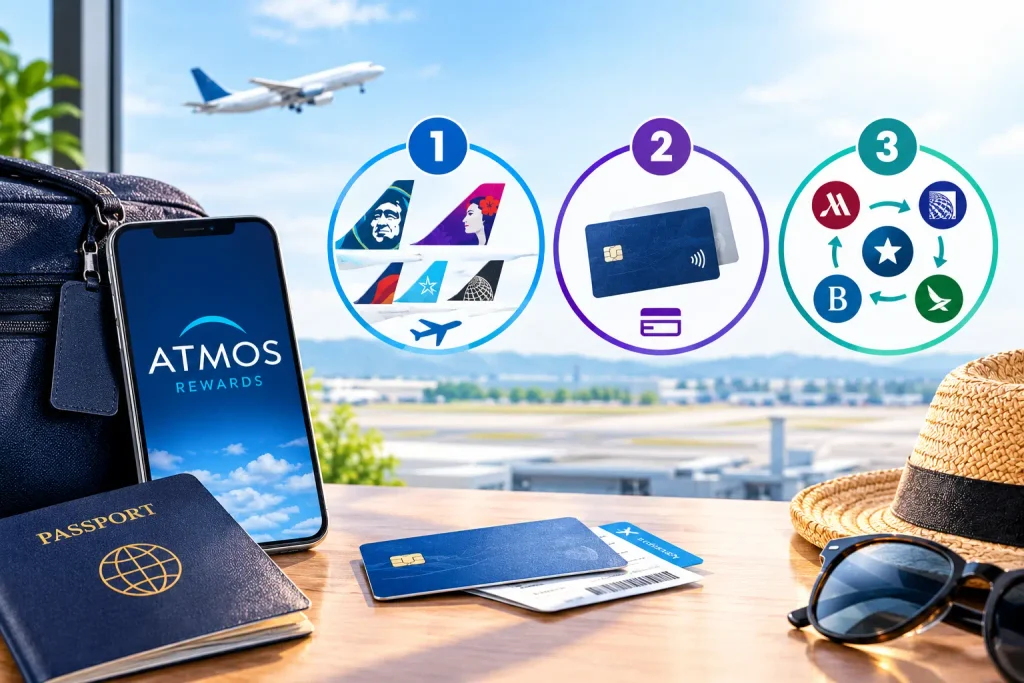
Travelers can build an Atmos balance through eligible flights, co-branded credit cards, and participating partners. The best earning method depends on how often they fly, their everyday spending, and which financial products are available.
Flying with Alaska, Hawaiian, and eligible partners
Members can earn points on qualifying flights with Alaska Airlines, Hawaiian Airlines, and participating partner airlines. Eligibility and earning rates depend on factors such as the airline, fare class, booking channel, and ticket details.
A program update taking effect for flights departing on or after January 1, 2027, allows members to choose how they earn points and status points: by distance traveled, price paid, or segments flown. Current members who do not select another method continue earning by distance; members joining on or after January 1, 2027, default to price paid unless they choose otherwise. The selection can be changed once per calendar year for future travel.
Using Atmos credit cards
Eligible Atmos Rewards credit cards can earn points on everyday purchases and may provide additional travel benefits. Earning rates, annual fees, and benefits vary by card, so compare current terms before applying.
Cardholders should avoid carrying a balance just to earn rewards. Interest and fees can outweigh the value of the points.
Transferring points from participating programs
Atmos has transfer relationships with select rewards programs. For example, Bilt Rewards points can transfer to Atmos at a 1:1 ratio, while Marriott Bonvoy points transfer at a 3:1 ratio under the published arrangements. Transfer partners, ratios, bonuses, and eligibility may change.
Before transferring, locate the award you want and confirm the final points requirement. Transfers may not be reversible, and moving points without confirmed award availability can leave a balance stranded in a program where it is less useful.
Common Mistakes to Avoid When Redeeming Atmos Points
Even a generous loyalty program can deliver poor value when you use points without comparing alternatives.
- Assuming every award costs the starting rate: Award charts list starting prices, not guaranteed prices for every date and flight.
- Ignoring taxes and fees: Cash charges can reduce the effective value of an award.
- Transferring points before checking availability: Confirm the intended flight can be booked before moving points from another program.
- Choosing a complicated itinerary for a small saving: Extra hotels, ground transport, and long layovers may outweigh the benefit.
- Treating points as cash: Their value varies by redemption and should be assessed against comparable cash fares.
- Overlooking partner restrictions: Not every flight operated by a partner is necessarily available as an Atmos award.
- Waiting too long to search: Popular routes and premium cabins may have limited award inventory, so flexibility and early searches can help.
Final Takeaway
Atmos Rewards points are most useful when travelers compare several award options rather than booking the first flight they find. International premium cabins may offer strong value, while short-haul flights and Hawaii or Mexico itineraries can make practical use of smaller balances. Eligible stopovers and multicity trips offer additional ways to structure a journey around destinations the traveler wants to visit.
Before redeeming, compare the cash fare, points price, taxes, and routing rules. For partner awards, confirm availability and eligibility directly through Atmos Rewards’ official booking channels. That extra check can help ensure you’re using points for a trip that is genuinely worth the cost.
Frequently Asked Questions
Yes. Alaska Airlines replaced the Mileage Plan with Atmos Rewards, the combined loyalty program for Alaska Airlines and Hawaiian Airlines. Existing members use the Atmos Rewards program to earn and redeem points under its current rules.
International business-class awards, short-haul flights, Hawaii and Mexico trips, eligible stopovers, and multicity itineraries are all worth investigating. The best option is the one that provides the strongest value for the traveler’s actual dates and route.
Award flights can start at 4,500 points one-way on eligible partner routes, while Alaska-operated flights have separate starting rates. The final number depends on distance, region, cabin, route, and available award inventory. Taxes and fees may still apply.
Yes. Members can redeem points on eligible Alaska and Hawaiian flights and participating partner airlines. The available airlines and routes are subject to current program rules and award inventory.
It depends on the cash fare, award price, and traveler’s priorities. Economy may be practical for inexpensive flights, while business class can offer strong value when cash fares are high. Compare the same itinerary in cash and points before booking.
Eligible itineraries may permit a stopover under Atmos Rewards’ current rules. Routing, partner, regional, and award conditions apply, so travelers should verify the intended stopover during booking.
Atmos Rewards points generally do not expire as long as the account remains subject to the program’s current terms. Members should review the official rules for account activity, account closure, and other circumstances that may affect points.