
Why Autumn Is a Great Time to Travel Across Europe
Autumn can be an appealing season for European travel because many destinations have cooler temperatures, lighter crowds, colorful landscapes, seasonal festivals, and potentially lower travel costs than during peak summer. September, October, and November bring a different experience across the continent, ranging from wine harvests and fall foliage to cultural events and quieter historic attractions.
Autumn is traditionally part of Europe’s shoulder season, although its growing popularity means lower prices are no longer guaranteed everywhere. Current travel data shows meaningful savings in some European destinations while prices remain steady or even increase elsewhere.
The season therefore provides more than a simple budget alternative to summer. Weather, local events, destination type, and travel dates can all determine whether an autumn European trip offers better overall value.
Read This Too: Europe’s Best Christmas Markets for a Festive 2026 Trip
5 Reasons to Visit Europe in Autumn
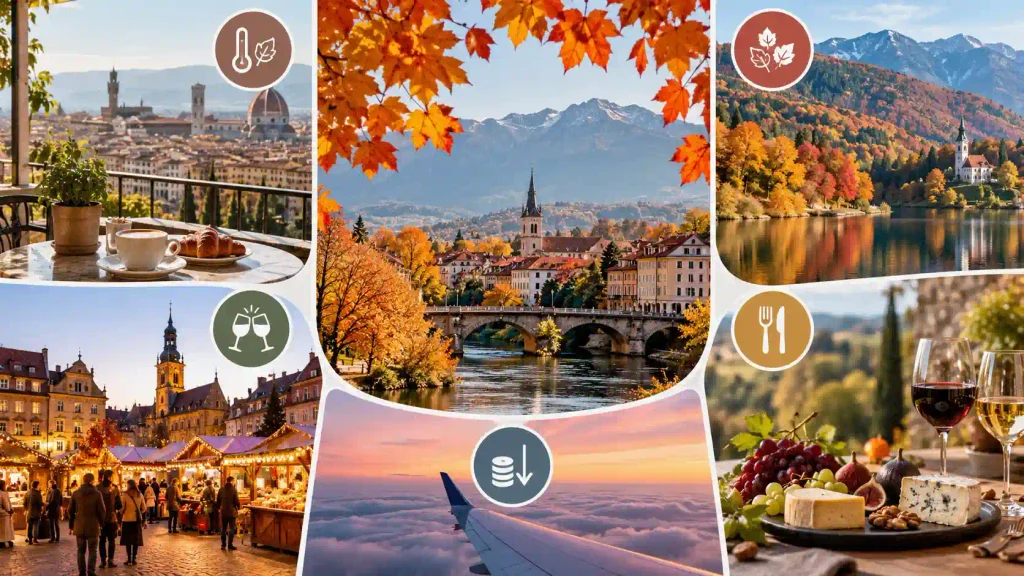
Europe changes considerably after the busiest summer months.
Five factors make autumn particularly notable:
- Cooler weather and potentially smaller crowds
- Attractive fall landscapes and foliage
- Seasonal festivals and cultural events
- Harvest-season food and wine experiences
- Potentially lower flight and accommodation prices
These advantages vary by country and month, making destination selection particularly important.
1. Cooler Weather and Lighter Crowds
Autumn generally brings milder temperatures and fewer peak-season visitors to many European destinations.
July and August are among the busiest periods for much of Europe. Popular beaches, historic centers, museums, and major attractions can experience substantial visitor numbers during those months.
By September and October, the peak summer tourism wave begins to ease in many destinations. Lonely Planet describes September and October as periods with thinning crowds and mild conditions, with September temperatures commonly ranging from approximately 59°F to 77°F across the destinations it highlights.
The difference can be particularly noticeable in destinations such as:
- Rome
- Madrid
- Lisbon
- Paris
- Dubrovnik
- Athens
- Seville
- Vienna
Southern European destinations can remain relatively warm well into autumn, while northern and central Europe generally cool more quickly.
Southern Europe Can Stay Warm
Autumn does not automatically mean cold conditions throughout Europe.
Parts of:
- Spain
- Portugal
- Italy
- Greece
- Croatia
- Southern France
can retain relatively mild or warm weather during September and early October.
This creates opportunities for sightseeing without the most intense summer temperatures.
Some Mediterranean coastal destinations can also retain suitable conditions for outdoor activities later into the season, although rainfall and temperature patterns become less predictable as autumn progresses.
European Cities Become Easier to Explore
Milder weather can make walking-intensive city trips more comfortable.
Destinations such as Paris, Vienna, Madrid, Lisbon, Rome, and Budapest contain major attractions spread across large urban areas. Cooler conditions can make long days of walking, outdoor dining, and sightseeing more manageable.
Autumn also brings shorter daylight hours, particularly later in October and November, so daily sightseeing schedules may require additional planning.
2. Europe Displays Impressive Autumn Scenery
Fall foliage transforms forests, parks, vineyards, mountains, and historic cities across many parts of Europe.
The timing varies considerably according to elevation, latitude, and local weather.
Depending on the region, autumn colors can appear from September through November.
Popular areas for seasonal landscapes include:
- Bavaria in Germany
- The Scottish Highlands
- The Swiss Alps
- Austria’s alpine regions
- France’s Loire Valley
- Tuscany in Italy
- Slovenia
- Transylvania in Romania
- Madrid’s Retiro Park
- European wine regions
Lonely Planet specifically highlights autumn in regions such as Burgundy, the Loire Valley, Portugal’s Douro Valley, and Tuscany, where changing foliage coincides with the grape harvest.
Vineyards Are Particularly Scenic in Autumn
European wine regions can be especially distinctive during harvest season.
Vineyard landscapes transition from summer green to shades of yellow, orange, and red.
Notable wine regions include:
- Tuscany, Italy
- Burgundy, France
- Bordeaux, France
- Douro Valley, Portugal
- La Rioja, Spain
- Rhine Valley, Germany
- Wachau Valley, Austria
Harvest schedules differ by grape variety, region, elevation, and annual weather conditions.
3. Autumn Brings Major European Festivals and Events
Autumn is a major cultural-event season across Europe, with festivals centered on music, food, wine, film, history, and regional traditions.
One of the most internationally recognized events is Munich’s Oktoberfest.
The official Oktoberfest website confirms that the 191st Oktoberfest runs from September 19 through October 4, 2026, at Munich’s Theresienwiese.
Other autumn events can include:
- Film festivals
- Jazz festivals
- Fashion weeks
- Wine festivals
- Food celebrations
- Harvest festivals
- Halloween events
- Local fairs
- Football matches
- Cultural exhibitions
Event dates vary each year, making advance schedule checks important.
Oktoberfest in Munich
Oktoberfest is one of Europe’s most prominent autumn events.
The 2026 festival began September 19 and continues through October 4.
Traditional events include the opening ceremony, costume and marksmen’s parade, festival church service, tent-band concert, and closing-day gun salute.
Accommodation demand in Munich can be exceptionally high during the festival, demonstrating why autumn does not always mean lower prices.
Food Festivals Become Common During Harvest Season
Autumn also brings smaller regional festivals centered on local ingredients.
Events across Europe celebrate products such as:
- Grapes
- Wine
- Apples
- Cider
- Truffles
- Mushrooms
- Olives
- Chestnuts
- Pistachios
- Seafood
These celebrations can provide a closer connection to regional food traditions than a conventional sightseeing itinerary.
4. Autumn Is Harvest Season Across Europe
September through November coincides with important harvest periods in many European agricultural regions.
Grape harvests are particularly prominent.
Wine-producing destinations in France, Italy, Spain, Portugal, Germany, and Austria become active during this period as vineyards collect grapes and begin producing new vintages.
Lonely Planet identifies September and October as particularly notable for wine harvests and highlights regions including Burgundy, the Loire Valley, Douro Valley, and Tuscany.
Seasonal Foods Become Part of the Experience
Autumn menus can feature ingredients associated with local harvests.
Depending on the destination, seasonal foods may include:
- Truffles
- Wild mushrooms
- Chestnuts
- Pumpkins
- Apples
- Pears
- Grapes
- Olives
- Game
- Fresh wine
Food-focused trips can therefore extend beyond major cities into rural regions and smaller towns.
5. Flights and Hotels Can Cost Less — But Not Everywhere
Autumn can provide lower travel prices than peak summer, but the savings depend heavily on the destination and exact travel dates.
This distinction is increasingly important because shoulder-season travel has become more popular.
Expedia data reported by Euronews in August 2026 found that hotel rates outside the U.K. tended to decline by an average of approximately 7% during autumn. Some destinations—including parts of the Algarve and Greek islands—showed reductions of as much as 30%.
However, the same research found autumn hotel prices increasing in some U.K. cities.
November international stays were approximately 10% cheaper than summer on average in the Expedia data.
The conclusion is therefore more nuanced than simply describing autumn as Europe’s cheap season.
Flight Prices Can Depend on the Week
Flight prices can fluctuate considerably throughout the shoulder season.
KAYAK data reported in August 2026 showed that autumn airfare varied significantly according to the travel week. Late October could provide better value on certain routes, while other periods experienced higher prices.
Travel dates around major events and school holidays can also increase demand.
Award Flights May Have Better Availability
Lower seasonal demand can sometimes make airline award seats easier to find.
The Upgraded Points reference identifies autumn availability through programs such as Flying Blue and Iberia Plus as examples of opportunities that can occur during lower-demand periods.
However, award pricing is dynamic on many airlines.
A specific mileage price should therefore be treated as itinerary- and date-dependent rather than a guaranteed autumn rate.
Is Europe Less Crowded in Autumn?

Many European destinations experience lower visitor numbers after the summer peak, particularly from late September onward.
However, major festivals and events can create localized crowds.
Examples include:
- Oktoberfest in Munich
- Major football matches
- Fashion weeks
- Film festivals
- School holidays
- Harvest celebrations
Popular cities such as Paris, Rome, Barcelona, and London also attract substantial tourism throughout the year.
Autumn therefore generally offers a reduction from peak summer congestion rather than empty attractions.
Is Europe Cheaper in Autumn?
Europe can be cheaper during autumn, but price reductions are not universal.
The strongest savings are often found in destinations where summer is the primary tourism season.
Examples can include:
- Greek islands
- Portugal’s Algarve
- Mediterranean beach destinations
- Certain Croatian destinations
- Some secondary European cities
Expedia’s 2026 data found autumn hotel rates outside the U.K. averaging around 7% below summer levels, while individual destinations recorded much larger reductions.
At the same time, major festivals, sporting events, conferences, and school holidays can increase accommodation prices.
September vs. October vs. November in Europe
Each autumn month provides a different travel environment.
| Month | Typical Advantages | Possible Drawbacks |
| September | Warmer weather, harvest season, long daylight | Some destinations remain busy |
| October | Strong fall colors, cooler temperatures, festivals | Increasing rain and shorter days |
| November | Potentially lower prices, lighter crowds | Colder weather and limited daylight |
Europe in September
September often functions as a transition between summer and autumn.
Mediterranean destinations can remain warm, while wine regions begin harvest activities.
The month can suit:
- Hiking
- Cycling
- Coastal trips
- Wine-region visits
- City breaks
Lonely Planet identifies September as particularly suitable for outdoor activities because of generally mild conditions.
Europe in October
October brings more noticeable autumn colors across many regions.
Euronews describes October 2026 as a period when temperatures cool across popular destinations, and autumn colors become increasingly visible.
The month can be suitable for:
- Fall foliage
- City sightseeing
- Food festivals
- Wine regions
- Cultural events
- Countryside trips
Weather becomes less predictable, particularly in northern Europe.
Europe in November
November typically brings cooler temperatures, fewer daylight hours, and lower tourism demand in many destinations.
Expedia’s 2026 data found international accommodation approximately 10% cheaper in November than during summer on average.
Late November can also mark the beginning of the Christmas market season in some European cities.
Best European Destinations for Autumn Travel
The ideal destination depends on the type of seasonal experience.
| Destination | Autumn Highlight |
| Munich, Germany | Oktoberfest and Bavarian culture |
| Tuscany, Italy | Vineyards, harvest season, countryside |
| Douro Valley, Portugal | Wine harvest and landscapes |
| Paris, France | City breaks and seasonal parks |
| Vienna, Austria | Culture, cafés, and cooler sightseeing weather |
| Madrid, Spain | Mild weather and urban parks |
| Lisbon, Portugal | Relatively mild autumn conditions |
| Slovenia | Mountains, lakes, and fall foliage |
| Scottish Highlands | Dramatic autumn scenery |
| Transylvania, Romania | Forest landscapes and seasonal atmosphere |
There is no single best autumn destination because weather conditions and seasonal priorities differ substantially across Europe.
Also Worth Reading: How to Find Great Travel Deals on Travelzoo In 2026
What Is the Weather Like in Europe During Autumn?
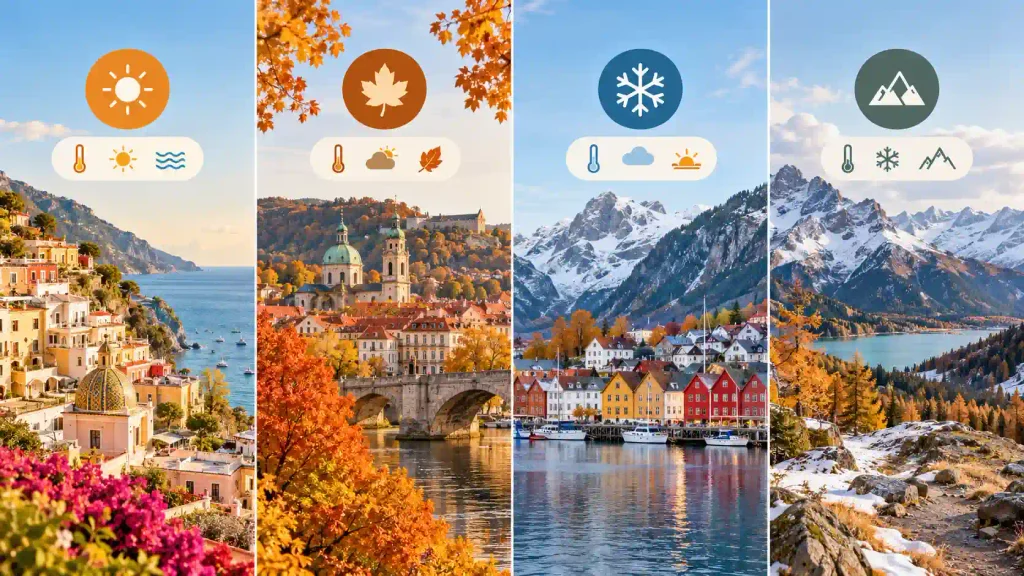
European autumn weather varies dramatically by region.
Southern Europe
Spain, Portugal, Italy, Greece, and other Mediterranean destinations generally retain warmer conditions longer.
September can still feel summer-like in some locations.
Central Europe
Germany, Austria, Switzerland, Czechia, Hungary, and surrounding areas generally transition toward cooler conditions through September and October.
Fall foliage can become a major attraction.
Northern Europe
Scandinavia, Scotland, the Baltic region, and other northern areas experience colder temperatures and rapidly shortening daylight hours.
Mountain Regions
Higher elevations can experience early snowfall and sudden weather changes.
Some summer hiking infrastructure also begins closing as winter approaches.
What Are the Drawbacks of Visiting Europe in Autumn?
Autumn travel has several potential disadvantages.
Weather becomes less predictable. Rain, wind, and sudden temperature changes become increasingly common later in the season.
Daylight decreases. Northern Europe experiences particularly noticeable reductions in daylight.
Seasonal attractions may close. Beach clubs, ferry routes, restaurants, and tourism services in highly seasonal destinations may operate reduced schedules.
Major events can raise prices. Oktoberfest and other major festivals can make accommodation considerably more expensive.
Fall foliage timing varies. Peak colors depend on location and annual weather patterns.
Coastal weather becomes less reliable. Mediterranean destinations may remain warm, but beach conditions cannot be assumed throughout autumn.
These factors make itinerary planning particularly important.
Tips for Planning an Autumn Trip to Europe
Several practical considerations can help with autumn travel planning:
- Compare September, October, and November prices separately.
- Check local event calendars before reserving accommodation.
- Verify seasonal opening hours for attractions.
- Prepare for changing weather conditions.
- Consider southern Europe for warmer temperatures.
- Consider central and northern Europe for stronger fall foliage.
- Review train, ferry, and seasonal transport schedules.
- Compare cash and points rates independently.
- Check daylight hours for outdoor itineraries.
- Reserve accommodation early around major festivals.
Autumn should not automatically be treated as the cheapest period. Comparing exact dates remains more reliable than assuming every shoulder-season itinerary provides savings.
Final Thoughts
Autumn provides a distinctive alternative to Europe’s peak summer travel season, combining cooler weather, changing landscapes, harvest traditions, cultural festivals, and potentially lower travel costs.
September can retain warmer conditions while introducing wine harvests and lighter crowds. October brings stronger fall colors and seasonal events, while November can provide lower tourism demand and potentially better accommodation value.
Current 2026 pricing data also shows that the traditional shoulder-season discount still exists in some destinations but should not be considered universal. Hotels in parts of southern Europe can become substantially cheaper after summer, while other destinations may experience little reduction or even higher rates.
Destination, travel dates, local events, and weather conditions ultimately determine the advantages of an autumn European trip.
Frequently Asked Questions
Autumn can provide milder weather, lighter crowds, fall foliage, harvest events, and potentially lower prices in many European destinations. Conditions vary significantly by country and month.
Meteorological autumn covers September, October, and November.
Some destinations are cheaper, but not all. Expedia data reported in 2026 found hotel rates outside the U.K. averaging around 7% lower in autumn, with considerably larger savings in some destinations.
Many destinations become less crowded after the peak July and August travel period, although major cities and festival destinations can remain busy.
September generally provides warmer weather, October offers stronger fall scenery, and November can bring lighter crowds and potential savings. The best month depends on the destination and purpose of the trip.
Southern Spain, Portugal, southern Italy, Greece, and other Mediterranean destinations generally retain warmer temperatures longer than northern and central Europe.
Popular regions include Bavaria, the Alps, Tuscany, the Loire Valley, Slovenia, Scotland, Austria, and parts of Germany and Romania.
Munich’s official Oktoberfest runs from September 19 through October 4, 2026.
Some destinations remain busy during September, particularly Mediterranean locations. Crowds generally decline as the month progresses, although local events can increase demand.
October can offer cooler sightseeing weather, fall scenery, and cultural events. Rainfall and shorter daylight hours become more important considerations later in the month.
Some are. Expedia data cited by Euronews found international stays averaging approximately 10% less in November than during summer, although individual destinations vary.
Layered clothing, a weather-resistant outer layer, comfortable walking footwear, and rain protection can accommodate the variable conditions common during European autumn.