
Best Hotel Booking Sites for Cheap Rates: 2026 Guide
No single hotel-booking website is consistently the cheapest, so travelers should compare several platforms and choose based on the final price, cancellation terms, loyalty benefits, and booking conditions. Hotel rates can differ by site, date, room type, membership status, currency, and included taxes or fees.
The major options fall into two broad categories: online travel agencies (OTAs), where travelers can complete the reservation, and metasearch sites, which compare rates from multiple providers before sending the traveler elsewhere to book. Understanding that difference is one of the easiest ways to avoid paying more than necessary.
This 2026 guide examines 17 widely used hotel-booking websites and explains what each platform is useful for, where its potential savings come from, and what travelers should check before paying.
Hotel Booking Websites vs. Hotel Search Engines
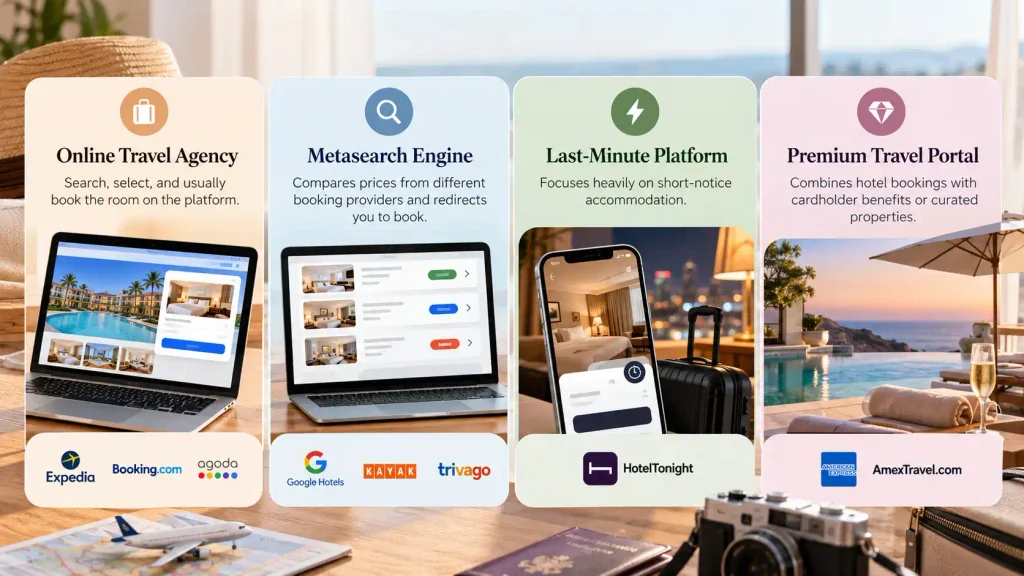
Before comparing individual websites, it helps to understand how they work.
| Type | How it works | Examples |
| Online travel agency | Search, select, and usually book the room on the platform | Expedia, Booking.com, Agoda |
| Metasearch engine | Compares prices from different booking providers and redirects travelers to book | Google Hotels, Kayak, Trivago |
| Last-minute platform | Focuses heavily on short-notice accommodation | HotelTonight |
| Premium travel portal | Combines hotel bookings with cardholder benefits or curated properties | AmexTravel.com |
A metasearch site can therefore be an excellent starting point, while an OTA or the hotel’s own website may be where the actual reservation is completed.
1. Kayak
Kayak is a metasearch engine that compares hotel rates from numerous travel websites. Its hotel search includes filters for price, cancellation, breakfast, ratings, and location.
One particularly useful feature is its map-based search, which allows travelers to compare hotel prices while seeing where properties are located. This matters in cities where a supposedly cheap hotel may be far from the attractions or business district.
Best use: Comparing several booking providers at once.
Watch for: The lowest rate a comparison site shows may not be the hotel’s direct rate, so check the final checkout price.
2. Expedia
Expedia is an OTA with hotels, flights, cars, vacation packages, and a unified One Key rewards program.
Members can receive Member Prices on eligible properties, while OneKeyCash can be earned on eligible travel purchases and used toward qualifying future travel. Expedia states that Member Prices are available only on selected properties and dates and can change.
Expedia can become particularly interesting when a traveler is booking more than just a hotel. Package pricing can sometimes produce a different total from purchasing each component separately.
Best use: Hotel searches combined with flights, cars, or package travel.
Watch for: A cheap room rate may have different cancellation or payment conditions from another rate at the same property.
3. Priceline
Priceline is known for standard hotel bookings and its Express Deals. Priceline currently advertises savings of up to 60% on qualifying Express Deal bookings, although actual savings vary.
Express Deals are especially relevant for travelers willing to sacrifice some certainty for a potentially lower price. The exact hotel may not be disclosed before booking.
Priceline also operates its VIP rewards program and offers package bookings.
Best use: Flexible travelers comfortable with opaque hotel deals.
Watch for: Nonrefundable or restrictive terms on certain discounted rates.
4. Momondo
Momondo is a metasearch platform that compares hotel rates from different booking providers.
The main advantage of a site like Momondo is that it can reveal pricing differences that may not be obvious when a traveler searches only one OTA. Travelers are redirected to another provider to complete the reservation.
Best use: A second price check after searching another booking platform.
Watch for: The booking relationship is ultimately with the provider to which Momondo redirects the traveler.
5. Booking.com
Booking.com offers hotels, apartments, hostels, guesthouses, vacation homes, and other accommodation types.
Its Genius loyalty program is a major selling point. Booking.com says Level 1 provides 10% discounts on participating stays, while higher levels can offer additional discounts and selected perks such as breakfast or room upgrades.
This can make the logged-in price materially different from the standard public rate for an eligible property.
Best use: Travelers wanting a broad range of accommodation types and recurring member discounts.
Watch for: Genius discounts generally apply to participating properties and are calculated before applicable taxes and fees.
6. Hotels.com
Hotels.com is part of the Expedia Group and now operates within the One Key rewards ecosystem.
Hotels.com promotes Member Prices on selected properties and dates. Its current rewards structure allows eligible travelers to earn OneKeyCash for future travel, with the exact earning rate depending on the booking and applicable terms.
The platform remains especially relevant for travelers who prefer a hotel-focused booking experience rather than managing several different hotel-chain loyalty programs.
Best use: Travelers who regularly book through Hotels.com and value its rewards ecosystem.
Watch for: Third-party bookings can have different hotel loyalty benefits from direct bookings.
7. Orbitz
Orbitz provides hotel bookings alongside flights, rental cars, vacation packages, and other travel products.
Because it participates in the broader Expedia Group ecosystem, travelers may encounter similar One Key-related benefits across participating brands. The platform can also help you compare the cost of booking a hotel alone with a bundled itinerary.
Best use: Travelers considering hotel-and-flight or other package combinations.
Watch for: The cheapest standalone hotel rate is not automatically the best value if another booking method includes stronger cancellation terms or rewards.
8. Hotwire
Hotwire specializes in discounted travel, particularly its Hot Rate hotel products.
Hotwire explains that Hot Rate bookings can conceal the property’s name and exact address until after booking. Travelers generally see information such as the area, star rating, customer rating, and amenities before committing.
That model allows hotels to sell otherwise unsold inventory without publicly advertising the same rate under their own name.
Best use: Flexible travelers who care more about price and hotel category than knowing the exact property in advance.
Watch for: The reduced price comes with reduced certainty, and terms can be restrictive.
9. AmexTravel.com
American Express Travel is particularly relevant to eligible American Express cardholders.
The portal offers standard hotel bookings as well as premium programs including Fine Hotels + Resorts and The Hotel Collection. American Express currently lists more than 1,900 Fine Hotels + Resorts properties, with benefits for eligible Platinum Card members that can include breakfast for two, a property credit, room upgrades when available, and guaranteed 4 p.m. checkout.
For a premium stay, comparing the total value of these benefits can matter more than choosing the lowest nightly rate.
Best use: Eligible Amex cardholders seeking premium hotel benefits.
Watch for: Program eligibility, minimum stays, card requirements, and property-specific terms.
Don’t Miss This Guide:
Amex Business Platinum Card Perks, Fees & Rewards 2026
10. Agoda
Agoda is an international OTA with particularly broad accommodation coverage across Asia, while also offering hotels and other stays worldwide.
Agoda operates its own rewards ecosystem, including AgodaCash, although its terms state that AgodaCash is not cash and that its value or availability is determined under Agoda’s applicable rules.
Its accommodation search can include hotels, homes, hostels, and other property types.
Best use: Comparing accommodation prices, particularly for destinations where Agoda has strong inventory.
Watch for: Compare the final payable amount rather than focusing only on the headline nightly rate.
11. Travelocity
Travelocity is another established OTA offering hotels, vacation packages, flights, and other travel products.
Its member pricing can make logged-in rates different from publicly displayed prices, while package bookings may produce different overall pricing from standalone reservations.
Best use: Travelers comparing hotel-only and package options.
Watch for: Check cancellation rules and inclusions before comparing the rate with another site.
12. Tripadvisor
Tripadvisor is useful because it combines hotel research with traveler reviews and price comparison.
Rather than simply looking for the smallest number, travelers can use Tripadvisor to examine reviews, photos, location information, and available booking rates. It can then direct users to a booking provider.
Best use: Researching a hotel before deciding where to book.
Watch for: A displayed price may not represent the final amount after all applicable taxes, fees, or booking conditions, so the partner’s checkout page should be reviewed.
13. Google Hotels
Google Hotels is a metasearch service built into Google Travel.
Travelers can search by destination, dates, neighborhood, hotel name, or requirements such as pet-friendly accommodation. Google displays hotel listings on a map and can show prices from hotel websites, OTAs, and other booking partners.
Google also provides price and value information, including deal indicators based on comparisons with historical and nearby hotel pricing.
Best use: Getting a broad snapshot of current hotel pricing.
Watch for: Google does not handle the reservation itself; the booking partner generally handles changes, cancellations, and refunds.
14. Skyscanner Hotels
Skyscanner is better known for flights, but it also provides hotel searches and price comparisons.
Its hotel search can help travelers already using Skyscanner build an itinerary. Like other metasearch platforms, travelers generally move to another provider to complete the booking.
Best use: Comparing accommodation while researching flights and trip dates.
Watch for: Filtering depth and available providers can differ by destination.
15. HotelTonight
HotelTonight focuses heavily on short-notice hotel reservations.
That makes it different from a general OTA. A traveler who suddenly needs accommodation for the same night or the next few days may find HotelTonight worth checking alongside standard booking sites.
Best use: Last-minute stays.
Watch for: Availability depends heavily on destination, date, and remaining hotel inventory.
16. Hopper
Hopper is a travel-booking platform known for its app-based approach and price-focused tools.
Hopper can help travelers who want to monitor pricing and use app-based travel features. Its hotel products and optional services can differ from those offered by conventional hotel-search websites.
Best use: Mobile-first travelers interested in price monitoring and booking tools.
Watch for: Review the checkout screen carefully for optional products, fees, and the exact terms attached to the reservation.
17. Trivago
Trivago is a hotel metasearch engine that compares prices from hundreds of websites.
It can be useful as a final cross-check because the same hotel may appear with rates from several different booking providers. Trivago itself generally helps travelers compare rather than serving as the primary booking provider.
Best use: Quickly checking whether another provider is advertising a lower rate.
Watch for: The highlighted or featured price isn’t necessarily the cheapest option, so travelers should open the available offers and compare them carefully.
Don’t Miss This Guide:
Trivago Hotels: How to Search & Compare Hotel Prices
Which Hotel Booking Website Is Actually Cheapest?
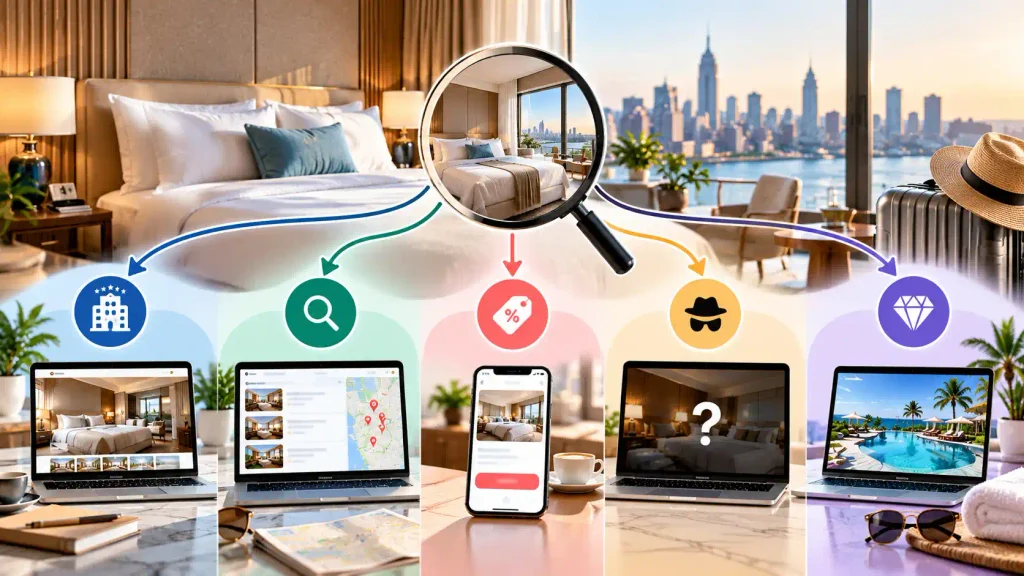
There is no permanent cheapest website. Hotel pricing is dynamic, and the lowest rate can change according to destination, dates, room type, occupancy, cancellation terms, currency, taxes, promotions, and membership status.
For example, a traveler searching for a hotel in New York for three nights might see:
| Platform type | What the traveler may find |
| Hotel website | Standard rate plus loyalty benefits |
| Metasearch engine | Several providers with different prices |
| OTA | Member or app-exclusive rate |
| Opaque-deal site | Lower rate with limited hotel information |
| Premium travel portal | Similar room price plus additional benefits |
The important comparison, then, is not simply $150 versus $145.
If the $150 rate includes free cancellation and breakfast while the $145 rate is prepaid and nonrefundable, the cheaper headline price may not provide the better overall fit.
How to Compare Hotel Prices Properly
1. Search the same room
Compare the same:
- Hotel
- Dates
- Number of guests
- Room category
- Bed configuration
- Meal plan
- Cancellation terms
- Payment conditions
A $120 standard room and a $135 breakfast-included room are not equivalent rates.
2. Compare the total price
Taxes and mandatory fees can substantially change the final amount. Google says its hotel partners must submit prices that include taxes and fees under its Price Accuracy Policy, although rates can change quickly. Travelers should still verify the final checkout amount.
3. Check the hotel’s own website
A metasearch engine may find a competitive OTA rate, but the hotel’s direct website can offer benefits not reflected in the headline price.
This matters particularly for travelers with hotel loyalty status.
4. Check membership pricing
Signing in can reveal rates that are not visible to an anonymous visitor. Booking.com’s Genius and Expedia’s One Key Member Prices are two examples of this model.
5. Consider loyalty points
A third-party OTA rate can be cheaper while producing fewer hotel loyalty benefits. A direct hotel booking may cost slightly more but preserve eligibility for hotel points, elite-night credit, or status benefits, depending on the chain’s rules.
6. Look at packages
If you need flights, rental cars, and hotels, compare the full itinerary rather than pricing each component separately. Some OTAs promote package discounts that can change the overall value.
7. Use opaque rates carefully
Priceline Express Deals and Hotwire Hot Rates can help flexible travelers, but the trade-off is less information and less flexibility.
Is It Better to Book Directly or Through an OTA?
The answer depends on the traveler.
Booking direct can make more sense when:
- The traveler has hotel elite status.
- Hotel points or qualifying nights matter.
- The direct rate is similar to the OTA rate.
- The hotel offers a direct-booking benefit.
- Flexible changes or direct hotel communication are important.
An OTA can make more sense when:
- The traveler has no loyalty to a specific hotel chain.
- The OTA offers a genuinely lower final price.
- A package discount reduces the overall trip cost.
- The OTA’s own rewards program provides useful value.
- The property is independent and has no strong loyalty program.
No universal rule says direct booking or third-party booking is always cheaper.
How To Find the Cheapest Hotel Rate in 2026
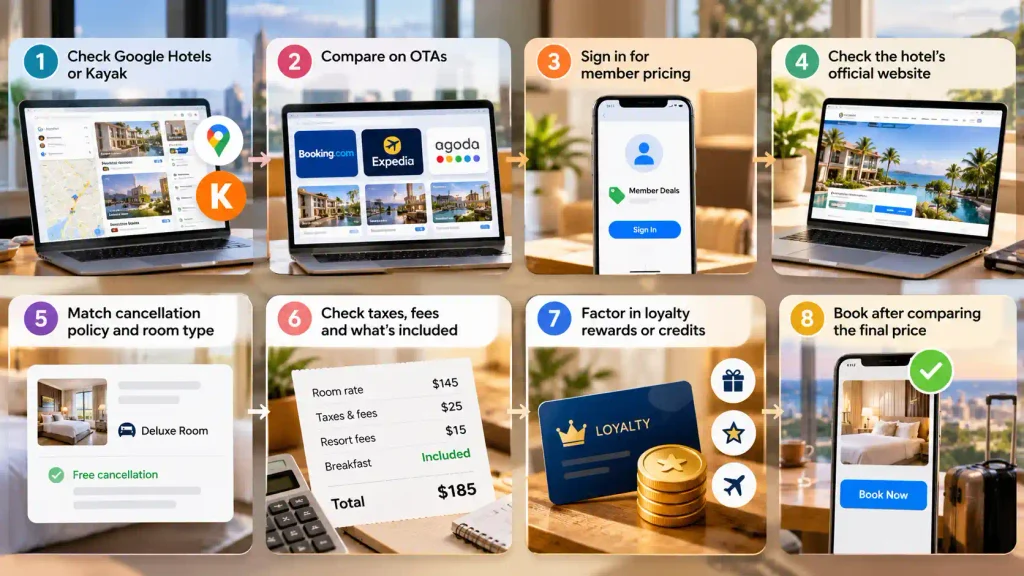
A practical search process can take only a few minutes:
- Start with Google Hotels or Kayak to understand the market price.
- Check Booking.com, Expedia, Agoda, or another relevant OTA.
- Sign in to see member pricing.
- Open the hotel’s official website and compare the direct rate.
- Match the cancellation policy and room type.
- Check taxes, fees, breakfast, resort fees, and other mandatory charges.
- Calculate loyalty rewards or credits if they matter.
- Book only after comparing the final payable price.
For example, if Google Hotels shows several providers between $145 and $155, a traveler should not automatically select the $145 option. The $155 direct rate could include breakfast or loyalty benefits that change the effective value.
Related to this blog:
DoubleTree by Hilton: 10 Top Locations & Best Redemptions
Common Mistakes When Booking Cheap Hotels
Focusing only on the nightly rate
The cheapest number displayed during the initial search is not necessarily the cheapest final booking.
Ignoring cancellation terms
A refundable $160 reservation can be more useful than a $145 prepaid reservation when travel plans are uncertain.
Forgetting hotel loyalty benefits
A small OTA discount may not outweigh the value of elite benefits for a frequent guest.
Comparing different room types
A rate for a room without breakfast, for example, should not be compared directly with a room that includes breakfast.
Booking an opaque deal without understanding it
A traveler who needs a specific hotel should avoid a booking that intentionally conceals the property until after payment.
Assuming prices remain fixed
Hotel prices can change quickly with demand, availability, events, holidays, and booking conditions. A comparison made several days before booking may not produce the same results later.
Final Takeaway
The 17 hotel-booking websites above serve different purposes, and none can guarantee the lowest price for every hotel and every date. Google Hotels, Kayak, Momondo, Skyscanner, Tripadvisor, and Trivago are useful for comparison, while Booking.com, Expedia, Priceline, Agoda, Hotels.com, and other OTAs can provide booking-specific discounts and rewards.
The most effective strategy in 2026 is to compare the all-in cost rather than the headline rate, check the hotel’s direct price, review cancellation terms, and account for loyalty rewards or included extras. For flexible travelers, opaque deals and last-minute platforms can also be worth checking, as long as you understand their restrictions.
FAQs
No single website is consistently the cheapest. Prices vary by property, dates, room type, membership status, taxes, fees, and cancellation terms. Metasearch tools such as Google Hotels and Kayak can help identify where competitive rates are currently available.
Sometimes, but not always. OTAs may offer member discounts, package pricing, or promotional rates, while hotels may provide loyalty benefits or direct-booking incentives. Compare the final price and benefits together.
There is no universal timing rule. Prices depend heavily on destination demand, season, events, availability, and cancellation inventory. Last-minute platforms can help when rooms remain unsold, but popular hotels can also get more expensive as availability falls.
Generally, many hotel loyalty programs treat third-party bookings differently from qualifying direct bookings. Travelers who care about points, elite-night credit, or status benefits should check the individual hotel’s loyalty rules before booking.
They are primarily metasearch services. They compare hotel offers and generally send travelers to a hotel, OTA, or other booking partner to complete the reservation.
Travelers should check the exact terms before booking. Discounted or opaque products can have more restrictive conditions than standard hotel rates, so the individual rate’s cancellation policy is more important than Priceline’s general hotel policy.
The most reliable approach is to compare the same hotel, dates, room, occupancy, cancellation terms, and inclusions across several providers and then compare the final payable total.