
Negev Desert Information: Top Places, History & Things to Do
The Negev Desert offers some of southern Israel’s most dramatic landscapes, from the immense Makhtesh Ramon and the cliffs of Ein Avdat to ancient Nabataean settlements, desert wildlife, stargazing sites, and the multicolored rock formations of Timna Park. It covers much of southern Israel and feels markedly different from the country’s densely populated Mediterranean coast.
For travelers, the Negev is not simply one attraction. A trip can combine geological landscapes around Mitzpe Ramon, archaeological sites such as Avdat, hiking through desert canyons, Bedouin cultural experiences, Sde Boker, wildlife, and nights beneath exceptionally dark skies.
However, travel planning in Israel and the West Bank currently requires particular attention to security conditions. Government travel advisories can change rapidly, and some areas are subject to stronger restrictions than others. Check your government’s latest guidance immediately before booking and again before traveling.
Important Information about the Negev Desert
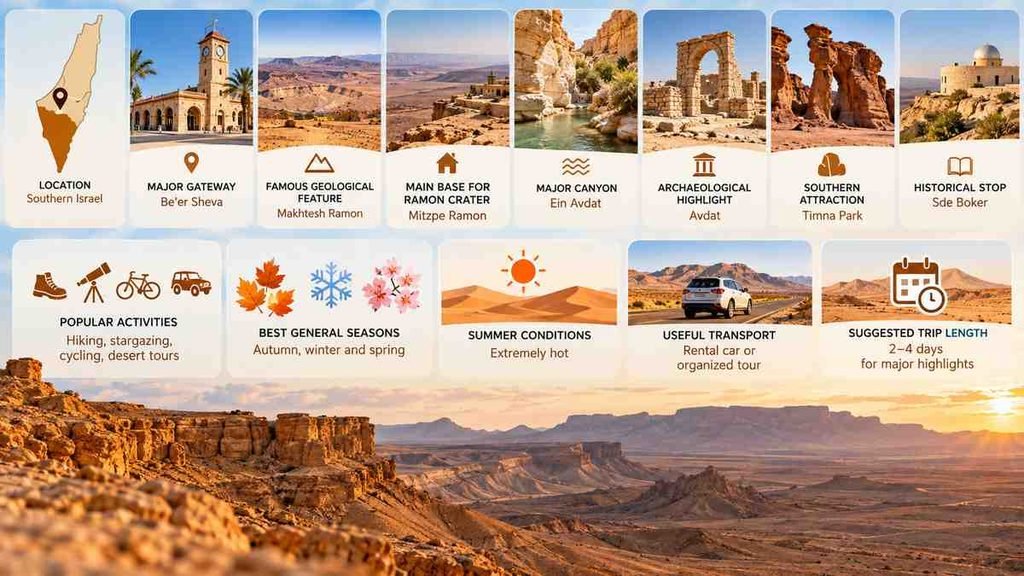
The Negev covers a substantial part of Israel, so distances between attractions can be greater than first-time visitors expect.
| Detail | Information |
| Location | Southern Israel |
| Major gateway | Be’er Sheva |
| Famous geological feature | Makhtesh Ramon |
| Main base for Ramon Crater | Mitzpe Ramon |
| Major canyon | Ein Avdat |
| Archaeological highlight | Avdat |
| Southern attraction | Timna Park |
| Historical stop | Sde Boker |
| Popular activities | Hiking, stargazing, cycling, desert tours |
| Best general seasons | Autumn, winter and spring |
| Summer conditions | Extremely hot |
| Useful transport | Rental car or organized tour |
| Suggested trip length | 2–4 days for major highlights |
Where Is the Negev Desert?
The Negev occupies much of southern Israel, extending roughly southward from the Be’er Sheva region toward the Arava and Eilat.
Official Israeli tourism information states that the Negev accounts for approximately 62% of Israel’s total land area.
The landscape changes considerably from north to south.
Visitors encounter:
- Rocky plateaus
- Erosion craters
- Canyons
- Dry riverbeds
- Sand and colorful rock formations
- Desert mountains
- Oases
- Archaeological remains
This variety is why simply driving across the Negev does not provide the same experience as spending several days there.
Is the Negev Desert in the West Bank?
No. The Negev Desert is primarily in southern Israel and should not be geographically confused with the West Bank.
This distinction is particularly important when planning travel.
The West Bank lies to the east of Israel’s central region, while the Negev extends across southern Israel.
Travelers sometimes see the phrase “Israel and the West Bank” used in travel guides or government advisories because those sources discuss both areas together.
That does not mean every destination mentioned is geographically located in both.
The Negev and West Bank should be researched separately for:
- Security conditions
- Transportation
- Entry procedures
- Checkpoints
- Local regulations
- Travel insurance
- Government travel advice
Current Travel Considerations for Israel and the West Bank
Travelers should check current government advice before planning a Negev or West Bank trip because security conditions remain changeable.
As of August 26, 2026, the U.S. Department of State advises travelers to reconsider travel to Israel due to terrorism and unrest, with stronger “Do Not Travel” guidance applying to certain areas.
The advisory includes specific restrictions close to the Gaza Strip and along portions of Israel’s borders.
These conditions can change.
Before departure:
- Read your own government’s latest travel advisory.
- Check regional restrictions rather than relying only on a countrywide advisory level.
- Verify that roads on your planned route are open.
- Confirm accommodation and tour operations.
- Review travel insurance exclusions.
- Follow instructions from local authorities.
- Avoid entering closed military or restricted areas.
- Keep plans flexible.
Historical information about the Negev remains useful, but an old travel itinerary should never substitute for current security information.
What Are the Best Places to Visit in the Negev?
A first Negev itinerary should concentrate on several major areas rather than attempting to cover the entire desert.
Key destinations include:
- Makhtesh Ramon
- Mitzpe Ramon
- Ein Avdat National Park
- Avdat National Park
- Sde Boker
- Timna Park
- Be’er Sheva
- Desert hiking areas
- Stargazing locations
- Bedouin communities and cultural experiences
Each offers a different reason to travel through the desert.
1. See Makhtesh Ramon
Makhtesh Ramon is the Negev’s defining geological attraction and one of the most remarkable landscapes in southern Israel.
Often called Ramon Crater, it is not an impact crater created by a meteorite.
A makhtesh is a distinctive erosion landform created through geological processes over millions of years.
Makhtesh Ramon measures approximately 40 km long and between 2 and 10 km wide, according to Israel’s official tourism information.
Its exposed geology includes:
- Multicolored sandstone
- Ancient rock layers
- Volcanic formations
- Fossils
- Cliffs
- Dry watercourses
The scale becomes most apparent from the rim.
Standing above the depression near Mitzpe Ramon gives visitors a broad view across layers of desert geology stretching toward the horizon.
Is Ramon Crater Really a Crater?
The word “crater” can be misleading.
Makhtesh Ramon was not created by a meteorite strike or volcanic explosion.
It developed through erosion.
Layers of harder rock covered softer underlying material. Geological uplift, water erosion, and the gradual removal of softer layers eventually produced the enormous depression visible today.
That unusual process makes the makhtesh scientifically significant as well as visually impressive.
2. Stay in Mitzpe Ramon
Mitzpe Ramon is the most practical base for experiencing Makhtesh Ramon and the surrounding central Negev.
The town sits directly beside the crater rim.
Travelers can use it as a base for:
- Hiking
- Scenic drives
- Jeep excursions
- Stargazing
- Cycling
- Wildlife watching
- Geological tours
The crater-edge viewpoints alone justify spending time here.
Rather than arriving, photographing the landscape, and immediately leaving, consider staying overnight.
Sunrise and sunset can transform the colors of the desert, while nighttime reveals another side of the region.
Visit the Ramon Visitor Center
The Ramon Visitor Center provides context for the landscape before you head into the crater.
Displays explain the area’s:
- Geology
- Wildlife
- Desert environment
- Formation of the makhtesh
The center also addresses the life of Ilan Ramon, Israel’s first astronaut.
Visiting before a hike can make the rock formations and geological layers considerably easier to understand.
Reservations may be required or recommended for Israel Nature and Parks Authority sites, so check current availability before arrival.
3. Go Stargazing in the Negev
The Negev’s dark skies make stargazing one of the most memorable reasons to stay overnight rather than treating the desert as a day trip.
Away from large urban areas, reduced artificial light can reveal:
- Dense fields of stars
- Planets
- Constellations
- Meteor activity during suitable periods
- The Milky Way under favorable conditions
Mitzpe Ramon and its surroundings are particularly associated with astronomical experiences.
Guided stargazing tours may provide telescopes and interpretation.
For independent viewing, remember that desert temperatures can fall sharply after sunset.
Bring warmer layers even when the daytime temperature feels comfortable.
4. Hike Through Ein Avdat National Park
Ein Avdat is a dramatic desert canyon where springs support water, vegetation, and wildlife amid otherwise arid surroundings.
The Tsin Stream has carved a deep canyon through the landscape near Midreshet Ben-Gurion.
The Israel Nature and Parks Authority identifies several major features:
- Ein Avdat waterfall
- Natural pool
- Euphrates poplar grove
- Monks’ caves
- Canyon viewpoints
Wildlife in the region includes ibex and vultures.
The contrast between pale canyon walls, water, vegetation, and surrounding desert makes Ein Avdat markedly different from Makhtesh Ramon.
Choose the Right Ein Avdat Trail
Visitors can encounter different walking options depending on access and current conditions.
Trail entry closes well before the overall park closing time.
Under the currently published daylight-saving schedule, last entry to the longer trail is 2:30 p.m., while last entry to the shorter route is 3:30 p.m. Fridays are earlier, and winter schedules shift earlier again.
This is an important example of why checking the current park timetable matters.
Arriving shortly before the official park closing time may be far too late to begin the hike you planned.
5. Discover Ancient Avdat
Avdat National Park preserves the remains of an important ancient Nabataean settlement overlooking the Negev highlands.
The site sits on a hill above the Tsin Stream region.
Its surviving structures reflect different phases of occupation and include:
- Nabataean remains
- Roman-period features
- Byzantine churches
- Burial structures
- Bathhouse
- Fortress
- Agricultural evidence
Avdat’s location was connected to ancient desert trade routes.
Visiting it adds historical depth to a Negev itinerary dominated by natural scenery.
Who Were the Nabataeans?
The Nabataeans were an ancient people known for developing trade networks across arid regions of the Middle East.
They are famously associated with Petra in present-day Jordan, but their influence extended much farther.
In the Negev, they developed settlements and agricultural systems adapted to limited rainfall.
Avdat provides a useful opportunity to understand how communities survived and prospered in this demanding environment.
6. Stop at Sde Boker
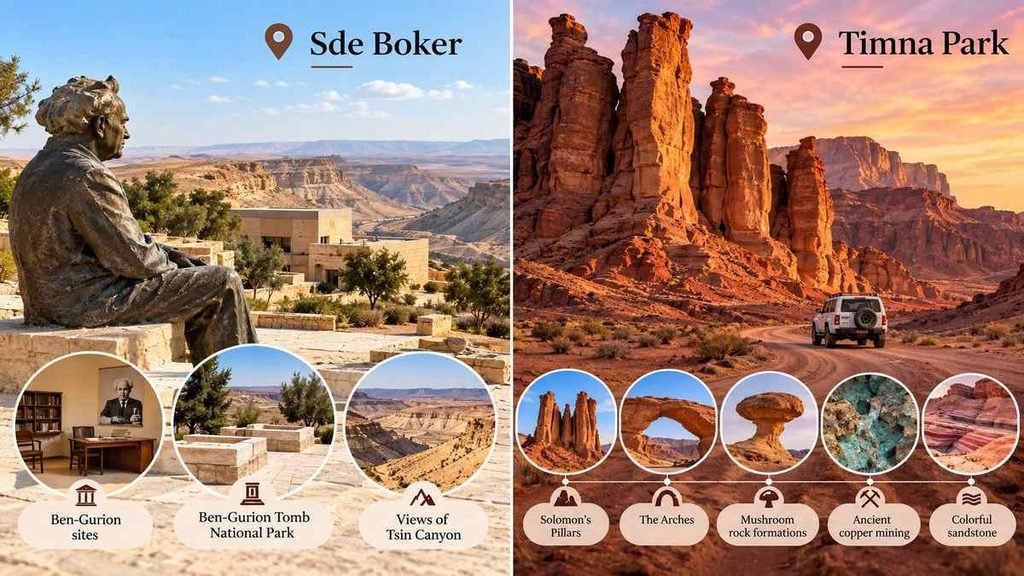
Sde Boker is closely associated with David Ben-Gurion, Israel’s first prime minister.
Ben-Gurion strongly advocated development and settlement in the Negev and spent part of his later life at Sde Boker.
Travelers interested in modern Israeli history can visit sites connected with his life and legacy.
Nearby, the Ben-Gurion Tomb National Park contains the graves of David and Paula Ben-Gurion.
The site overlooks the Tsin Canyon and Avdat highlands, providing a particularly impressive desert view.
Sde Boker also works naturally with Ein Avdat because the attractions are close to one another.
7. Visit Timna Park
Timna Park combines extraordinary desert geology with evidence of ancient copper mining and is one of the major attractions of the southern Negev-Arava region near Eilat.
The landscape contains striking sandstone formations created through erosion.
Notable features include:
- Solomon’s Pillars
- The Arches
- Mushroom-shaped rock formations
- Ancient mining areas
- Colored sandstone
- Desert cliffs
Timna is large.
It is not a conventional attraction where visitors park once and walk around a small site.
A vehicle is particularly useful for moving between the major formations.
How Long Should You Spend at Timna Park?
Allow several hours if you want to see the major geological and archaeological attractions without rushing.
Hikers and cyclists may want considerably longer.
Timna Park currently lists regular entry hours of 8 a.m. to 4 p.m., while visitors can remain in the park until sunset under its published visitor information.
Hours can change for holidays and special circumstances.
Check before traveling.
8. Learn About Ancient Desert Trade Routes
The Negev was not historically an empty wilderness.
Trade routes crossed the region for centuries.
Caravans transported valuable goods through desert settlements connecting the Arabian Peninsula and Mediterranean world.
Archaeological remains help illustrate the infrastructure required to support that trade.
Travelers interested in this history can investigate places such as:
- Avdat
- Mamshit
- Shivta
- Haluza
The archaeological landscape demonstrates how communities developed agriculture, water-management systems, religious buildings, and settlements under arid conditions.
9. Spend Time in Be’er Sheva
Be’er Sheva is often described as the gateway to the Negev and can serve as a useful transition between central Israel and the deeper desert.
The city provides a different experience from Mitzpe Ramon or Timna.
Instead of dramatic wilderness, visitors encounter:
- Urban life
- Markets
- Museums
- Historical sites
- Restaurants
- Transportation connections
Travelers driving south can use Be’er Sheva as a practical stop before continuing toward Sde Boker and Mitzpe Ramon.
10. Experience Bedouin Culture Responsibly
Bedouin communities have longstanding cultural and historical connections with the Negev.
Some tourism experiences introduce visitors to elements of Bedouin:
- Food
- Hospitality
- Desert traditions
- Craft
- Music
- Local history
Choose experiences operated with meaningful community participation rather than attractions that reduce Bedouin culture to stereotypes.
A good cultural visit should provide context about contemporary life as well as traditional practices.
Bedouin communities are living communities, not historical exhibits.
11. Look for Desert Wildlife
The Negev may appear barren at first, but numerous species have adapted to its extreme conditions.
Depending on location and luck, wildlife can include:
- Nubian ibex
- Gazelles
- Foxes
- Reptiles
- Desert birds
- Vultures
Wildlife observation requires patience.
Early morning and later afternoon can provide better conditions than the intense midday heat.
Never approach, feed, or disturb wild animals for photographs.
12. Try a Desert Jeep Tour
A guided 4×4 excursion can help visitors reach areas that are difficult to appreciate from paved roads.
Tours around Makhtesh Ramon may focus on:
- Geological formations
- Desert ecology
- Wildlife
- Rock layers
- Scenic viewpoints
- Local history
A knowledgeable guide can also explain why the makhtesh landscape developed.
Choose an established operator that follows permitted routes and avoids damaging fragile desert terrain.
13. Go Hiking in the Negev
Hiking is one of the best ways to experience the Negev, but desert walking requires more preparation than an ordinary urban sightseeing day.
Conditions can become dangerous quickly.
Before hiking:
- Check the weather.
- Check flash-flood warnings.
- Confirm trail status.
- Carry sufficient water.
- Use sun protection.
- Tell someone your route.
- Avoid hiking during extreme heat.
- Start early.
- Carry an offline map where appropriate.
- Follow marked trails.
Do not underestimate distance simply because a destination is visible.
Desert scale can be deceptive.
Flash Floods Are a Serious Risk
A clear sky directly above you does not necessarily mean a desert canyon is safe.
Rain falling elsewhere in a drainage basin can send water rapidly through dry riverbeds and narrow canyons.
Never enter a canyon when authorities issue a flash-flood warning.
Follow closures immediately.
14. See the Negev at Sunrise or Sunset
The desert changes dramatically with the angle of the sun.
Early morning and late afternoon can produce:
- Longer shadows
- Warmer rock colors
- More comfortable temperatures
- Better conditions for photography
Makhtesh Ramon is particularly impressive around sunrise and sunset.
If photographing from a viewpoint, remain behind safety barriers.
Desert cliffs can be unstable, steep, and difficult to judge in low light.
When Is the Best Time to Visit the Negev Desert?
Autumn, winter, and spring generally provide more comfortable conditions for outdoor travel in the Negev than the peak summer months.
Israel’s official tourism information particularly recommends spring, fall, and winter for desert travel.
October to November
Temperatures generally become more suitable for hiking.
Conditions still vary substantially between day and night.
December to February
Winter can provide excellent hiking temperatures during the day.
Nights can become surprisingly cold.
Rain also introduces flash-flood risk.
March to April
Spring can be excellent for outdoor activities before summer heat becomes intense.
May to September
Summer temperatures can become extreme.
Long exposed hikes during the hottest hours can be dangerous.
Plan activities for suitable times and follow heat warnings.
How Many Days Do You Need in the Negev?
Two to 4 days provide a useful introduction to the Negev, although travelers interested in hiking, geology, archaeology, or desert experiences could easily spend longer.
1 Day
Choose one geographic area.
For example:
Sde Boker + Ein Avdat + Avdat
or:
Mitzpe Ramon + Makhtesh Ramon
Do not attempt to cover the entire Negev in one day.
2 Days
Combine Sde Boker and Ein Avdat with Mitzpe Ramon.
Stay overnight near the crater for sunset and stargazing.
3 to 4 Days
Add:
- Longer hiking
- Jeep tour
- Archaeological sites
- Bedouin cultural experience
- Additional desert viewpoints
Travelers continuing toward Eilat can incorporate Timna farther south.
Sample 3-Day Negev Itinerary
Day 1: Be’er Sheva to Sde Boker
Travel south toward Sde Boker.
Visit:
- Ben-Gurion-related sites
- Ben-Gurion’s Tomb viewpoint
- Ein Avdat National Park
Continue toward Mitzpe Ramon.
Stay overnight.
Day 2: Makhtesh Ramon
Start with the crater viewpoint and visitor center.
Depending on conditions, add:
- Hiking
- Jeep excursion
- Geological stops
- Wildlife observation
Watch sunset from an appropriate viewpoint.
Spend the evening stargazing.
Day 3: Avdat and Desert History
Visit Avdat National Park.
Spend time understanding the Nabataean and Byzantine remains before continuing north or south.
Travelers heading toward Eilat can instead extend the itinerary and add Timna Park on another day.
Can You Visit the Negev as a Day Trip?
Yes, but choose a specific part of the desert.
Trying to visit Be’er Sheva, Sde Boker, Ein Avdat, Mitzpe Ramon, Makhtesh Ramon, and Timna in a single day is unrealistic.
The Negev is geographically extensive.
For a day trip, concentrate on one cluster of attractions.
An overnight stay also gives you access to two experiences that day visitors often miss:
Sunset and the night sky.
Do You Need a Car in the Negev?
A rental car is one of the most practical ways to visit the Negev because many attractions are spread across a large area and public transportation does not reach every trailhead or viewpoint conveniently.
Organized tours are another option.
Public buses connect some larger communities, but they provide less flexibility for:
- Trailheads
- Sunrise visits
- Remote viewpoints
- Multiple national parks
- Weather-related itinerary changes
If renting a car, remember that a standard rental vehicle should remain on roads where it is permitted.
Do not take an ordinary car onto unapproved desert tracks.
How Far Is the Negev From Major Cities?
Distances depend on which part of the Negev you are visiting.
Official tourism information gives approximate road distances such as:
| Destination | From Tel Aviv | From Jerusalem | From Be’er Sheva | From Eilat |
| Sde Boker area | 162 km | 171 km | 49 km | 185 km |
| Ramon Crater | 210 km | 192 km | 97 km | 141 km |
| Timna Park | 330 km | 294 km | 208 km | 30 km |
These are road-distance estimates rather than guaranteed driving times.
Traffic, road closures, checkpoints, construction, and security conditions can affect travel.
What Should You Pack for the Negev?
Desert travel requires preparation for both heat and temperature swings.
Useful items include:
- Plenty of water
- Hat
- Sunglasses
- High-SPF sunscreen
- Comfortable hiking shoes
- Lightweight daytime clothing
- Warm evening layer
- Navigation tools
- Portable battery
- Basic first-aid supplies
- Snacks
- Reusable water bottles
Do not assume “desert” always means hot.
Winter evenings and nights can feel very cold.
Can You Combine the Negev With the Dead Sea?
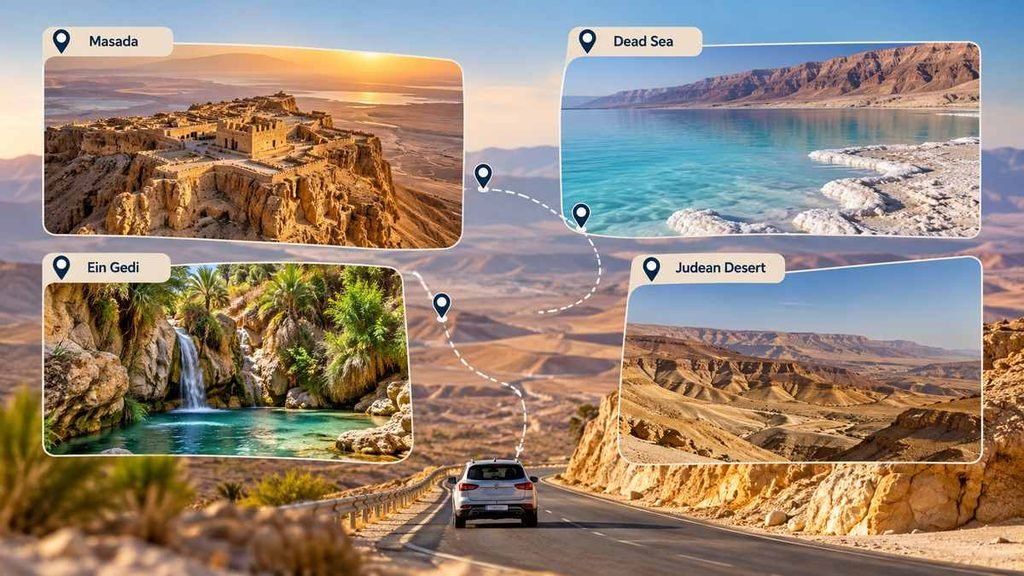
Yes, depending on your route and current road conditions.
The Dead Sea and Judean Desert are geographically distinct from the core Negev attractions but can form part of a broader desert itinerary.
Potential attractions in the wider region include:
- Masada
- Dead Sea
- Ein Gedi
- Judean Desert landscapes
Avoid treating them as though they are all located inside the Negev.
Allow sufficient driving time and check current security and road information before departure.
What About Visiting the West Bank?
A visit to the West Bank requires separate planning from a Negev trip because the two areas have different geography, transportation considerations, security conditions, and access arrangements.
Travelers considering places in the West Bank should consult current official travel advice for the exact destination they intend to visit.
Conditions can vary significantly by area.
Potential considerations include:
- Checkpoints
- Road access
- Security restrictions
- Vehicle and rental-car rules
- Passport requirements
- Tour arrangements
- Local holidays
- Political demonstrations
- Sudden closures
Do not assume that advice for Mitzpe Ramon or Timna applies to a trip in the West Bank simply because both appear under the same country-level travel advisory.
Negev Travel Safety Tips
Desert safety and regional security both require attention.
For Desert Conditions
Check:
- Temperature
- Rain
- Flash-flood alerts
- Trail closures
- Park opening hours
- Water requirements
For Regional Security
Check:
- Government travel advisories
- Local authority alerts
- Road closures
- Current border-area restrictions
- Accommodation updates
Keep emergency information accessible offline.
Conditions can change after an itinerary has been booked.
Final Thoughts
The Negev rewards travelers who spend enough time to appreciate its scale. Makhtesh Ramon may be the headline attraction, but Ein Avdat’s canyon, Avdat’s ancient ruins, Sde Boker’s modern history, Timna’s colorful geology, desert wildlife, and exceptionally dark night skies reveal how varied southern Israel can be.
For a first trip, 2 to 4 days gives you enough time to combine natural landscapes with archaeological and cultural experiences without spending the entire visit driving.
Current conditions are equally important. Before traveling in Israel or the West Bank, review your government’s latest travel advisory, check individual roads and national parks, confirm reservations, and monitor weather and flash-flood warnings. A flexible itinerary is especially important when regional security or desert conditions can change quickly.
Frequently Asked Questions
Yes. The Negev combines unusual geological formations, desert hiking, archaeological sites, wildlife, stargazing, ancient trade-route history, and dramatic scenery that differs substantially from Israel’s coastal cities.
It is particularly known for Makhtesh Ramon, desert landscapes, Nabataean archaeological sites, hiking, stargazing, Bedouin culture, and the geological formations found farther south around Timna.
No. Makhtesh Ramon is an erosion landform rather than an impact crater.
Mitzpe Ramon is the most convenient base because the town sits directly beside Makhtesh Ramon.
Yes, but transportation becomes less flexible. Organized tours can be practical for visitors who do not want to rent a vehicle.
Some outdoor activities may still be possible at appropriate times, but summer heat can be extreme. Check current heat warnings and trail guidance, and avoid exposed hiking during dangerous temperatures.
Yes. Desert temperatures can fall considerably after sunset, particularly in winter and at higher elevations around Mitzpe Ramon.
Timna lies in southern Israel’s Arava region near Eilat and is commonly included in broader Negev/desert itineraries, although geographically the Arava has its own identity.
Allow at least several hours for viewpoints and the visitor center. A full day or overnight stay is preferable if you want to hike, take a jeep tour, watch sunset, or go stargazing.
Some Israel Nature and Parks Authority sites use an advance reservation system. Check the individual park before traveling because availability and requirements can change.
No. The Negev is in southern Israel. The West Bank is a separate geographic area requiring its own travel and security planning.
It can be possible with an early start and careful planning, but check trail-entry deadlines and park opening hours first. Staying overnight in the region creates a less rushed itinerary.