
Chase Freedom Card: Rewards, Benefits & Key Drawbacks
The Chase Freedom Card is a no-annual-fee cash-back credit card that rewards eligible spending through rotating quarterly bonus categories and offers a straightforward earning structure for everyday purchases. It provides 5% cash back on up to $1,500 in combined purchases within activated bonus categories each quarter and 1% cash back on other purchases. Its rewards can also become more flexible when combined with eligible Chase Ultimate Rewards cards.
The card is designed for consumers who want to earn rewards without paying an annual fee. Its rotating categories can deliver strong returns on qualifying purchases, while the Chase shopping portal offers additional ways to earn rewards through participating retailers. However, the card has a 3% foreign transaction fee, doesn’toffer permanent elevated bonus categories, and,, according to the supplied review, according to the supplied review, is no s.
This review examines the Chase Freedom card’s rewards structure, redemption options, introductory offers and fees, advantages, limitations, and suitability for different spending habits, based on the supplied review.
Related: Chase Freedom Flex Drops Foreign Transaction Fees.
Chase Freedom Card at a Glance
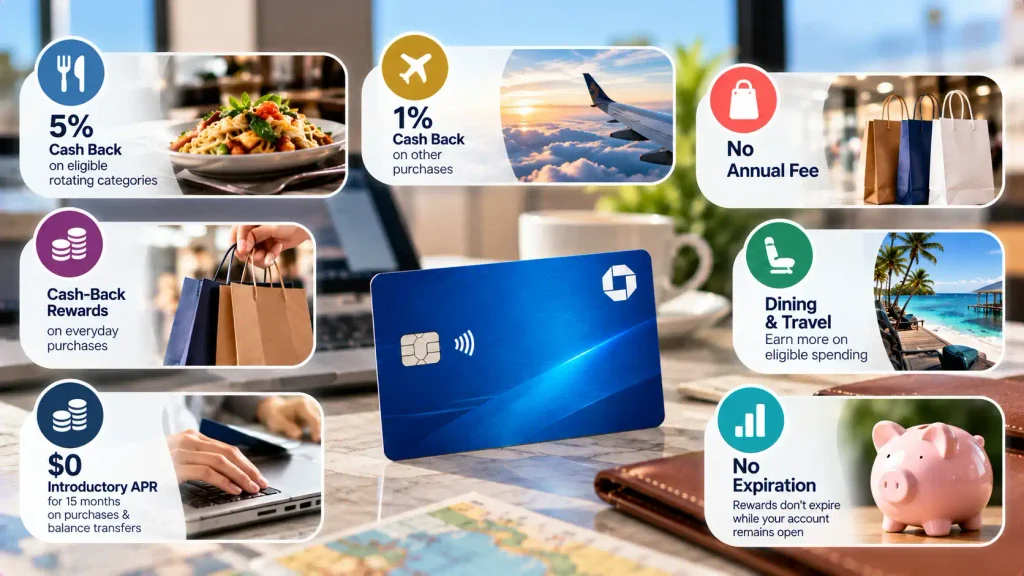
The Chase Freedom Card offers cash back on everyday purchases with no annual fee. Depending on the card version, cardholders can earn rewards on dining, travel, and rotating bonus categories, making it a practical option for everyday spending.
| Feature | Details |
| Card type | Cash-back credit card |
| Annual fee | $0 |
| Quarterly bonus rate | 5% cash back on eligible activated categories |
| Quarterly bonus spending cap | $1,500 in combined purchases |
| Base earning rate | 1% cash back on other purchases |
| Introductory APR | 0% for 15 months on purchases and balance transfers, according to the source |
| Ongoing APR | 16.49%–25.24% variable, according to the source |
| Balance transfer fee | 3% during the first 60 days, with a $5 minimum |
| Foreign transaction fee | 3% of each transaction in U.S. dollars |
| Reward expiration | Rewards do not expire while the account remains open, subject to program terms |
| Additional features | Chase shopping portal and weekly credit-score updates through Credit Journey |
| New applications | No longer available to new applicants, according to the supplied review |
1. Overview of the Chase Freedom Card
The Chase Freedom card focuses on cash-back rewards rather than premium travel benefits. Its main distinguishing feature is a rotating quarterly bonus structure that lets cardholders earn an enhanced rate on selected categories throughout the year.
Unlike cards that offer fixed bonus rates for dining, travel, or groceries, the original Freedom card changed its featured categories. This structure can reward cardholders who adjust their spending to match the active categories, but it requires more attention than a flat-rate rewards card.
The card also provides access to the Chase Ultimate Rewards ecosystem. Although it is marketed as a cash-back product, the rewards are tracked as points within the program. Depending on other eligible Chase cards you hold, these points may offer additional redemption flexibility.
The original Chase Freedom card is no longer open to new applicants, as noted in the source review. Existing cardholders may still find its reward structure useful, while consumers looking for a new account can compare currently available alternatives such as the Chase Freedom Flex℠.
2. How the Chase Freedom Card Earns Rewards
The card’s earning structure has two main components: rotating quarterly bonus categories and a standard rate on other purchases.
5% Cash Back on Rotating Categories
Cardholders can earn 5% cash back on up to $1,500 in combined purchases within the eligible bonus categories each quarter, provided the categories are activated as required.
At the maximum quarterly spending limit, the 5% rate can generate $75 in cash back. Across four quarters, reaching the cap each quarter could produce up to $300 in annual cash back from the rotating categories, assuming you meet qualifying spending and activation requirements.
The source identifies groceries, gas, restaurants, and department stores as examples of categories featured in previous years. These are examples from past category selections, not a guarantee that the same categories will be offered in every quarter.
The spending cap is important. Once the combined eligible purchases reach $1,500 for the quarter, additional purchases do not continue earning the 5% bonus rate under this structure.
1% Cash Back on Other Purchases
Purchases outside the active bonus categories earn 1% cash back. The rate applies automatically, providing a basic reward on everyday spending that does not qualify for a quarterly bonus.
This approach is simple, but it can be less rewarding than cards that offer a higher base rate on all purchases or permanent bonuses in common spending categories.
Consumers who regularly spend in the active quarterly categories may benefit more than those whose purchases rarely match the available bonuses.
Activation Is Required
The quarterly bonus categories must be activated to qualify for the enhanced earning rate. Cardholders should review the available categories at the start of each quarter and complete the activation process within the applicable period.
For people who prefer a low-maintenance rewards strategy, this requirement can be a drawback. Missing activation may mean losing the opportunity to earn the bonus rate on otherwise eligible purchases.
3. How to Maximize Chase Freedom Rewards
The card’s rewards structure works best when you plan spending around the bonus categories and available shopping offers.
Plan Spending Around Quarterly Categories
First, review the active categories and identify purchases you can reasonably direct toward them. Everyday expenses that naturally fall within an eligible category can help cardholders approach the $1,500 quarterly limit without making unnecessary purchases.
For example, if groceries are included in a particular quarter’s categories, eligible grocery purchases can earn the bonus rate after activation. The same principle applies to other categories when they are officially included.
Cardholders should avoid spending more simply to earn rewards. Cash back is most useful on purchases you would have made anyway.
Use the Chase Shopping Portal
The Chase Shopping Portal offers another way to earn extra rewards. According to the review, Chase has partnered with retailers such as Apple, Nike, and Samsung to offer additional rewards ranging from 2x to 20x points per dollar on qualifying purchases.
The rate depends on the participating retailer and offer. Cardholders should check the portal’s current terms before purchasing, since not every product or transaction will necessarily qualify for an advertised rate.
The portal can help with planned purchases, especially when a participating retailer offers a competitive rewards rate. It should not replace comparing prices, delivery costs, and return policies.
Combine Rewards With Other Eligible Chase Cards
One of the card’s biggest advantages is its ability to combine rewards with eligible cards that earn Chase Ultimate Rewards points.
On its own, the Freedom card primarily functions as a cash-back product. When paired with an eligible premium Ultimate Rewards card, however, rewards may be pooled and used through additional redemption options, including eligible travel opportunities.
For example, the supplied review describes using the Freedom card for purchases in its rotating categories while using the Chase Sapphire Reserve® Card for eligible dining purchases. The points from both cards can then be combined under the applicable program rules.
This strategy lets each card serve a different purpose: the Freedom card captures quarterly bonuses, while the premium card may offer different earning rates and travel benefits.
The value of this approach depends on the cards you hold, their terms, and how you ultimately redeem rewards.
4. Understanding Chase Ultimate Rewards
Although the Chase Freedom card is marketed as a cash-back card, it earns rewards as Chase Ultimate Rewards points.
This arrangement gives cardholders a choice of how to use eligible rewards, subject to the options available on their account. Cash back can be redeemed as a statement credit, while the broader Ultimate Rewards ecosystem may provide additional ways to use points.
Cash-Back Redemptions
Cash back is a straightforward option for cardholders who want to offset everyday expenses. The supplied review notes that there is no minimum redemption amount for cash back.
The card’s reward structure is therefore relatively accessible for people who prefer to use their earnings regularly instead of saving them for a larger redemption.
Pooling Points With Other Eligible Cards
Combining rewards with an eligible Chase card can expand how you can use points. The review identifies cards such as the Chase Sapphire Preferred® Card and Chase Sapphire Reserve® Card as examples that can complement the Freedom card.
Depending on the eligible card and applicable program terms, points may be used through travel booking options or transferred to eligible travel partners. This can create additional value for people who understand how to compare redemption options.
However, travel rewards are not automatic simply because a cardholder has the Freedom card. The additional flexibility depends on the other card account and the rules governing the rewards program.
Do Chase Freedom Rewards Expire?
According to the supplied review, rewards do not expire as long as the account remains open, subject to the program’s conditions. Points may be lost in certain circumstances, including account closure or serious payment delinquency.
Keeping the account in good standing and reviewing the current rewards agreement can help cardholders understand the conditions that apply to their points.
Read this blog: Chase the United Cards Compared: Rewards & Benefits
5. Introductory APR and Fees
The Chase Freedom card has no annual fee, which is one of its main attractions. However, cardholders should also consider the account’s interest rates and transaction fees.
No Annual Fee
The $0 annual fee means you pay no recurring yearly charge just to keep the card open. This can make the card a useful secondary account for quarterly bonuses, especially for cardholders who want to earn rewards without paying for another card.
A no-annual-fee structure means you pay no annual fee. Interest, balance transfer fees, and foreign transaction fees may still apply.
Introductory APR
The supplied review lists a 0% introductory APR for 15 months from account opening on purchases and balance transfers. After the introductory period, the variable APR is listed at 16.49%–25.24%.
The actual rate and eligibility depend on the terms offered for the account. An introductory APR can reduce interest costs during the promotional period, but cardholders should know when the promotion ends and what rate applies afterward.
The card’s reward benefits should not justify carrying an unaffordable balance. Interest charges can outweigh the value of cash-back earnings.
Balance transfer
The source lists that a balance transfer applies to transfers made during the first 60 days after the account opens, with a minimum fee of $5.
Anyone considering a balance transfer should calculate the fee alongside the introductory APR period and the amount they expect to repay. The applicable terms should be checked before initiating a transfer.
Foreign Transaction Fee
The Chase Freedom card charges a 3% foreign transaction fee on each transaction in U.S. dollars, according to the supplied review.
This can reduce the value of rewards when the card is used for purchases processed outside the United States or otherwise subject to the fee. Travelers who regularly make foreign purchases may prefer a card without foreign transaction fees.
6. Additional Features
Beyond its core rewards structure, the card offers a few additional features that may help with everyday account management.
Credit Journey Score Updates
The supplied review lists free credit-score access through Chase Credit Journey, with updates available weekly. Monitoring your score can help you track changes in your credit profile over time.
A credit score is only one part of a credit report and does not replace checking the report itself for errors or unfamiliar accounts.
Shopping Offers
The Chase shopping portal can provide extra points on qualifying purchases at participating retailers. This feature may be useful for consumers who already shop with those retailers and can compare available offers before buying.
Additional earning rates vary by retailer and promotion, so cardholders should check offer details and eligibility requirements rather than assuming every purchase qualifies.
No Annual Fee for Long-Term Ownership
Because the card has no annual fee, you don’t need to pay anything to keep it open. However, account management decisions should also consider the cardholder’s overall credit profile, spending habits, and current account terms.
7. Advantages and Disadvantages
The Chase Freedom card is strongest for consumers who want rewards without an annual fee and can use rotating categories. Its limitations are most noticeable for people who prefer consistent bonus categories, travel abroad frequently, or want premium travel benefits from a single card.
Advantages
- No annual fee: The card does not charge a recurring annual membership fee.
- 5% quarterly bonus rate: Eligible activated categories earn 5% on up to $1,500 in combined purchases each quarter.
- Automatic 1% base rewards: Other purchases earn cash back without needing to select a category.
- Potential to pool points: Eligible Chase Ultimate Rewards cards can provide additional redemption flexibility.
- Shopping portal access: Participating retailers may offer extra rewards through Chase’s shopping portal.
- No minimum cash-back redemption: The review states that you don’t need a minimum amount to redeem cash back.
- Introductory APR offer: The source lists a 0% introductory APR for 15 months on purchases and balance transfers.
- Credit-score monitoring: Credit Journey provides free score access with weekly updates, according to the source.
Disadvantages
- No longer open to new applicants: The supplied review states that the original card is no longer available for new applications.
- Quarterly activation required: Cardholders must activate the categories to receive the bonus rate.
- Limited bonus spending cap: The 5% rate applies only to the first $1,500 in combined eligible quarterly purchases.
- No permanent bonus categories: The source does not identify standard elevated earning categories that apply throughout the year.
- Foreign transaction fee: A 3% fee can make international use less attractive.
- Limited standalone travel value: The card does not offer the premium travel benefits associated with some other rewards cards.
- Base rate of 1%: Purchases outside the quarterly categories earn a relatively basic rate under the structure described in the source.
8. Who Is the Chase Freedom Card Best For?
The card’s usefulness depends on how well its rotating categories match a cardholder’s regular expenses and whether the cardholder can take advantage of the wider Ultimate Rewards ecosystem.
Consumers Seeking No-Annual-Fee Rewards
The Freedom card can help people earn cash back without paying an annual fee. The rotating categories let you earn more than the base rate on selected purchases, while other spending still earns 1%.
This structure is most appealing when the bonus categories align with expenses already in the household budget.
Cardholders Who Track Quarterly Categories
Consumers who are comfortable reviewing and activating categories every quarter may be better positioned to benefit from the card’s enhanced earning rate.
The requirement is relatively simple, but it adds a step compared with cards that automatically provide a fixed rewards rate.
Existing Chase Ultimate Rewards Cardholders
The card can work particularly well as a secondary rewards card for people who already hold an eligible Chase card with broader redemption options.
The Freedom card can capture rotating-category bonuses, while another eligible card may offer different earning rates or additional redemption options. The combined strategy depends on the terms of each account.
Consumers Who Prefer Simple, Consistent Rewards
People who don’t want to track quarterly categories may find a flat-rate cash-back card easier to manage. A fixed earning rate can provide more predictable returns without requiring activation or changes to spending habits.
Similarly, people who frequently make foreign purchases or want travel benefits from one card may find the Freedom card’s limitations significant.
9. Chase Freedom Card Alternatives
The supplied review identifies the Chase Freedom Flex℠ and Capital One Savor Cash Rewards Credit Card as alternatives worth considering. They use different earning structures and may suit different spending patterns.
| Card | Reward structure described in the source | Potential appeal |
| Chase Freedom® Card | 5% on activated quarterly categories up to $1,500 in combined purchases; 1% on other purchases | Existing cardholders who can maximize rotating categories |
| Chase Freedom Flex℠ | 5% on travel through Chase Travel, 3% on dining and drugstores, and 1.5% on other purchases, as described in the source comparison | Consumers looking for more consistent everyday bonus categories |
| Capital One Savor Cash Rewards Credit Card | 3% on dining, entertainment, select streaming services, and grocery stores; 1% on other purchases, as described in the source | Consumers whose spending concentrates in dining, entertainment, streaming, and groceries |
Chase Freedom Flex
The source presents the Freedom Flex as an alternative for consumers who want a no-annual-fee cash-back card with a different mix of earning categories. Its described structure includes rewards on travel booked through Chase Travel, dining, drugstores, and other purchases.
It may be more suitable for cardholders who prefer some consistent bonus categories alongside rotating quarterly opportunities. The exact terms should be checked before applying.
Best for: 17 Best Credit Cards for citizenM Hotel Travelers
Capital One Savor Cash Rewards Credit Card
The Savor card offers elevated cash back on dining, entertainment, select streaming services, and grocery-store purchases, with a standard rate on other eligible spending.
This structure may appeal to consumers whose regular expenses fall into those categories and who prefer not to rely primarily on quarterly rotating bonuses.
The better option depends on actual spending patterns, current offers, fees, and the rewards a cardholder values most.
Final Verdict: Is the Chase Freedom Card Worth Keeping?
The Chase Freedom® Card offers a straightforward no-annual-fee rewards structure with the potential to earn 5% cash back on activated quarterly categories and 1% on other purchases. Its access to Chase Ultimate Rewards, shopping portal offers, and ability to combine points with eligible Chase cards can make it useful for consumers who actively lack rewards.
Its main drawbacks are the annual activation requirement, the $1,500 bonus-category spending cap, the 3% foreign transaction fee, and the lack of permanent elevated bonus categories. It also lacks the premium travel benefits some other cards offer.
For existing cardholders whose spending aligns with the rotating categories, the card can remain a useful part of a broader rewards strategy. Consumers seeking a new card should compare currently available alternatives and review their reward structures, fees, and redemption rules before choosing an account.
Frequently Asked Questions
The card can be useful for existing cardholders who want no-annual-fee cash back and can make use of its rotating quarterly categories. It may be especially valuable when combined with eligible Chase Ultimate Rewards cards. Its limitations include a 3% foreign transaction fee and the need to activate quarterly categories.
The supplied review states that the original Chase Freedom card is no longer available to new applicants. It identifies the Chase Freedom Flex℠ as an alternative to consider. Current product availability and points should be confirmed with the issuer.
The card earns 5% cash back on up to $1,500 in purchases within activated quarterly bonus categories. Reaching that limit produces $75 in cash back per quarter, as long as other purchases earn 1% under the reward structure described in the source.
Yes. Cardholders need to activate the quarterly categories to earn the enhanced rate. They should review the eligible categories and applicable activation deadline each quarter.
It is marketed as a cash-back card, but rewards are tracked as points through Chase Ultimate Rewards. Eligible redemption options may include cash back and, when combined with certain other Chase cards, additional ways to use points.
You can use the card’s rewards through Chase Ultimate Rewards. The supplied review explains that pairing the card with an eligible premium Ultimate Rewards card may allow points to be combined and used through additional travel redemption options, subject to program rules.
The supplied review states that rewards do not expire as long as the account remains open, subject to the program’s terms. Points may be lost under certain circumstances, including account closure or serious payment delinquency.
Yes. The source lists a foreign transaction fee of 3% of each transaction in U.S. dollars. Consumers who regularly spend abroad should compare cards with no foreign transaction fees.
The supplied review lists a 0% introductory APR for 15 months on purchases and balance transfers, followed by a variable APR of 16.49%–25.24%. Rates and eligibility can vary, so the applicable offer and card agreement should be checked.
Yes. According to the supplied review, the card is subject to Chase’s 5/24 rule. Applicants who have opened five or more new credit-card accounts in the preceding 24 months may not qualify under this rule, subject to the issuer’s application policies.