
Can You Fly With a Pet on Breeze Airways? Cabin Rules & Availability
Breeze Airways allows eligible small cats and dogs to travel in the aircraft cabin, but it does not transport pets as checked baggage or cargo, and pet spaces are available on a first-come, first-served basis. Passengers must reserve space for their pets, use an approved carrier that fits beneath the seat, and comply with the airline’s applicable pet travel requirements.
This cabin-only policy means a pet can remain close to its owner throughout the flight rather than traveling in a separate aircraft compartment. However, the limited number of pets permitted on each flight makes advance planning particularly important.
A traveler booking a seat several weeks before departure, for example, should not assume that a pet space will still be available when they decide to add their cat or dog later.
Understanding the booking process, carrier requirements, fees, and airport procedures can help prevent unexpected complications. This guide explains how the Breeze Airways pet policy works, which animals are accepted, and what passengers should check before traveling with their pets.
Read this blog: Can Pets Travel in Cargo on Aeromexico? Policy, Limits & Rules
What Is Breeze Airways’ Pet Policy?
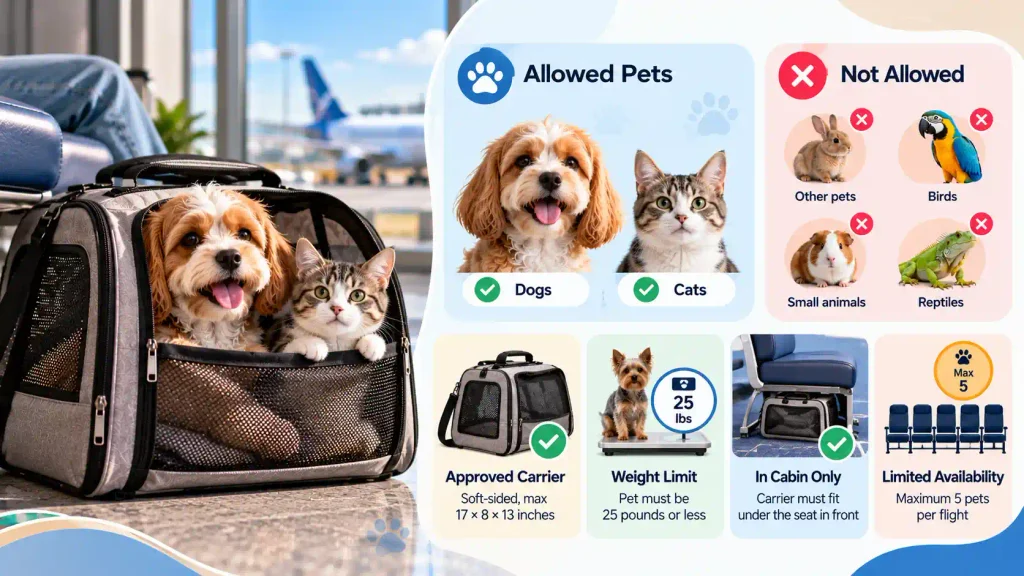
Breeze Airways’ pet policy permits eligible domestic cats and dogs to travel inside the passenger cabin in an approved carrier. Pets must remain inside their carriers during the flight, and the carrier must fit beneath the seat in front of the passenger.
The airline does not provide a separate checked-baggage or cargo transportation option for household pets.
This distinction is especially important for owners of larger animals. A dog that cannot comfortably fit inside an under-seat carrier generally cannot travel as a regular cabin pet, even if its owner is willing to pay an additional fee.
Breeze also limits the number of pets accepted on each flight. Availability must therefore be confirmed before travelers finalize arrangements that depend on their pets accompanying them.
Which Animals Can Travel on Breeze Airways?
Breeze Airways accepts eligible domestic cats and dogs as cabin pets. Other animals are not covered by its standard household pet transportation policy.
The animal must be small enough to travel safely inside an approved carrier beneath the passenger’s seat.
| Pet travel category | Breeze Airways policy |
| Domestic cats | Accepted in the cabin, subject to requirements |
| Domestic dogs | Accepted in the cabin, subject to requirements |
| Other household animals | Not accepted under the standard pet policy |
| Large dogs unable to fit in a carrier | Not eligible as regular cabin pets |
| Pets traveling as checked baggage | Not accepted |
| Pets traveling as cargo | Not accepted |
| Trained service dogs | Subject to separate service animal rules |
A trained service dog is not treated in the same way as an ordinary household pet. Different documentation and behavioral requirements may apply under federal service animal regulations.
Owners should confirm their animal’s eligibility before purchasing a ticket, particularly when traveling with a young pet or an animal requiring special accommodation.
How Many Pets Are Allowed on a Breeze Airways Flight?
Breeze Airways allows a maximum of five cabin pets per flight, with no more than one pet per passenger. Because availability is limited, passengers should add their pets to their reservations as early as possible.
The airline’s five-pet limit applies to the entire flight, not to each row or cabin section. A passenger may therefore find an available seat on a flight even when no additional pet spaces remain.
For example, if five passengers have already registered their pets, a sixth passenger cannot assume that another pet will be accepted simply because several passenger seats are still available.
The restriction is particularly important for round-trip journeys. Pet availability should be confirmed separately for the outbound and return flights.
Breeze’s official Contract of Carriage confirms both the one-pet-per-passenger restriction and the five-pet-per-flight maximum.
How Much Does Breeze Airways Charge for Traveling With a Pet?
Breeze Airways commonly lists a pet transportation fee of $75 per pet, each way for eligible cabin travel. However, passengers should confirm the amount displayed during booking because optional service charges can change.
The pet fee is separate from the passenger’s airfare and any other applicable travel charges.
| Pet travel expense | What passengers should expect |
| Cabin pet fee | Commonly reported as $75 each way |
| Round-trip pet fee | Approximately $150 if the $75 rate applies in both directions |
| Pet carrier | Purchased separately by the passenger |
| Additional baggage | Subject to the selected fare and baggage allowance |
| Veterinary documents | Any applicable costs are the passenger’s responsibility |
| Cargo transportation | Not available |
For example, a passenger traveling with a small dog on a round-trip itinerary could pay approximately $150 in pet transportation charges, excluding airfare and other expenses.
The airline’s Contract of Carriage confirms that an additional pet charge applies but directs travelers to its website for the current amount. Therefore, the booking checkout price should be treated as the final reference.
What Are the Breeze Airways Pet Carrier Size and Weight Requirements?
Breeze Airways requires a soft-sided pet carrier measuring no more than 17 × 8 × 13 inches (length × width × height). The pet must weigh no more than 25 pounds and must be able to stand and turn around comfortably inside the carrier.
The carrier must fit completely beneath the seat directly in front of the passenger and remain there throughout the flight.
| Carrier requirement | Breeze Airways rule |
| Maximum dimensions | 17 × 8 × 13 inches |
| Carrier type | Soft-sided |
| Pet weight limit | 25 pounds |
| Storage location | Under the seat in front |
| Space inside | Enough for the pet to stand and turn around |
| During the flight | Pet must remain inside the carrier |
| Baggage classification | Counts as the passenger’s personal item |
| Inspection | Subject to airline approval |
Breeze’s official policy specifies a maximum pet weight of 25 pounds. Some secondary travel guides describe this as a combined pet-and-carrier limit, so travelers close to the threshold should confirm the applicable weighing procedure directly with Breeze.
Can Passengers Use a Hard-Sided Pet Carrier?
No. Breeze’s published cabin pet rules require a soft-sided carrier that fits within the permitted under-seat dimensions.
A rigid carrier may not fit safely beneath the seat, even if its advertised measurements appear similar.
Passengers should also check the carrier’s ventilation, closures, and interior space. A carrier that meets the measurements but leaves the animal unable to move comfortably may still be rejected.
Does the Pet Carrier Count as a Personal Item?
Yes. Breeze Airways counts a regular pet carrier toward the passenger’s personal item allowance.
This means passengers should not assume they can bring a separate under-seat backpack or handbag without considering the applicable baggage rules.
For example, someone traveling with a cat in an approved carrier may need to place personal belongings in an eligible carry-on bag rather than bringing another item intended for under-seat storage.
Additional carry-on baggage may involve a separate charge depending on the fare purchased.
Where Can Passengers Sit When Traveling With Pets on Breeze Airways?
Passengers traveling with ordinary cabin pets must select seats that provide sufficient under-seat storage for the approved carrier.
Breeze does not permit regular cabin pets in its Ascent seating section, the row immediately behind that section, or exit rows.
These restrictions are based on the need to store the pet carrier safely beneath the seat during the flight.
For example, a passenger who purchases an Ascent seat cannot simply place the pet carrier beside their feet. The traveler must choose an eligible seating location.
Passengers should confirm their seat eligibility when adding a pet, particularly if they have already purchased an upgraded seat.
The airline’s published seating restrictions are included in its Contract of Carriage.
How Can Passengers Book a Pet on Breeze Airways?
Passengers can add an eligible pet through Breeze Airways’ booking and reservation management channels, subject to availability and the applicable pet fee.
The most practical approach is to arrange the pet’s transportation at the same time as the passenger’s flight.
What Steps Should Travelers Follow to Add a Pet?
- Search for an eligible domestic flight. Confirm that the itinerary permits cabin pet transportation.
- Check pet availability. Make sure the flight has not reached its five-pet limit.
- Choose an eligible seat. Avoid Ascent, the restricted row behind Ascent, and exit rows.
- Add the pet to the reservation. Use the available pet option during booking or through the reservation management process.
- Review the applicable fee. Confirm the charge before completing payment.
- Check both travel directions. A confirmed outbound pet reservation does not automatically guarantee availability on the return flight.
- Save the booking confirmation. Keep the reservation details accessible for airport check-in.
Breeze’s reservation tools allow travelers to manage optional services, including pets, through its website and app.
Can a Pet Be Added After Booking the Flight?
Yes, a pet may be added to an existing eligible reservation if space remains available.
However, waiting until the day of departure is risky because the flight may already have reached its pet limit.
A traveler who books a ticket first and adds a pet several days later should confirm that the pet has been successfully included in the reservation.
A passenger ticket alone is not proof that a pet has been accepted.
Does Breeze Airways Allow Pets on International Flights?
No. Breeze Airways‘ standard cabin pet transportation policy applies to domestic flights, and its Contract of Carriage explicitly excludes ordinary pets from international flights.
For the purposes of its contract, domestic travel includes journeys between points within the United States and between the United States and its territories.
Passengers should still check any animal entry requirements that apply to their destination, particularly when traveling to U.S. territories with additional animal health regulations.
A route’s availability for passengers does not automatically mean it is available for household pets.
What Documents Are Required to Fly With a Pet on Breeze Airways?
Passengers should check the applicable animal health and entry requirements before departure, including any veterinary documentation required by their destination.
Some third-party guides state that Breeze requires a veterinary health certificate issued within 10 days of travel. However, that specific blanket requirement is not established in the airline’s published Contract of Carriage reviewed for this article.
Travelers should therefore confirm the current documentation requirement with Breeze rather than assuming that every domestic itinerary requires the same certificate.
Depending on the destination and the animal’s circumstances, relevant documents may include a veterinary health certificate, vaccination records, or other applicable animal entry paperwork.
A passenger traveling with a pet for an extended visit should also check whether separate documentation will be needed for the return journey.
How Are Service Dogs Treated Under the Breeze Airways Pet Policy?
Trained service dogs are handled separately from ordinary cabin pets and may travel without an additional pet transportation charge when they meet Breeze’s service animal requirements.
Under U.S. Department of Transportation rules, a service animal is a dog individually trained to perform work or tasks for a person with a disability.
Unlike an ordinary household pet, a qualifying service dog is not necessarily required to travel inside an under-seat carrier.
Breeze requires the DOT Service Animal Air Transportation Form to be submitted in advance under its published procedures, generally at least 48 hours before departure. Additional documentation applies to certain flights expected to exceed eight hours.
Service dogs must also meet applicable safety and behavior requirements.
Are Emotional Support Animals Considered Service Animals?
No. Breeze does not classify emotional support animals as service animals solely because they provide emotional comfort.
An emotional support cat or dog that does not qualify as a trained service dog must travel under the airline’s ordinary pet rules, including the applicable carrier, seating, and fee requirements.
This distinction matters because a letter describing an animal as an emotional support animal does not automatically exempt it from cabin pet restrictions.
What Happens at the Airport When Flying With a Pet on Breeze Airways?
Passengers traveling with pets must complete additional checks before boarding, including airline verification of the animal and its carrier.
Breeze identifies passengers traveling with pets or service animals among those who need to visit the airport check-in counter rather than relying entirely on online check-in.
The airline recommends arriving at least two hours before domestic departure. Domestic check-in closes 45 minutes before the scheduled flight, although certain airports may have additional requirements.
What Happens During Pet Check-In?
At the airport counter, airline personnel may inspect the pet carrier and verify that the animal meets the transportation requirements.
Passengers should keep the pet’s reservation details and any required documents accessible.
If the carrier is too large, unsuitable for under-seat storage, or does not provide adequate space for the animal, transportation may be refused.
This is why checking carrier dimensions at home is more reliable than discovering a problem at the airport.
How Do Pets Pass Through Airport Security?
At a Transportation Security Administration checkpoint, passengers generally remove the pet from its carrier while the empty carrier passes through screening equipment.
The passenger carries or walks the animal through the appropriate screening process under TSA instructions.
A secure harness or leash is useful because unfamiliar sounds, crowds, and equipment can frighten animals.
For nervous cats or dogs, passengers may request assistance with alternative screening arrangements, including a private screening when appropriate.
Pets should never be placed inside an X-ray machine.
Can Pets Leave Their Carriers During the Flight?
No. Ordinary cabin pets must remain inside their approved carriers throughout the flight.
The carrier must stay beneath the seat in front of the passenger, and the animal cannot sit on the passenger’s lap or occupy a separate seat.
Even a calm pet must follow these restrictions because the carrier is part of the airline’s cabin safety arrangements.
How Can Travelers Prepare Their Pets for a Breeze Airways Flight?
Preparing a pet for air travel involves more than purchasing a carrier. The animal should be comfortable remaining inside an enclosed space for the duration of the journey.
A useful approach is to introduce the carrier several weeks before departure.
Owners can place familiar bedding inside, allow the pet to enter voluntarily, and gradually increase the amount of time it spends in the carrier.
Short practice journeys may also help identify whether the animal becomes unusually anxious or uncomfortable.
Before departure, travelers should consider the pet’s feeding schedule, hydration needs, and opportunities to relieve itself.
The animal’s veterinarian can provide advice based on its age, breed, medical history, and tolerance for travel.
What Should Passengers Pack for Their Pets?
A small pet travel kit can help manage the journey without taking up unnecessary cabin space.
Useful items include:
- A secure leash or harness for airport screening.
- Absorbent pads for the carrier.
- A small supply of food or treats.
- A collapsible water bowl.
- Any necessary medication and veterinary instructions.
- Applicable health and vaccination documents.
- Cleaning supplies and waste bags.
The items should be packed in accordance with the airline’s baggage allowance and airport security restrictions.
Should Pets Be Sedated Before Flying?
Pet owners should not administer sedatives simply to make air travel easier without veterinary guidance.
Sedation can affect an animal’s breathing, circulation, and ability to respond to changes in its environment.
A veterinarian can assess whether a pet is medically fit to travel and recommend appropriate strategies for managing anxiety.
For some animals, gradual carrier training and familiar bedding may be more suitable than medication.
What Happens If All Five Pet Spaces Are Already Booked?
If a Breeze Airways flight has reached its five-pet limit, another ordinary cabin pet cannot be accepted simply because passenger seats remain available.
Travelers may need to choose another flight or adjust their itinerary.
For example, a passenger planning to travel on a Friday evening may find that the flight is available for passengers but closed to additional pets. An earlier departure or another travel date may offer a better option.
Because Breeze does not provide checked-baggage or cargo transportation for pets, moving the animal into another aircraft compartment is not an alternative.
Passengers should confirm pet availability before changing a reservation, especially when a journey includes multiple flight segments.
What Happens to a Pet Reservation If a Breeze Airways Flight Is Canceled?
When a flight is canceled, passengers should confirm that any replacement itinerary can accommodate their pet.
A new passenger reservation does not necessarily guarantee that a pet space is available on the replacement flight.
This is especially important when the alternative departure is already close to the five-pet limit.
Travelers should review the airline’s available rebooking or refund options and confirm how the pet transportation charge will be handled.
If Breeze cancels the flight, the applicable refund rights differ from a passenger’s voluntary cancellation. The airline’s published cancellation guidance states that canceled portions of reservations are refunded to the original payment method when Breeze cancels the flight.
What Are the Most Common Mistakes to Avoid When Flying With Pets on Breeze Airways?
Several avoidable mistakes can complicate a journey with a pet, even when the passenger’s own flight reservation is confirmed.
| Common mistake | Why it creates a problem | Better approach |
| Adding the pet at the last minute | The five-pet limit may already be reached | Reserve pet space early |
| Buying an oversized carrier | It may not fit under the seat | Measure against the 17 × 8 × 13-inch limit |
| Selecting an Ascent seat | Regular cabin pets are not permitted there | Choose an eligible standard or extra-legroom seat |
| Bringing a second personal item | The pet carrier uses the personal item allowance | Check the baggage allowance before packing |
| Assuming international pets are accepted | Ordinary pets are restricted to domestic flights | Confirm route eligibility |
| Skipping airport counter check-in | Pet reservations require additional verification | Allow sufficient check-in time |
| Assuming the return pet space is reserved | Availability is limited separately on each flight | Confirm every travel segment |
The most important preparation is to verify the pet’s eligibility, carrier fit, and confirmed reservation before arriving at the airport.
Conclusion: What Should Travelers Know Before Flying With Pets on Breeze Airways?
Breeze Airways offers a straightforward option for passengers traveling with small cats and dogs, but its cabin-only policy leaves little flexibility when a pet exceeds the size requirements or a flight reaches its five-pet limit.
The most important steps are to confirm pet availability early, choose an eligible seat, and use a soft-sided carrier that meets the airline’s 17 × 8 × 13-inch restriction. Passengers should also account for the pet transportation fee, personal item allowance, and additional airport check-in requirements.
Travelers with round-trip or connecting itineraries should verify pet reservations for every flight and check any destination-specific animal health documentation before departure.
Because pet policies and optional charges can change, the final check should always be against Breeze Airways’ current booking conditions and official transportation rules.
Related FAQs!
Eligible puppies and kittens may travel if they meet the airline’s applicable age, health, size, and carrier requirements. Published secondary guidance identifies eight weeks as the minimum age, but travelers should confirm the current requirement directly with Breeze before booking a very young animal.
No. Breeze permits only one ordinary cabin pet per passenger. Two pets would require two eligible accompanying passengers, with separate pet availability confirmed for each animal.
Large dogs generally cannot travel as ordinary pets because Breeze requires cabin pets to fit comfortably inside an approved under-seat carrier. The airline does not offer checked-baggage or cargo transportation for household pets.
Pet transportation must be confirmed for every applicable flight segment. Travelers should not assume that a pet reservation on one flight automatically guarantees availability on another.
No. Ordinary cabin pets are not permitted in the Breeze Ascent section or the row immediately behind it. Passengers must select an eligible seat with suitable under-seat carrier space.
No. The pet carrier must remain beneath the seat directly in front of the passenger. Overhead bins are not appropriate storage locations for live animals.
No. Breeze’s standard cabin pet policy accepts eligible domestic cats and dogs, not birds, rabbits, reptiles, or other household animals.
No. Ordinary cabin pets are not permitted on Breeze’s international flights under its published Contract of Carriage. Eligible pet travel is limited to domestic routes.
No. Regular cabin pets must remain inside their carriers throughout the flight. Qualifying trained service dogs are subject to separate rules.
Breeze requires pets to be well-behaved and not cause a disturbance. Its Contract of Carriage permits removal of a disruptive pet from the aircraft at the first en-route stop, where applicable.
Breeze’s online tools may allow last-minute pet add-ons when availability remains. However, passengers traveling with pets must still complete the required airport counter check-in process. Reserving pet space earlier is preferable.