
Chase the United Cards Compared: Rewards & Benefits
Chase currently offers four personal United credit cards the United Gateway Card, United Explorer Card, United Quest Card, and United Club Card with annual fees ranging from $0 to $695 and increasingly extensive United travel benefits. The right card depends primarily on how frequently you fly United, how many bags you check, whether you value United Club access, and whether you can realistically use each card’s annual travel and partner credits.
The differences have become more significant following changes to the United card portfolio. The Explorer now carries a $150 annual fee after its introductory first year, the Quest costs $350, and the premium Club card costs $695. In return, the cards offer different combinations of checked-bag benefits, award-flight discounts, Premier Qualifying Points (PQP), United Club access, travel credits, and bonus MileagePlus earnings.
This guide compares the four personal Chase United cards so you can understand what each annual fee actually buys.
Chase United Credit Cards at a Glance
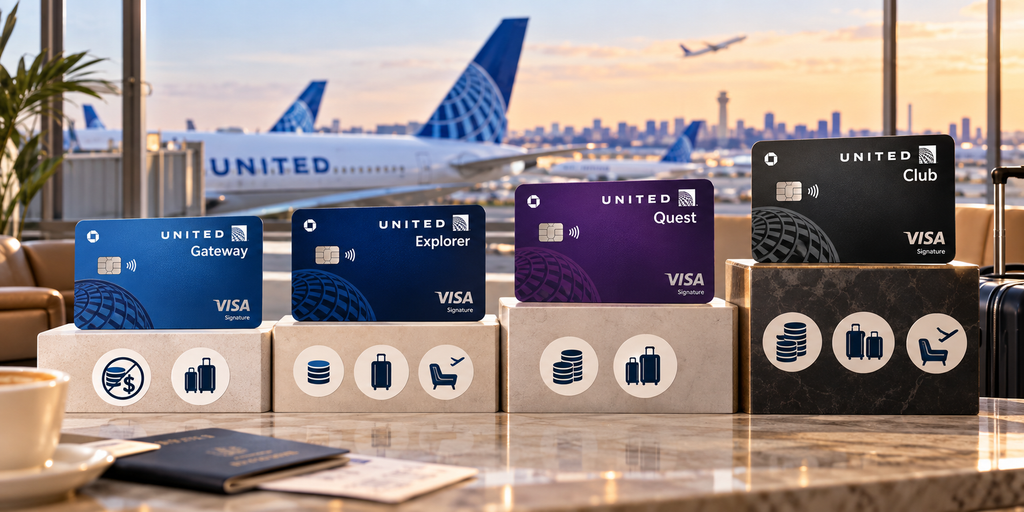
The “total miles” figures advertised on Chase’s card pages can be higher because Chase combines card earnings with the MileagePlus miles a general member can earn from eligible United flights. For a clean card-to-card comparison, it is more useful to focus on the miles earned specifically from eligible card purchases.
| Card | Annual Fee | United Purchase Earnings | Checked Bag Benefit | United Club Benefit |
| United Gateway Card | $0 | 2x miles on eligible United purchases* | 2 checked bags after $10,000 annual spend* | None |
| United Explorer Card | $0 first year, then $150 | 3x miles on eligible United purchases* | First checked bag free for primary cardmember + 1 companion* | 2 one-time passes each year* |
| United Quest Card | $350 | 4x miles on eligible United purchases* | First and second checked bags free for primary cardmember + 1 companion* | No standard United Club membership |
| United Club Card | $695 | 5x miles on eligible United purchases* | First and second checked bags free for primary cardmember + 1 companion* | United Club membership* |
Benefits are subject to Chase and United’s eligibility, purchase, ticketing, reservation, and other applicable terms.
How Do Chase United Credit Cards Work?
Chase issues the cards, while rewards are earned in the United MileagePlus loyalty program.
Instead of accumulating Chase Ultimate Rewards points, purchases on these co-branded cards earn United MileagePlus miles.
Those miles can then be used for eligible award travel with the airlines and participating airline partners such as Aegean Airlines, Copa Airlines, and many more.
United is a Star Alliance member, which expands the usefulness of MileagePlus miles beyond United-operated aircraft. The precise number of miles required for an award depends on the itinerary and available award pricing.
The four personal cards occupy distinct positions:
- Gateway: $0 annual fee and basic MileagePlus earning.
- Explorer: Travel perks such as a free first checked bag and limited United Club access.
- Quest: Higher United earnings, 2 checked bags, annual United travel credit, and award-flight benefits.
- Club: Premium card centered on United Club membership and frequent-flyer benefits.
United Gateway Card: The $0-Annual-Fee Option
The United Gateway Card has no annual fee and provides a way to earn United miles without committing to a yearly card fee.
Chase currently advertises:
- 5x total miles on eligible United flights
- 2x card miles on other eligible United purchases
- 2x miles at gas stations
- 2x miles on local transit and commuting
- 1x mile on other purchases
- 25% back as a statement credit on eligible United inflight purchases and Club premium drinks
- No foreign transaction fees
- 0% introductory APR on purchases for the first 12 months, followed by the applicable variable APR
The “5x total miles” figure combines card earnings with MileagePlus earnings available to a general member on eligible United airfare; the card itself earns 2x miles on other eligible United purchases.
Does the United Gateway Card Include Free Checked Bags?
The Gateway Card has an unusual checked-bag benefit.
Chase currently states that cardmembers can earn 2 checked bags after spending $10,000 in a calendar year. The card also unlocks a discount of 10% or more on eligible flights booked with miles after meeting the $10,000 annual spending threshold.
This differs substantially from the Explorer, Quest, and Club cards, whose core baggage benefits are tied directly to their card benefits and applicable ticketing requirements.
Who Might Find the Gateway Card Useful?
The Gateway can suit a traveler who wants to keep a United MileagePlus card open without paying an annual fee and values bonus earnings on United, gas, or commuting purchases.
Its limitations become more noticeable for regular United travelers because it does not include the Explorer’s standard first-checked-bag benefit or annual United Club passes.
United Explorer Card: More Everyday United Benefits
The United Explorer Card combines a moderate annual fee with a free first checked bag, priority boarding, 2 United Club one-time passes each year, and higher United earnings.
Its annual fee is currently:
$0 introductory annual fee for the first year, then $150.
Chase currently advertises:
- 9x total miles on eligible United flights
- 3x miles on other eligible United purchases
- 2x miles on dining
- 2x miles on qualifying hotel stays booked directly with the hotel
- 1x mile on other purchases
- First checked bag free
- Priority boarding
- 2 United Club one-time passes annually
- 25% back on eligible United inflight purchases
- Global Entry, TSA PreCheck, or NEXUS application-fee credit
- More than $500 in potential annual partner credits
The card’s “9x total miles” includes the MileagePlus miles earned on eligible United airfare as a general member plus card earnings.
How Does the Explorer Free Checked Bag Benefit Work?
The primary cardmember and 1 companion traveling on the same reservation can each receive a first standard checked bag free when the applicable benefit requirements are satisfied.
The ticket generally needs to be purchased with the qualifying United card, and United’s complete baggage-benefit terms apply.
This is an important detail because simply having the card in your wallet does not mean every United ticket automatically receives the baggage benefit.
United Club One-Time Passes
Explorer cardmembers receive 2 United Club one-time passes each year.
This is different from holding a United Club membership.
The passes can be useful for occasional lounge visits, but admission remains subject to the rules governing the passes and participating United Club locations.
United Quest Card: Higher Benefits Without Full Club Membership
The United Quest Card costs $350 per year and provides 2 free checked bags, a $200 annual United travel credit, an anniversary award-flight discount, priority boarding, and higher United earnings.
Current earning rates include:
- 10x total miles on eligible United flights
- 4x miles on other eligible United purchases
- 2x miles on other travel
- 2x miles on dining
- 2x miles on eligible streaming services
- 1x mile on other purchases
The card also earns 5x miles on qualifying stays purchased through Renowned Hotels and Resorts under the current program.
$200 United Travel Credit
Quest cardmembers currently receive a $200 United travel credit each account anniversary year, subject to the card’s terms.
A traveler who would naturally use the credit should factor it into the effective cost of keeping the card. Someone who would alter their spending merely to use a credit should be more conservative when valuing it.
10,000-Mile Award Flight Discount
The Quest also provides a 10,000-mile award-flight discount each account anniversary, subject to eligibility and award-booking conditions.
An additional 10,000-mile award-flight discount can be earned after spending $20,000 on the card during the applicable annual period.
2 Free Checked Bags
The Quest provides the primary cardmember and 1 eligible companion on the same reservation with their first and second standard checked bags free when the benefit requirements are satisfied.
For travelers who regularly check 2 bags, this creates a meaningful distinction from the Explorer.
Premier Qualifying Points
The Quest also provides 1,000 bonus PQP each year, beginning under the card’s current program rules, and spending can generate additional PQP toward United Premier status.
PQP benefits matter primarily to travelers actively pursuing MileagePlus Premier status. They should not be valued highly by someone who rarely flies enough to make elite qualification realistic.
United Club Card: Premium United Benefits and Lounge Access
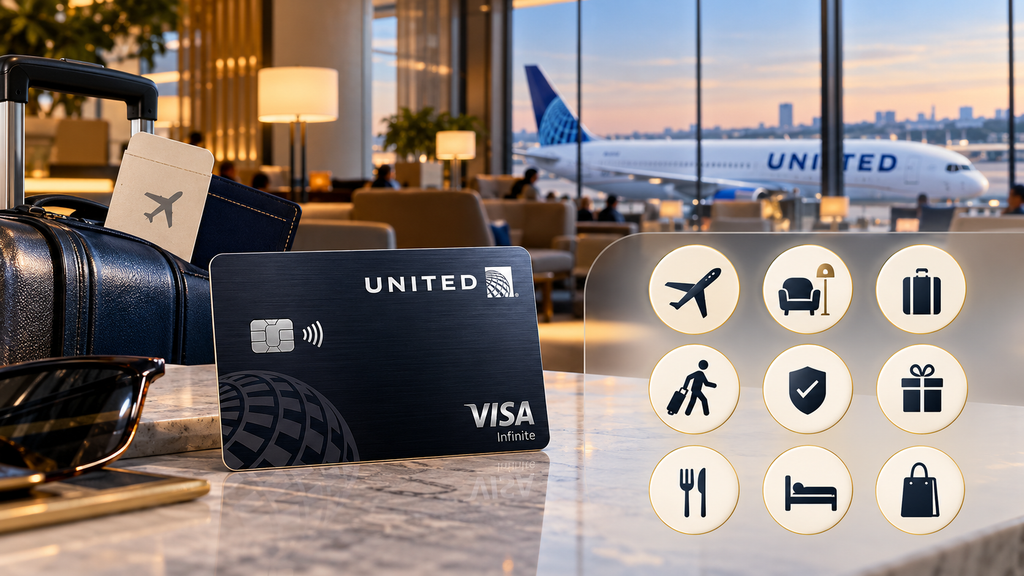
The United Club Card is the premium personal Chase United card, charging a $695 annual fee in exchange for United Club membership, 2 free checked bags, Premier Access travel services, higher United earnings, and a collection of travel benefits and credits.
Chase currently advertises:
- 11x total miles on eligible United flights
- 5x miles on other eligible United purchases
- 2x miles on dining
- 2x miles on other travel
- 1x mile on other purchases
- United Club membership
- First and second checked bags free for the primary cardmember and 1 eligible companion
- Premier Access travel services where available
- Global Entry, TSA PreCheck, or NEXUS application-fee credit
- More than $875 in potential annual partner credits
As with the other cards, the advertised 11x total on eligible United flights includes the MileagePlus miles a general member earns plus the card’s earnings.
How Does United Club Access Work With the Club Card?
The Club Card includes a United Club membership rather than a limited number of annual one-time passes.
That is one of the clearest differences between the Explorer and Club cards.
| Card | United Club Benefit |
| Gateway | None |
| Explorer | 2 one-time passes annually |
| Quest | No standard Club membership |
| Club | United Club membership |
The premium Club card can also unlock enhanced lounge privileges through United’s All Access membership structure when the applicable qualification requirements are met. Current rules can tie enhanced guest privileges to factors such as United Premier Gold status or qualifying annual card spending.
Travelers should check United’s current Club access rules before traveling because guest policies, eligible flights, and participating lounge requirements matter.
How Do Checked-Bag Benefits Compare?
Checked baggage is one of the easiest United card benefits to quantify because it replaces an expense that many travelers would otherwise pay.
| Card | Checked-Bag Benefit |
| Gateway | Earn 2 checked bags after $10,000 calendar-year spending* |
| Explorer | First checked bag free for primary cardmember + 1 companion* |
| Quest | First and second checked bags free for primary cardmember + 1 companion* |
| Club | First and second checked bags free for primary cardmember + 1 companion* |
United and Chase’s complete benefit and ticket-purchase requirements apply.
For example, someone who regularly travels with a companion and both travelers check luggage could extract substantially more value from the baggage benefit than a passenger who normally travels with only a carry-on.
That is why the headline annual fee alone is not enough to compare the cards.
Which United Card Earns the Most Miles on United Purchases?
The Club Card has the highest card earning rate for eligible United purchases among the four personal cards.
| Card | Card Earnings on Eligible United Purchases |
| Gateway | 2x |
| Explorer | 3x |
| Quest | 4x |
| Club | 5x |
Chase advertises higher total earnings on eligible United flights—5x, 9x, 10x, and 11x respectively—because those figures combine credit-card earnings with the standard MileagePlus earnings an eligible general member receives from the flight.
Keeping those two concepts separate makes comparisons much clearer.
How Do the Annual Fees Compare?
The current annual fees form a straightforward progression:
| Card | Annual Fee |
| United Gateway | $0 |
| United Explorer | $0 first year, then $150 |
| United Quest | $350 |
| United Club | $695 |
A higher annual fee does not automatically mean poorer value. The relevant question is how much of the included benefit package you would naturally use.
A traveler paying for checked bags several times a year, visiting United Clubs regularly, and using applicable travel credits has a very different calculation from someone who takes one United trip annually with a carry-on.
United Explorer vs. United Quest
The Explorer and Quest are likely to attract travelers who want meaningful United benefits without paying for the premium Club card.
The main differences are:
| Feature | Explorer | Quest |
| Annual fee | $0 first year, then $150 | $350 |
| Eligible United purchases | 3x | 4x |
| Checked bags | First bag* | First + second bags* |
| United Club | 2 one-time passes/year | No standard membership |
| Annual United travel credit | Spending-based benefit may apply | $200 anniversary credit* |
| Anniversary award discount | Eligible award savings | 10,000-mile discount* |
| Annual bonus PQP | — | 1,000 PQP under current terms* |
The Explorer emphasizes a lower annual cost plus occasional lounge access, whereas the Quest shifts more value toward frequent United travel, checked baggage, award travel, and elite-status progress.
United Quest vs. United Club Card
Moving from the $350 Quest to the $695 Club card increases the annual fee by $345.
In return, the Club card’s major distinctions include:
- United Club membership
- 5x rather than 4x miles on other eligible United purchases
- Premier Access travel services
- Higher potential PQP earning
- Premium travel-status benefits
- A larger collection of partner credits
The Quest retains its own valuable features, particularly the $200 annual United travel credit and anniversary award-flight discount.
The practical comparison therefore comes down largely to lounge use, United travel frequency, status goals, and whether the additional Club-card benefits replace expenses you would otherwise incur.
Can Chase United Cards Help You Earn Premier Status?
Yes. Eligible spending on United co-branded cards can generate Premier Qualifying Points, or PQP, under United’s current rules.
The earning rate and annual maximum differ by card.
The Quest and Club cards also provide annual bonus PQP under their current benefit structures, with the Quest receiving 1,000 bonus PQP and the Club receiving 1,500.
Credit-card PQP can be helpful when a frequent United traveler is close to a Premier qualification threshold.
However, card spending should not be viewed as an automatic substitute for understanding United’s full Premier qualification rules. The program can change its PQP and flight requirements by qualification year.
Do Chase United Cards Offer Award-Travel Discounts?
Yes, but the conditions differ by card.
The current portfolio includes benefits such as:
- Preferred or discounted award pricing
- Spending-triggered award discounts
- Anniversary award-flight discounts
- Additional discounts after qualifying annual spending
For example, the Gateway currently unlocks savings of 10% or more on eligible flights booked with miles after $10,000 in calendar-year card spending, while the Quest includes a 10,000-mile anniversary award-flight discount.
These benefits can be useful to MileagePlus members who redeem miles frequently, but their practical value depends on the award itineraries you actually book.
What Are the Partner Credits on United Cards?

The refreshed United card portfolio includes credits or benefits involving travel and lifestyle partners.
Depending on the card, these can involve services such as:
- United travel
- Renowned Hotels and Resorts
- Rideshare
- Avis or Budget
- JSX
- DoorDash
Enrollment, spending thresholds, eligible transactions, expiration dates, and maximum credit amounts can apply.
For example, Chase currently markets the Explorer as providing more than $500 in potential annual partner credits and the Club card as offering more than $875.
Do not subtract the advertised value of every credit from the annual fee automatically.
A $50 credit is worth close to $50 only when you would otherwise have made an eligible purchase. A credit that causes you to spend money you would not normally spend should be valued more conservatively.
Should Welcome Bonuses Determine Which United Card You Choose?
Welcome offers can be valuable, but they should not be the only reason for selecting a long-term card.
Chase’s offers can change frequently. At the time of writing, its official pages advertise “up to” bonus offers across the personal United portfolio, with qualifying activities and spending requirements attached.
Because offers can change faster than the card’s core annual benefits, always verify the application page immediately before applying.
For a card you plan to keep beyond the first year, compare the recurring benefits with the recurring annual fee rather than judging it solely on the first-year bonus.
Can You Have More Than One United Credit Card?
It can be possible to hold more than one United co-branded card, subject to Chase’s application, eligibility, credit, and bonus-offer rules.
That does not mean holding several is automatically useful.
There can be overlap among benefits such as baggage allowances, inflight statement credits, award pricing, and partner credits.
Before adding another card, identify which incremental benefit it provides beyond the card you already hold.
For example, an Explorer cardholder considering the Club card should determine whether full United Club membership and the premium card’s additional benefits justify adding or replacing the existing card.
Can United Miles Be Transferred to Another Airline?
United MileagePlus miles are not generally transferred into another airlines loyalty currency simply because that carrier is a United partner.
Instead, MileagePlus members can use United miles to book eligible award flights operated by United airline partners, including Star Alliance carriers when partner award availability exists.
That is an important distinction: you keep the miles in MileagePlus and redeem them for eligible partner travel rather than moving them into the partner’s program.
What Should You Check Before Applying for a United Card?
Credit-card benefits and welcome offers change, so verify the current Chase application page before applying.
Pay particular attention to:
- Annual fee
- Welcome-offer requirements
- Bonus eligibility
- Checked-bag conditions
- United Club access rules
- Authorized-user benefits
- Partner-credit enrollment requirements
- PQP earning limits
- Award-flight discount conditions
- Foreign transaction fees
- APR and other pricing terms
Most importantly, calculate value using benefits you expect to use—not every benefit appearing in the marketing materials.
Final Thoughts
The four personal Chase United cards create a clear progression from a $0-annual-fee MileagePlus card to a premium product with full United Club membership. The Gateway concentrates on basic mileage earning, the Explorer adds useful airline benefits and occasional lounge access, the Quest adds stronger baggage, award, credit, and PQP benefits, and the Club card provides the most extensive United-specific travel package.
When comparing them, focus on the benefits you would naturally use during a normal year. Checked bags, lounge visits, United travel credits, award discounts, and PQP can have substantial practical value for some travelers but little value for others.
Since annual fees, welcome offers, credits, and card benefits can change, verify Chase’s current terms before submitting an application.
Frequently Asked Questions
Chase currently offers 4 primary personal United cards: United Gateway, United Explorer, United Quest, and United Club.
The United Gateway Card has a $0 annual fee. It earns 2x miles on eligible United purchases, gas stations, and local transit and commuting, plus 1x on other purchases.
The United Club Card includes United Club membership as a core card benefit. The Explorer instead provides 2 United Club one-time passes per year.
The Explorer currently has a $0 introductory annual fee for the first year, then $150.
The United Quest Card currently charges a $350 annual fee.
The United Club Card currently charges a $695 annual fee.
Under the current benefits, the Quest and Club cards provide the first and second standard checked bags free for the primary cardmember and 1 eligible companion on the same reservation when applicable requirements are met.
Gateway cardmembers can currently earn a benefit covering 2 checked bags after spending $10,000 on the card in a calendar year, subject to the applicable terms.
The current personal United cards are marketed without foreign transaction fees, although travelers should always verify the card’s pricing and terms before applying.
No. The co-branded United cards earn United MileagePlus miles rather than Chase Ultimate Rewards points.