
What Are the 25 Airplane Etiquette Rules Every Traveler Should Follow?
Good airplane etiquette means respecting fellow passengers, following crew instructions, using shared cabin space thoughtfully, and avoiding behavior that makes a flight uncomfortable or unsafe. From boarding queues and overhead bins to reclining seats and restroom use, small decisions can make a noticeable difference to everyone onboard.
Air travel brings strangers together in a confined space, often for several hours. Some passengers want to sleep, others are traveling with children, and many are managing tight connections or long journeys. With limited personal space and shared facilities, even ordinary habits can become frustrating when they affect nearby travelers.
Airplane etiquette is not simply about being polite. Certain behaviors, such as fastening seat belts when instructed, following safety announcements, and keeping emergency exits clear, are safety requirements. Others, such as avoiding strong-smelling food or keeping conversations quiet, are considerate practices rather than formal airline rules.
This guide covers 25 practical airplane etiquette tips, from preparing for boarding to leaving the aircraft, along with common in-flight disagreements and the best ways to handle them.
What Are the Most Important Rules of Airplane Etiquette?
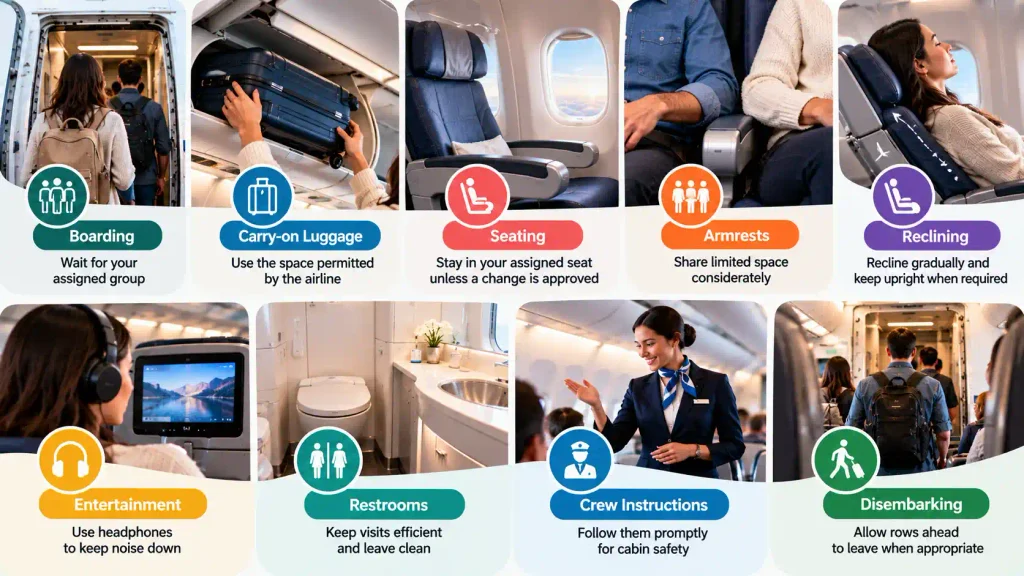
The most important airplane etiquette rules are to follow cabin crew instructions, respect personal space, board and disembark in an orderly manner, control noise, and share facilities fairly.
The following overview separates everyday courtesy from practices that may also involve airline safety requirements.
| Situation | Recommended behavior | Why it matters |
| Boarding | Wait for the assigned boarding group | Reduces congestion |
| Carry-on luggage | Use the space permitted by the airline | Leaves room for other passengers |
| Seating | Remain in the assigned seat unless a change is approved | Prevents disputes and seating confusion |
| Armrests | Share limited space considerately | Reduces discomfort |
| Reclining | Recline gradually and remain upright when required | Protects nearby passengers and supports safety |
| Entertainment | Use headphones | Keeps cabin noise down |
| Restrooms | Keep visits efficient and leave facilities clean | Improves access for others |
| Crew instructions | Follow them promptly | Supports cabin safety |
| Disembarking | Allow rows ahead to leave when appropriate | Prevents aisle congestion |
These principles apply broadly, although individual airlines may have additional rules concerning baggage, seating, electronic devices, and onboard services.
How Should Travelers Behave Before Boarding a Flight?
Good airplane manners begin before passengers enter the aircraft. Preparing belongings, respecting boarding priorities, and avoiding unnecessary congestion help the boarding process move efficiently.
1. Why Should Passengers Arrive at the Gate Before Boarding Begins?
Arriving at the gate with sufficient time allows passengers to confirm their boarding group, check for schedule changes, and organize essential documents.
Travelers who arrive at the last minute may need assistance from gate staff, creating additional pressure during an already busy boarding process.
Passengers should check the airline’s recommended airport arrival time and boarding cutoff, which can vary by route and airport.
Take a Look at Our Blog: 17 Best Credit Cards for citizenM Hotel Travelers
2. Why Is It Important to Respect Boarding Groups?
Passengers should board only when their assigned group or boarding category is called, unless they qualify for an authorized priority or preboarding arrangement.
Crowding the gate before boarding begins can obstruct passengers who are eligible to board earlier.
For example, someone assigned to a later boarding group should remain clear of the boarding lane until called rather than standing directly in front of the gate entrance.
Passengers who need disability-related assistance or additional boarding time may have specific preboarding rights. For flights covered by U.S. regulations, qualifying passengers can request preboarding assistance.
3. How Can Travelers Prepare Their Carry-On Bags Before Boarding?
Carry-on bags should be organized before entering the aircraft so passengers can reach their seats without prolonged searching in the aisle.
Essential items such as medication, headphones, a phone, and travel documents can be placed in an accessible personal item.
Passengers should also check the airline’s baggage size and quantity limits in advance. Travelers comparing different carriers can use the AirlineLocations airline directory to identify their airline and then confirm its official baggage rules.
4. Why Should Passengers Avoid Blocking the Aircraft Aisle?
Passengers should move into their row promptly and avoid occupying the aisle longer than necessary.
A traveler who spends several minutes removing a jacket, opening multiple bags, and rearranging belongings can delay everyone boarding behind them.
Preparing before entering the aircraft and stepping into the row when possible allows others to continue toward their seats.
5. What Is the Proper Way to Use Overhead Bin Space?
Overhead bins should be used according to airline instructions, with bags positioned efficiently and smaller personal items placed under the seat when required.
The compartment directly above a passenger’s seat is not automatically reserved for that passenger. Overhead storage is generally shared, although some airlines or cabins offer designated storage privileges.
Passengers should avoid moving someone else’s luggage without permission. If a bag needs repositioning, asking the owner or a flight attendant is the better approach.
How Should Passengers Share Seats and Personal Space?
Respecting personal space is one of the most important aspects of airplane etiquette, particularly in economy cabins where seats, armrests, and legroom are limited.
6. Who Should Get the Middle Armrests on an Airplane?
The middle-seat passenger is generally given priority for the two shared armrests as a courtesy, although this is not a universal airline rule.
Window-seat passengers have the window-side space, while aisle-seat passengers have easier access to the aisle. The middle passenger typically has neither advantage.
Giving the middle passenger the shared armrests is a widely accepted compromise, but passengers should remain flexible when someone has mobility or physical-space needs.
7. How Should Passengers Handle Seat Reclining?
Passengers should recline their seats slowly, remain aware of the person behind them, and follow crew instructions about keeping seats upright.
A sudden recline can interfere with a laptop, spill a drink, or interrupt a meal.
On longer flights, reclining may be expected, particularly during designated rest periods. However, checking behind the seat before moving it is a considerate habit.
Seatbacks must be upright when instructed, including during takeoff and landing.
8. Is It Acceptable to Ask Another Passenger to Switch Seats?
Passengers may politely request a seat exchange, but the other traveler is free to decline.
Someone who paid for an aisle seat or extra legroom should not feel pressured to exchange it for a less desirable location.
For example, parents traveling with children may ask another passenger to switch seats, but should first seek help from airline staff if their assigned seats are separated.
Any seat exchange should be approved by the crew when necessary, especially if it involves different cabins, safety restrictions, or seating accommodations.
9. Who Controls the Window Shade During a Flight?
The passenger sitting beside the window generally has the strongest claim to controlling its shade as a matter of courtesy, but airline instructions take priority.
Other passengers may reasonably request that the shade be lowered to reduce glare or raised to improve visibility.
On certain flights, crews may ask passengers to adjust window shades for operational or safety reasons.
A polite request is more effective than reaching across another passenger to adjust the shade without permission.
10. How Can Passengers Avoid Invading Someone Else’s Personal Space?
Passengers should keep their arms, legs, bags, and other belongings within their own seating area whenever practical.
Stretching feet beneath another person’s seat, repeatedly bumping a seatback, or leaning heavily into neighboring space can make a flight uncomfortable.
Passengers who need to stretch can use the aisle when movement is permitted, rather than extending into another traveler’s legroom.
If personal space becomes a recurring problem, a calm conversation or assistance from the crew is preferable to a confrontation.
What Are the Best Airplane Etiquette Tips During a Flight?
Once the aircraft is airborne, passengers share the same environment for an extended period. Managing noise, food, hygiene, and movement becomes especially important.
11. Why Should Travelers Always Use Headphones?
Passengers should use headphones when listening to music, watching videos, playing games, or participating in permitted calls.
Even low-volume audio from a personal device can disturb nearby passengers, particularly during overnight flights.
Children using tablets should also have suitable headphones or keep devices muted.
Headphones should not prevent passengers from hearing important safety announcements or crew instructions.
12. How Loud Is Too Loud When Talking on a Plane?
Conversations should be kept at a moderate volume, especially when surrounding passengers are resting.
Cabin noise can make people speak louder than they realize, but shouting across rows or holding extended conversations over sleeping passengers is inconsiderate.
Passengers should also avoid repeatedly initiating conversations with seatmates who are reading, wearing headphones, or otherwise signaling that they prefer privacy.
13. What Is Proper Airplane Etiquette for Eating and Drinking?
Passengers should eat carefully, manage packaging, and avoid foods with particularly strong odors when practical.
Meals involving messy sauces, excessive crumbs, or strong smells can affect nearby travelers in a confined cabin.
For example, bringing a neatly packed sandwich is generally easier to manage than a large meal requiring several containers and utensils.
Passengers should also avoid placing food wrappers or used napkins in seat pockets when waste collection is available.
14. Why Should Passengers Avoid Strong Perfumes and Fragrances?
Strong fragrances can cause discomfort for passengers who are sensitive to smells.
Applying perfume, scented lotion, or aerosol products during a flight may affect several surrounding rows because the cabin is enclosed.
A better approach is to use lightly scented or fragrance-free products when possible and avoid spraying perfume onboard.
Passengers should also be considerate when using medicated or personal-care products that produce noticeable odors.
15. Is It Acceptable to Remove Shoes During a Flight?
Removing shoes may be acceptable when airline rules permit it, but passengers should keep their feet clean, covered, and within their own seating area.
Putting bare feet on armrests, tray tables, seatbacks, or another passenger’s space is inappropriate.
Comfortable socks can help on longer flights, but shoes should be readily available when passengers need to move around.
Airplane lavatory floors should not be treated as clean surfaces, making footwear particularly important when visiting the restroom.
16. Why Should Personal Grooming Be Avoided in the Cabin?
Activities such as clipping nails, filing toenails, or performing messy skincare routines should be avoided at the seat.
These activities can create hygiene concerns and disturb nearby travelers.
Simple adjustments, such as brushing hair discreetly or applying lip balm, are generally less disruptive, provided they do not affect others.
More involved grooming should be completed before boarding or in an appropriate facility after landing.
17. How Should Travelers Use Airplane Restrooms Considerately?
Passengers should use aircraft restrooms efficiently, maintain cleanliness, and avoid occupying them unnecessarily.
Long grooming routines or changing clothes during busy periods can create queues.
After using the restroom, passengers should dispose of waste properly, leave surfaces clean, and follow posted instructions.
Travelers should also remember that restroom access may be restricted during turbulence, takeoff, landing, or other operational situations.
18. What Is the Best Way to Move Past Seated Passengers?
Passengers should politely alert their seatmates before attempting to leave their row.
A brief request gives others time to move their legs, secure their belongings, or stand up.
Trying to climb over someone without warning can lead to accidental contact or spilled drinks.
Passengers should also avoid pulling heavily on the seatback in front of them for balance, as this can jolt the person sitting there.
How Should Travelers Treat Flight Attendants and Other Passengers?
Cabin crew members are responsible for safety and onboard service. Respectful communication helps them manage the flight effectively while addressing passenger needs.
19. Why Is Following Flight Attendant Instructions Essential?
Passengers must follow lawful crew instructions related to safety and security, including seat belt requirements, baggage storage, and restrictions during critical flight phases.
The Federal Aviation Administration emphasizes the importance of following crew directions and keeping the seat belt fastened while seated.
For example, if the crew instructs passengers to return to their seats because of turbulence, continuing to stand in the aisle creates unnecessary risk.
Safety instructions are not optional etiquette suggestions.
20. How Should Passengers Handle Disagreements With Seatmates?
Passengers should address minor disagreements calmly and involve the cabin crew when a problem cannot be resolved respectfully.
Arguments about armrests, reclining seats, noise, or personal space can escalate when either person becomes confrontational.
A useful approach is to explain the specific issue rather than criticize the other person.
For example, asking someone to lower their device volume is more productive than making personal remarks about their behavior.
Passengers should avoid touching another traveler or their belongings during a disagreement.
21. How Can Travelers Be Considerate Toward Families With Children?
Passengers should recognize that traveling with infants and young children can involve unavoidable noise, movement, and additional needs.
Parents and caregivers should make reasonable efforts to keep children comfortable, supervised, and safely seated.
Other travelers can contribute by avoiding hostile remarks or confrontations when a child becomes upset.
If a child’s behavior repeatedly affects another passenger, such as kicking a seat, a polite request to the caregiver is appropriate.
Children are permitted in premium cabins when the airline’s ticketing rules allow it; nearby passengers do not have a general right to demand their removal because of age.
22. What Should Passengers Know About Travelers With Disabilities?
Passengers should respect accessibility needs, avoid making assumptions, and allow airline personnel to provide appropriate assistance.
Someone using a wheelchair, mobility aid, or other assistive equipment may need additional boarding time or a specific seating arrangement.
On flights covered by U.S. disability regulations, airlines have obligations to provide qualifying passengers with appropriate assistance and seating accommodations.
Travelers should not move another person’s mobility equipment or assume they can take a seat reserved for an accessibility accommodation.
Offering assistance is considerate, but it is important to ask first rather than act without permission.
Read this blog: Air China Domestic Economy: Seats, Meals, and Booking
What Is Proper Airplane Etiquette When Landing and Disembarking?
Airplane etiquette remains important after landing. Passengers should wait for clearance to stand, retrieve their belongings carefully, and leave the aircraft without obstructing others.
23. Why Should Passengers Remain Seated Until the Seat Belt Sign Is Off?
Passengers should remain seated with their seat belts fastened until the aircraft has stopped and the crew indicates that it is safe to move.
Standing immediately after touchdown can be dangerous because the aircraft may still be taxiing, turning, or braking.
Even after reaching the gate, passengers should wait for the seat belt sign to be switched off before standing or opening overhead compartments.
24. How Should Travelers Retrieve Luggage From Overhead Bins?
Passengers should retrieve their luggage carefully, checking that bags do not fall onto people seated nearby.
Overhead compartments may contain heavy items that have shifted during the flight.
Travelers should avoid pulling luggage out suddenly or attempting to remove multiple bags while blocking the aisle.
If an item is difficult to reach or unusually heavy, requesting assistance is safer than risking an injury.
25. What Is the Correct Way to Exit an Airplane?
Passengers should generally allow those in rows ahead to leave first, unless the crew provides different instructions or another passenger is permitted to move ahead.
Pushing into the aisle before nearby passengers have collected their belongings rarely saves meaningful time and can create congestion.
Travelers with tight connections can inform the crew before landing and politely request assistance. However, they should not assume that having a connecting flight automatically gives them priority over everyone else.
Passengers requiring mobility assistance may need to follow a different disembarkation procedure.
Which Airplane Behaviors Are Considered Rude or Unacceptable?
Some airplane behaviors are minor etiquette mistakes, while others can interfere with safety or violate airline policies.
| Passenger behavior | Why it is problematic | Better alternative |
| Playing videos without headphones | Disturbs nearby passengers | Use headphones or mute the device |
| Pushing through the boarding queue | Creates congestion | Wait for the assigned boarding group |
| Taking over both shared armrests | Limits another passenger’s space | Share armrests considerately |
| Reclining suddenly | Can disturb meals or damage belongings | Recline gradually |
| Placing bare feet on seatbacks | Creates hygiene and personal-space concerns | Keep feet within the seating area |
| Repeatedly kicking the seat ahead | Disrupts another passenger | Keep legs and belongings controlled |
| Arguing with flight attendants | Can interfere with cabin operations | Follow instructions and raise concerns calmly |
| Standing during taxiing | Creates a safety risk | Remain seated until permitted |
| Rushing past other rows after landing | Disrupts orderly disembarkation | Wait for a clear opportunity to leave |
A useful distinction is that courtesy can often be negotiated, while safety requirements must be followed.
For instance, passengers may politely discuss an armrest arrangement, but they cannot disregard a crew instruction to fasten seat belts.
How Does Airplane Etiquette Change Between Economy, Business, and First Class?
The basic rules of airplane etiquette apply across all cabins, although seating layouts and available services can affect how passengers share space.
| Etiquette consideration | Economy Class | Business or First Class |
| Armrest sharing | Often important because seats are close together | May be less relevant with separate armrests |
| Seat reclining | Requires awareness of limited space behind | Some seats recline substantially or convert into beds |
| Overhead storage | Shared storage may be limited | Storage arrangements depend on aircraft and cabin |
| Noise | Nearby passengers may be easily disturbed | Privacy features may reduce, but not eliminate, disturbance |
| Meal service | Passengers should keep tray areas clear | Additional meal services still require consideration |
| Crew instructions | Mandatory | Equally mandatory |
A premium ticket does not exempt a passenger from safety requirements or respectful behavior.
Likewise, passengers in economy should not be expected to tolerate disruptive behavior simply because they purchased a lower-priced ticket.
Related: Baby Bassinet Seats on 50+ Airlines: The Complete 2026 Guide
How Can Passengers Handle Common Airplane Etiquette Problems?
The most effective response to an uncomfortable situation is usually a polite request followed by crew assistance if necessary.
Here are practical examples of how passengers can address common issues without escalating them.
| Situation | Suggested response |
| A passenger is playing loud audio | “Would you mind using headphones? The sound is carrying into our row.” |
| Someone is repeatedly kicking the seat | “Could you please be careful with the seat? I can feel it moving quite a bit.” |
| A passenger asks for an unwanted seat exchange | “I understand, but I’d prefer to keep my assigned seat.” |
| A seatmate occupies excessive armrest space | “Would it be possible for us to share the armrest?” |
| Someone is blocking access to the aisle | “Excuse me, could I get past when you have a moment?” |
| A traveler wants to leave early for a connection | “I have a very short connection. Would you mind if I went ahead when it’s safe?” |
If another passenger becomes aggressive, threatening, or physically intrusive, travelers should avoid confrontation and notify a flight attendant.
Conclusion: How Can Travelers Practice Better Airplane Etiquette?
Good airplane etiquette is built around consideration, patience, and awareness of shared space. The most useful habits are often simple: preparing belongings before boarding, sharing armrests fairly, controlling noise, respecting personal boundaries, and allowing others to move through the cabin safely.
Travelers should also recognize the difference between courtesy and mandatory safety rules. Seat reclining and window shades may involve compromise, while seat belt instructions and crew directions require compliance.
Before flying, passengers should review their airline’s baggage and seating policies, prepare essential items, and understand any assistance they may need.
A respectful approach to fellow passengers and cabin crew can prevent many common frustrations and make the journey more comfortable for everyone onboard.
Related FAQs!
Yes, unintentionally leaning onto another passenger can invade their personal space. Travelers who expect to sleep can use a neck pillow or adjust their position to avoid disturbing nearby passengers.
Yes. A polite request is appropriate when repeated kicking or movement causes discomfort. If the behavior continues, a flight attendant can help address the situation.
Airline rules determine what food may be carried onboard, but passengers should consider how strong odors affect others. Foods with milder smells and minimal mess are generally better choices for shared cabins.
Yes, when necessary. A quiet, polite request is preferable to attempting to climb over a sleeping passenger. Most travelers understand that others may need to leave their seats during a flight.
Passengers should ask a flight attendant before moving to another seat. Availability, fare differences, aircraft balance, accessibility arrangements, and safety requirements may affect whether a change is permitted.
It depends on the circumstances. The window-seat passenger generally controls the shade as a courtesy, but considering nearby passengers who are trying to sleep is appropriate. Crew instructions take priority.
Yes. A traveler is not generally obligated to surrender an assigned seat simply because another group wants to sit together. Families should seek help from airline staff when seating arrangements create a problem.
Passengers should notify a flight attendant rather than attempt to physically intervene. Crew members are trained to respond to onboard disruptions and can determine the appropriate next steps.
Applauding after landing is not generally prohibited, but customs vary by region and flight. Passengers should avoid creating excessive noise or interfering with safety announcements.
Personal electronic devices may be used according to airline and regulatory instructions. Cellular connections, airplane mode requirements, onboard Wi-Fi, and voice-call restrictions vary by airline and jurisdiction.
Passengers should follow crew instructions and avoid disturbing others with loud audio or conversations.