
Solo Travel Guide: Essential Tips for First-Time Travelers
Solo travel is one of the best ways to discover new places independently, build confidence, and experience a destination at your own pace. For first-time adventurers, the key is to choose a manageable destination, prepare for common challenges, and leave enough flexibility to enjoy unexpected experiences. With thoughtful planning, traveling alone can be rewarding without feeling overwhelming.
A solo trip does not have to involve crossing continents or spending weeks backpacking. A weekend in a nearby city can be an excellent starting point before moving on to longer international journeys. The right approach balances independence with practical preparation, from choosing accommodation and arranging transport to managing money and knowing what to do if plans change.
This guide covers how to plan your first solo adventure, stay safe, manage expenses, pack efficiently, meet people, and decide whether travel insurance is worth it.
Relatable: 5 Best Ways to Use Atmos Points for Travel
Why Is Solo Travel Worth Trying?
Solo travel gives travelers control over their schedules, spending decisions, activities, and pace. Instead of coordinating with a group, an individual can spend an entire afternoon in a museum, change plans to visit a local market, or enjoy a quiet day without compromising anyone else’s preferences.
The benefits extend beyond convenience.
- Greater independence: Planning routes, handling bookings, and solving small problems can strengthen decision-making skills.
- Flexible itineraries: Travelers can change activities without negotiating with companions.
- Cultural immersion: Exploring independently may encourage more conversations with residents, guides, and fellow travelers.
- Personal growth: Navigating unfamiliar surroundings can build confidence and adaptability.
- Time for personal interests: A solo trip can focus entirely on food, nature, history, photography, shopping, or relaxation.
Traveling alone does not mean being lonely throughout the journey. Some travelers enjoy the solitude, while others meet people through walking tours, group excursions, hostels, and cultural activities. Both approaches are valid.
The key difference is that solo travel lets you choose how social or independent each day should be.
How to Choose the Best Destination for Your First Solo Trip
The best destination for a first solo trip is one that feels manageable, offers suitable accommodation and transport, and matches the traveler’s budget and interests. A famous destination isn’t automatically the right choice if getting there involves complicated transfers, difficult navigation, or costs beyond your budget.
Before booking, evaluate the following factors.
| Factor | What first-time travelers should consider |
| Safety | Current travel advisories, common scams, local laws, and neighborhood conditions |
| Transportation | Reliable public transport, walkability, airport connections, and clear route information |
| Accommodation | Well-reviewed properties in convenient areas with secure access |
| Budget | Daily food, transport, accommodation, activities, and emergency expenses |
| Language | Availability of translation tools and the ability to communicate in common situations |
| Healthcare | Access to pharmacies, clinics, hospitals, and emergency assistance |
| Activities | Attractions, guided tours, outdoor experiences, and interests suited to solo visitors |
| Connectivity | Mobile coverage, Wi-Fi availability, and access to offline maps |
Domestic or international: Which is better for beginners?
A domestic trip may be easier for someone who wants to practice traveling alone without navigating unfamiliar immigration procedures, international roaming, or currency exchange. Familiar payment methods and easier access to home support can also make the first experience less intimidating.
An international trip may suit travelers who already feel comfortable navigating airports and managing bookings. Still, choose the destination carefully, paying attention to visa requirements, local customs, health considerations, and transportation.
For example, a first-time traveler might begin with two nights in a nearby city, then try a longer domestic journey, and eventually plan an overseas holiday. This gradual approach builds experience without making the first trip unnecessarily complicated.
What makes a destination beginner-friendly?
Look for destinations with clear transport information, reliable accommodation, accessible attractions, and established tourism services. A city with convenient public transportation is often easier to navigate than a remote destination that requires multiple private transfers.
Solo travelers should also consider their personal comfort. Someone who enjoys busy cultural districts may prefer a large city, while a nature enthusiast may be happier in a well-connected town near hiking trails or national parks.
No destination is completely risk-free. Conditions vary by neighborhood and change with weather, local events, and political developments, so research should match your intended itinerary.
How to Plan Your First Solo Trip Step by Step
A first solo trip is easier to manage when you break the planning process into smaller decisions. The aim is to secure the essentials while keeping the daily schedule flexible.
1. Decide on the length and purpose of the trip
Start by deciding what the trip should offer. A food-focused city break, a beach holiday, a hiking adventure, and a museum weekend require different levels of preparation.
First-time travelers often benefit from a shorter itinerary. Two or three nights can give you enough time to practice navigating a destination, arranging meals, and managing transport without the pressure of filling a long holiday.
Choose a realistic travel period based on work or study commitments, seasonal weather, and the amount of time available for preparation.
2. Set a realistic budget
Solo travelers generally pay full price for accommodation and transport rather than splitting costs with companions. That makes budgeting especially important.
Build a budget around these categories:
- Flights, trains, buses, or other long-distance transport
- Accommodation and any local taxes or service charges
- Meals, snacks, and drinking water
- Local transport and airport transfers
- Attraction tickets, tours, and activities
- Mobile data and communication
- Travel insurance, where appropriate
- Emergency funds and unexpected expenses
Research current prices for the specific destination instead of relying on a generic daily estimate. Accommodation, transport, and food costs can vary substantially by city and season.
For example, a traveler planning a five-day city break could book accommodation and the return journey first, then set daily limits for food, local transport, and attractions. Keeping a separate emergency reserve helps prevent an unexpected taxi ride or medical expense from disrupting the rest of the trip.
3. Book the essentials in a sensible order
For a first solo trip, it is usually helpful to secure the main transport and initial accommodation before departure. The exact booking order depends on the destination, availability, and cancellation terms.
A practical sequence is:
- Confirm travel dates and check entry requirements.
- Compare transport options and book the main journey.
- Arrange suitable accommodation for arrival.
- Review travel insurance options and purchase appropriate coverage.
- Reserve activities that require booking.
- Research local transport, food options, and alternative plans.
Do not assume that the cheapest booking is always the best value. A hotel far outside the main area may require extra transport spending, while a non-refundable reservation could be costly if plans change.
4. Create a flexible itinerary
A solo itinerary should provide direction without turning the holiday into a timetable that is hard to change.
Plan one main activity for each day and add optional stops nearby. For instance, a morning museum visit could be followed by lunch in the surrounding neighborhood, leaving the afternoon free for a market, a park, or a rest.
Group attractions by location to reduce unnecessary travel time. Check opening hours, reservation requirements, weather forecasts, and how long it takes to return to your accommodation.
Keep copies of booking confirmations and note the address of the place where you are staying. If your phone battery dies or mobile data stops working, this basic information can be invaluable.
5. Share your plans with someone you trust
Give a trusted friend or family member your key travel details, including accommodation information, main transport bookings, and a rough itinerary. Agree on a convenient check-in routine, particularly if traveling through remote areas or changing destinations frequently.
Sharing your live location can help when appropriate, but do so selectively with someone trustworthy. Avoid publishing real-time accommodation details or a complete itinerary publicly.
Solo Travel Safety Tips for First-Time Adventurers
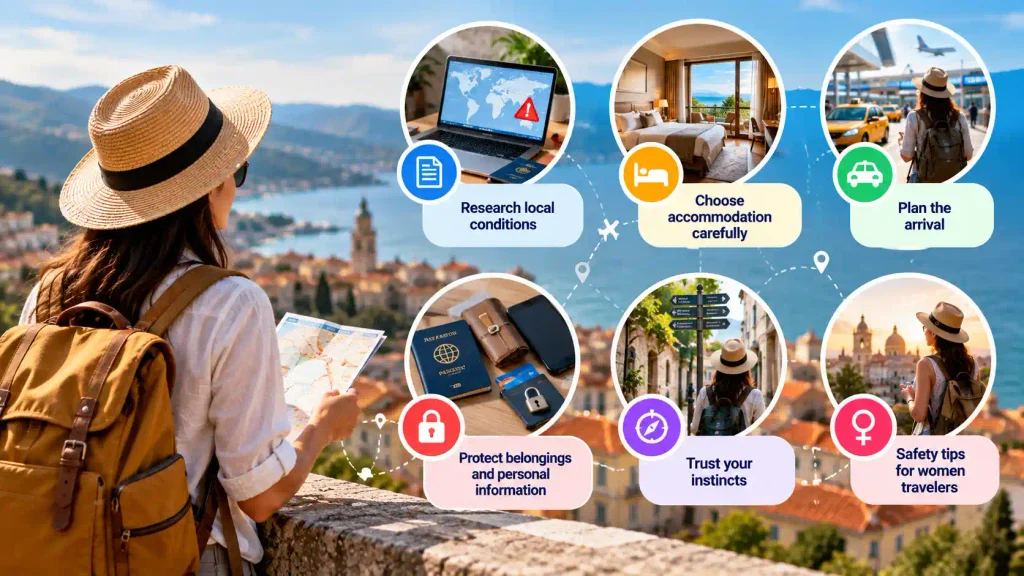
Traveling alone requires greater personal responsibility because you don’t automatically have a companion to help with navigation, belongings, or unexpected problems. Good preparation reduces avoidable risks, although it cannot eliminate every danger.
Research local conditions before departure
Review current travel advisories, local laws, transport guidance, and common scams. Check whether any areas have restrictions, whether weather could affect planned activities, and whether local customs influence clothing or behavior at religious and cultural sites.
Official information is especially important when conditions change quickly. A destination that was suitable for travel several months earlier may now have different transport, health, or security conditions.
Choose accommodation carefully
Look beyond the nightly price when comparing hotels, hostels, guesthouses, or short-term rentals.
Consider:
- Recent reviews that mention security, cleanliness, and staff responsiveness
- The distance from public transport and essential services
- How guests enter the property and access their rooms
- Reception or check-in arrangements, particularly for late arrivals
- The availability of a clear address and reliable contact details
- Cancellation terms and alternative accommodation nearby
Plan the arrival.
The first journey from an airport, station, or bus terminal can be one of the most stressful parts of solo travel. Before you leave, check official transport options, estimated journey time, payment methods, and operating hours.
If you arrive late at night, consider booking transport through a reputable provider or using an official taxi stand. When using a ride-hailing service, verify the vehicle and driver details, and share the journey information with a trusted contact if possible.
Save the accommodation address offline so that directions remain accessible without mobile data.
Protect belongings and personal information.
Keep your passport, cash, cards, and phone secure. Avoid displaying expensive equipment unnecessarily, particularly in crowded areas. Use accommodation safes when available and appropriate, but do not rely on a single storage method for every important item.
Carry only the identification and payment methods needed for the day. Keep backup cards or emergency cash separately from the main wallet.
Use strong device passwords, enable available tracking features, and avoid accessing sensitive financial accounts over unsecured public Wi-Fi. Do not leave your phone, bag, or drink unattended in unfamiliar settings.
Trust your instincts and set boundaries.
Travelers don’t need to accept invitations, reveal where they are staying, or keep a conversation going if it makes them uncomfortable. If a situation feels wrong, move to a public place, contact a trusted person, or seek help from local authorities or established staff.
When meeting people, arrange the first meeting in a public setting. Be cautious about sharing personal details, accepting unsolicited offers, or meeting someone in a private location before you establish trust.
These precautions are practical habits, not reasons to approach every stranger with suspicion. Many travelers have positive experiences meeting people along the way; the goal is to move at a pace that feels comfortable.
Safety considerations for women traveling alone
Women may face destination-specific concerns involving harassment, transport, accommodation, or local cultural expectations. Research should therefore include recent information relevant to the places and activities on the itinerary.
Useful precautions include selecting well-reviewed accommodation, understanding local dress expectations, checking transport options before going out at night, and keeping a trusted contact informed of major itinerary changes.
Travelers should also check whether local emergency services, support organizations, or embassy services can assist if needed. The best precautions depend on the destination and the traveler’s individual circumstances.
What Should You Pack for a Solo Trip?
Packing for solo travel means carrying everything yourself and keeping important items accessible. A lighter bag makes it easier to use public transportation, climb stairs, move between accommodations, and respond to itinerary changes.
| Category | Items to consider |
| Documents | Passport or identification, visa if required, booking confirmations, insurance details |
| Money | Main payment card, backup card, some local currency where useful |
| Clothing | Weather-appropriate layers, comfortable walking shoes, versatile outfits |
| Health | Personal medication, prescriptions, basic first-aid supplies |
| Technology | Phone, charger, power bank, plug adapter where needed |
| Navigation | Offline maps, saved accommodation address, translation tools |
| Security | Secure day bag, luggage lock where suitable, emergency contacts |
| Personal essentials | Toiletries, reusable water bottle where safe, any necessary hygiene products |
Check baggage rules for every airline on the itinerary before packing. Carry-on dimensions, weight limits, restricted items, and battery rules vary by airline and route. Power banks and spare lithium batteries generally must be carried in accordance with the applicable airline and aviation-security requirements, so check the latest instructions before departure.
Keep important documents accessible.
Save digital copies of travel documents and bookings in a secure location that can be accessed offline. Keep a separate backup of essential information with someone you trust.
For international travel, check passport validity, visa or electronic authorization requirements, permitted medication rules, and any health documentation well in advance. The IATA Travel Center can help travelers review passport, visa, and health-entry requirements, but consult official government sources for final confirmation.
Pack for the actual itinerary.
A hiking trip may require sturdy footwear, weather protection, and activity-specific equipment, while a city break may call for comfortable walking shoes and a compact day bag.
Avoid packing items simply because they might be useful in an unlikely situation. Instead, consider the climate, planned activities, laundry access, and whether everyday essentials are available at the destination.
How to Manage Money While Traveling Alone
Financial preparation matters most when you have no companion to lend money or help resolve a blocked card.
Before you leave, notify your bank if required, review foreign transaction fees, and confirm your cards work at your destination. Check how to contact the bank from overseas and understand its process for freezing or replacing a lost card.
A practical money-management routine includes:
- Carrying a backup payment method separately from the primary wallet
- Keeping a modest amount of local currency when cash is useful
- Using ATMs in secure, reputable locations
- Reviewing transactions regularly
- Avoiding public discussion of available funds
- Setting spending limits for meals, transport, shopping, and activities
For international trips, compare the total cost of currency exchange, ATM withdrawals, card fees, and any currency-conversion choices offered at payment terminals.
If you lose or have your card stolen, contact the issuer promptly to block it and review recent transactions. If your passport disappears, contact local authorities where appropriate and your country’s nearest embassy or consulate for instructions on replacement.
How to Meet People During a Solo Trip
Solo travel offers the freedom to be independent without making you spend every moment alone. Social opportunities often arise naturally through shared activities and accommodation.
Join group activities
Walking tours, cooking classes, guided hikes, museum tours, and small-group excursions create opportunities to meet people with similar interests. They also offer structured ways to explore an unfamiliar area with a guide.
Choose reputable operators, check what is included in the price, and read recent reviews before booking.
Choose accommodation that matches your social preferences
Hostels and guesthouses may offer common areas or group activities, while hotels can provide more privacy. Neither is universally better: the right option depends on budget, comfort, sleep needs, and the desire to socialize.
A private room in a hostel, for example, may provide personal space while keeping shared lounges and organized events accessible.
Attend public events and use travel communities carefully
Food markets, festivals, public lectures, and cultural events can make it easier to connect with locals and other travelers. Online travel communities can also help you find meetups and recommendations.
When meeting someone for the first time, choose a public venue, arrange your own transport, and tell a trusted contact where you are going. Do not feel obliged to share accommodation details or change your itinerary to accommodate a new acquaintance.
Make peace with occasional solitude.
Some evenings, plans may fall through, or conversations may not happen. That is a normal part of travel, not evidence that the trip is going badly.
Bring a book, keep a list of independent activities, or plan a relaxed evening at a well-reviewed restaurant. Solo travel is most enjoyable when social interaction is optional rather than required.
Do Solo Travelers Need Travel Insurance?
Travel insurance can be especially useful for solo travelers because they often must handle a medical emergency, lost baggage, or a major transport disruption without immediate help from a companion. Whether a policy is worthwhile depends on the trip, the traveler’s existing coverage, and the financial risks involved.
For international trips, ordinary domestic health insurance may not cover treatment abroad or emergency transportation back to an appropriate medical facility. The U.S. Centers for Disease Control and Prevention advises travelers to review medical, trip-disruption, and medical-evacuation coverage before departure.
What can travel insurance cover?
Benefits vary by insurer and policy, but travel insurance may include:
| Coverage | Why it may matter |
| Emergency medical expenses | Helps cover eligible medical treatment for a covered illness or injury |
| Emergency medical evacuation | May pay for eligible transport to appropriate medical care |
| Trip cancellation | May reimburse eligible prepaid expenses if a covered reason prevents departure |
| Trip interruption | May cover eligible unused costs and additional transport after a covered disruption |
| Travel delay | May reimburse specified expenses after a qualifying delay |
| Baggage loss or delay | May cover eligible losses or essential purchases, subject to policy limits |
Do not assume every event is covered. Exclusions, benefit limits, deductibles, documentation requirements, and eligibility conditions can affect claims. Adventure sports, existing medical conditions, travel against official advice, and certain disruption scenarios may require particular attention.
When should you buy travel insurance?
Compare coverage early in the booking process, especially if you are paying non-refundable deposits. Some benefits and optional upgrades are available only when you purchase insurance within specified time windows, and those requirements vary by insurer and jurisdiction.
Check the policy’s emergency contact process, whether it offers 24-hour assistance, what expenses you must pay upfront, and which documents you need for a claim. Keep the policy number and assistance contact details accessible offline.
Travel insurance does not replace sensible preparation, and it cannot guarantee reimbursement for every unexpected expense. Its value lies in providing specified financial protection and assistance when covered problems occur.
Common Mistakes First-Time Solo Travelers Should Avoid
A few planning errors can make a solo trip more stressful or expensive than necessary.
Overloading the itinerary: Trying to visit too many attractions can leave little time for meals, rest, delays, or spontaneous discoveries. Plan fewer activities and allow time between them.
Choosing accommodation on price alone: A low nightly rate may be offset by expensive transfers, inconvenient access, or limited check-in arrangements. Compare the full cost and location.
Arriving without a transport plan: Research the route from the airport or station before you leave, especially if you arrive late.
Keep all money and documents together: A lost wallet or stolen bag can become a much bigger problem if you store every backup in the same place.
Ignoring local rules and customs: Research photography restrictions, dress expectations, public behavior, and rules affecting medication or outdoor activities.
Depending entirely on mobile data: Download maps, save addresses, and keep essential booking details available offline.
Sharing too much online: Avoid publishing real-time location information or publicly identifying an empty accommodation.
Plan for disruptions: Keep alternative transport options and a reserve of money for unexpected changes. A flexible plan is often more useful than a perfect itinerary with no backup.
Final Thoughts
A successful first solo trip depends less on having every detail figured out and more on being prepared to make sensible decisions. Choose a destination that matches your comfort level, budget carefully, secure suitable accommodation, and keep important information accessible. Build flexibility into the itinerary and make safety part of everyday planning, not an afterthought.
Start with a trip that feels achievable, learn from the experience, and use that confidence to plan the next adventure. With practice, traveling alone can get easier, and the freedom to shape each day around your interests is one of its greatest rewards.
FAQs About Solo Travel
Yes. A short trip to a familiar or easy-to-navigate destination can be a manageable introduction. Start with a realistic itinerary, secure accommodation, and arrange transport clearly, then increase the complexity of future trips as your confidence grows.
There is no universal amount. The budget depends on the destination, trip length, accommodation style, transport, food, activities, and insurance needs. Research current local prices and include a reserve for unexpected expenses before booking.
Hostels can make it easier to meet other travelers and may offer lower-cost accommodation, while hotels often provide more privacy. Compare reviews, location, security, amenities, and the type of social experience you prefer.
Contact the airline through its official channels, check rebooking options, and keep receipts for eligible expenses. Depending on the route and applicable rules, travelers may have rights to refunds, assistance, or compensation. Review the airline’s policy and relevant passenger-rights regulations rather than assuming every cancellation has the same outcome.
Balance independent activities with opportunities to socialize. Group tours, classes, walking excursions, and public events can provide easy ways to meet people. It is also helpful to schedule downtime and stay in touch with friends or family at home.
Balance independent activities with opportunities to socialize. Group tours, classes, walking excursions, and public events can provide easy ways to meet people. It is also helpful to schedule downtime and stay in touch with friends or family at home.