
Airline Passenger Rights: Delay & Cancellation Guide
When an airline cancels a flight or delays a journey, passengers may be entitled to a refund, rebooking, meals, hotel accommodation, or financial compensation, depending on the country’s laws and the circumstances of the disruption. However, no single worldwide rule guarantees compensation for every delayed or canceled flight.
Passenger protections vary by departure and arrival locations, the operating airline, the length of the delay, and the reason for the disruption. For example, U.S. rules generally focus on refunds when passengers reject a significantly changed itinerary, while European rules can provide fixed compensation for qualifying long delays and late-notice cancellations. The United Kingdom and other countries have their own regulatory frameworks.
Understanding these differences helps travelers decide whether to accept an alternative flight, request a refund, seek compensation, or claim eligible expenses through travel insurance.
What Are Airline Passenger Rights?
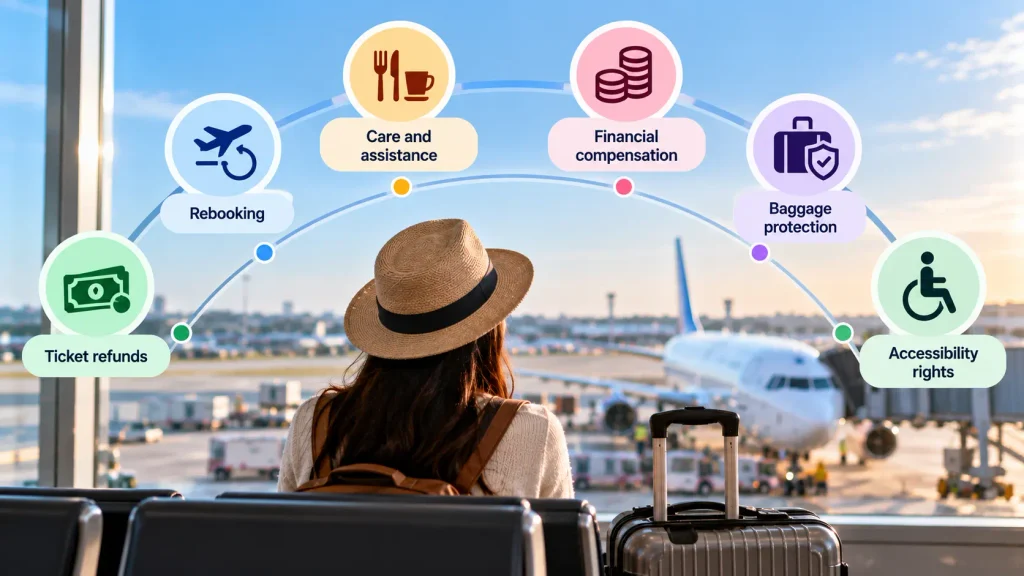
Airline passenger rights are legal protections and contractual entitlements that determine what airlines must do when a journey is disrupted, a passenger is denied boarding, or a traveler requires specific assistance.
Depending on the applicable rules, these protections may cover:
- Ticket refunds: Returning eligible payments when a flight is canceled or significantly changed, and the passenger chooses not to travel.
- Rebooking: Arranging alternative transportation to the destination.
- Care and assistance: Providing meals, refreshments, accommodation, or transportation in qualifying circumstances.
- Financial compensation: Paying a prescribed amount when a disruption meets specific legal conditions.
- Baggage protection: Addressing eligible claims involving delayed, lost, or damaged checked baggage.
- Accessibility rights: Providing assistance and protections for passengers with disabilities or reduced mobility.
These entitlements are not interchangeable. A traveler might qualify for a refund without qualifying for additional compensation. Another passenger might receive rebooking and meals while remaining eligible to submit a separate compensation claim.
First, identify the rules governing the flight rather than assuming the airline’s general customer-service policy determines every entitlement.
Flight Refunds, Rebooking, and Compensation: What’s the Difference?
Travelers often use refund, reimbursement, and compensation interchangeably, but they mean different things.
| Type of protection | What it generally means | When it may apply |
| Ticket refund | Returning eligible payments for an unused flight | Cancellation or a qualifying significant change when the passenger declines the alternative |
| Rebooking | Moving the passenger to another flight | Cancellation, schedule disruption, or other qualifying circumstances |
| Care and assistance | Meals, refreshments, hotel accommodation, or transport | When applicable regulations or airline commitments require them |
| Fixed compensation | A prescribed payment for inconvenience or disruption | When the applicable law’s conditions are met |
| Expense reimbursement | Repayment of eligible additional costs | When required by law, contract, airline policy, or an insurance policy |
| Travel insurance benefit | Payment for covered losses under an insurance contract | When the policy’s triggers, exclusions, limits, and documentation requirements are satisfied |
For example, suppose an airline cancels a flight and offers a replacement departing the following afternoon. A passenger who no longer wishes to travel may have a right to a ticket refund under the applicable rules. A passenger who accepts the replacement may instead continue the journey and may be entitled to meals, accommodation, or compensation, depending on the circumstances.
A refund normally returns eligible ticket payments. It does not automatically cover a separate hotel reservation, prepaid tour, or rental car.
Airline Passenger Rights in the United States
In the United States, the U.S. Department of Transportation (DOT) distinguishes between a passenger’s right to a refund and an airline’s responsibility for additional assistance or compensation.
When Can Passengers Get a Refund?
Under DOT rules, passengers are entitled to a refund when an airline cancels a flight or makes a significant change, and the passenger declines the offered alternative. This protection can apply even to non-refundable tickets.
A refund may be available when an airline:
- Cancels the flight and the passenger declines rebooking or another alternative.
- Makes a significant change to the itinerary, including qualifying major schedule changes.
- Changes the departure or arrival airport.
- Adds a connection or makes another qualifying itinerary change.
- Downgrades the passenger to a lower class of service.
DOT’s refund framework generally treats a departure or arrival time change of at least three hours for domestic itineraries or at least six hours for international itineraries as significant. Other changes can qualify independently of the time threshold. Passengers should check the DOT’s current definition and applicable rules for their particular itinerary.
The key distinction is that a qualifying refund is not the same as automatic cash compensation for inconvenience. If the passenger accepts an alternative flight, refund rules generally do not require the airline to return the ticket price as though the passenger had rejected travel.
Are U.S. Airlines Required to Pay Flight Delay Compensation?
Generally, U.S. federal rules do not require airlines to pay passengers a standard cash amount simply because a flight is delayed or canceled.
However, airlines may commit to providing services during disruptions they can control. These can include:
- Rebooking on the same airline without an additional fare.
- Rebooking with a partner airline, where the airline has made that commitment.
- Meal vouchers or meal reimbursement.
- Hotel accommodation for qualifying overnight disruptions.
- Transportation between an airport and a hotel.
Maintenance issues and crew scheduling problems are examples of potentially controllable disruptions. Severe weather and certain air traffic control restrictions may be outside the airline’s control. The classification depends on the actual circumstances, and it can affect assistance commitments without removing an otherwise applicable refund right.
What Happens if a U.S. Flight Is Delayed Overnight?
Passengers should ask the airline whether it will arrange a hotel, meals, and ground transportation. Some airlines promise these services when a disruption is within their control, while others may assist at their discretion.
Do not assume that every overnight delay guarantees a complimentary hotel. If you pay for accommodation yourself, retain itemized receipts and request reimbursement, but understand that the airline may not be legally required to cover the expense.
EU Flight Delay and Cancellation Compensation
European Union Regulation EC 261/2004 provides more structured protections for eligible flights. Depending on the journey, passengers may qualify for a refund or rerouting, assistance during a disruption, and fixed financial compensation.
The rules generally apply to:
- Flights departing from an EU airport, regardless of the airline’s nationality.
- Flights arriving in the EU from a non-EU country when operated by an EU airline, subject to the regulation’s conditions.
Other details, including connecting itineraries and the operating carrier, can affect eligibility.
How Much Compensation Can Passengers Receive Under EU Rules?
For qualifying delays and cancellations, standard compensation amounts are based mainly on flight distance and the relevant arrival delay or cancellation conditions.
| Flight distance | Standard compensation amount |
| Up to 1,500 km | €250 |
| More than 1,500 km for eligible intra-EU flights, and other flights between 1,500 and 3,500 km | €400 |
| Other flights exceeding 3,500 km | €600 |
These amounts are not guaranteed payments for every disruption. The eligibility conditions, exceptions, and circumstances of rerouting must be considered. In certain rerouting situations, compensation may be reduced.
Under the current EU framework, passengers generally need to arrive at their final destination at least three hours late to qualify for delay compensation, unless an exception applies. A flight cancellation may also qualify for compensation, particularly when the airline provides less than 14 days’ notice, subject to the applicable notice periods, alternative-flight conditions, and exceptions.
For example, a passenger on an eligible 1,200-kilometer journey who reaches the final destination four hours late may qualify for €250. The passenger must still meet the other legal conditions, including the rules concerning the cause of the disruption.
When Does EU Compensation Not Apply?
An airline may not have to pay fixed compensation if it proves the disruption resulted from extraordinary circumstances that could not have been avoided, even if it took all reasonable measures.
Examples can include:
- Severe weather that makes the flight unsafe or impossible to operate.
- Certain air traffic management restrictions.
- Security risks or political instability affecting operations.
The label alone does not settle the claim. The airline must establish the relevant circumstances and their connection to the disruption.
Technical problems arising during normal aircraft maintenance and internal airline staff strikes are not automatically extraordinary circumstances. The facts of the individual case matter.
Even when fixed compensation is unavailable, passengers may retain rights to assistance, rerouting, or reimbursement. A compensation exemption should not automatically be interpreted as permission for the airline to ignore every other obligation.
Refund or Rerouting After an EU Cancellation
When an eligible flight is canceled, passengers generally have a choice between:
- Reimbursement of the ticket, with a return flight to the initial departure point where applicable.
- Rerouting to the final destination at the earliest opportunity under comparable transport conditions.
- Rerouting at a later date convenient to the passenger, subject to seat availability and the applicable conditions.
Once the passenger chooses one of these options, they generally cannot demand the other two as alternative remedies for the same ticket. Compensation may remain separately payable if its conditions are met.
UK Flight Delay and Cancellation Rights
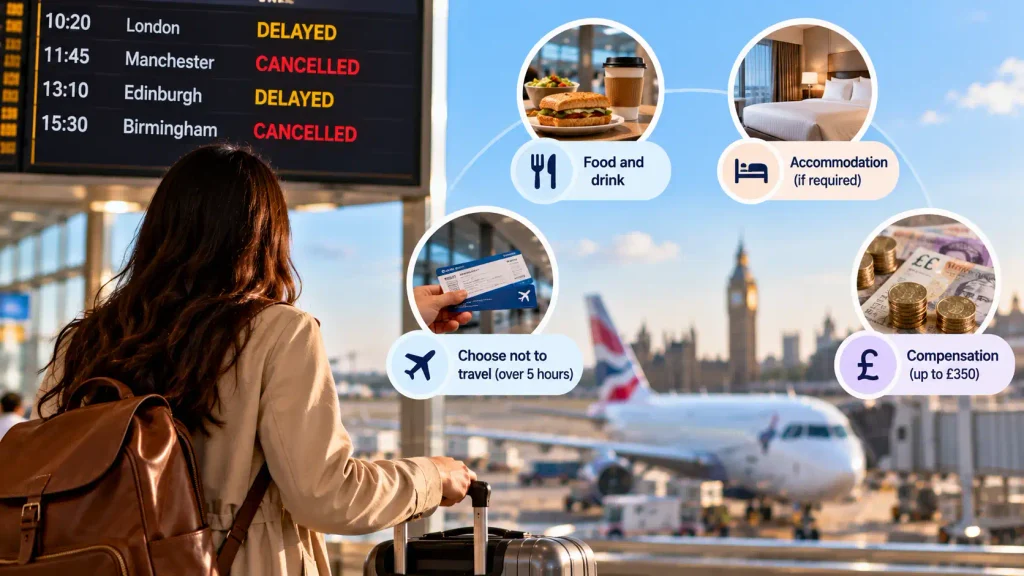
The United Kingdom has a separate framework commonly known as UK261. Its protections are similar in several respects to EU passenger rights, but the applicable rules and compensation amounts should be checked against current UK Civil Aviation Authority guidance.
Under UK rules, eligible passengers may receive assistance during a qualifying delay, including food and drink and, where required, overnight accommodation. A delay of more than five hours may allow a passenger to choose not to travel and request a refund under the relevant conditions.
Compensation may also be available if a passenger arrives more than three hours late, provided the legal requirements are met, and the delay is not attributable to qualifying extraordinary circumstances.
The compensation amount depends on the flight distance and, for certain long-haul journeys, the length of the arrival delay. For example, the UK Civil Aviation Authority lists £220 for qualifying flights under 1,500 kilometers and £350 for flights between 1,500 and 3,500 kilometers. Long-haul amounts can vary according to the arrival delay.
What About Passenger Rights in Other Countries?
Passenger rights are not limited to the United States, the EU, and the United Kingdom. Other jurisdictions have their own legislation and complaint processes.
| Region or country | What travelers should check |
| Canada | Air Passenger Protection Regulations, including the cause of the disruption, delay length, airline size, and applicable compensation rules |
| India | Directorate General of Civil Aviation (DGCA) passenger charter and applicable Civil Aviation Requirements |
| Australia | Australian Consumer Law, the airline’s conditions of carriage, and any applicable consumer remedies |
| International itineraries | The laws governing each flight segment, the operating carrier, ticket conditions, and applicable international conventions |
Passenger Rights in Canada
Canada’s Air Passenger Protection Regulations (APPR) establish obligations for airlines in specified situations involving delays, cancellations, denied boarding, and other disruptions. The rules may provide communication, assistance, rebooking, refunds, or compensation, depending on the circumstances.
Eligibility may depend on whether the disruption was within the airline’s control, within its control but required for safety, or outside its control. Compensation conditions can also vary according to the airline’s size and the length of the delay at the final destination.
Passenger Rights in India
Passengers traveling to, from, or within India should check the DGCA’s applicable passenger charter and Civil Aviation Requirements. The outcome depends on whether a flight was canceled, delayed, or subject to denied boarding; when the airline notified the passenger; and whether it offered an alternative.
A refund, alternate flight, or other remedy may be available under the applicable conditions, but travelers should not assume that the EU’s fixed compensation amounts apply to an Indian itinerary.
What Should Passengers Do When a Flight Is Canceled or Delayed?
Taking the right steps during a disruption can protect both the journey and a potential claim.
1. Ask for the Reason for the Disruption
Ask the airline for the stated reason for the cancellation or delay and, if possible, obtain the explanation in writing. The reason may determine whether the airline must pay compensation or provide certain assistance.
Keep the explanation, but do not assume that the airline’s initial description conclusively establishes the legal outcome.
2. Check Rebooking and Refund Options
Ask the airline to explain the alternatives available. Compare the new departure time, arrival time, connections, airport changes, and any overnight wait.
If you no longer wish to travel, check whether the applicable rules entitle you to a refund before accepting a replacement flight or travel credit. The consequences of accepting an alternative depend on the governing rules and the option chosen.
3. Save Evidence
Keep the following documents and records:
- Booking confirmation and ticket number.
- Boarding pass, if issued.
- Cancellation or delay notifications.
- Screenshots showing scheduled and actual flight times.
- Written explanations from airline staff.
- Receipts for eligible meals, accommodation, transport, or replacement travel.
- Any claim reference or correspondence with the airline.
For connecting itineraries, preserve the full itinerary and record the actual arrival time at the final destination.
4. Ask About Meals and Accommodation
If the wait becomes lengthy, ask whether the airline will provide meal vouchers, hotel accommodation, and transport. Do so before making expensive arrangements yourself whenever practical.
If the airline doesn’t help and you need to pay for essential expenses, keep receipts and request reimbursement. Reimbursement is not automatic in every country or situation.
5. Submit a Written Claim
Use the airline’s official customer-service or claims process. Include the flight number, date, booking reference, disruption details, requested remedy, and supporting documents.
Be precise about what you are seeking. A request for a ticket refund is different from a claim for statutory compensation or reimbursement of additional expenses.
6. Escalate if the Airline Rejects the Claim
If the airline refuses a claim, ask for the legal or policy basis for the decision. You can then consider the relevant regulator or dispute-resolution process.
Depending on the jurisdiction, options may include the U.S. DOT, an EU national enforcement body, the UK Civil Aviation Authority, Transport Canada, or the DGCA in India. Some authorities investigate regulatory compliance rather than award individual damages directly, so check the available procedure before filing.
Can Travel Insurance Cover Flight Delays and Cancellations?
Travel insurance may cover certain additional costs when a delay, cancellation, missed connection, or trip interruption meets the policy’s conditions. It can complement airline passenger rights, but it does not replace them.
Trip Delay Coverage
Trip delay benefits may reimburse eligible expenses such as meals, accommodation, and local transportation after a covered delay reaches the policy’s required duration.
Policies differ in:
- The minimum delay period.
- Covered causes.
- Per-person or per-trip limits.
- Required receipts and documentation.
- Exclusions and other insurance conditions.
For example, one policy might require a six-hour delay before you can claim eligible meal and hotel expenses, while another may use a different threshold. The actual policy wording controls.
Trip Cancellation and Interruption Coverage
Trip cancellation coverage may reimburse eligible prepaid, non-refundable costs when a covered event forces the traveler to cancel before departure. Trip interruption coverage may help with eligible unused trip costs or additional transportation after a covered event interrupts travel.
These benefits may help if a flight disruption causes a traveler to miss a cruise departure, prepaid tour, or non-refundable hotel night. However, a missed booking isn’t automatically covered just because a flight was late. The disruption’s cause and the policy’s terms must qualify.
Cancel For Any Reason Coverage
Some comprehensive policies offer optional Cancel For Any Reason (CFAR) coverage. It generally has specific purchase deadlines, cancellation timing requirements, and reimbursement limits. It usually reimburses only a stated percentage of eligible prepaid expenses rather than the full trip cost.
Travelers should compare insurance benefits with their airline rights and avoid assuming one source will cover every expense.
Tarmac Delays: What Are Passenger Rights?
A tarmac delay occurs when an aircraft remains on the tarmac, and passengers cannot disembark, often because of weather, airport congestion, or operational restrictions.
In the United States, DOT rules generally prohibit airlines from keeping passengers on domestic flights on the tarmac for more than three hours or international flights for more than four hours, except in cases involving safety, security, or air traffic control.
Airlines must also meet applicable requirements for food and water, operable lavatories, and medical attention during qualifying tarmac delays. These requirements are separate from a passenger’s potential refund or compensation claim.
A tarmac delay does not automatically entitle a passenger to a cash payment. Travelers should document the delay and check the applicable regulations and the airline’s obligations.
Common Mistakes to Avoid When Claiming Compensation
Passengers can make a claim harder to resolve by overlooking important details.
- Assuming every delay qualifies: Eligibility depends on the governing law, delay duration, cause, and other conditions.
- Confusing a refund with compensation: A refund returns eligible ticket payments; compensation is a separate remedy where available.
- Accepting a voucher without checking its terms: A voucher may have restrictions and may not be equivalent to a cash refund. Ask what rights remain before accepting it.
- Discarding receipts: Documentation may be essential for expense reimbursement or an insurance claim.
- Booking a costly replacement flight too quickly: Check the airline’s rerouting obligations and, when possible, obtain written guidance.
- Ignoring the final destination: On a protected connecting itinerary, the arrival delay at the final destination may matter more than the delay of an individual segment.
- Missing claim deadlines: Time limits vary by jurisdiction, type of claim, and applicable legal process.
- Using an unofficial claims service without checking its fees: Some third parties charge a percentage or service fee. Passengers can often start by filing a claim directly with the airline.
Conclusion
Airline passenger rights can protect travelers from the financial and practical consequences of cancellations and delays, but the available remedies depend on the rules governing the flight. A refund, rebooking, assistance, fixed compensation, and insurance reimbursement each serve a different purpose.
Before accepting a replacement flight or voucher, travelers should check the applicable rules, ask the airline why the disruption occurred, and keep all relevant records and receipts. If the airline rejects a claim, the next step is to review its explanation and use the appropriate official complaint process. Checking the rules early gives passengers a clearer basis for deciding whether to continue traveling, request a refund, or pursue compensation.
Frequently Asked Questions
No. The answer depends on the jurisdiction and the circumstances. U.S. rules generally provide a refund when a passenger rejects a qualifying cancellation or significant change, but do not generally require fixed cash compensation for inconvenience. EU and UK rules may provide compensation when specific conditions are met.
There is no universal threshold. Under EU rules, eligible passengers may qualify for compensation if they arrive at their final destination at least three hours late, subject to exceptions. UK rules have similar arrival-delay protections. U.S. federal rules do not generally require a fixed cash payment solely because a flight crosses a particular delay threshold.
Yes, in certain circumstances. Under U.S. DOT rules, a passenger who declines travel after a cancellation or qualifying significant change may be entitled to a refund even on a non-refundable ticket. Other jurisdictions have their own rules, so check the applicable law.
Bad weather can qualify as an extraordinary circumstance under some passenger-rights laws and may remove the obligation to pay fixed compensation. It does not necessarily eliminate other rights, such as rerouting, a refund, or required assistance. The outcome depends on the governing rules and circumstances.
Not automatically. A voucher may be useful if the traveler plans to fly with the airline again, but it may come with restrictions, expiry dates, or other conditions. Before accepting it, compare its value and terms with any refund entitlement and ask whether accepting it affects other claims.
Potentially, but it depends on the nature of each payment and the insurance policy. Statutory compensation and insurance benefits may cover different losses. Travelers must disclose relevant payments and follow the policy’s coordination, documentation, and reimbursement terms.
Passengers should use the regulator or dispute-resolution process relevant to the flight. Examples include the U.S. DOT, the relevant EU national enforcement body, the UK Civil Aviation Authority, Transport Canada, or India’s DGCA. The authority’s powers and filing procedure differ by jurisdiction.