
Can You Change the Name on a Plane Ticket? Rules
Yes, passengers can often correct a misspelled name or update a ticket after a legal name change, but changing the ticket to a completely different person is restricted by many airlines. Rules and fees depend on the carrier, ticket conditions, route, booking method, and the type of correction required.
A small typo may be easy to fix, while replacing the passenger with a friend or family member may be prohibited or require a paid name change on airlines that allow transfers. Some low-cost airlines allow full passenger name changes for a fee, whereas many traditional carriers primarily permit corrections that keep the original traveler on the booking.
The most important step is to identify what needs to change before editing the reservation. This guide explains the difference between a name correction and a passenger transfer, how airline policies work, when charges may apply, which documents may be needed, and what to do if the flight is approaching.
Name Correction vs. Name Change: What Is the Difference?
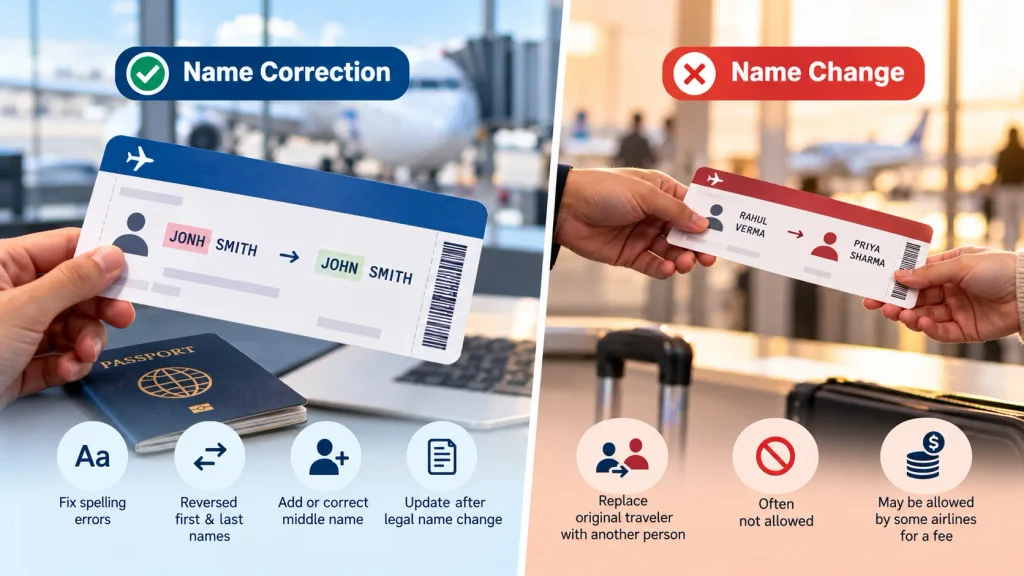
Airlines generally distinguish between correcting a passenger’s existing identity and replacing that passenger with someone else. Understanding the difference helps travelers choose the right request and avoid unnecessary cancellations.
| Type of request | Example | Typical treatment |
| Minor spelling correction | “Jonh” changed to “John” | Often permitted, sometimes free within limits |
| First and last names reversed | “Patel/Asha” entered in the wrong order | May be correctable under the airline’s policy |
| Missing or incorrect middle name | Adding a middle name or initial | Depends on the carrier and travel documents |
| Legal name update | Surname changes after marriage or a court-approved change | Usually requires supporting documents |
| Typographical error in surname | Correcting a few letters in a family name | May be allowed within defined limits |
| Passenger transfer | Replacing the original traveler with a different person | Often prohibited; some airlines allow it for a fee |
These are general patterns, not universal rules. An airline may allow one correction but require approval for another, particularly when the itinerary includes partner airlines or international flights.
Check This Out: Disney Magic Alaska Cruise Review: Dining, Activities and Excursions
What counts as a name correction?
A name correction fixes a booking so that it accurately identifies the person who was originally supposed to travel. Common examples include a typing error, reversed first and last names, or a surname that needs updating after a legal change.
For example, if a ticket reads “Anita Sharm” but the passenger’s passport says “Anita Sharma,” the traveler should request a correction. The airline may ask for identification to verify the intended name.
The permitted number of characters, whether a fee applies, and the reissuance process vary. Some airlines also distinguish between a minor typo and a correction that changes several letters.
What counts as a passenger name change?
A passenger name change replaces the person named on the booking with someone else. For instance, if Rahul can no longer travel and wants his colleague to use his ticket, that is a passenger transfer—not a spelling correction.
Many airlines prohibit this because tickets are issued to specific passengers and are subject to identity checks and fare conditions. Some carriers, especially certain low-cost airlines, permit transfers if the passenger follows the required process and pays the applicable charge.
Never assume that a ticket can be transferred just because the airline’s website has a “change name” option. Read the terms carefully: the option may cover corrections, transfers, or both.
Why Must the Name on a Plane Ticket Match the Travel Document?
The name on a flight reservation must accurately identify the passenger and meet the airline’s and destination’s documentation requirements. Airlines may compare booking details with a passport, government-issued identification, visa records, or passenger information required for security and border checks.
A mismatch can cause problems during online check-in, airport document verification, boarding, or international entry procedures. A minor difference may be accepted under an airline’s rules, but travelers should not rely on airport staff overlooking an error.
Do middle names have to appear on the ticket?
Not always. Requirements vary by airline, route, booking system, and travel document. Some airlines do not require a middle name on the reservation, while others ask for passenger details to match the document more closely.
If a passport contains a first name, middle name, and surname but the ticket displays only the first and last names, the booking may still be acceptable. Travelers should confirm the applicable rule with their airline, especially for international itineraries or bookings involving multiple carriers.
What if the ticket displays a shortened name?
Booking systems sometimes display names without spaces, punctuation, or certain special characters. Hyphenated surnames, accents, and long names may also appear differently because of system formatting.
A formatting difference is not necessarily a name error. Compare the underlying passenger details with the airline’s requirements before requesting a change. If the actual name is misspelled or identifies the wrong person, contact the carrier rather than assuming the difference is harmless.
Airline Name Change Rules: What Travelers Should Know
There is no single policy that applies to every airline. Some carriers allow only corrections that preserve the original passenger’s identity, while others permit full name transfers under specific conditions. The following examples illustrate how policies can differ.
Delta Air Lines
Delta’s name-correction policy permits certain corrections while keeping the original passenger on the reservation. Its procedures include limited corrections to first, middle, and last names, as well as certain reversed-name situations. Restrictions can apply to tickets involving partner airlines, travel to or from India, or more extensive corrections. Travelers should not treat this as permission to transfer a ticket to another person.
Southwest Airlines
Southwest provides a process for updating a passenger’s name using legal documentation, such as a marriage license, divorce decree, updated identification, or other legal name-change records. Check its rules for upcoming reservations and account details directly, as eligibility and fare conditions can vary. A legal name update should not be confused with transferring the reservation to a different traveler.
Ryanair
Ryanair allows name changes on bookings, subject to its terms and fees. Its published help guidance permits certain minor corrections free of charge within specified limits and timeframes. Full name changes can generally be made online up to 24 hours before scheduled departure, or through customer service or at the airport up to two hours before departure, subject to the applicable fee and conditions.
The airline also states that a full name change must cover all flights in the booking. Travelers should check the current fee table before proceeding.
easyJet
easyJet allows passengers to correct spelling mistakes and make certain title changes without charge under its published rules. A change that transfers a booking to a different person may incur a name-change fee. Its guidance also distinguishes minor spelling corrections from errors involving more than three characters, which may require customer-service assistance.
These examples show why travelers should verify the exact rule instead of relying on a general claim that all airlines permit—or prohibit—name changes.
| Airline | General published approach | What to verify |
| Delta Air Lines | Limited corrections for the same passenger | Partner flights, route restrictions, and correction limits |
| Southwest Airlines | Legal name updates may be supported with documentation | Reservation eligibility and applicable fare conditions |
| Ryanair | Full name changes may be permitted for a fee | Current charges, deadlines, and booking-wide requirements |
| easyJet | Minor corrections may be free; passenger transfers may be charged | Current fee schedule and correction limits |
Read More Here: Pros and Cons of Flying With easyJet: Is It Worth It?
How Much Does It Cost to Change a Name on a Plane Ticket?
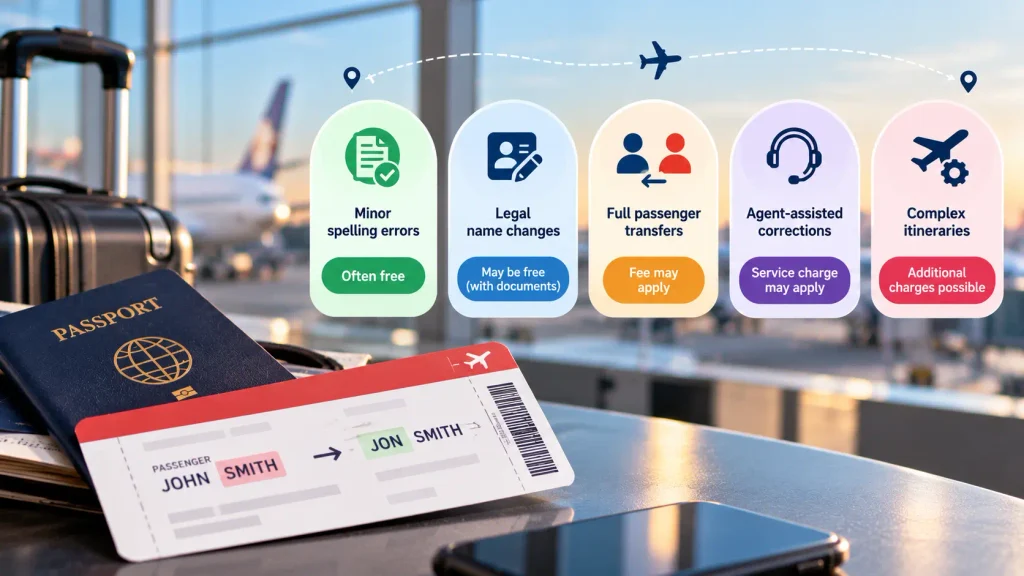
The cost ranges from nothing for an eligible minor correction to a substantial charge for a full passenger name change. Some airlines may also require a ticket reissue, while others may apply additional conditions depending on the route and booking.
No reliable universal fee exists for changing a flight ticket’s name. A quoted amount from one airline—or even one fare type—should not be assumed to apply elsewhere.
Common fee situations
- Minor spelling errors: Some airlines correct small typos without charge, especially when the request falls within a defined character limit or correction window.
- Legal name changes: A carrier may update the reservation without a fee when the original traveler provides acceptable documentation, although the exact policy varies.
- Full passenger transfers: Airlines that allow another person to take over a booking may charge a name-change fee.
- Agent-assisted corrections: A booking made through a travel agency or online travel agency may need to be changed through that provider. Service charges may apply separately.
- Complex itineraries: Partner-operated or codeshare flights may require additional review and ticket reissuance.
Could changing the name cost more than buying a new ticket?
Yes. On some bookings, the combined cost of a name-change fee and any other required charges may approach or exceed the price of a new ticket. However, a new booking is not always a valid workaround. If the original ticket is non-transferable, the passenger may need to cancel or forfeit it under the applicable fare conditions.
Before paying, ask the airline or booking provider to explain the total cost and confirm whether they can correct the existing ticket. If a full transfer is permitted, compare the fee with the cost of arranging separate travel—but include any cancellation loss on the original booking in that calculation.
How to Change the Name on a Flight Ticket
The safest approach is to contact the company that issued the ticket and establish which type of change is allowed. Avoid canceling the reservation or buying another ticket until you understand the consequences.
Step 1: Review the booking confirmation
Check the passenger name on the confirmation, e-ticket, and any travel documents. Identify the exact error and determine whether it is a typo, an omitted name element, a legal name update, or a request to substitute another person.
If the name looks different only because spaces or punctuation have been removed, ask the airline whether the displayed format is normal.
Step 2: Check the airline’s official policy
Open the airline’s website and look for its booking-management, name-correction, or passenger-details guidance. Confirm:
- Whether the requested change is permitted.
- How many letters can be corrected.
- Whether a fee applies.
- Whether the request must be made by a deadline.
- Which documents are required?
- Whether all flights on the reservation must be updated.
For example, a carrier may allow a limited spelling correction online but require its reservations team to review a legal surname change or an itinerary involving partner airlines.
Step 3: Contact the original booking provider
If the ticket was purchased directly from an airline, use its official website, app, or reservations service. If a travel agency or online booking platform issued it, contact that provider first unless the airline explicitly directs you elsewhere.
Provide the booking reference, passenger name as currently shown, correct name, flight details, and a clear explanation of the change. Do not send passport copies or other sensitive documents through unofficial channels.
Step 4: Provide supporting documentation if requested
For a legal name update, the airline may ask for documents that connect the name on the ticket with the passenger’s current identity. Depending on the situation, these could include:
- A marriage certificate.
- A divorce decree.
- A court order or legal name-change certificate.
- An old and a new passport or government-issued ID.
- Other documentation specified by the carrier.
Requirements differ, and not every airline accepts the same documents. A name correction caused by a typing error may require less evidence than a change following marriage or a legal proceeding.
Step 5: Confirm the revised ticket
Do not assume that a request has been completed simply because an agent acknowledged it or an online form was submitted. Check for a revised booking confirmation or reissued e-ticket showing the approved name.
Review the entire itinerary, including connecting flights, and confirm that the corrected details have been passed to any relevant operating carriers. If the airline says the correction is complete, but the confirmation still shows the old name, contact it again before traveling.
Can You Change the Name on a Ticket After Booking Online?
Yes, if the airline permits the particular correction and provides an online process. Some carriers offer a booking-management tool where passengers can correct limited spelling errors, update personal details, or request a paid name change.
Online changes are not available for every case. A legal name change, a complex international itinerary, a ticket issued by an agent, or a reservation involving multiple airlines may need customer-service assistance.
Before making changes online, check whether the option corrects the existing passenger or transfers the booking. Review the total charge before confirming payment and save the updated itinerary.
Can You Change a Ticket Name After Check-In?
Possibly, but the process can become more complicated once check-in is complete. Some airlines require passengers to be checked out of the flight before they can process a name correction or permitted name change.
Ryanair, for example, advises passengers who are already checked in to contact the airline so it can reverse the check-in before making the permitted change. Its standard time limits and charges still matter.
If departure is approaching, contact the airline immediately. Do not wait until reaching the boarding gate, where staff may have limited time or authority to resolve a reservation issue. Ask whether the correction can be completed before the flight and whether the ticket must be reissued.
Can You Change the Name on an International Flight Ticket?
International tickets can be corrected in many circumstances, but they require particular care because passenger details may be checked against passports, visas, and border-entry requirements. The rules can also be more complex when the ticket includes several airlines.
A carrier’s domestic name-correction policy may not automatically apply to an international itinerary. For example, Delta lists travel to or from India among the situations requiring additional assistance in its published agency guidance. This illustrates why a traveler should check the rules for the actual route rather than applying a general policy to every journey.
For international travel, compare the booking with the passport that will be used for the trip. If the passenger has recently changed their legal name, confirm that the passport and any required visa or travel authorization are valid for the planned journey. Ask the airline whether the booking can be updated before changing travel documents or paying for a replacement ticket.
What Happens if You Cannot Change the Name?
If an airline will not allow the requested change, the next step depends on the reason for the request and the fare’s conditions.
If the ticket contains a spelling mistake
Escalate the request through the airline’s official customer-service channel and explain that the original passenger is still traveling. Ask whether the correction is handled under a separate policy, requires supporting identification, or must be processed by the ticketing team.
Do not immediately purchase a replacement ticket. The airline may be able to correct an error that the normal online tool can’t handle.
If another person needs to travel
If the airline prohibits passenger transfers, the ticket generally cannot simply be reassigned. Check the original fare’s cancellation, credit, and refund conditions, then compare the available options with the cost of a new ticket.
A low-cost carrier that allows name transfers may offer a different solution, but the change must still meet its deadlines and payment requirements. Never assume that a ticket can be transferred because the original passenger has paid for it.
If the flight departs soon
Contact the airline or ticketing provider as quickly as possible and explain the departure time. Ask whether the correction can be processed before check-in closes, whether airport assistance is available, and whether any additional charges apply.
Arriving at the airport with a name mismatch and hoping it will be overlooked is risky. The airline may be unable to board a passenger whose booking does not meet its identification requirements.
Can You Change a Name Within 24 Hours of Booking?
No universal rule requires every airline to correct a name free of charge within 24 hours. The United States has a separate 24-hour booking cancellation or hold requirement for qualifying reservations, but it does not require airlines to make name corrections free.
According to the U.S. Department of Transportation, airlines must generally offer either a full refund for a reservation canceled within 24 hours or the option to hold a reservation without payment for 24 hours when the ticket is booked at least seven days before departure. The rule does not require both options, and it does not make name changes free. It also does not apply in the same way to bookings made through travel agencies or online travel agencies.
Other countries may have different rules. India’s Directorate General of Civil Aviation has published a provision stating that airlines must not charge for correcting the name of the same person when the error is reported within 24 hours of booking directly through the airline’s website. Travelers should check the current applicable regulation and the airline’s process before relying on this provision.
The practical lesson is to report an error as soon as you notice it. A short correction window may make a difference, but its existence and scope depend on the applicable law, booking channel, and airline policy.
How to Avoid Name Errors When Booking a Flight
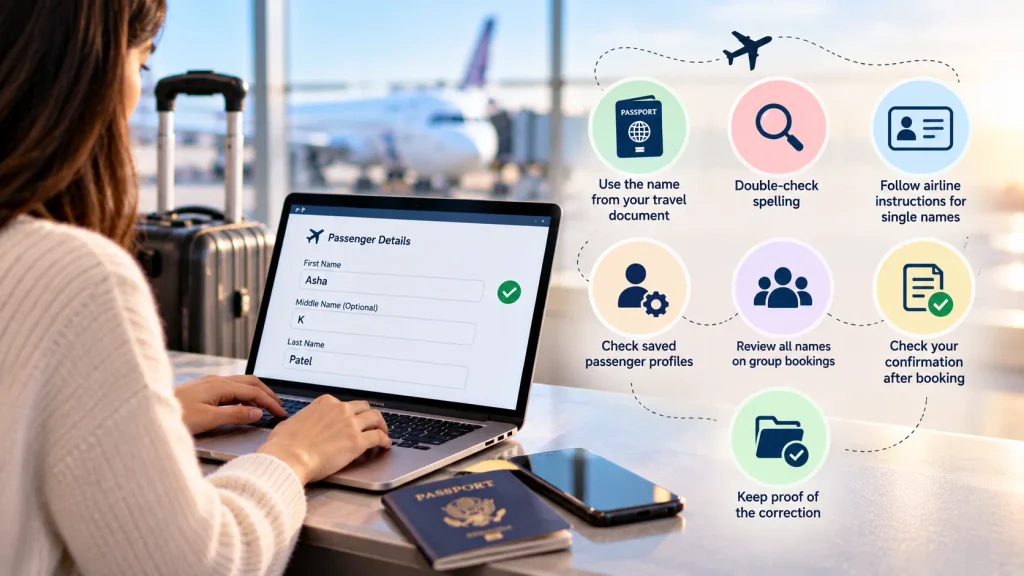
A few checks before payment can prevent stressful changes later.
- Use the name required by your travel document. Enter the passenger’s legal name as shown on the ID or passport you’ll use, following the airline’s instructions.
- Check the spelling before paying. Review first name, surname, and any required middle name or suffix.
- Do not guess how to enter a single name. If a passport contains only one name, follow the airline’s specific instructions for single-name passengers.
- Check saved passenger profiles. An old profile may contain a former surname or an incorrect spelling.
- Review every passenger on a group booking. A typo affecting one traveler can be overlooked when several names are entered together.
- Check the confirmation immediately. If a mistake appears, contact the airline or booking provider promptly.
- Keep proof of the correction. Save the updated itinerary and any written confirmation of the approved change.
If the trip involves a codeshare or multiple airlines, verify that the corrected name is reflected across the itinerary before departure.
Final Takeaway
Changing a name on a plane ticket is often possible when the request corrects the original passenger’s details, but transferring a ticket to someone else is a separate matter and may be prohibited. Fees, correction limits, documentation, and deadlines vary widely among airlines.
Before paying or canceling a booking, identify the required change, check the airline’s official policy, and contact the original ticketing provider if needed. Then verify that the revised confirmation accurately reflects the passenger’s identity and every flight on the itinerary.
Frequently Asked Questions
Sometimes. Minor spelling corrections and certain legal name updates may be free under an airline’s policy. Full passenger transfers may incur a fee or be prohibited. The exact rule depends on the carrier and booking.
Only if the airline permits passenger name transfers. Many carriers don’t allow one person to use another person’s ticket, while some low-cost airlines allow transfers for a fee within specific deadlines.
It can be, particularly if the name no longer matches the passenger’s travel document. Some airlines allow minor corrections, but the permitted limits vary. Contact the airline promptly instead of assuming a small typo will be accepted.
Many airlines have a process for updating a ticket after a legal name change, but they may require documentation. Confirm whether the passport and other travel documents are valid for the trip and ask the airline which documents it accepts.
Often, but not always. Some airlines allow a limited number of spelling corrections free of charge. Others require a request through customer service, particularly if the change affects the surname or involves partner-operated flights.
A travel agent may be able to make an eligible correction, depending on the ticketing arrangement and airline rules. If the agent issued the ticket, contact them first. Some corrections require airline authorization or a ticket reissue.
No. In the United States, the federal 24-hour rule concerns qualifying cancellation or reservation-hold options, not a general right to change a ticket name for free. Other jurisdictions may have separate provisions for correcting the same passenger’s name.
There is no guarantee. A difference may need to be corrected or supported by appropriate documentation before travel. Contact the airline and confirm the requirements for your specific route before you go to the airport.