
Missed Your Flight? Here’s Exactly What to Do — and How to Recover Fast
Missing a flight doesn’t always mean losing the entire trip, but the outcome depends on how quickly the traveler contacts the airline, the type of ticket purchased, and the reason for missing the departure. Acting immediately can preserve rebooking options, clarify refund eligibility, and reduce the risk of losing the rest of the itinerary.
A missed flight can happen because of traffic, long security queues, a late arrival at the gate, a delayed connecting flight, or an emergency. Each situation may be handled differently. The key distinction is whether the passenger missed the flight due to their own circumstances or an airline disruption.
This guide explains what to do first, how to request another flight, what happens to connecting reservations and checked baggage, and when refunds, insurance claims, or passenger protections may apply.
Check Out This Blog: When Is the Best Time to Visit Turkey in 2026?
What to Do Immediately After Missing a Flight
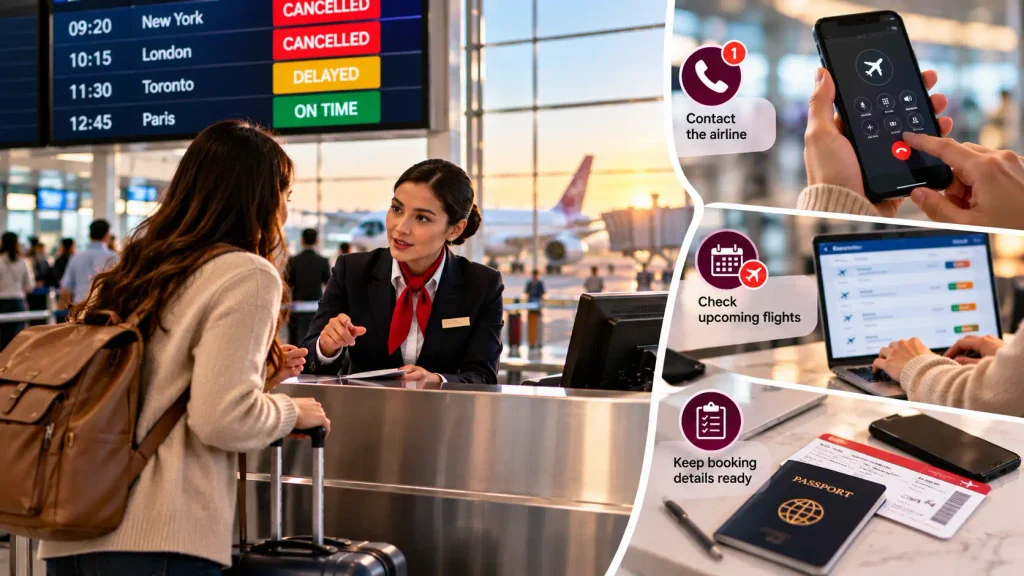
First, contact the airline as soon as possible. Do not assume the booking will remain active or that the airline will automatically move the passenger to another departure.
1. Contact the airline before making another booking
If the passenger is still traveling to the airport, they should contact the airline through its official customer service channel. If they are already inside the terminal, they should go to the airline’s ticketing or customer service desk.
Explain what happened and ask three direct questions:
- Can the original booking be rebooked?
- Is there a same-day flight or standby option?
- Will the missed departure affect the remaining flights on the itinerary?
If the ticket was purchased through an online travel agency or travel agent, the passenger may also need to contact that provider. For example, Air India directs customers who booked through third-party websites or agents to those providers for help initiating a refund.
2. Check whether the rest of the booking is still active
A missed flight can affect later segments, especially if the traveler doesn’t contact the airline. Some airlines may cancel onward or return reservations after a passenger is recorded as a no-show.
Ask the agent to confirm the status of every remaining flight, including return segments. Do not assume that a return ticket remains valid simply because it is scheduled for a later date.
3. Keep the booking information ready
Having the relevant details available can make the conversation faster. Prepare:
- Booking reference or reservation code.
- E-ticket number, if available.
- Passport or government-issued identification.
- Original flight number and departure time.
- Boarding pass, if check-in was completed.
- Receipts or evidence explaining the delay, if relevant.
If you missed the flight because of a road accident, medical emergency, or other unexpected event, keep supporting documents. They may help with an airline goodwill request or a later insurance claim, but they don’t guarantee a fee waiver.
Can You Rebook a Flight After Missing It?
Yes, rebooking may be possible, but it is not automatically free. Your options depend on the airline, fare conditions, seat availability, timing, and why you missed the flight.
| Situation | Possible outcome | What the passenger should do |
| Passenger arrives late for the original flight | Rebooking fee, fare difference, or a new ticket may be required | Contact the airline immediately |
| Emergency | Airline may review the case for an exception or goodwill assistance | Explain the circumstances and provide evidence |
| Airline delay causes a missed connection on one booking | Rebooking may be provided under the applicable disruption policy | Contact the operating airline or transfer desk |
| Two flights booked separately | The second airline may treat the passenger as a no-show | Contact each airline and check its conditions |
| Flight is canceled by the airline | Rebooking or refund options may apply under local rules | Request the available alternatives before buying another ticket |
These are general outcomes, not guaranteed entitlements. Airlines have different policies, and legal protections depend on the route, jurisdiction,n and reason for the disruption.
Ask about same-day changes and standby.
Some airlines offer same-day changes or standby options, subject to availability and fare conditions. Standby means waiting for a seat to become available rather than holding a confirmed reservation on a particular flight.
Ask the airline whether these options exist and whether they involve a fee or fare difference. A confirmed replacement booking is generally easier to plan around than an uncertain standby position, particularly when the traveler has a hotel reservation or onward transport waiting at the destination.
What is the flat-tire rule?
The “flat-tire rule” is an informal term used for discretionary leniency that some airlines may offer when a passenger misses a flight because of an unexpected problem, such as a vehicle breakdown.
It is not a universal airline rule or a guaranteed passenger right. The airline may decline the request, impose conditions, or offer a different solution. Passengers should explain the circumstances promptly and ask whether any missed-flight exception is available rather than assume they qualify.
Will You Get a Refund for a Missed Flight?
A passenger who misses a flight for personal reasons should not assume they are entitled to a refund of the ticket price. Refund eligibility depends on the fare rules, the airline’s policy, applicable law, and whether the flight operated as scheduled.
A refundable ticket may offer more flexibility than a restrictive fare, but you still need to check the specific conditions. A non-refundable ticket may have little or no refundable base fare after a no-show, although local rules may treat certain taxes or charges differently.
What if the ticket is non-refundable?
A non-refundable ticket does not necessarily mean that every part of the payment is automatically forfeited in every country. The passenger should ask the airline for an itemized refund assessment, including any refundable taxes or government-imposed charges.
In India, the Directorate General of Civil Aviation’s Civil Aviation Requirements state that airlines must refund specified statutory taxes and certain passenger-related charges in cases of cancellation, non-utilization, or no-show, including for promotional or special fares with a non-refundable basic fare. Confirm the exact amount and procedure with the airline under the current rules.
Example: Missing a flight in India
Air India’s published FAQ defines a no-show as missing a flight without canceling or changing the booking beforehand. It states that passengers have a two-hour no-show window to cancel or modify their booking; after that, a refund may no longer be available. The refund or modification amount depends on the fare, route, and timing.
This is an Air India-specific policy, not a universal rule for all airlines. Travelers should verify the conditions on their ticket and consult the airline’s official refund information.
What if the airline caused the disruption?
The situation changes when the airline cancels or significantly changes a flight. In the United States, Department of Transportation rules provide for a refund when an airline cancels a flight or makes a qualifying significant change or delay, and the passenger chooses not to travel or accept an alternative. These rules differ from those for a passenger who arrives late for a flight that operates as scheduled.
For disruptions elsewhere, travelers should check the applicable country’s aviation rules and the airline’s conditions. Do not assume that a refund entitlement in one country applies to every international itinerary.
What Happens If You Miss a Connecting Flight?
The key question is whether the connecting flights are part of the same booking or were purchased separately.
If both flights are on one booking
When an airline-caused delay on the first segment causes a passenger to miss a connection on the same ticket, the airline will generally need to address the disruption under the applicable ticket conditions and passenger-rights rules. This often means arranging alternative travel to the ticketed destination.
The passenger should speak to the airline or transfer desk as soon as possible. Ask for a confirmed replacement itinerary and clarify whether baggage will be transferred automatically or needs to be collected.
Meals, hotel accommodation or other assistance may be available in some circumstances, but eligibility depends on the cause of the delay, the route, the airline’s policy and local regulations.
If the flights were booked separately
Separate tickets create greater risk. If the first flight arrives late and the passenger misses a second flight booked independently, the second airline may treat that passenger as having missed the departure voluntarily.
For example, a traveler might book a flight from Delhi to Singapore and a separate onward ticket from Singapore to another destination. If the first flight is delayed, the onward carrier may not be obligated to provide a free replacement ticket.
The passenger should contact the second airline immediately, explain the delay, and ask about rebooking. They should also check whether their travel insurance covers missed connections on separate tickets.
What if the missed connection was caused by immigration or security queues?
Contact airport staff and the airline as quickly as possible, explaining where the delay occurred and whether it was related to an official queue, a terminal transfer, or another issue.
A long queue does not automatically entitle a passenger to free rebooking. The airline will assess the circumstances and applicable conditions. Keep any available evidence, such as flight notifications or documentation of a significant airport disruption.
What Happens to Checked Baggage If You Miss Your Flight?
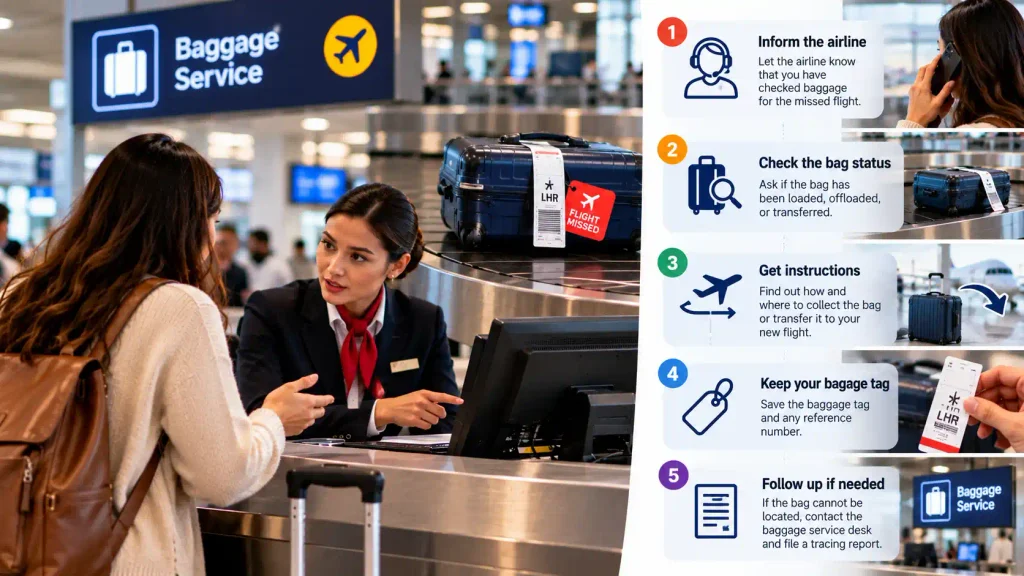
Checked baggage requires separate attention. The bag may already be checked in, screened, or loaded, but the airline’s procedures and when the passenger missed the departure determine how it’s handled.
If the passenger is marked as a no-show, the airline may need to locate or remove the checked bag in line with its security procedures. Do not assume the bag will automatically be placed on the replacement flight or returned immediately to the check-in area.
What should passengers do?
- Tell the airline that checked baggage is attached to the missed flight.
- Ask whether the bag has been loaded, offloaded,d or transferred.
- Request instructions for collection or transfer to the new itinerary.
- Keep the baggage tag and any baggage reference number.
- Confirm where and when the bag can be collected, if necessary.
If the missed flight was part of a connection, the bag’s location may depend on whether the itinerary was issued as one ticket and how the airline handles the disruption. Get explicit confirmation before leaving the airport.
If the airline can’t locate the baggage, contact its baggage service desk and follow its tracing procedure.
What If You Already Checked In or Have a Boarding Pass?
Online check-in does not guarantee that the passenger can board after the gate closes. Airlines set check-in, bag-drop, and boarding deadlines that vary by airport, route, and carrier.
If the passenger has checked in but missed the gate, they should go to the airline’s service desk rather than attempting to board after the aircraft has closed. Show the boarding pass and ask whether the reservation can be rebooked.
The boarding pass helps staff identify the flight, but it doesn’t automatically protect the ticket or guarantee a free change.
Travelers should also distinguish between the scheduled departure time and the final boarding deadline. Arriving at the gate at the departure time may be too late, even if the aircraft is still visible at the stand.
How Travel Insurance Can Help After a Missed Flight
Travel insurance may cover some costs associated with a missed departure or missed connection, but only if the policy includes the relevant benefit and the circumstances meet its conditions.
Coverage can differ considerably. One policy may cover a missed connection caused by a delay on a previously scheduled service, while another may exclude situations where the traveler simply left home too late. Some policies may also require a minimum delay or particular supporting evidence.
Before filing a claim, review the policy’s wording for:
- Missed departure or missed connection benefits.
- Covered causes, such as a documented accident or transport disruption.
- Exclusions for late arrival, negligence, or insufficient transfer time.
- Limits for replacement transport, meals and accommodation.
- Required documents and claim deadlines.
Keep receipts and evidence.
Save receipts for replacement flights, local transport, meals and accommodation. Keep airline messages, delay notifications, incident reports and written confirmation of the missed departure.
Contact the insurer as soon as practical, particularly before paying for expensive alternative travel if the policy requires prior approval. Insurance reimbursement isn’t automatic, and the insurer may reject costs outside the policy.
How to Recover Faster Without Spending More Than Necessary
A missed flight can quickly become expensive if a traveler books the first available alternative without checking the original ticket’s options. A short, structured approach helps avoid unnecessary costs.
Compare the total cost of each option.
Ask the airline to compare the cost of changing the original booking with the cost of purchasing a new ticket. The relevant amount may include a change fee, fare difference, baggage charges, or other conditions.
If a new ticket appears cheaper, confirm what happens to the original booking and any unused segments before purchasing it.
Notify hotels and onward providers.
If the delay affects a hotel check-in, airport transfer, tour, cruise departure, or train connection, contact the provider promptly. Ask whether the reservation can be moved or held and whether a late-arrival or cancellation charge applies.
For example, a traveler arriving a day late may be able to keep a hotel reservation by notifying the property early, though any waiver depends on the property’s terms.
Keep communication in writing.
When possible, keep written confirmation of the airline’s rebooking offer, refund decision, or explanation for the missed flight. This information can help resolve a later dispute or support an insurance claim.
If the airline declines a request, ask for the relevant fare rule or policy in writing and keep the case reference.
How to Avoid Missing Your Next Flight
Preventing another missed departure starts with planning around the airport’s actual deadlines, not just the published flight time.
- Check the airline’s deadlines. Review check-in, baggage-drop, and boarding cutoffs for the specific airport and flight.
- Allow enough time for transport. Build in a buffer for traffic, parking, terminal transfers, and unexpected delays.
- Complete online check-in when available. This can save time, but it does not remove baggage-drop or gate deadlines.
- Monitor flight alerts. Check the airline’s app, email,l and airport information displays for schedule or gate changes.
- Plan realistic connections. Consider immigration, security, terminal changes,s and the possibility of delayed arrivals.
- Keep documents accessible. Keep your booking reference, passport, and boarding pass ready.
- Understand the ticket conditions. Review the rules for changes, cancellation, and no-shows before travel.
There is no single airport-arrival buffer that works for every flight. Airline guidance, airport procedures, destination requirements, and the time of year should determine how early passengers arrive.
See This Guide: The Best Flight Cancellation Insurance: What It Covers and When It’s Worth It
Final Takeaway
After missing a flight, contact the airline immediately, confirm whether the rest of the itinerary remains active, and ask for the least expensive available way to continue the journey. Do not assume that rebooking is free, that the ticket has no refundable value, or that checked baggage will follow automatically.
Before accepting an alternative, compare the cost of changing the existing ticket with buying a new one, check insurance coverage, and keep written records of the disruption. Acting quickly gives travelers the clearest picture of their options and helps prevent one missed departure from disrupting the entire trip.
Frequently Asked Questions
Usually, passengers should not expect an aircraft to wait for them. Boarding closes according to the airline’s procedures, and a flight may depart even if a checked-in passenger has not reached the gate. Contact the airline immediately if a delay seems likely.
Not always. The airline may offer rebooking, a same-day change, or a standby option, depending on the fare and circumstances. If you can’t change the original ticket or it’s too expensive, you may need to buy a new one. Compare the total cost before deciding.
It can, depending on the airline’s no-show rules and the itinerary. Some airlines may cancel later segments after a passenger misses an earlier flight. Contact the airline immediately and ask it to confirm the status of every remaining segment.
Compensation is generally not guaranteed when a passenger misses a flight because of personal travel delays. An airline may offer discretionary assistance, and a travel insurance policy may cover certain circumstances, but both depend on the applicable conditions.
If the flights are part of the same booking, contact the airline immediately to request a replacement itinerary and ask about applicable assistance. Your rights depend on the cause of the disruption, the route, the ticket, and the local passenger-protection rules.
Possibly. The answer depends on the country, the type of charge, and the airline’s refund process. In India, DGCA requirements allow refunds of specified statutory taxes and passenger-related charges in no-show cases. Ask the airline for an itemized refund assessment.
Contact the airline first and ask about the consequences of canceling or changing the ticket. A cancellation may affect later segments and the amount refundable. The correct action depends on the fare rules and the airline’s no-show policy.