
Airline Trading Cards Explained: Beginner’s Guide 2026
Airline trading cards are collectible aircraft cards, usually handed out free by pilots or crew members, and in 2026 they have become a growing hobby for aviation enthusiasts, families, frequent flyers, and first-time collectors. The cards typically feature an aircraft image, specifications, registration details, historical facts, or special liveries, turning an ordinary flight into a small aviation keepsake.
What began as a relatively obscure airline giveaway has developed into a recognizable collecting niche.
Delta Air Lines started its aircraft-card program in 2003, while airlines such as Alaska Airlines, Hawaiian Airlines, Southwest Airlines, and Frontier Airlines have since developed their own versions. JetBlue has also introduced limited-edition cards for special events.
This beginner’s guide explains how airline trading cards work, where they came from, how to get them, which airlines currently offer them, how to protect a collection, and what determines a card’s potential value.
What Are Airline Trading Cards?
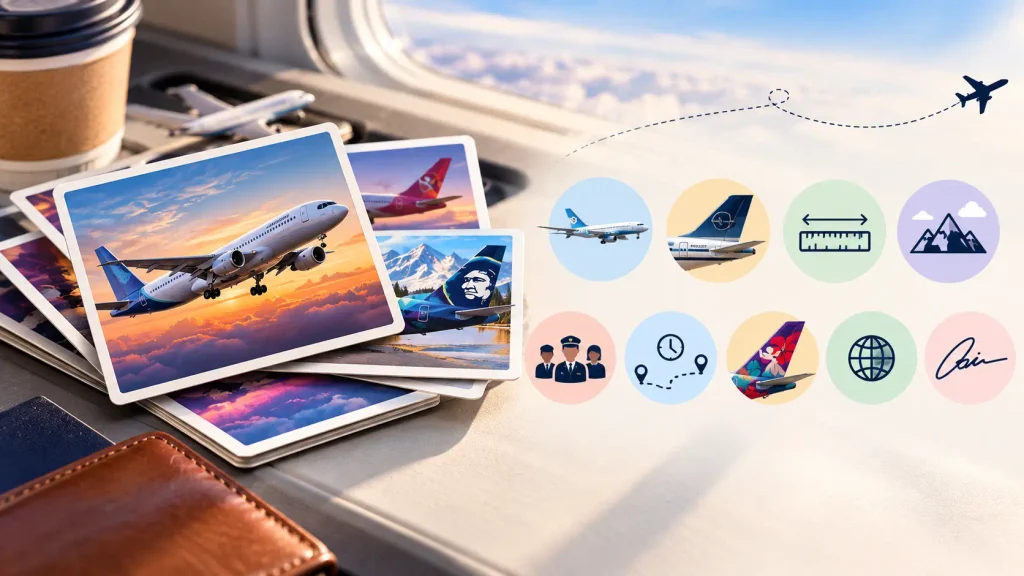
Airline trading cards are small collectible cards centered on aircraft, airline history, special liveries, or aviation-related subjects. Unlike traditional sports cards, they generally are not designed around individual players. The aircraft itself is usually the star.
A typical card may include:
- Aircraft type and model
- Aircraft registration
- Length, wingspan, or other specifications
- Maximum operating altitude
- Passenger or crew information
- Aircraft history
- A special livery or destination
- Airline branding
- A space for a pilot’s signature
The exact design varies considerably by airline. Southwest, for example, says its cards feature aircraft imagery on the front and facts, milestones, and other information on the back.
Hawaiian Airlines‘ pilot cards feature four aircraft types and include a signature field for pilots, while Alaska’s newer cards use holographic and lenticular finishes.
That variety is part of the appeal. One collector may focus on aircraft types, another on airline history, while someone else may simply collect cards from every flight they take.
How Did Airline Trading Cards Start?
The modern airline trading-card hobby traces back to Delta Air Lines.
Delta’s 2003 MD-11 card
Delta released its first aircraft trading card in 2003 to commemorate the retirement of its McDonnell Douglas MD-11. The card was originally intended as a one-time promotional item, but the concept proved popular enough that Delta continued producing cards.
More than two decades later, Delta’s program had expanded into multiple series. Its 2025 Centennial collection included cards for aircraft such as the Airbus A220-300, Boeing 717, Boeing 737-800, Airbus A321neo, Boeing 757-200, Boeing 767-300, Airbus A330-900, and Airbus A350, along with certain Delta Connection aircraft. Delta said more than 5 million cards were being produced for that collection.
That history matters to collectors because early issues, retired aircraft, special editions, and unusual variations can be more interesting than ordinary current-fleet cards.
Why did other airlines follow?
The concept works because the cards combine several inexpensive forms of engagement: aviation education, airline branding, a physical souvenir, and direct interaction between passengers and flight crews.
Alaska Airlines says its first trading cards date back to the 1990s. Its 2025 return to the hobby brought an eight-card set developed with pilots and featuring modern airline liveries.
Social media has also helped expose the hobby to people who may never previously have considered themselves collectors. As a result, the hobby now includes children, aviation enthusiasts, frequent flyers, and traditional collectibles buyers.
Which Airlines Have Trading Cards in 2026?
The airline-card landscape changes frequently, so collectors should treat availability as a current-program question rather than assuming an airline will always participate.
| Airline | Current or recent card program | How cards are generally obtained |
| Delta Air Lines | Long-running aircraft-card program; Centennial series launched in 2025 | Ask pilots |
| Alaska Airlines | 2025 eight-card modern-livery collection | Ask pilots |
| Hawaiian Airlines | Four-card pilot set launched in 2025 | Ask a pilot or crewmember |
| Southwest Airlines | Current aircraft trading-card program, including special 2026 cards | Ask pilots |
| Frontier Airlines | Animal-themed collectible cards | Ask flight attendants/crew |
| JetBlue | Limited-edition special-event cards have been issued | Availability depends on promotion |
Delta’s current collection has evolved through several series, while Alaska’s 2025 set returned after more than a decade without a new release.
Hawaiian Airlines introduced four pilot cards in November 2025, covering the Boeing 717, Airbus A321neo, Airbus A330, and Boeing 787-9. The airline also launched digital cards representing its aircraft, making its program particularly distinctive.
Southwest now has an official trading-card program and specifically says cards can be requested from pilots, subject to availability. Its 2026 “America Trio” includes the Independence One, Liberty One, and Freedom One aircraft.
Frontier takes a different approach. Its cards traditionally focus on the animal characters painted on aircraft tails, and the airline says flight attendants can provide collectible cards during flights.
American entered the mainstream airline-card market in 2026 with a Centennial collection featuring four current fleet types and three historic aircraft. The airline said pilots would distribute the cards and that it would print more than seven million for summer distribution.
JetBlue has also participated through limited-run commemorative cards. In July 2026, it announced 1,776 trading cards featuring its special “Vets in Blue” aircraft celebrating the U.S. 250th anniversary.
How Do You Get Airline Trading Cards?
For most airline programs, the simplest strategy is also the most effective: ask politely.
The flight deck is usually the best place to start because many airline cards are specifically intended for pilots to distribute. Southwest explicitly tells customers to ask pilots, while Alaska says its cards are distributed from the flight deck.
A simple question works:
“Hi, do you happen to have any aircraft trading cards available?”
No need to make the interaction complicated.
When should you ask?
The timing matters. Pilots are responsible for operating the aircraft, so collecting cards should never interfere with safety procedures or operational duties.
Good opportunities may include:
- When boarding is complete and the pilot is available
- After landing
- During a brief conversation with the flight crew
- When a child is particularly interested in aviation
- At an airport when a pilot is clearly available and not rushing
Avoid interrupting pilots during safety-critical duties, boarding coordination, pushback, or other operational tasks.
Do flight attendants have cards?
Sometimes
It depends on the airline. Southwest specifically describes its cards as a gift from pilots and says they are not sold online or at terminals.
Hawaiian’s announcement says guests can ask a crewmember, while its pilot-card description specifically encourages asking a pilot.
Frontier is an important exception because its official family-travel information specifically tells passengers to ask a flight attendant for its animal-themed cards.
The practical rule is simple: ask the appropriate crew member rather than assuming every employee carries cards.
Are Airline Trading Cards Free?
Generally, airline crews distribute the cards as free souvenirs.
Southwest explicitly states that it does not sell its trading cards online or at airport terminals; pilots provide them as a special gift.
American’s 2026 cards are also being distributed through pilots rather than sold as ordinary airline merchandise.
However, the secondary market is different. Once a card has entered private hands, collectors can buy, sell, or trade it independently.
This creates an important distinction:
Original acquisition: often free from an airline crew member.
Secondary-market acquisition: may involve a purchase price.
A collector should never assume that a card advertised online for $50 originally cost $50. The airline may have given it away at no charge, with the later price reflecting scarcity, demand, condition, or collector interest.
What Makes an Airline Trading Card Valuable?
No universal pricing formula exists for airline cards, and the market is still relatively young.
Several factors can influence collector interest.
1. Age
Older cards can attract attention because fewer examples may remain in excellent condition.
Delta’s 2003 MD-11 card, for example, has historical importance because it was the company’s first aircraft trading card.
2. Scarcity
Limited distribution can make certain cards harder to find.
Alaska says it produces newer cards in limited quantities and distributes them on a first-come, first-served basis.
Southwest has also introduced rarity levels for its cards, including Common, Semi Rare, and Rare categories.
3. Retired aircraft
A card featuring an aircraft that has left an airline’s fleet may interest collectors more because it documents a particular period in the airline’s history.
4. Special liveries
A standard aircraft card may have broad appeal, but a card depicting a commemorative, sports, cultural, or anniversary livery can attract a more specialized audience.
Alaska’s collection, for instance, includes cards connected to distinctive liveries and special themes.
5. Condition
Condition matters in virtually every physical-card hobby.
Corners, edges, surface scratches, creases, fading, fingerprints, moisture damage, and warping can affect desirability.
A card kept flat in a protective sleeve is generally easier to preserve than one that has spent years loose in a backpack.
6. Autographs
Some cards include a signature area, making pilot-signed examples particularly interesting to collectors.
Hawaiian’s cards, for example, include dedicated signature fields.
An autograph can add appeal, but it does not automatically make a card valuable. The signer’s identity, authenticity, condition, and collector demand all matter.
How Much Are Airline Trading Cards Worth?
Airline trading cards do have a secondary market, but collectors should approach prices cautiously.
The hobby still lacks the mature pricing infrastructure found in sports cards or Pokémon. No universally accepted grading system or comprehensive price guide covers airline cards. Upgraded Points reported examples ranging from inexpensive cards to several hundred dollars for individual cards and thousands for collections. Still, those figures represent individual transactions or listings rather than standardized market values.
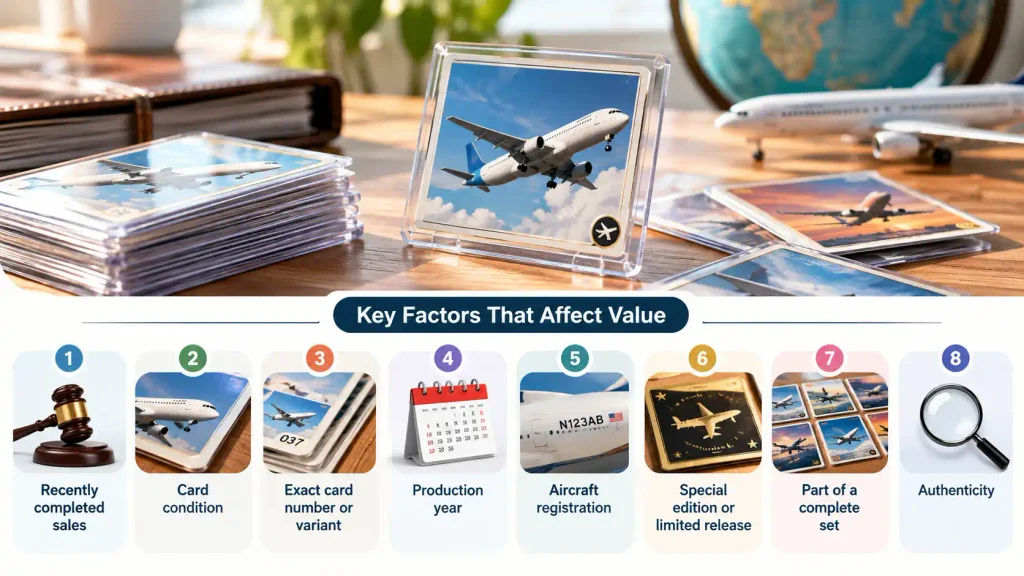
For a beginner, recently completed sales are more useful than asking prices.
For example, suppose a seller lists a card for $150. That does not mean the card is worth $150. If comparable cards have recently sold for $35, the $150 listing may simply be an ambitious asking price.
Before buying, compare:
- Recently completed sales
- Card condition
- Exact card number or variant
- Production year
- Aircraft registration
- Whether it is a special edition
- Whether it is part of a complete set
- Whether the card is authentic
This approach helps prevent overpaying.
Where Can Beginners Buy Airline Trading Cards?
Several sources offer cards, each with different advantages.
Airline stores
Some airlines sell collectible products directly. Alaska Airlines’ official company store, for example, currently lists a Pilot Trading Cards product.
This can help collectors get an authentic product without relying on an unknown marketplace seller.
Online marketplaces
Marketplaces such as eBay contain older and newer airline cards, including complete sets.
They are useful for cards that are no longer distributed by airlines, but buyers should compare completed sales and examine seller photographs carefully.
Collector communities
Aviation and airline-card communities can help you trade duplicates and find cards that are difficult to locate.
The major advantage is that collectors can sometimes exchange cards rather than paying cash for every missing card.
Direct trading
Trading is one of the most enjoyable ways to build a collection.
For example, a collector who has three duplicate Delta aircraft cards might exchange one for an Alaska card and another for a missing Southwest issue.
The key is to confirm exactly which cards are being exchanged before agreeing to the trade.
How Should Beginners Store Airline Trading Cards?
Good storage is one of the easiest ways to protect a collection.
Use individual sleeves
A basic trading-card sleeve can protect the surface from fingerprints, dust, and minor scratches.
Use a binder
For a growing collection, a binder with archival-quality pages makes it easier to organize cards by airline, aircraft type, year, or card number.
Keep cards away from sunlight.
Extended exposure to ultraviolet light can fade printed materials and change colors.
Control humidity
Paper and laminated cards can react poorly to excessive moisture. A stable, dry indoor environment is preferable to storing cards in a damp basement, garage, or vehicle.
Avoid unnecessary handling
Collectors should hold cards by the edges whenever possible.
A simple example: if you remove a card from a sleeve every few weeks for photos, it’s more likely to develop edge wear than if it stays protected.
Should You Grade Airline Trading Cards?
For most beginners, professional grading is not necessary.
The airline-card market remains much smaller than established collectibles categories, and grading costs can represent a significant portion of a card’s potential value.
A better approach is to learn how to evaluate the condition yourself.
Look for:
- Sharp corners
- Clean edges
- No creases
- No surface scratches
- No stains
- No fading
- No bending or warping
- Clear printing
For particularly old, rare, or expensive cards, professional authentication or grading may become more relevant.
The key is to consider the potential value before spending money on professional services.
How Should a Beginner Organize a Collection?
No single system is correct, but a consistent organization method makes collecting much easier.
Organize by airline
A simple structure could be:
- Delta
- Alaska
- Southwest
- Hawaiian
- Frontier
- Other airlines
Organize by aircraft
Another approach is:
- Boeing 737
- Boeing 757
- Boeing 767
- Boeing 777
- Airbus A220
- Airbus A320 family
- Airbus A330
- Airbus A350
Organize chronologically
Collectors interested in airline history may prefer:
2003 → 2010s → 2020s → 2026
This makes changes in airline fleets and branding easier to follow.
Track the collection digitally.
A basic spreadsheet can record:
| Field | Example |
| Airline | Delta |
| Aircraft | Airbus A220 |
| Registration | Aircraft-specific |
| Card number | Series-specific |
| Year | 2025 |
| Condition | Near mint |
| Source | Pilot |
| Cost | $0 |
| Notes | Pilot signed |
This becomes particularly useful once a collection reaches several dozen cards.
Are Airline Trading Cards a Good Investment?
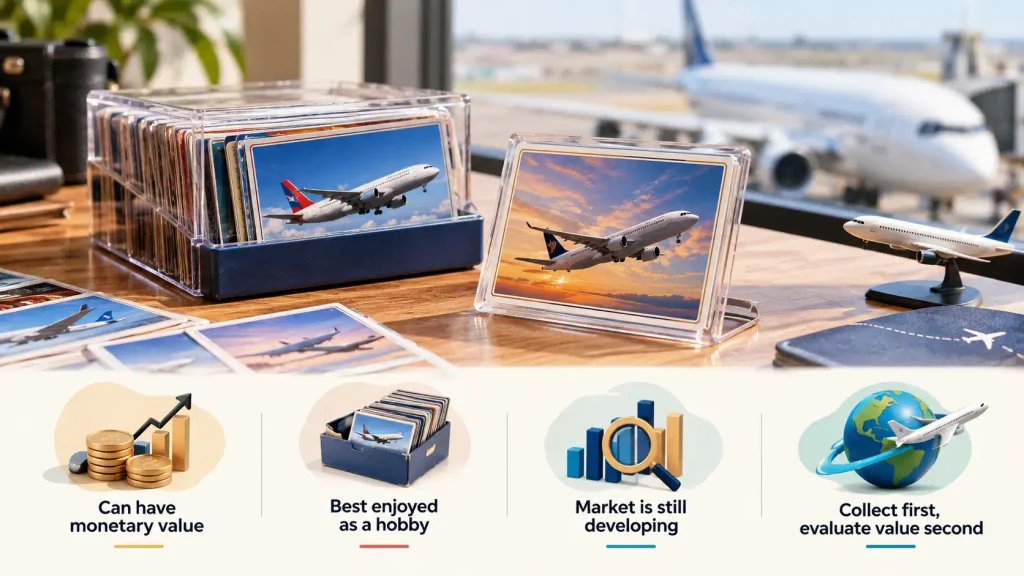
They can have monetary value, but you should treat them primarily as a hobby rather than a guaranteed investment.
The market is still developing, and airline cards lack the decades of standardized sales data found in larger collectibles markets. Upgraded Points’ reporting also notes that the category lacks the mature pricing infrastructure and established legacy of sports cards and Pokémon.
A better mindset is:
Collect first, evaluate value second.
If a card eventually becomes valuable, that is a bonus. Buying cards solely because someone predicts that their price will rise carries considerably more uncertainty.
A collector who genuinely enjoys aircraft, airline history, liveries, or travel is more likely to find value in the hobby regardless of future resale prices.
A Simple Airline Trading Card Strategy for Beginners
Someone starting from zero does not need to buy a complete collection immediately.
A practical first-year approach could look like this:
Step 1: Pick a theme.
Choose one airline, aircraft family, decade, or special-livery category.
Step 2: Collect during normal travel.
Ask politely when flying airlines that distribute cards.
Step 3: Protect every card immediately.
Use sleeves rather than leaving cards loose.
Step 4: Record what you own.
A spreadsheet prevents accidental duplicate purchases.
Step 5: Trade duplicates.
Use collector communities to fill gaps.
Step 6: Research before buying.
Check recent completed sales rather than relying only on active listings.
Step 7: Expand slowly.
Once the collection has a clear direction, add older or harder-to-find cards.
This keeps the hobby affordable while teaching a beginner how airline-card collecting actually works.
The Future of Airline Trading Cards in 2026
The hobby is entering an interesting period as more airlines experiment with physical and digital collectibles.
American’s 2026 centennial program demonstrates how an airline can use trading cards to connect a major corporate milestone with aircraft history.
Southwest has expanded its program with special aircraft cards tied to the U.S. 250th anniversary.
Hawaiian has gone a step further by combining physical pilot cards with digital aircraft collectibles.
Meanwhile, Alaska’s return to physical cards and Frontier’s continuing animal-card program show that airlines can take very different approaches to the same basic idea.
That variety is likely to remain one of the hobby’s biggest attractions. Depending on where and when they travel, a collector may find traditional aircraft cards, commemorative issues, special liveries, digitally connected cards, or airline-history releases.
Final Thoughts
Airline trading cards offer an unusually accessible way to combine travel, aviation history, and collecting; many can still be obtained simply by politely asking a pilot or crew member. The best beginner strategy is to focus on cards that genuinely interest the collector, protect them from the start, document the collection, and use recent sales rather than optimistic listings when researching market prices.
With Delta’s long-running program, Alaska’s renewed collection, Hawaiian’s physical and digital cards, Southwest’s expanding releases, Frontier’s animal cards, and American’s 2026 Centennial series, new collectors now have plenty of ways to start without immediately spending money on the secondary market.
FAQs About Airline Trading Cards
Many cards airline employees distribute are free souvenirs. Southwest explicitly says its cards are not sold online or at terminals and are given by pilots, while other airline programs use crew distribution as well.
Delta Air Lines is widely credited with starting the modern airline aircraft-card tradition in 2003 with an MD-11 retirement card.
Yes. Airlines including Alaska, Frontier, Hawaiian, and Southwest explicitly position their cards as ways to connect younger travelers with aviation and airline history.
Some cards are specifically designed for signatures. Hawaiian Airlines, for example, includes a signature field on its pilot cards.
Yes. Airlines may distribute them for free, but collectors can subsequently trade or sell cards privately. Prices depend on factors such as condition, scarcity, age, demand, and the specific card.
Start with cards you get on normal flights, choose a collecting theme, protect the cards properly, and learn the market before spending heavily on secondary-market examples.