
TSA PreCheck in 2026: Eligibility, Costs, Benefits & How to Apply
TSA PreCheck is a U.S. government trusted traveler program that allows approved passengers to use expedited airport security screening at participating U.S. airports. Members generally benefit from dedicated screening lanes and simplified procedures for shoes, belts, light jackets, laptops, and carry-on liquids.
Administered by the Transportation Security Administration (TSA), the program is designed for travelers who have completed an eligibility review and security background check. Once approved, membership generally lasts five years.
TSA PreCheck is available at more than 200 U.S. airports and is supported by more than 90 participating airlines. However, the service is not guaranteed for every flight, even when a traveler has an active membership.
For frequent domestic travelers, families, and passengers making international departures from the United States, TSA PreCheck can make airport screening more convenient. This guide covers its current costs, eligibility requirements, enrollment process, benefits, renewal rules, and common travel questions.
What Is TSA PreCheck, and How Does It Work?
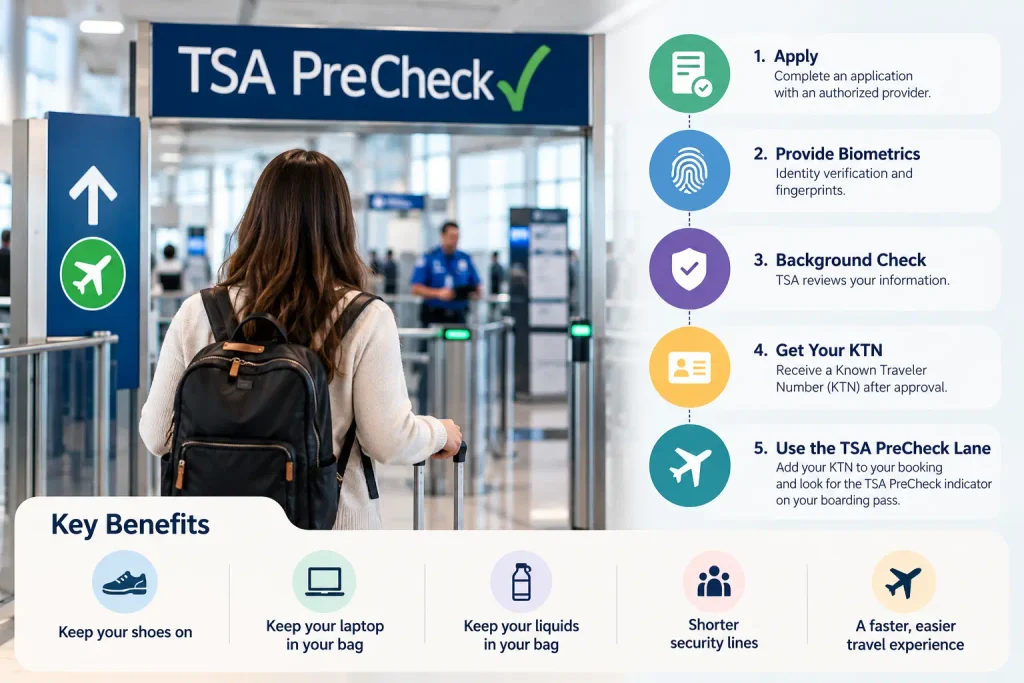
TSA PreCheck is an expedited airport security screening program for approved, low-risk travelers. It allows eligible passengers to undergo a modified screening process at participating U.S. airport checkpoints.
The program began in October 2011 and operates under the Transportation Security Administration, an agency of the U.S. Department of Homeland Security.
Unlike ordinary airport screening, TSA PreCheck uses advance eligibility screening to determine which travelers may receive expedited procedures.
After approval, members receive a Known Traveler Number (KTN). This number must be associated with their airline reservation so the airline can request TSA PreCheck eligibility for that journey.
When the appropriate indicator appears on the boarding pass, the passenger can generally use the designated TSA PreCheck lane, subject to checkpoint availability and TSA instructions.
Related: TSA PreCheck Touchless ID: What Travelers Should Know
TSA PreCheck at a Glance
| Feature | TSA PreCheck details |
| Administered by | Transportation Security Administration |
| Program introduced | October 2011 |
| Membership validity | 5 years |
| Who can apply directly | U.S. citizens, U.S. nationals, and lawful permanent residents |
| New enrollment fee | Varies by authorized provider |
| Enrollment process | Application, identity verification, fingerprints, and background check |
| Airports | More than 200 participating U.S. airports |
| Participating airlines | More than 90 |
| Membership identification | Known Traveler Number (KTN) |
| Main benefit | Expedited airport security screening |
| International departures | Eligible at participating U.S. departure airports |
| Renewal | Available online or in person, subject to eligibility |
Program coverage and enrollment arrangements are published through TSA’s authorized providers.
What Are the Benefits of TSA PreCheck?
The biggest advantage of TSA PreCheck is a simpler security screening experience, particularly at airports with busy departure checkpoints.
1. Access to Expedited Security Lanes
Approved travelers can use dedicated TSA PreCheck lanes when the program is available and their boarding pass displays the required indicator.
These lanes are intended to process eligible passengers through modified screening procedures.
TSA’s authorized enrollment providers report that approximately 99% of TSA PreCheck passengers wait less than 10 minutes, although actual waiting times vary by airport, terminal, staffing, and travel demand.
2. Simplified Screening for Shoes and Clothing
TSA PreCheck passengers generally do not need to remove shoes, belts, or light jackets during standard screening.
This reduces the amount of preparation required before passing through the checkpoint.
However, TSA officers may require additional screening or different procedures when necessary.
3. Laptops and Liquids Can Usually Remain Packed
Under standard TSA PreCheck procedures, laptops and compliant 3-1-1 liquids can generally remain inside carry-on luggage.
This is particularly convenient for business travelers carrying electronic devices and passengers with multiple small items.
The benefit does not remove the restrictions on liquids. The usual 3-1-1 requirements still apply unless a specific exception permits otherwise.
4. Convenient Screening for Eligible Families
Children may be able to accompany an eligible parent or guardian through TSA PreCheck without holding their own paid membership.
The applicable conditions depend on the child’s age and boarding-pass eligibility, as explained below.
5. Benefits on Domestic and International Departures
TSA PreCheck is not limited to domestic flights. Approved travelers may use the program when departing from a participating U.S. airport on an eligible international itinerary.
For example, a passenger flying from New York to London on a participating airline may receive TSA PreCheck benefits at the U.S. departure checkpoint.
The program does not provide expedited security screening at foreign airports.
Featured image: TSA PreCheck security screening at a U.S. airport.
Who Is Eligible for TSA PreCheck in 2026?
Direct enrollment in TSA PreCheck is available to U.S. citizens, U.S. nationals, and lawful permanent residents who satisfy the program’s eligibility and security requirements.
Travelers must complete an application and undergo the required identity verification and background screening.
Can Foreign Citizens Apply for TSA PreCheck?
Foreign visitors generally cannot enroll directly unless they qualify as lawful permanent residents.
However, some foreign nationals may receive TSA PreCheck benefits through eligible U.S. Customs and Border Protection Trusted Traveler Programs, particularly Global Entry.
For example, an eligible Indian citizen approved for Global Entry may be able to receive TSA PreCheck benefits when flying with a participating airline from a U.S. airport.
Eligibility for Global Entry depends on nationality, program agreements, background screening, and other conditions. Approval for one program should not be assumed merely because a traveler holds an eligible passport.
What Can Disqualify Someone From TSA PreCheck?
TSA may deny or revoke eligibility for several reasons, including:
- Certain criminal convictions or pending criminal charges.
- Violations of transportation security regulations.
- False or incomplete application information.
- Failure to satisfy identity or immigration-status requirements.
- Other disqualifying security findings.
Not every criminal offense results in permanent disqualification. TSA applies specific eligibility rules, including permanent and interim disqualifications for certain offenses.
Applicants should review the official eligibility requirements rather than assuming that every past legal issue automatically prevents enrollment.
How Much Does TSA PreCheck Cost in 2026?
TSA PreCheck enrollment fees vary according to the authorized provider and whether the applicant is enrolling for the first time or renewing.
The older flat $78 enrollment fee frequently mentioned in travel guides is not a reliable universal price in 2026.
TSA PreCheck Enrollment and Renewal Fees
| Authorized provider | New enrollment | Online renewal | In-person renewal |
| IDEMIA | $76.75 | $58.75 | $66.75 |
| Telos | $85 | $69.95 | $58.75 |
| CLEAR | Provider-specific; published offers vary | Provider-specific | Check current provider terms |
IDEMIA and Telos publish these rates on their official enrollment websites. CLEAR has displayed different promotional and enrollment prices, so its live checkout should be used to confirm the applicable fee.
The fee generally covers five years of membership and is nonrefundable if an application is denied.
Are There Credit Cards That Cover TSA PreCheck Fees?
Yes. Several travel credit cards offer statement credits toward qualifying TSA PreCheck or Global Entry application fees.
Depending on the card, eligible benefits may reimburse the application fee once during a specified period, such as every four or five years.
Travelers should confirm the following before paying:
- Whether the card covers TSA PreCheck, Global Entry, or both.
- The maximum statement-credit amount.
- How frequently the benefit can be used.
- Whether payment must be made directly to an authorized enrollment provider.
- Whether the benefit is available to primary cardholders or authorized users.
A credit card statement credit does not change the TSA application or background-check requirements.
How to Apply for TSA PreCheck: Step-by-Step Process
Applying for TSA PreCheck generally involves an online application, an in-person identity verification appointment or visit, and a security background check.
Step 1: Start the application
Visit the official TSA PreCheck website and choose an authorized enrollment provider. Complete the application with accurate personal, citizenship, and contact information.
Step 2: Choose an enrollment location
Find a participating location and review its hours. Some providers allow walk-ins, while others offer appointments. Availability varies by provider and location.
Step 3: Verify identity and provide fingerprints
Bring the required documents. Enrollment personnel verify identity and eligibility, collect fingerprints, and complete the required application steps.
Step 4: Wait for the application decision
Many applicants receive a decision within three to five days after completing enrollment, but some applications take up to 60 days.
Step 5: Add the Known Traveler Number
Once approved, add the KTN to airline reservations and frequent-flyer profiles. Confirm that the TSA PreCheck indicator appears on the boarding pass before proceeding to security.
The application timeline and provider options are described by TSA’s authorized enrollment services.
What Documents Are Required for TSA PreCheck?
Applicants must present documents establishing their identity and qualifying citizenship or immigration status.
An unexpired U.S. passport is commonly accepted as a standalone document. Other applicants may need an approved combination of documents, such as identification and proof of citizenship.
A lawful permanent resident may need an appropriate permanent resident document.
The precise requirements depend on the applicant’s circumstances and the provider’s accepted-document list. Applicants should confirm the necessary documents before visiting an enrollment center.
How Long Does TSA PreCheck Approval Take?
Many applicants receive their Known Traveler Number within three to five days after completing enrollment.
However, applications requiring additional review may take up to 60 days.
The processing period does not necessarily include the time required to find a convenient enrollment appointment.
For a trip departing soon, travelers should not assume that completing the application a few days beforehand guarantees approval.
How to Use TSA PreCheck After Approval
An approved TSA PreCheck membership does not automatically mean that every airline reservation will receive expedited screening.
Members must ensure their Known Traveler Number is associated with their booking and that the TSA PreCheck indicator appears on the boarding pass.
Where to Enter the Known Traveler Number
Most participating airlines provide a Known Traveler Number field during flight booking or within the passenger’s frequent-flyer profile.
The number may also be added to an existing reservation through the airline’s website, mobile app, or customer service department.
For example, a traveler flying with Delta Air Lines can generally save the KTN in the appropriate loyalty account profile so that it is included in future reservations.
The traveler’s name and date of birth must match the details associated with the TSA PreCheck enrollment.
What if TSA PreCheck Is Missing From the Boarding Pass?
A missing TSA PreCheck indicator can prevent access to the expedited lane.
Common causes include an incorrect KTN, mismatched passenger details, an expired membership, or a flight that does not qualify.
The traveler should check the reservation and contact the airline to correct any errors.
Even when the membership is valid and the reservation details are accurate, TSA PreCheck eligibility is not guaranteed for every trip.
Which Airlines and Airports Offer TSA PreCheck?
TSA PreCheck operates at more than 200 participating airports in the United States and works with more than 90 airlines.
Popular Airports With TSA PreCheck
Examples of major U.S. airports offering TSA PreCheck include:
| Airport | Code |
| Hartsfield-Jackson Atlanta International Airport | ATL |
| Los Angeles International Airport | LAX |
| John F. Kennedy International Airport | JFK |
| Chicago O’Hare International Airport | ORD |
| Dallas Fort Worth International Airport | DFW |
| Denver International Airport | DEN |
| San Francisco International Airport | SFO |
| Miami International Airport | MIA |
| Seattle-Tacoma International Airport | SEA |
| Orlando International Airport | MCO |
Lane availability can vary between terminals and checkpoints, even at participating airports.
The latest information can be checked through the official TSA PreCheck website.
Which Airlines Participate?
Numerous domestic and international carriers participate in TSA PreCheck, including Delta Air Lines, Alaska Airlines, Southwest Airlines, JetBlue, Frontier Airlines, British Airways, Air Canada, Lufthansa, Emirates, and Qatar Airways.
Participation does not guarantee that every flight, ticket, or airport checkpoint will provide the benefit.
TSA PreCheck Rules for Children and Families
Children aged 17 and under may be eligible to accompany an approved adult through TSA PreCheck without purchasing a separate membership.
The rules differ by age.
| Child’s age | TSA PreCheck access |
| 12 and younger | May accompany an eligible parent or guardian through the TSA PreCheck lane |
| 13–17 | May accompany an eligible adult when the required TSA PreCheck indicator appears on the child’s boarding pass |
| 18 and older | Generally requires individual eligibility or membership |
For children aged 13–17, traveling on the same airline reservation as the eligible adult is generally important.
Children who travel independently or regularly without an enrolled adult may benefit from obtaining their own membership if eligible.
Families should check each boarding pass before entering the checkpoint.
TSA PreCheck vs. Global Entry vs. CLEAR+
TSA PreCheck, Global Entry, and CLEAR+ can all help reduce airport processing time, but they perform different functions.
| Feature | TSA PreCheck | Global Entry | CLEAR+ |
| Main purpose | Expedited airport security screening | Expedited U.S. entry processing | Expedited identity verification |
| Operated by | TSA | U.S. Customs and Border Protection | CLEAR |
| Main location | Participating U.S. airport checkpoints | Eligible U.S. international arrival locations | Participating airports |
| TSA PreCheck benefits included | Yes | Generally, for eligible members | No |
| Membership duration | 5 years | 5 years | Annual |
| Typical cost structure | Provider-specific fee | $120 application fee | Annual membership fee |
| Best suited for | Frequent U.S. airport departures | International travelers returning to the U.S. | Travelers seeking faster identity verification |
Global Entry’s published adult application fee is $120, with membership generally lasting five years.
Is Global Entry Better Than TSA PreCheck?
Global Entry may provide better overall value for eligible travelers who frequently fly internationally and return to the United States.
It provides expedited U.S. arrival processing and generally includes TSA PreCheck eligibility.
However, Global Entry has its own application, background-check, and approval requirements.
TSA PreCheck alone may be sufficient for travelers who mainly take domestic flights or do not need expedited U.S. customs processing.
Can CLEAR+ and TSA PreCheck Be Used Together?
Yes. Travelers who hold both memberships may use CLEAR+ for eligible identity verification and TSA PreCheck for the associated security screening benefits, where both services are available.
CLEAR+ does not replace TSA PreCheck membership. The two programs have separate eligibility rules and fees.
How to Renew TSA PreCheck Membership
TSA PreCheck membership generally expires five years after approval.
Eligible members can renew through an authorized provider, with online renewal available for qualifying applicants.
Renewal can generally begin up to six months before the membership expires.
Steps to Renew TSA PreCheck
- Check the current membership expiration date.
- Visit the official TSA PreCheck renewal website or an authorized provider.
- Confirm the applicant’s identity and membership details.
- Complete the renewal application.
- Pay the applicable provider fee.
- Monitor the renewal status and verify the updated expiration date.
Some travelers may be required to renew in person.
The Known Traveler Number generally remains the same after a successful renewal, but members should confirm that their airline profiles contain the correct information.
Is TSA PreCheck Worth It in 2026?
TSA PreCheck can be worthwhile for travelers who regularly depart from participating U.S. airports and value shorter lines and simpler screening procedures.
For example, a traveler paying $85 for five years of membership spends an average of $17 per year. Someone taking several flights annually may find the convenience worthwhile.
However, the value depends on individual travel patterns.
TSA PreCheck may be less useful for travelers who rarely fly, primarily depart from airports outside the United States, or frequently use airlines and checkpoints where the benefit is unavailable.
Travelers should also remember that TSA PreCheck does not guarantee faster screening on every occasion.
Final Thoughts
TSA PreCheck offers a practical way for eligible travelers to simplify security screening at participating U.S. airports. Its five-year membership, expedited lanes, and modified screening procedures can be particularly useful for frequent flyers and families.
Before applying, travelers should compare enrollment provider fees, confirm eligibility, and consider whether another Trusted Traveler Program would better match their travel needs.
Once approved, keeping the Known Traveler Number updated in airline reservations and checking the boarding pass before departure are essential steps for receiving the benefits.
Frequently Asked Questions
Yes. TSA PreCheck can be used on eligible international departures from participating U.S. airports. It does not provide expedited screening at airports outside the United States.
No. Waiting times depend on airport conditions, passenger volume, and staffing. TSA PreCheck generally offers expedited procedures, but a particular waiting time is not guaranteed.
Eligible U.S. military personnel can receive TSA PreCheck benefits without paying the standard civilian enrollment fee. Applicable Department of Defense identification and eligibility procedures must be followed.
No. TSA PreCheck does not generally increase the standard carry-on liquid allowance. Travelers must continue to follow the applicable 3-1-1 rule and any permitted exceptions.
Generally, no. The TSA PreCheck indicator must appear on the boarding pass for access to the expedited lane.
No. TSA PreCheck does not replace acceptable identification requirements. Travelers must still carry an accepted form of identification when required.
An expired membership does not provide continuing TSA PreCheck eligibility. Travelers should renew before expiration to reduce the possibility of losing access.